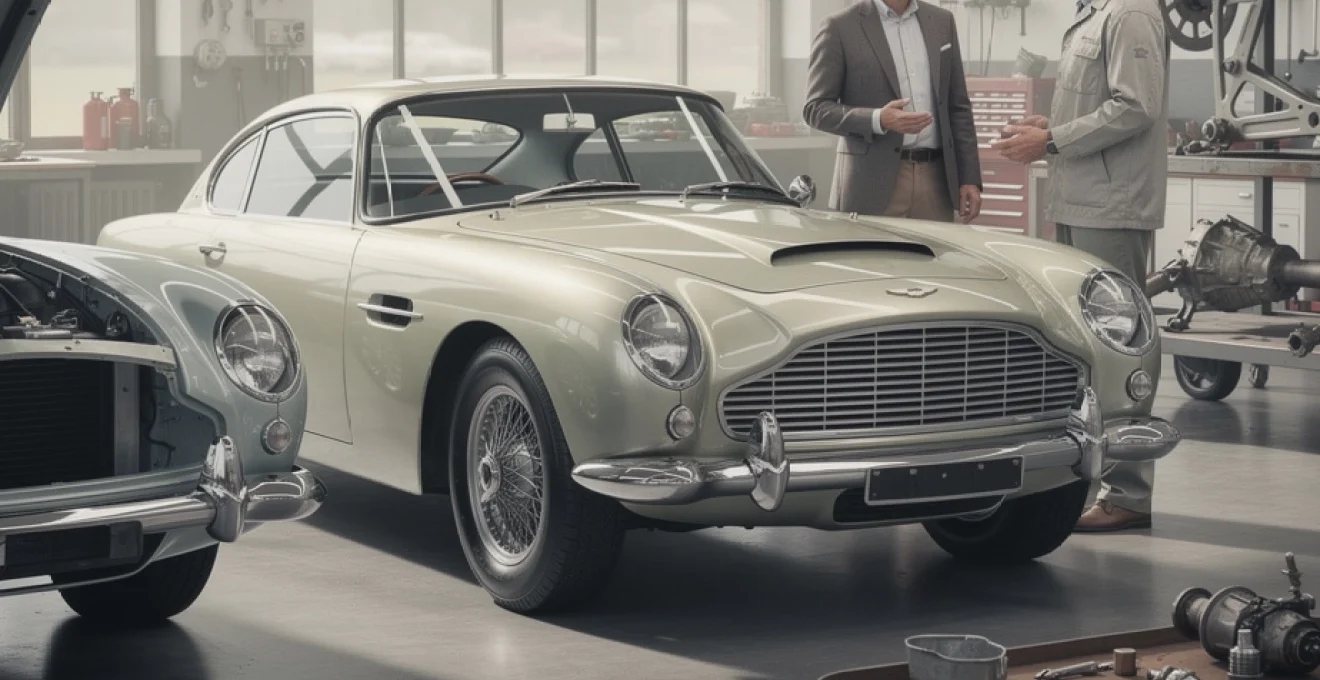
The Aston Martin DB5 occupies a unique space where British craftsmanship, Italian style and cinematic myth all converge. By 1969, the model was already a global icon thanks to its starring role as James Bond’s Silver Birch company car, yet underneath the fame sat a very real and very serious grand tourer. If you are looking at a late-production DB5 today, you are dealing with a car that bridges two eras: the last of the classic Superleggera Astons and the beginning of a more modern, DB6-led generation. Understanding that context is essential if you want to judge authenticity, specify a restoration or simply appreciate why a correct 1969 DB5 commands such respect – and value – in the classic car world.
For collectors and drivers alike, a late DB5 delivers a particular blend of usability and old-school character. The 4.0‑litre Tadek Marek straight-six still defines the driving experience, the ZF five-speed gearbox makes long-distance touring surprisingly relaxed, and the cockpit wraps around you in Connolly leather, Smiths instruments and thick Wilton carpets. At the same time, age, rarity and six-figure restoration costs mean that every decision you take – from paint colour to carburettor specification – has implications for both enjoyment and long-term value.
1969 aston martin DB5 model year overview: production context, chassis codes and UK market positioning
Late-series DB5 production run: chassis number ranges, build dates and linkage to DB6 transition
By 1969 the DB5 was no longer in full series production, having been officially superseded by the DB6 in 1965. What you encounter in this period are effectively late-built DB5-based cars, notably the so‑called Short Chassis Volante, which used the final batch of DB5 convertible chassis alongside early DB6 coupés. These Volantes retained the DB5’s basic dimensions and much of its bodywork, but began to incorporate DB6-style details such as two-piece bumpers and revised rear lights. In practical terms, the 1969 DB5 landscape is about understanding where a car sits in the sequence from late DB5 saloon to Short Chassis Volante and on to full DB6.
Chassis codes are the starting point. Factory records show approximately 1,021–1,059 DB5s in total, with 898–899 saloons, 123 convertibles and 12 Radford Shooting Brakes. The last 37 DB5 convertible chassis formed the basis of those Short Chassis Volantes built into late 1965–1966, but many were first registered and traded later, meaning that a car wearing a 1968 or 1969 plate may still be DB5-based beneath. When you look at a “1969 DB5”, therefore, the question is really: is this a late-registered DB5 saloon or convertible, or a DB5-derived Volante sitting in the DB6 era?
Original pricing, UK registration data and export markets for 1969 aston martin DB5 units
Period price lists place a DB5 saloon at around £4,175 including UK taxes in the mid‑1960s, with the convertible nearer £4,490. That made the car substantially more expensive than a Jaguar E‑type, and broadly in line with some contemporary Bentleys, even though the Aston was positioned as a more overtly sporting grand tourer. Adjusted for inflation, those prices equate to roughly £90,000–£100,000 today, yet the current market values of £600,000–£900,000 for good DB5s illustrate how demand has outstripped simple economic indexing.
By 1969, most DB5s on UK roads were already a few years old, and registration patterns reflect the car’s low-volume, hand-built nature. Fewer than 1,100 examples worldwide meant only a small fraction of cars carried late-1960s UK registrations, often as a result of re‑registration or delayed first use. Export was critical from the outset: right-hand drive cars primarily served the UK and some Commonwealth markets, while left-hand drive DB5s went to continental Europe, the United States and the Middle East. Celebrity ownership – including musicians and actors – and the Bond connection accelerated demand in export regions, particularly for Silver Birch saloons.
Factory specifications versus dealer-installed options on 1969 DB5s in london and newport pagnell
Newport Pagnell built DB5s to a remarkably high standard specification: leather upholstery, wool carpets, electric windows, twin fuel tanks, chrome wire wheels and a fire extinguisher were all included. Optional extras such as air conditioning, a three-speed Borg‑Warner automatic transmission and various radio units were added either at the factory or by London-area dealers to suit affluent clients. For a 1969-registered car, dealer-installed options become especially important, because some DB6-era equipment – upgraded radios or additional gauges – was retrofitted to earlier DB5 shells.
When you assess an apparent 1969 DB5, it is useful to think of the car in three layers: core factory build, period dealer or coachbuilder modifications, and later upgrades. Period-correct options such as a factory steel hardtop for convertibles, or a dealer-installed fog lamp kit, enhance character without undermining authenticity. Later add-ons, by contrast, need to be checked for quality and reversibility if you are balancing drivability with long-term collectability.
Identifying authentic 1969 DB5 examples: heritage trust certificates, build sheets and matching numbers
Authenticating any late DB5 starts with paperwork. The Aston Martin Heritage Trust can issue a build certificate based on the original factory ledger, confirming chassis and engine numbers, body style, original colours and delivery date. For a car carrying a 1969 registration mark, the Heritage certificate will often show a build date several years earlier, which is entirely normal. The key is that the stamped numbers on the chassis and engine block match those on the certificate.
Matching-numbers status is so important that auction houses frequently cite it as a separate value driver. As a rule of thumb, a fully matching example can command a 10–25% premium over a car with a replacement engine or “re‑stamped” block. Build sheets and period service records also reveal whether a car left Newport Pagnell as a standard or Vantage specification, a distinction that has a direct impact on desirability. If you are planning a purchase, commissioning a marque specialist to verify stamps, welds and tell-tale construction details against the Heritage paperwork is strongly recommended.
Engine, drivetrain and performance specifications of the 1969 DB5 4.0-litre straight-six
Tadek marek 4.0-litre DOHC inline-six: bore, stroke, compression ratios and power output figures
At the heart of every 1969 DB5-based car lies the Tadek Marek-designed 4.0‑litre straight-six, one of only two engines conceived fully in‑house by Aston Martin. The alloy block and twin overhead camshaft layout gave the DB5 genuinely advanced credentials in period, especially when compared with pushrod rivals. The engine displaces 3,995cc thanks to a 96mm bore and 92mm stroke, up from 3.7 litres in the DB4. Standard DB5 tune used a compression ratio of around 8.8:1, delivering a claimed 282bhp at 5,500rpm and approximately 280lb ft of torque at 4,500rpm.
Contemporary road tests sometimes questioned the factory power figures, suggesting that real-world outputs were slightly lower. Yet the broad spread of torque and the engine’s willingness to rev made the car feel notably brisk in the early 1960s, with performance comparable to some V12 Italians. For a 1969 owner, the same engine still feels muscular enough to mix confidently with modern motorway traffic, especially when paired with sympathetic internal upgrades during a rebuild, such as modern pistons or a 4.2‑litre conversion.
SU versus triple weber carburettor configurations on late DB5 cars and their tuning characteristics
Standard DB5s used three SU HD8 carburettors, prized for their relative simplicity and smooth, progressive throttle response. The optional Vantage specification replaced these with triple Weber 45 DCOE carburettors, more akin to race hardware and claimed to raise power to 314–325bhp depending on source. In practice, the Weber engine feels sharper, more urgent and slightly more temperamental when cold, rewarding a driver who is prepared to use the throttle with finesse.
For a 1969 DB5 owner today, carburettor choice is as much about character as outright output. SU-equipped cars are easier to set up for road touring and tend to deliver marginally better fuel consumption, important when realistic figures can sit between 12–21mpg. Weber-equipped Vantages offer that extra edge and a throatier induction roar that many enthusiasts consider essential to the “full” DB5 driving experience. Many standard cars have been upgraded to Vantage carburettors over the decades; the Heritage build sheet and engine stamp suffixes tell you how the car left the factory.
ZF five-speed manual gearbox, 3-speed Borg-Warner automatic and final drive ratios used in 1969
Early DB5s carried a David Brown four-speed manual with overdrive, but from relatively soon in the production run Aston Martin adopted a ZF S5/325 five-speed manual as standard. By the time cars appearing on 1969 plates were delivered, the five-speed was overwhelmingly dominant. Period road testers praised the ZF unit’s strength and precision, if not its slightly heavy shift at low speeds. Some aficionados still prefer the earlier four-speed for its lighter, more delicate action, but for high-speed touring the extra ratio in the ZF box makes a tangible difference.
The optional three-speed Borg‑Warner automatic appealed mainly to US buyers. While smooth, it dulled the car’s sporting edge, and many have since been converted to manual, as the market places a clear premium on three-pedal cars. Final drive ratios varied slightly by market and gearbox, but a typical manual DB5 ran a rear axle around 3.54:1, balancing brisk acceleration with a relaxed cruise. For long-distance trips across Europe, that gearing and the five-speed box allowed a DB5 to sit at continental autobahn speeds all day – provided the cooling system was in top condition.
Acceleration, top speed and period road test data from autocar, motor and road & track
Contemporary figures from magazines such as Autocar and Motor help frame expectations for a well-sorted 1969 DB5 today. Standard cars returned 0–60mph times between 7.1 and 8.1 seconds depending on driver, weather and equipment, with top speeds quoted in the 140–150mph range. Vantage models could dip into the mid‑6‑second zone for the benchmark sprint and edge closer to 150mph, although those numbers were often achieved with carefully prepared, press-fettled examples.
Compared with modern sports cars, those figures might sound modest, but consider the context: in 1963–1965, only a handful of exotic 12‑cylinder Italians were demonstrably faster. For current owners, the more relevant point is that a properly rebuilt DB5 still feels lively and flexible in everyday use. Acceleration in-gear, especially from 40–70mph, is satisfyingly strong, and the combination of growling exhaust and intake noise lends even modest speeds a sense of occasion.
Cooling, lubrication and exhaust system design on the 1969 DB5 and common performance upgrades
The DB5’s cooling and lubrication systems were broadly robust but can become weak points on aging or heavily used cars. The alloy block and head demand clean coolant and oil, and any blockage in the water passages or radiator can quickly lead to overheating, with head-gasket failure or warped heads as the consequence. Originally, the car used a belt-driven fan and a conventional crossflow radiator sized for 1960s traffic and fuel quality.
Modern upgrades often focus on this area: high-efficiency aluminium radiators, electric fans with thermostatic control, and improved water pumps help a DB5 cope with city congestion and warm continental summers. On the lubrication side, careful monitoring of oil pressure – often close to 100psi at 3,000rpm on a fresh engine – is vital. Many owners specify improved oil cooler arrangements during rebuilds. Exhaust-wise, the DB5 originally used four silencers for refinement, and late cars sometimes gained stainless-steel replacements for durability. Subtly freer-flowing systems can liberate a few extra horses and a richer soundtrack without compromising GT usability.
Chassis, suspension and braking engineering in the 1969 aston martin DB5
Steel platform chassis construction, superleggera body mounting and structural rigidity considerations
Underneath its elegant skin, the DB5 uses a pressed-steel monocoque platform, with the Superleggera framework and aluminium panels mounted above. This combination delivers strength with relatively low mass by period standards, but it also introduces specific ageing issues. Wherever the aluminium skin meets the steel structure, especially around sills, wheel arches and the lower doors, electrolytic corrosion can set in. Early attempts to separate the metals using cloth or similar barriers often trapped moisture, accelerating the problem.
From a rigidity perspective, the saloon is substantially stiffer than the convertible or Short Chassis Volante, which in turn affects how you feel the car respond over poor road surfaces. Flex is particularly noticeable in open cars when driven on modern, broken tarmac, but a well-maintained chassis still feels secure and planted at speed. Any restoration of a 1969 DB5 should begin with a forensic inspection of the steel structure; extensive chassis rot can render repairs economically unfeasible even at current values, simply due to the labour involved.
Front unequal-length wishbones, rear live axle and armstrong selectaride damper configuration
The suspension design reflects the DB5’s dual role as high-speed GT and sporting coupé. At the front, unequal-length wishbones with coil springs and Armstrong dampers handle steering and braking loads. The rear uses a live axle, controlled by parallel trailing arms, coil springs and a Watt’s linkage to locate it laterally. Period cars sometimes featured Armstrong Selectaride dampers, with adjustable settings to tailor ride and handling to road conditions or driver preference.
On the road, the setup gives a distinctive “big GT” feel: the DB5 leans and breathes over bumps rather than slicing across them with modern firmness. If you press on along a B‑road, you will feel the rear axle move and the body roll progressively, like a classic sports saloon rather than a razor-sharp supercar. Many owners today adopt subtly uprated springs and dampers, often with adjustable telescopic units at the rear, to tighten control without destroying the car’s period character.
Girlling disc brake system, servo assistance and fade characteristics under spirited driving
Braking is via servo-assisted Girling discs all round, 11.5‑inch at the front and 10.8‑inch at the rear on factory specification cars. For its era, this was state-of-the-art and represented a meaningful upgrade over the earlier Dunlop system in early DB4s. Modern drivers used to high‑assist, ABS‑equipped systems often underestimate the physical effort required in an original DB5: the pedal is firm, with a longish travel, but once accustomed, you can metre braking with considerable precision.
Brake fade under repeated hard use is a reality, particularly on cars that have not been rebuilt with modern pads and refreshed hydraulics. Period tests noted performance that was “more than adequate” for quick road work but not immune to fade on mountain descents or track activity. Common upgrades include high-friction pads, braided lines and sometimes discreetly larger discs, all helping a 1969 DB5 integrate more happily into today’s faster traffic environment.
Steering box setup, turning circle and handling traits compared with DB4 and DB6
The DB5 uses a traditional steering box rather than rack-and-pinion, contributing to its heavy low-speed feel but also to the sense of solidity once moving. Parking forces are substantial by modern standards, particularly on wide tyres, but the steering lightens nicely above 20–30mph. The turning circle is respectable for a car of its size, yet this is not a machine designed for tight city streets; instead, it comes alive on open A‑roads and fast sweeping routes.
Compared with a DB4, the DB5 feels slightly more mature and GT‑oriented, helped by additional weight and a more refined suspension tune. Against the DB6, which introduced a longer wheelbase and revised rear geometry, a late DB5 can seem a touch more compact and agile, if marginally less stable at very high speeds. Many owners describe the ideal DB5 pace as a “fast flow” rather than an attack: use the torque, settle the car into the corner and let the long wheelbase and predictable balance do the work.
Exterior design and bodywork details: touring superleggera styling on the 1969 DB5
Iconic DB5 silhouette: front grille, faired-in headlamps and wire wheel design elements
The DB5’s styling, penned by Carrozzeria Touring Superleggera, is arguably the most recognisable in Aston Martin history. The broad, gently smiling grille, faired-in headlamps and muscular front wings give the nose a sense of intent without aggression. Side vents punctuate the front wings, while the roofline flows in an unbroken arc to the subtly tapered tail, emphasising the car’s grand touring purpose. In period, the car wore 15‑inch chrome wire wheels with knock‑off hubs, a key visual signature that also dictates brake and tyre choices today.
What makes a late DB5 visually timeless is the balance of proportions: the car is about 4.5 metres long and 1.6 metres wide, small by current GT standards yet substantial enough to feel important in modern traffic. It is no coincidence that film producers returned repeatedly to the DB5 for James Bond long after newer Astons arrived; very few shapes communicate “elegant British performance” so directly.
Differences between 1969 DB5 and contemporary DB6 bodywork, including kamm tail and roofline
For buyers and restorers, distinguishing a DB5 from a DB6-based car is essential, especially in the case of DB5-derived Short Chassis Volantes sold alongside early DB6s. The DB6 introduced a longer wheelbase and a distinctive Kamm-style tail with an upturned lip, designed to improve high-speed stability. It also received a taller roofline and larger rear quarter windows to enhance rear passenger space, making it more of a true 2+2.
A 1969 DB5 saloon, by contrast, retains the shorter, purer tail and a slightly lower roof, which many enthusiasts consider more aesthetically pleasing. Short Chassis Volantes mix DB5-style sides and proportions with certain DB6 cues such as revised bumpers and lights, leading to some confusion. When authenticity matters, close examination of rear bodywork, boot floor layout and rear valance shape, combined with chassis numbers, will confirm the underlying identity.
Original paint codes, chrome trim specs and UK-delivered colour combinations for 1969
Aston Martin offered a surprisingly rich palette on the DB5. Today, Silver Birch dominates due to the Bond association, but factory records show only about 127 DB5s originally left Newport Pagnell in that colour. Other period shades such as Dubonnet Rosso, Caribbean Pearl, California Sage and various dark greens and blues were popular, especially among UK buyers seeking understatement rather than film-star recognition.
By the time late cars were being registered around 1969, some owners and dealers were already repainting earlier DB5s into the now-iconic Silver Birch, a trend that has since intensified. Chrome trim – including bumpers, window surrounds and side spears – was substantial and of high quality, forming a crucial part of the visual appeal. If you are specifying a restoration, resisting the automatic switch to silver and considering a period-correct but less common colour can produce a more individual – and historically interesting – result.
Aluminium skinning over tube framework: corrosion points, panel fit and restoration techniques
The DB5’s Superleggera skinning uses aluminium-magnesium alloy panels over a lattice of small-diameter steel tubes. This technique allowed Touring to create those graceful curves with relatively few panel joints, but it also presents restoration challenges. Electrolytic corrosion between the two metals, especially around wheel arches, door bottoms and boot corners, is a recurrent problem. Pimpling under the paint is often the first visible sign of deeper issues in the structure beneath.
A high-level restoration will typically remove outer panels, repair or replace corroded tube-framework sections, and then fabricate new aluminium panels by hand. Panel gaps and the fit of details such as headlamp rims are reliable indicators of quality: on a properly restored car, the joins are narrow, consistent and visually satisfying. Because body and chassis work account for the majority of a DB5’s restoration cost – often well into six-figure territory – a pre-purchase inspection by an experienced coachbuilder or marque specialist is essential.
1969 DB5 interior, instrumentation and GT usability
Connolly leather upholstery, wilton carpet options and period-correct cabin colour schemes
Open the door of a DB5 and the cabin smell tells you more than any brochure could. Connolly leather covers the seats, door cards and much of the interior trim, while thick Wilton carpets line the floors and transmission tunnel. As standard, the seats were generously padded and offered a relaxed, semi-upright driving position suited to long-distance work. Period colour schemes paired exterior hues with tasteful hides – black, natural tan, red and dark blue were common – though some 1960s combinations, such as Autumn Gold with red leather, feel very much of their time.
For a 1969 DB5 being retrimmed today, choosing colours becomes a question of balancing originality, taste and resale expectations. Auction data suggest that traditional combinations such as silver with black or dark blue, or deep green with tan, remain the most liquid in the UK and European markets. From a practical perspective, lighter leathers show wear and dye transfer more readily, while darker hides better conceal patina from enthusiastic use.
Smiths gauges, toggle switches and centre console layout unique to late DB5 production
The DB5’s dashboard is a masterpiece of 1960s British instrumentation. A painted metal fascia houses large Smiths speedometer and tachometer directly in front of the driver, flanked by auxiliary gauges for fuel, water temperature, oil pressure and oil temperature. A central clock and a bank of chrome toggle switches manage everything from lights to heater fans, giving the driver a satisfying sense of mechanical engagement. The centre console contains the gear lever, ashtray and radio aperture, with minor variations between early DB5s, late DB5s and DB6 models.
Late-production cars and those first registered around 1969 may show minor updates such as different radio models or revised switchgear fonts, but the overall aesthetic remains consistent. When restoring a DB5 interior, sourcing correct gauge faces and period-appropriate switchgear is critical; incorrect modern replacements can significantly dilute the cabin’s authenticity, even if functionality is improved.
Heating, ventilation, seating ergonomics and long-distance grand touring comfort
As a grand tourer, the DB5 offers more comfort than a pure sports car but less space than a modern saloon. Front occupants enjoy generous room and an excellent forward view over the sculpted bonnet, while the rear seats are best described as occasional, particularly for adults. In this respect, the DB6’s extended wheelbase and higher roof clearly outperforms the DB5 for rear-seat comfort, which may matter if you intend to carry passengers regularly.
Heating and ventilation were advanced for the early 1960s, with effective heaters and demisters, and optional air conditioning available on some cars. However, cabin heat soak from the engine and transmission can be marked, especially in warmer climates or traffic. Modern restorations often incorporate improved insulation beneath carpets and subtly enhanced ventilation ducting, making a late DB5 a genuinely usable car for long-distance tours across Europe or the UK.
Factory options list in 1969: air conditioning, electric windows and radio equipment
Electric windows were part of the DB5’s standard specification, an impressive feature for the time and one that contributes to the perception of the car as a luxury GT rather than a stripped-back sports machine. Optional extras in the mid‑1960s, still relevant to 1969-registered examples, included air conditioning, different radio units, power aerials, heated rear windows and factory steel hardtops for convertibles.
Today, period-correct radios, even if internally updated with modern electronics, help preserve the cabin’s look. Factory-style air conditioning, when present, adds desirability for buyers in warmer climates, though retrofitting such systems to non‑AC cars requires careful planning to avoid cluttering the engine bay. From a usability standpoint, a late DB5 with functioning electric windows, a sympathetic audio upgrade and well-sorted HVAC becomes an appealing partner for cross-continental touring rather than a garage queen.
Collectability, provenance and market values of the 1969 aston martin DB5
Surviving 1969 DB5 production numbers, RHD versus LHD and desirability in the UK and europe
Exact survival numbers for DB5s first registered in 1969 are difficult to pin down because of re‑registrations, imports and exports over six decades. However, with an original production of around 1,021–1,059 cars and the high survival rate typical of valuable classics, it is reasonable to assume that several hundred DB5s remain worldwide. Right-hand drive examples are naturally favoured in the UK, while left-hand drive cars command a premium in continental Europe and North America.
Within this already small pool, late-registered or particularly original cars attract close scrutiny from collectors. A 1969 DB5 with verified provenance, low ownership count and minimal modifications sits in a highly desirable niche: rare enough to excite serious buyers, but still usable enough for events such as the Goodwood Revival, Concours of Elegance or European classic rallies.
Impact of originality, matching-numbers and documented service history on auction prices
Market data across leading auction houses show consistent premiums for DB5s that tick the holy trinity of collectability: originality, matching numbers and documented history. A fully restored car with its original engine, gearbox and correct VIN stamps, accompanied by factory records and decades of service invoices, can be worth 20–40% more than a superficially similar car lacking paperwork or carrying a replacement drivetrain. Buyers know that a top-quality restoration can cost upwards of £300,000, and an engine rebuild alone may exceed £50,000.
In the DB5 market, documentation is not a formality; it is an integral part of the car’s value, as critical as coachwork or mechanical condition.
Paint and interior originality also influence prices, though here the balance is subtler. A car still wearing its factory colour scheme – even if repainted once – and retaining correctly patinated interior trim can command a significant premium over an otherwise similar example retrimmed in non-original hues. For investment-focused buyers, commissioning a marque expert to verify such details before bidding is essential risk management.
Notable sales of 1969 DB5s at RM sotheby’s, bonhams and gooding & company
Headline-grabbing DB5 sales often involve Bond provenance or celebrity ownership, with values well into seven figures. The DB5 used in the filming of Goldfinger and Thunderball, for example, has been valued north of £20 million, while cars formerly owned by famous musicians have sold for more than £1.3 million. Although not all of these are 1969-registered cars, the publicity influences the entire DB5 market, anchoring expectations at a high level.
For standard, non‑celebrity 1969 DB5s appearing at major auctions, recent hammer prices typically fall in the £600,000–£900,000 band for excellent saloons, with convertibles and Shooting Brakes well above £1 million. Short Chassis Volantes, often first registered around 1966–1967 rather than 1969, form a closely related subset, frequently commanding similar or higher numbers due to their rarity. Observers of auction results from RM Sotheby’s, Bonhams and Gooding & Company will note a growing divergence between merely presentable cars and those restored by top-tier UK specialists; the latter consistently set the benchmarks that the rest of the market follows.
Maintenance, restoration and modern upgrades for a 1969 DB5 classic
Common mechanical weak points: cooling system, oil leaks, synchro wear and electrical gremlins
Owning a 1969 DB5 is as much about stewardship as driving pleasure. The car’s age and complexity create predictable weak points that you should address proactively. Cooling system neglect, as mentioned earlier, is particularly risky: clogged radiator cores or failing water pumps can lead to overheating in slow traffic. Regular coolant changes, system flushes and careful monitoring of the temperature gauge are not optional if you value the engine’s health.
Oil leaks from the straight-six – especially around the rear main seal, cam covers and timing cover – are common, though not always serious. Gearbox synchro wear, particularly 2nd to 3rd in the ZF five-speed, manifests as baulking or crunching under fast shifts. The period Lucas electrical system, while fundamentally sound, can suffer from corroded connections and tired wiring, leading to intermittent faults. Addressing these areas methodically, often during winter maintenance, pays dividends in reliability.
Body and chassis restoration: rust treatment, superleggera frame repairs and panel fabrication
Rust and structural corrosion are the most expensive aspects of DB5 ownership to rectify. Sills, jacking points, radius arm mounts, boot floors, spare wheel wells and the crucial front cross-member above the gearbox are all known trouble spots. A thorough inspection involves getting the car on a lift and probing these areas physically as well as visually; small bubbles in the paint can conceal extensive steel decay beneath.
Any restoration plan for a DB5 should begin with the philosophy that structural integrity comes first, cosmetics second.
Specialists typically cut out and replace corroded sections of the steel monocoque, address the Superleggera tube framework, and then turn to panel fabrication. Hand-rolling new aluminium skins to original contours requires craftsmanship comparable to that of the 1960s factory, which explains the high labour component of restoration invoices. For you as an owner, choosing a workshop with documented DB5 experience is the single most important decision in any major body and chassis project.
Sympathetic upgrades: electronic ignition, improved cooling and discreet suspension enhancements
The best 1969 DB5s on the road today often combine visual originality with discreet mechanical upgrades. Electronic ignition systems replace mechanical points, improving starting and reducing maintenance without any obvious change in appearance. High-efficiency radiators and electric cooling fans, as noted earlier, transform hot-weather usability. In the suspension, modern dampers and carefully chosen springs can sharpen handling while retaining ride comfort; some owners also fit slightly wider radial tyres on original-style wire wheels for better grip.
Steering assistance is another area where taste and practicality intersect. Original DB5 steering is heavy at parking speeds, so some owners fit electric power steering systems hidden under the dash, leaving the steering box itself untouched. As long as such upgrades are reversible and carried out by recognised experts, they rarely harm values and can make the difference between a car that is admired in a garage and one that you actually drive and enjoy.
Working with UK aston martin specialists such as aston service dorset and R.S. williams
Given the DB5’s complexity and value, partnering with experienced UK-based Aston Martin specialists is essential. Firms such as Aston Service Dorset, R.S. Williams and a handful of others have spent decades refining their knowledge of DB‑series cars, from sourcing original-spec parts to developing proven performance and reliability upgrades. Their expertise extends beyond the mechanical: advice on correct fasteners, cup washers, trim patterns and even screw-head types (slot-head, not cross-head) can make the difference between an acceptable restoration and a concours contender.
For a 1969 DB5, entrusting routine servicing, major engine work or complete nut-and-bolt restorations to such specialists also creates a valuable paper trail. Future buyers know that a car maintained or rebuilt by recognised names stands a better chance of being structurally sound, mechanically correct and historically faithful. In a market where a full restoration can exceed £300,000 and a top-flight DB5 may approach or surpass £1 million, that reassurance is worth almost as much as the polished aluminium and leather you see on the surface.