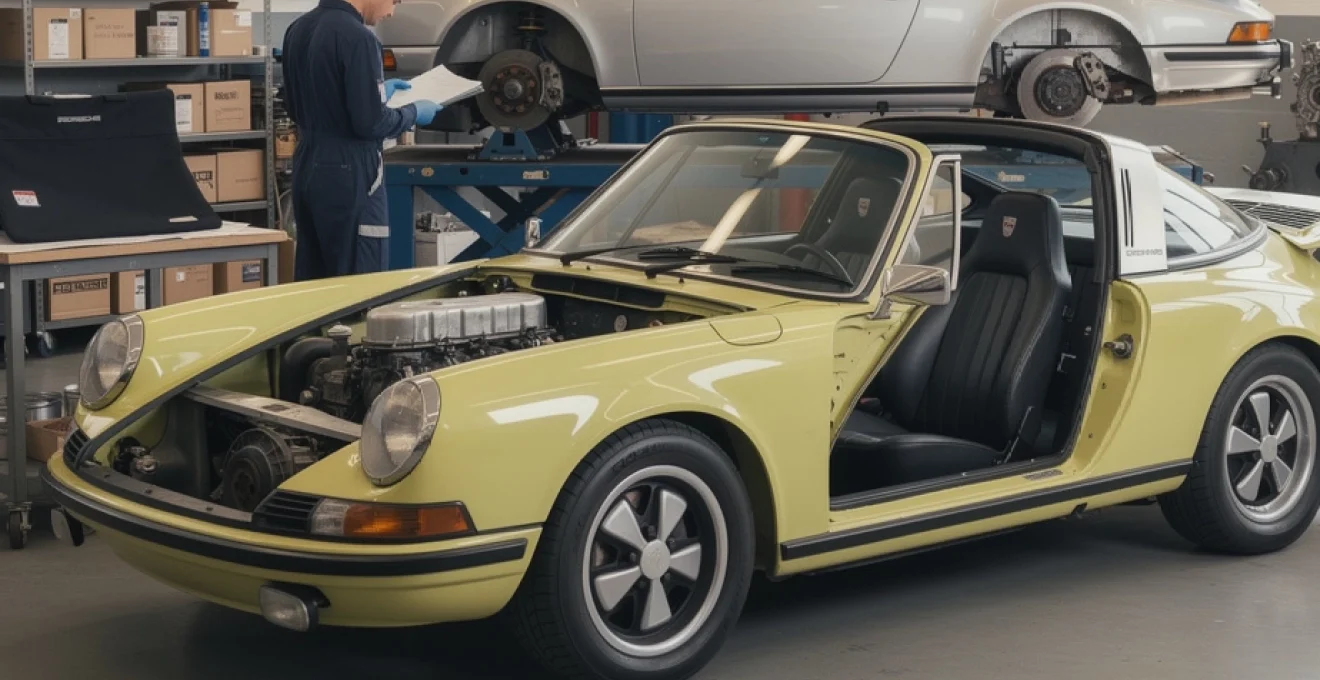
The 1973 Porsche 911 Targa sits at a fascinating crossroads in the 911 story. It combines the purity of the original long‑hood design with the most mature engineering of the first generation, all wrapped in a semi‑open body that offers both coupe‑like rigidity and convertible drama. For many enthusiasts, this is the last truly classic 911 before the impact‑bumper era began in 1974, and for you as a buyer or restorer, it offers a compelling mix of usability, character and long‑term collectability. Understanding exactly where the 1973 911 Targa fits in the F‑series timeline, how its 2.4‑litre flat‑six and 915 gearbox transformed the driving experience, and what to inspect before purchase can make the difference between a dream classic and a very expensive project.
1973 porsche 911 targa model overview: f‑series characteristics and model year distinctions
How the 1973 porsche 911 targa fits into the f‑series evolution (1972–1973)
The 1973 Porsche 911 Targa belongs to the F‑series cars, produced from August 1972 to July 1973. These were the final long‑hood 911s before crash regulations forced the move to impact bumpers for 1974. Engine displacement had grown from the early 2.0‑litre units to 2.2 litres in 1970 and finally to 2.4 litres (2341 cc), giving the Targa significantly more torque and flexibility than earlier cars. The F‑series also benefited from ongoing improvements to the chassis, including subtle wheelbase revisions and refinements to suspension geometry that made the car less punishing in everyday driving while preserving that classic 911 agility you expect from a pre‑impact‑bumper car.
Key differences between 1973 911 targa and earlier long‑hood 911s (1969–1972)
Compared with 1969–1972 long‑hood 911s, the 1973 Targa feels like the fully evolved version of the original concept. The long‑wheelbase layout introduced for 1969 remained, but the 2.4‑litre engines delivered stronger mid‑range, making the car easier to drive quickly in modern traffic. Earlier 2.0 and 2.2‑litre engines often needed to be worked hard to reveal their performance; the 2.4 offers more relaxed pace without losing that rev‑happy nature. The switch to the stronger 915 gearbox from the older Type 901 also marked a turning point, replacing the dog‑leg first with a more conventional pattern and improved synchros. For you as a driver, that translates to more intuitive shifts and better durability, especially if the car is used regularly.
Comparing 1973 911 T, 911 E and 911 S targa specifications
For 1973, Porsche offered the 911 Targa in three familiar flavours: 911 T, 911 E and 911 S. All shared the 2.4‑litre flat‑six but differed in state of tune, induction and specification. The 911 T was the entry‑level model, using carburettors and producing roughly 130–140 bhp depending on market. The 911 E sat in the middle with mechanical fuel injection (MFI) and around 165 bhp, while the 911 S topped the range with 190 bhp, higher compression and more aggressive camshafts. Unsurprisingly, the 911 S Targa delivered the strongest performance, with 0–60 mph in roughly 7 seconds and a top speed approaching 140 mph, putting it in genuine period supercar territory. The E struck a sweet spot between performance and drivability that many collectors favour today.
Us‑spec vs euro‑spec 1973 porsche 911 targa: emissions, bumpers and lighting
Differences between US‑spec and European‑spec 1973 911 Targas go beyond emissions equipment. North American cars typically came with black rubber bumper overrider pads and different lighting arrangements, including sealed‑beam headlamps and side‑marker lights to meet federal regulations. From January 1973, US‑market 911 T models adopted Bosch K‑Jetronic fuel injection to satisfy stricter emission standards, whereas many European 911 T cars retained carburettors. These changes affected power output slightly, so a Euro‑spec 911 T often feels a little more eager. For you as a buyer, understanding whether a car is US‑ or Euro‑spec is important when comparing historic performance figures, sourcing the correct parts and assessing long‑term value, especially if considering a conversion back to original specification.
Bodywork and targa roof engineering on the 1973 porsche 911 targa
Stainless steel targa roll‑hoop construction and chassis reinforcement
The defining feature of any 911 Targa is the stainless‑steel roll hoop. On a 1973 car, this distinctive band is not merely cosmetic; it forms a structural element designed to restore rigidity lost by removing the fixed roof panel. Underneath the brushed stainless trim sits a robust steel frame tied into the sills and rear quarters. Additional reinforcement in the floor and door apertures helps the Targa approach coupe‑like stiffness, although an experienced driver can still detect a subtle difference in flex over rough surfaces. From an engineering standpoint, the Targa concept was a clever compromise: a semi‑convertible layout that preserved safety, torsional strength and the characteristic 911 handling balance, while offering you open‑air motoring on demand.
Removable soft top panel: folding mechanism, sealing and common failure points
The removable Targa roof panel on a 1973 911 uses a complex folding frame covered in vinyl or similar material, designed to be stowed in the front luggage compartment. Over decades of use, this ingenious mechanism can become a source of creaks, wind whistle and water leaks. Common failure points include worn hinge joints, perished edge seals and distorted frames caused by incorrect folding or long‑term storage under load. If you are inspecting a car, pay close attention to how easily the roof locks into place, whether the latches operate smoothly, and how well the panel sits against the roll hoop and windscreen frame. A correctly rebuilt Targa top can feel remarkably solid, but refurbishment is specialist work and should be budgeted accordingly.
Fixed rear glass vs soft rear window: configuration on 1973 911 targa
Early Targas were available with a soft rear window, but by 1973 the fixed glass rear screen was the standard configuration. This large curved pane significantly improves rear visibility, weather protection and refinement, making the car feel closer to a coupe with the top fitted. Period testers commented that the glass‑window Targa offered even better rearward vision than some closed 911s, thanks to the generous glass area and slim pillars. For you as an owner, the fixed rear glass also simplifies maintenance compared with an ageing soft rear screen, although delamination, heating element issues and seal deterioration can still appear on unrestored cars.
Corrosion hotspots on 1973 targa shells: sills, parcel shelf, kidney bowls and torsion bar areas
Despite gradual adoption of galvanised panels, early 1970s 911s remain vulnerable to rust, and Targas can suffer even more if roof leaks have been ignored. Key corrosion hotspots include the front and rear sills, the inner “kidney bowls” behind the rear quarter panels, the parcel shelf area and the torsion bar tube mounts. Water ingress around the Targa seals or rear glass can feed hidden rust in the rear structure for years before it becomes visible. When you book a pre‑purchase inspection, insist on a thorough probe of these areas, ideally with the rear quarter trim removed. Repairing structural rust in the sills and torsion bar regions can easily exceed five figures, so a seemingly “cheap” Targa with hidden corrosion often turns out to be the most expensive route into classic 911 ownership.
Factory paint codes, colour charts and original trim combinations for 1973 targas
Factory paint codes for 1973 911 Targas ranged from subdued silvers and whites to period‑perfect browns, greens and bright reds. Colours like Copper Brown Metallic or lighter earth tones were common at the time, although many cars have since been resprayed in more fashionable hues such as Guards Red or silver. Collectors increasingly value originality and unusual period shades, and a 1973 Targa wearing its original colour and correct trim combination often commands a meaningful premium. Interior options included vinyl, leatherette and full leather, with contrasting or matching dashboards and door caps. Repainting from an unfashionable but original colour can reduce value by 5–10%, whereas a high‑quality respray in the factory hue, documented by a build sheet or certificate, can enhance desirability significantly.
Engine and drivetrain: 2.4‑litre flat‑six powertrains in the 1973 911 targa
2.4‑litre air‑cooled boxer engine architecture: bore, stroke and compression ratios
The 2.4‑litre unit in the 1973 Porsche 911 Targa is an air‑cooled, horizontally opposed six‑cylinder engine, often referred to in Porsche circles as a flat‑six or boxer engine. Displacement is 2341 cc achieved via an 84 mm bore and 70.4 mm stroke, up from the 66 mm stroke of earlier 2.0‑litre engines. Compression ratios varied by model, with the 911 T using a lower ratio than the high‑revving 911 S, which helped the latter produce up to 190 bhp while still relying on mechanical fuel injection. The architecture retained dry‑sump lubrication, forged crankshafts and hemispherical combustion chambers, maintaining the robust, motorsport‑derived character that made early 911 engines so durable. For you, that means an engine capable of high mileages if maintained correctly, but rebuilds are intricate and should be entrusted to recognised specialists.
Mechanical fuel injection (bosch MFI) on 911 E and 911 S targa vs zenith carburettors on 911 T
A major technical divide in 1973 lies between carburetted and mechanically injected engines. The 911 T in many markets used Zenith carburettors, offering simpler maintenance and slightly softer throttle response. The 911 E and 911 S, by contrast, employed Bosch mechanical fuel injection (MFI), a technically fascinating analogue system that meters fuel via a cam‑driven pump. When correctly set up, MFI delivers razor‑sharp response and consistent fuelling, crucial for the higher‑revving E and S engines. However, tuning MFI requires specialist knowledge, and incorrect adjustments can lead to poor starting, flat spots or even engine damage. If you are choosing between a T and an E or S, consider whether a trusted MFI specialist is within reach, as a well‑sorted system transforms the car, while a poorly set‑up one can be frustrating.
915 gearbox technical overview: ratios, dog‑leg layout and synchro design
The 915 gearbox introduced in 1972 replaced the earlier 901 transmission and remains a defining feature of 1973 911s. Unlike the 901’s dog‑leg first gear, the 915 uses a conventional H‑pattern with first up and to the left, followed by a standard 2‑3‑4‑5 layout. Ratios were chosen to exploit the broader torque curve of the 2.4‑litre engines, allowing relaxed cruising yet brisk acceleration. Synchros are of Porsche’s own design, and while durable, they demand deliberate, unhurried shifts. Rapid, modern‑style gear‑changing can accelerate wear, particularly in second gear. When properly rebuilt and filled with the correct oil, a 915 offers a mechanical, engaging shift feel. Treat it like a precision instrument rather than a modern hot‑hatch gearbox and it will reward you with longevity and character.
Oil cooling system on the 1973 targa: front wing cooler, oil lines and thermostat
Early 911s rely heavily on effective oil cooling, as oil temperature directly affects engine longevity. By 1973, many higher‑spec cars used an additional front‑wing oil cooler, connected by long lines running under the sill. A thermostat controls flow to this cooler, opening as oil temperature rises. Over time, these lines can corrode externally or become internally restricted, reducing cooling efficiency. Stone damage to the front cooler, leaking unions and seized thermostats are all age‑related problems that prospective buyers should check. A car regularly driven in warm climates or on spirited runs benefits greatly from a healthy external oil cooling system, keeping temperatures in the safe zone and helping preserve that valuable magnesium‑case flat‑six.
Factory performance figures: power, torque, 0–60 mph and top speed for each 1973 targa variant
Factory figures for 1973 911 Targa models paint a clear performance ladder. The 911 T produced around 130–140 bhp and could reach 0–60 mph in about 8.5 seconds, with a top speed of roughly 127–130 mph. The 911 E stepped up to approximately 165 bhp, trimming the 0–60 time to the mid‑7‑second range and pushing top speed closer to 135 mph. At the top, the 911 S delivered about 190 bhp, 0–60 mph in around 7 seconds or less and a top speed near 140 mph. These are period numbers, but even today a well‑sorted 911 S Targa feels genuinely quick thanks to its light weight, direct throttle response and strong mid‑range torque, especially compared with many modern hot hatches.
| 1973 Targa variant | Approx. power (bhp) | 0–60 mph (s) | Top speed (mph) |
|---|---|---|---|
| 911 T Targa 2.4 | 130–140 | ≈ 8.5 | ≈ 127–130 |
| 911 E Targa 2.4 | ≈ 165 | ≈ 7.5 | ≈ 135 |
| 911 S Targa 2.4 | ≈ 190 | ≈ 7.0 | ≈ 140 |
Chassis, suspension and braking setup on the 1973 porsche 911 targa
Torsion‑bar suspension geometry: front MacPherson struts and rear trailing arms
The 1973 911 Targa retains the classic torsion‑bar suspension layout that defines early 911 handling. At the front, MacPherson struts and lower control arms are combined with longitudinal torsion bars, while at the rear, semi‑trailing arms work with transverse torsion bars. Anti‑roll bars front and rear (standard or optional, depending on model) further tune roll resistance. This layout delivers a blend of ride comfort and sharp response that feels very different from modern coil‑spring setups. When bushes, ball joints and dampers are fresh, the car feels light on its feet yet stable at speed. A well‑set‑up 911 T Targa can be as rewarding as an S if you value balance and feedback over outright power.
Steering feel and feedback: recirculating ball steering box and alignment settings
Unlike many contemporary sports cars that adopted rack‑and‑pinion steering, early 911s use a recirculating ball steering box. On paper that might sound old‑fashioned, yet in practice the steering in a sorted 1973 Targa is a revelation. Without power assistance and with relatively narrow tyres, every nuance of the road surface is transmitted to your fingertips. Correct alignment settings are critical: too much toe‑in or incorrect camber can dull response and increase tyre wear. Many specialists have preferred fast‑road geometry settings that sharpen turn‑in without making the car nervous. When correctly aligned, a 911 Targa rewards smooth, precise inputs and will quickly teach you that classic 911 adage: brake in a straight line, then feed in power progressively.
Braking systems: solid vs ventilated discs, ATE calipers and brake bias
Braking performance on the 1973 911 Targa reflects the model hierarchy. All cars feature disc brakes on all four wheels, but higher‑spec variants benefit from ventilated discs and uprated ATE calipers. The 911 S, in particular, gained larger, ventilated front and rear discs, giving it strong fade‑resistance for spirited driving or light track work. Brake bias is naturally rear‑biased compared with many front‑engined cars, reflecting the rear‑engine layout. For you as a driver, the key is to ensure the system is in perfect condition: flexible hoses age, master cylinders can leak internally, and old fluid reduces boiling point. A fresh set of quality pads, good tyres and properly bled fluid can make a 50‑year‑old 911 stop with impressive authority.
Wheel and tyre specifications: fuchs alloys vs steel wheels on 1973 targas
Wheel choice is both a technical and aesthetic decision on a 1973 911 Targa. Many cars left the factory with iconic 6J x 15‑inch forged Fuchs alloys, particularly the E and S variants, while some T models may originally have worn steel wheels. Fuchs rims are light, strong and now highly prized, contributing to reduced unsprung weight and sharper suspension response. Tyre sizes were modest by modern standards, often around 185/70 R15, but this modest footprint is one reason the steering feels so alive. Over‑tyring a classic 911 with very wide modern rubber can blunt the feedback and make the car feel less playful. If originality matters, checking that the Fuchs part numbers and finish match period specifications is a worthwhile step.
Interior, ergonomics and period options on the 1973 911 targa
Dashboard layout, five‑dial VDO instrumentation and 8,000 rpm tachometer
The cabin of a 1973 Porsche 911 Targa is dominated by the classic five‑dial VDO instrument cluster. From left to right, you see fuel/oil level, oil temperature/pressure, speedometer, 8,000 rpm tachometer and a combination clock or auxiliary gauge. The central rev counter emphasises the engine’s role as the car’s heart, encouraging you to use the full range when conditions allow. Switchgear is sparse by modern standards but logically arranged once you are familiar with it. The dashboard itself has a slightly padded upper section on later cars, a nod to evolving safety standards, while the Targa still retains thin pillars and excellent visibility. Ergonomically, pedal offset and steering wheel angle feel different to modern cars, but after a few drives most enthusiasts find the position natural and engaging.
Seat designs: standard seats, sport “recaro” seats and upholstery materials
Seating in the 1973 911 Targa varied according to specification and options. Standard seats offer modest bolstering and are comfortable for touring, while optional sport seats, often referred to as “Recaro” seats, provide deeper side support and a more purposeful look. Upholstery ranged from basic leatherette to full leather, with some cars featuring cloth inlays or distinctive period patterns. For spirited driving, the sport seats make a noticeable difference, especially in a Targa where the sensation of speed and wind is more pronounced. When assessing a car, check seat frames for damage and ensure reclining mechanisms operate smoothly. Reupholstery in correct materials can be expensive, but high‑quality work that matches factory patterns enhances both enjoyment and value.
Heating, ventilation and optional air‑conditioning on open‑roof 911 targas
Heating and ventilation in early 911s are famously quirky, relying on heat exchangers around the exhaust to warm air blown into the cabin. In a Targa, this system must cope with the additional challenge of an open roof. When properly set up, it can keep the cabin surprisingly warm even with the roof off on cool days, but worn cables, rusted heater boxes or missing flaps reduce effectiveness. Factory air‑conditioning was available in some markets, though systems were often marginal by modern expectations and many have been removed or replaced. If you plan to use a 1973 Targa in hot climates, an upgraded but sympathetic air‑conditioning system can make ownership far more enjoyable without significantly harming originality.
Factory option codes (m‑codes) commonly found on 1973 911 targa build sheets
Every 1973 911 Targa left the factory with a set of M‑codes describing optional equipment, noted on the original build sheet or Kardex. Common options included sport seats, front and rear spoilers, Fuchs alloys, headlamp washers, tinted glass and upgraded radios. Some cars were specified with limited‑slip differentials, external oil coolers or special‑order colours, all of which are now highly prized. When you review documentation for a prospective purchase, comparing the current specification against the original M‑code list can reveal whether the car retains its as‑built configuration or has been modified. Period‑correct additions are usually acceptable, but major deviations from the factory spec can affect collectability and long‑term value.
Factory documentation showing original colours, options and mechanical specification is one of the strongest indicators of authenticity and can significantly influence the desirability of a 1973 911 Targa.
Collectability, values and buying guide for the 1973 porsche 911 targa
Production numbers and rarity of 1973 911 T, 911 E and 911 S targas
Precise production numbers for each 1973 Targa variant vary slightly by source, but overall volumes were modest compared with later generations. Across 1964–1973, Porsche built tens of thousands of 911s, yet 1973 represents just a single model year at the tail end of the first generation. Within that year, Targas formed a minority compared with coupes, and high‑spec 911 S Targas are especially scarce. This inherent rarity, combined with the model’s late‑long‑hood status, explains why values for well‑documented cars have risen steadily in the past decade. Market observers note that early 911s, and particularly 1972–1973 2.4‑litre cars, have outperformed many other classic segments, with some rare variants more than doubling in value over the last 10–15 years.
Originality markers: matching numbers, Kardex/COA and correct targa components
For serious collectors, originality is everything. A 1973 911 Targa with matching numbers (original engine and gearbox), confirmed by a period Kardex or modern certificate of authenticity (COA), sits at the top of the desirability scale. Equally important are correct Targa‑specific components: original stainless hoop, proper folding roof frame, correct fixed rear glass and period‑correct interior trim. Replacement engines, later gearboxes or non‑factory colour changes do not necessarily ruin a car, but they do influence price. From a practical perspective, a sympathetically upgraded car can be enjoyable and slightly more affordable, but if your goal is long‑term investment, prioritising authenticity and factory specification tends to be the safer path.
Among first‑generation 911s, the sweet spot for many enthusiasts lies in cars that balance originality with sensible, reversible upgrades that enhance reliability without erasing period character.
Market values and auction results: recent RM sotheby’s and bring a trailer sales
Recent market data for first‑generation 911s illustrates the strength of demand. Valuation guides indicate that a driver‑level 1969 911 T Targa can sit around the US$57,000 mark, while concours examples of similar era cars can exceed US$120,000. A 1966 911 was recently advertised around US$185,000, underlining how early production and originality push prices upwards. For 1973 Targas specifically, high‑quality 911 S examples have sold in the mid‑six figures at major auction houses, while more modest 911 T or 911 E cars in good condition often trade between US$80,000 and US$150,000 depending on history, specification and provenance. At the upper end, the related 1973 Carrera RS 2.7 has achieved prices well into the seven‑figure range, pulling the broader early‑911 market upwards in its wake.
| Model / condition | Indicative value range (US$) | Notes |
|---|---|---|
| 1969 911 T Targa (driver level) | ≈ 57,000 | Good condition, non‑concours |
| 1969 911 T Targa (concours) | ≥ 120,000 | Top‑tier restoration |
| 1973 911 S Targa | ≈ 145,000–250,000+ | Depending on originality and history |
For buyers looking under six figures, the Targa “discount” compared with coupes still exists. Period examples show a 10–15% premium for coupes over equivalent Targas, and even in modern listings, a similar spread often appears. That difference can allow you to access a more interesting specification Targa for the same budget as a plainer coupe, especially in the 911 T and 911 E brackets.
Pre‑purchase inspection checklist for 1973 911 targa buyers
Approaching a 1973 911 Targa purchase methodically protects both budget and enjoyment. A structured pre‑purchase inspection (PPI) by a marque specialist is essential, but you can also perform an initial assessment yourself. Thinking of the car as a 50‑year‑old thoroughbred rather than a used hatchback helps set expectations. Consider the following key areas during your evaluation:
- Body and chassis integrity: inspect sills, kidney bowls, torsion bar mounts, front pan and parcel shelf for rust, accident damage or poor repairs.
- Engine and drivetrain health: look for oil leaks, excessive smoke, noisy timing chains, weak compression and worn
915synchros (especially second gear). - Targa roof and seals: check folding frame operation, latch function, alignment, water ingress signs and condition of all rubber seals.
- Originality and documentation: verify VIN, engine and gearbox numbers, paint code, interior trim and
M‑codesagainst Kardex or COA and historic invoices.
On the road, a good 1973 911 Targa should start easily when warm, pull strongly from low revs, rev cleanly to the red line and track straight under braking. Steering feel ought to be light yet talkative, with no excessive play around the straight‑ahead. Any sense of vague steering, spongy brakes, misfires or chassis shudder over bumps merits further investigation. Treat the car like an aircraft pre‑flight check: every small anomaly is a clue, and attending to these details before money changes hands dramatically increases the chances that your 1973 Porsche 911 Targa will deliver exactly what it promises – an involving, characterful and genuinely usable classic that still feels alive on today’s roads.