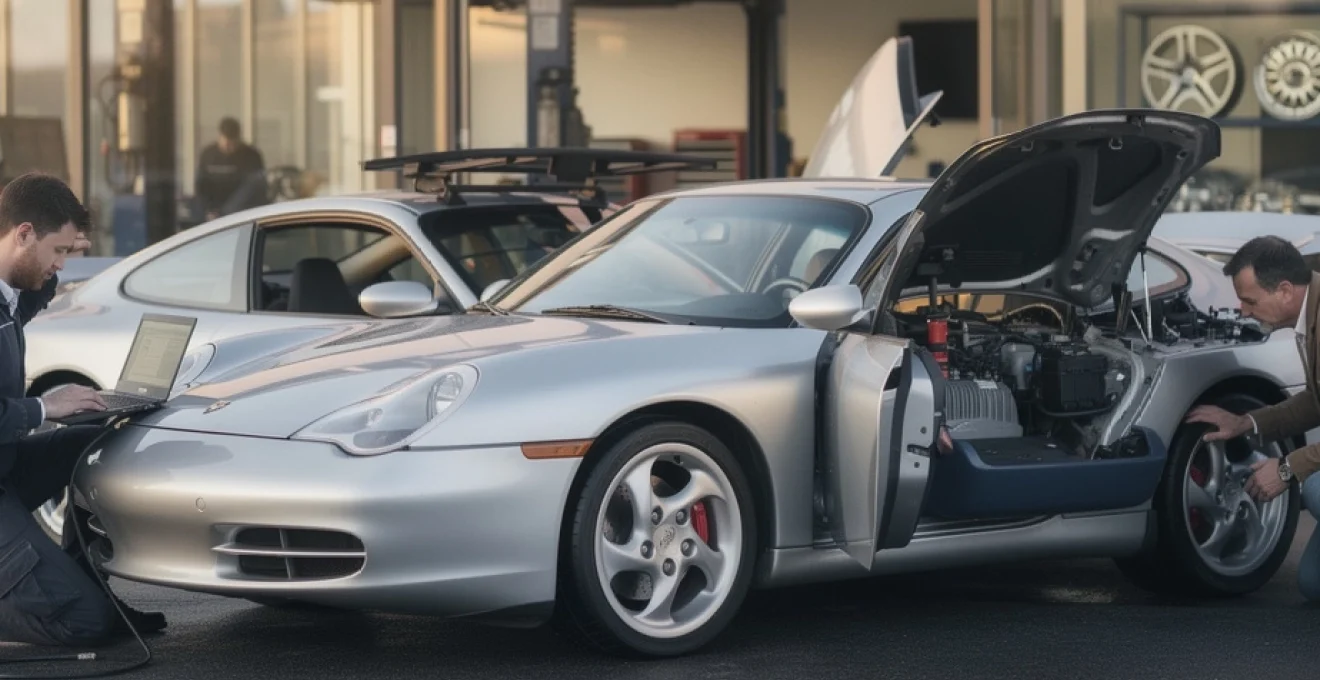
The 1999 Porsche 911 Carrera (996) occupies a fascinating sweet spot in the 911 family tree. It combines the raw, compact feel of earlier air‑cooled cars with the everyday usability of more modern generations, yet values still lag far behind later 997 and classic 993 models. For someone who wants authentic 911 steering feel, a characterful flat‑six and genuine usability as a daily performance car, the 1999 996 Carrera is hard to ignore. It is also the first truly “modern” 911 in terms of ergonomics, safety and refinement, which means you can jump in, drive a long distance across Europe and step out relaxed rather than wrung out.
At the same time, early water‑cooled 911s attract a fair amount of debate, especially from purists. Concerns over the M96 engine, styling and long‑term reliability are often repeated online, sometimes without context. Understanding what changed in 1999 – and which issues genuinely matter when buying one today – helps you spot a strong example and avoid expensive surprises.
Overview of the 1999 porsche 911 carrera (996): model year, variants and market positioning
Transition from air-cooled 993 to water-cooled 996: engineering rationale and purist controversy
The leap from the air‑cooled 993 to the water‑cooled 996 was the biggest engineering shift in 911 history. Emissions and noise standards in Europe and the US were tightening rapidly by the late 1990s, leaving little headroom for an enlarged, more powerful air‑cooled engine. A new water‑cooled flat‑six, coded M96, allowed Porsche to meet EU3 emissions, improve cabin refinement and unlock higher power with better fuel efficiency. From an engineering point of view, the shift was inevitable: tighter tolerances, improved thermal management and lower noise opened the door to future performance versions.
For traditionalists, though, the 996’s radiator and the loss of that iconic air‑cooled “fan whirr” felt like heresy. The shared front‑end design with the 986 Boxster further blurred the 911’s identity. Yet the market responded enthusiastically: more than 175,000 996s were sold globally, roughly double the volume of the 993. For you as a buyer today, that volume translates into a wide choice of cars, strong parts availability and a deep specialist network, particularly in the UK and wider Europe.
1999 porsche 911 carrera trim levels: carrera, carrera 4 and carrera cabriolet compared
For the 1999 model year, the 996 Carrera range in Europe revolved around three main variants: the rear‑wheel‑drive Carrera 2 Coupé, the all‑wheel‑drive Carrera 4 and the Carrera Cabriolet. All shared the same 3.4‑litre M96.01 flat‑six producing around 297 bhp and 258 lb ft, enough for a 0–62 mph time of roughly 5.2–5.4 seconds in manual form. The Carrera 2 was the lightest and most focused, with the most traditional 911 handling balance and the largest front boot.
The 1999 Carrera 4 added a viscous‑coupled all‑wheel‑drive system for enhanced traction in poor weather, at the cost of around 55 kg and a slight reduction in luggage capacity due to the front‑axle hardware. For UK buyers planning to drive all year on mixed roads, the C4 offered a reassuring blend of grip and stability. The Carrara Cabriolet delivered the open‑top 911 experience, albeit with slightly reduced rear space and a small penalty in torsional rigidity compared with the coupé.
VIN decoding and production numbers for 1999 996 carrera models
The 1999 996 Carrera uses a 17‑digit VIN with a structure familiar to other contemporary Porsches. The first three characters identify Porsche as the manufacturer, with subsequent characters denoting the model line, body type, engine and restraint system. The 10th character indicates model year, and the 11th character shows the assembly plant. While detailed global production by VIN range is not always publicly published, broad estimates suggest that early narrow‑body Carrera and Carrera 4 models account for tens of thousands of units worldwide, with UK deliveries in the low thousands during the 1998–1999 period.
For a serious buyer, decoding the VIN helps confirm whether a car is a genuine 1999 example, rather than an earlier 1998 build or later facelift model mis‑advertised for marketing reasons. Matching VIN data with option codes on the under‑bonnet sticker and service book allows you to verify whether the car left the factory as a Carrera, Carrera 4 or Cabriolet, and whether key options such as M030 sports suspension or M220 limited‑slip differential were fitted.
Original UK and EU pricing, option packages and standard equipment in 1999
In period, the 1999 911 Carrera positioned itself above the Boxster and below halo models such as the GT3 and Turbo that followed soon after. UK list prices for a 996 Carrera 2 Coupé were in the region of the mid‑£60,000s, with the Carrera 4 and Cabriolet commanding several thousand pounds more. Adjusted for inflation, that places an early 996 Carrera roughly on par with a modern 992 Carrera in real‑terms affordability for new buyers, underlining how far depreciation has brought values down today.
Standard equipment on a 1999 Carrera typically included ABS, dual airbags, climate control, electric windows and mirrors, and high‑quality leather trim. Popular options ranged from heated seats and Porsche Stability Management (PSM) to upgraded audio systems and 18‑inch wheels. Many cars were ordered with the desirable Porsche Sports seats and the three‑spoke steering wheel, both of which add appeal for enthusiastic driving. As you browse used adverts, pay attention to well‑specified cars; option value often outweighs mile‑age when it comes to long‑term enjoyment.
Engine and drivetrain of the 1999 911 carrera: M96 flat-six architecture in detail
M96.01 3.4-litre flat-six: bore, stroke, compression ratio and output characteristics
The heart of the 1999 996 Carrera is the M96.01 3.4‑litre flat‑six. This engine uses an aluminium block with integrated cylinders and water jackets, a departure from the separate cylinder barrels of air‑cooled predecessors. With a bore and stroke combination designed for free‑revving response and a compression ratio close to 11.3:1, the unit delivers 297 bhp at around 6800 rpm and 258 lb ft of torque near 4600 rpm. Power delivery feels linear and eager, with a noticeable step in urgency as revs climb past 4000 rpm.
Unlike the dry‑sumped Mezger engine in the GT3 and Turbo, the M96 employs an integrated dry sump, combining the oil reservoir within the crankcase. This saves space and weight but has implications for high‑G track use and oil starvation, which is why frequent oil changes and maintaining correct oil level are important practices if you plan spirited driving. For road use, the engine provides a robust balance of performance and everyday drivability, with real‑world fuel economy typically in the 23–27 mpg range depending on driving style.
Bosch motronic ME 7.2 engine management, VarioCam and emissions compliance (EU3)
Engine management on the 1999 Carrera 911 relies on Bosch Motronic ME 7.2, a sophisticated ECU system that coordinates fuel injection, ignition timing, drive‑by‑wire throttle and knock control. It works in tandem with Porsche’s VarioCam system, which adjusts intake camshaft timing to optimise low‑end torque and high‑rpm power. The combination allowed the 996 to meet EU3 emissions regulations while maintaining strong performance, a key reason Porsche adopted water cooling.
From a maintenance point of view, ME 7.2 is highly diagnosable via OBD‑II and factory PIWIS tools. Fault codes for misfires, oxygen sensors and mass‑airflow readings provide clear guidance when something is amiss. The system also logs over‑rev events, which becomes important during a pre‑purchase inspection if you want to know whether the engine has spent time bouncing off the limiter. For you as an owner, keeping sensors healthy and avoiding air leaks helps preserve both performance and fuel efficiency.
Manual vs tiptronic S 5-speed gearboxes: gear ratios, shift logic and reliability patterns
Buyers in 1999 could choose between a six‑speed manual transmission and a five‑speed Tiptronic S automatic. The manual gearbox, paired with a reasonably short final drive, offers close ratios that keep the engine in its sweet spot. Shift quality is more mechanical than modern Porsches, but once warmed up it delivers a satisfying, positive action that suits enthusiastic road driving. Clutch replacement, however, is labour‑intensive on the rear‑engined layout; budgets from around £1000 are realistic at specialist rates.
Tiptronic S is often misunderstood. Underneath the marketing badge lies a conventional torque‑converter automatic with selectable manual modes via steering‑wheel buttons. Shift logic adapts to driving style, holding gears longer in Sport settings and slurring changes in normal mode. Reliability is generally strong provided fluid is changed sensibly, even if Porsche’s original schedules suggested “lifetime” fills. For urban or mixed‑use driving, Tiptronic can make the 1999 Carrera a more relaxed companion, though enthusiast buyers tend to pay a premium for manual cars.
All-wheel drive system in the 1999 carrera 4: viscous coupling, torque split and handling impact
The 1999 Carrera 4 adds an all‑wheel‑drive system built around a viscous coupling connecting the front and rear axles. Under normal conditions, torque bias remains strongly rear‑focused; only when the rear wheels begin to slip does the viscous unit send additional torque forwards. This passive system lacks the active torque‑vectoring sophistication of later generations but delivers a natural, rear‑biased feel that still reads as a classic 911.
From the driver’s seat, the Carrera 4’s extra security is most noticeable in wet or cold conditions, especially when accelerating hard out of slow corners. Turn‑in remains sharp, and only keen drivers on dry roads are likely to notice the slight extra nose weight and marginally smaller front boot. If you intend to use a 1999 911 Carrera as an all‑season sports car across the UK and northern Europe, the C4 variant deserves serious attention, particularly when paired with high‑quality winter or all‑season tyres.
Exhaust system configuration, catalytic converters and popular OEM upgrades (porsche sport exhaust)
The standard exhaust on the 1999 996 Carrera uses a twin‑path layout with rear silencers and dual catalytic converters to meet emissions standards. Sound levels are deliberately civilised, especially at idle and cruising speeds, a key part of the car’s broader market appeal in the late 1990s. Under load, though, the flat‑six still delivers a distinct, mechanical howl that becomes more pronounced above 4000 rpm.
For owners seeking a richer soundtrack, the factory Porsche Sports Exhaust (PSE) remains a popular upgrade. This system uses vacuum‑operated valves to open a more direct path at higher revs or in sport mode, deepening the tone without resorting to intrusive drone. Many specialists also offer mild “Gundo” bypass modifications to the rear silencers, which can restore character if a car feels too muted. When considering aftermarket exhausts, check that catalytic converters remain in place and that the system remains emissions‑compliant for MOT tests.
Chassis, suspension and braking system: how the 1999 carrera 911 drives
996 platform and body-in-white: torsional rigidity and weight distribution vs 993
The 996 platform introduced a stiffer, lighter body‑in‑white compared with the 993. Porsche claimed a significant increase in torsional rigidity – figures around 40% stiffer are often cited – while overall weight was kept under tight control. A manual Carrera 2 Coupé typically weighs in the region of 1320–1340 kg, depending on options, which means the 1999 car remains genuinely light by modern sports‑car standards. That lightness underpins the agility many enthusiasts talk about when comparing the 996 to later, heavier 911s.
Weight distribution stays characteristically rear‑biased due to the engine location, but revised suspension geometry and wider front tracks help tame the infamous “on‑the‑limit” behaviour associated with older 911s. The result for you is a car that still demands respect on a wet B‑road yet remains far more approachable than earlier generations. Buyers coming from BMW M or AMG products often comment that the 996 feels more compact and alive, closer to a slightly oversized hot hatch than a traditional GT car.
Macpherson strut front and multi-link rear suspension: kinematics, bushings and wear points
Suspension on the 1999 996 uses a MacPherson strut front end and a sophisticated multi‑link rear arrangement with coil springs and wishbones. This layout, shared in part with the contemporary Boxster, allows precise wheel control and good ride comfort when correctly set up. Over 20‑plus years and six‑figure mileage, however, bushes, balljoints and dampers inevitably age, leading to knocks, vague steering and tramlining.
Front control arms with integrated balljoints are widely available from OEM suppliers at around £120 per corner, making a full refresh more achievable than many expect. Anti‑roll bar drop links and top mounts are also common wear items. A set of high‑quality aftermarket springs costs roughly £300, and pairing these with fresh dampers can transform a tired 996 into a sharp, confidence‑inspiring car again. For a potential buyer, budget for a suspension overhaul unless there is recent documentation confirming the work.
Steering feel: hydraulic power steering, rack ratio and feedback characteristics
One of the 1999 Carrera 911’s standout features is its hydraulic power steering. Unlike the later switch to electric assistance, the 996’s system offers a delicate stream of feedback through the wheel. Many enthusiasts rate early 996 steering as some of the best in the entire 911 lineage, combining lightness at low speed with increasing weight and feel as cornering loads build. On a twisting road, you can sense surface changes and grip levels in a way that is increasingly rare in modern cars.
Steering racks are generally durable, though leaks from old hoses and tired track‑rod ends can dull the experience. If a test‑drive car feels inert or heavy off‑centre, alignment settings and worn suspension components are often more to blame than the rack itself. A proper geo set‑up by a Porsche specialist can feel like giving the car new life, aligning it with factory settings or a mild fast‑road specification tailored to how you drive.
Brake hardware: four-piston monobloc calipers, disc sizes and pad compounds
Braking hardware on the 1999 996 Carrera features four‑piston monobloc calipers all round, clamping vented and cross‑drilled discs. Front discs are approximately 318 mm, with rears around 299 mm, more than sufficient for spirited road driving and occasional track days when paired with the right pads and fluid. ABS tuning reflects Porsche’s experience from motorsport, intervening progressively rather than abruptly.
Replacement costs are surprisingly reasonable if you choose quality aftermarket components. Expect around £100 per front disc and £80 per set of pads from reputable brands. Stainless steel brake lines and higher‑temperature fluid are worthwhile upgrades if you intend to use the car on circuit. For a 1999 911 Carrera that will see mostly road use, sticking to OEM‑equivalent parts maintains the original pedal feel that many owners appreciate.
Exterior design and aerodynamics of the first water-cooled 911
“fried egg” headlamps and shared 986 boxster design language: form vs function
The design language of the 1999 996 Carrera is defined by its so‑called “fried egg” headlamps, shared with the 986 Boxster. This move reduced development costs at a critical time for Porsche’s finances, but also gave the 911 a less distinct face than previous generations. Over time, those lamps have become a visual shorthand for early water‑cooled cars, and taste is slowly shifting; what once looked controversial now reads as a clear marker of an emerging classic era.
Functionally, the integrated headlamp units improved light output and aerodynamic cleanliness compared with the upright units on the 993. The sleeker nose profile helped achieve a lower drag coefficient while preserving front‑end lift characteristics that could be managed with subtle spoilers and the active rear wing. For some buyers today, the 996’s design feels refreshingly simple next to the heavily styled 992, especially in narrow‑body Carrera form on 17‑inch wheels.
Cd value, lift coefficients and active rear spoiler operation on the 1999 carrera
Aerodynamically, the 996 Carrera marked a noticeable step forward. Drag coefficient dropped to around Cd 0.30, placing it among the more efficient sports cars of its time. Porsche’s engineers also focused on reducing front and rear lift, leading to a more stable car at high Autobahn speeds. The active rear spoiler, which deploys automatically around 75 mph and retracts below roughly 37 mph, plays a key role in this stability.
The spoiler can also be raised manually from the cabin, which is worth checking during a viewing. A non‑functioning spoiler may point to a failed motor, a wiring issue or simple neglect. While not a catastrophic fault, sorting it maintains both the original look and the car’s high‑speed behaviour. Think of the spoiler as the last line in a carefully balanced aerodynamic package rather than a styling gimmick.
Factory bodywork options: aero kit, wheels (carrera, turbo twist) and paint codes
Factory body options for the 1999 Carrera included the attractive Aero Kit, which added a deeper front bumper, side skirts and a fixed rear wing. This package subtly sharpened the car’s stance without the overt aggression of GT3‑style addenda. Many cars also left the factory on 17‑inch “Carrera” wheels, while 18‑inch “Turbo Twist” designs became a popular upgrade both new and in the used market.
Paint choices ranged from classic Arctic Silver and Guards Red through to darker hues such as Ocean Blue and black. Special colours and metallic finishes carry extra appeal today, especially when paired with contrasting interiors. When inspecting a car, check paint codes on the option sticker and compare panel fit. A uniformly clean nose respray is common and often desirable on a 1999 911 due to stone‑chip exposure, but mismatched shades or orange peel may indicate lower‑quality repair work after accident damage.
Corrosion protection, galvanised body panels and common rust locations on early 996s
The 996 generation benefited from fully galvanised body shells, which is one reason so many 1999 Carrera 911s still present well despite two decades of British weather. Galvanising significantly reduces the likelihood of structural rust, making any obvious corrosion a potential red flag for poorly repaired accident damage or severe neglect. That said, no protection is perfect once stone chips and scratches expose bare metal.
Common rust spots include the leading edge of the bonnet, wheelarches and door bottoms where trapped moisture can sit. Underneath, low ride height can lead to scraped undertrays and exhaust hangers, so a look under the car is essential. A damp front boot may point to compromised seals after a light front impact. Addressing these issues early, with proper preparation and paint, prevents cosmetic blemishes from turning into more serious corrosion problems over time.
Interior, ergonomics and on-board electronics in the 1999 porsche 911 carrera
Dashboard layout, seat types (comfort vs sports seats) and driving position
The 1999 996 Carrera cabin marked a shift towards more conventional ergonomics. The upright, classically 911 dashboard gave way to a cleaner layout with logically placed controls and improved legroom. For anyone coming from a modern German saloon or coupé, the driving position feels instantly familiar: supportive seats, a multi‑adjustable steering wheel and clear instrumentation. Yet the classic five‑dial cluster remains, preserving a vital link to earlier cars.
Comfort seats were standard, but many enthusiasts sought the optional Sports seats with deeper bolsters and firmer padding. These provide better lateral support without becoming intrusive on longer journeys. Rear seats remain occasional perches, best for children, small adults or extra luggage. They do, however, give the 1999 Carrera 911 an everyday practicality that many rival sports cars cannot match, especially if you like to travel light over long distances.
PCM 1 infotainment, becker head units, CD-changer and audio system specifications
In 1999, Porsche Communication Management (PCM 1) was a cutting‑edge option, featuring a small navigation screen and integrated audio functions. Today, technology has moved on so far that most owners view PCM 1 as period charm rather than a must‑have. Many 996s instead came with Becker head units, CD‑changers and high‑quality speakers that still deliver acceptable sound, especially after the fitment of fresher speakers or discreet amplifiers.
One practical upgrade is installing a modern double‑DIN head unit with Bluetooth and smartphone integration. Porsche designed the later navigation systems to live in this double‑DIN space, so relocating the climate controls lower down using a proper kit allows a retrofit head unit to sit neatly in the dash. Carried out carefully, this maintains a factory‑like appearance while vastly improving daily usability for navigation and streaming audio.
Climate control, sunroof and cabriolet roof mechanisms: typical failure modes
Automatic climate control was standard on most 1999 Carrera 911s and usually remains reliable if kept serviced. Weak air‑conditioning often suggests more than “just a regas”; common culprits include corroded condensers in the front bumper area or leaky pipework. Inspecting the front radiators and condensers for debris and corrosion is worthwhile, as leaves and road grime can trap moisture and accelerate deterioration.
Cars with a steel sunroof require checks for drain blockage and seal integrity, as leaks can lead to damp headliners and electrics. Cabriolet models add a complex powered roof mechanism with motors, cables and hydraulic elements. Slow operation, misalignment or unusual noises during opening and closing hint at impending repair bills. Early cars with plastic rear windows can also suffer from clouding and cracking; replacing these involves more work than the later glass‑window design but is manageable with specialist help.
Airbag system, PSM (porsche stability management) availability and safety equipment
Safety equipment on the 1999 996 Carrera includes dual front airbags and side airbags, along with ABS and, on many cars, optional Porsche Stability Management (PSM). PSM uses sensors to monitor yaw, steering angle and wheel speeds, selectively braking individual wheels and reducing engine power to maintain stability. For everyday road use, especially in wet or icy conditions, PSM provides a valuable safety net without overwhelming the natural feel of the chassis.
Seatbelt pretensioners and strong crash structures contribute to safety performance that, while not matching today’s NCAP leaders, far exceeds many 1990s sports cars. For a buyer, confirming that airbag warning lights operate correctly on start‑up and that no fault codes remain stored in the system is essential. Any sign of post‑accident airbag deployment should be scrutinised closely in the service history and verified by a reputable specialist.
Known issues, reliability and preventive maintenance for the 1999 996 carrera
Intermediate shaft (IMS) bearing design on early M96 engines: failure risk and retrofit solutions
The intermediate shaft, or IMS, has become the headline topic whenever early 996 Carreras are discussed. The IMS drives the camshafts from the crankshaft, supported by bearings at each end. On some engines, particularly after Porsche’s switch from dual‑row to single‑row bearings around the 2000 model year, the flywheel‑end bearing can degrade because it runs as a sealed unit with limited lubrication. If it fails catastrophically, major internal damage can result.
It is important, though, not to overstate the risk. Failure rates, while not negligible, affect a minority of engines, and most surviving 1999 cars have either had the bearing replaced with an upgraded part or have run long enough that the probability of sudden failure is reduced. Many specialists recommend replacing the IMS bearing proactively when the clutch is changed, combining the labour for a more cost‑effective solution. Treated this way, IMS becomes a manageable risk rather than a reason to avoid the 1999 911 Carrera entirely.
Rear main seal (RMS) leaks, cylinder bore scoring and cooling system weaknesses
Rear main seal (RMS) oil leaks are another widely discussed M96 issue. A weeping seal at the junction between engine and gearbox often leaves tell‑tale drips or a misting of oil. While unsightly, RMS leaks are usually more of an annoyance than an immediate threat, but they do warrant attention during a clutch replacement. Fitting an updated seal when the gearbox is already removed adds relatively little cost and helps keep the underside clean.
Cylinder bore scoring and cracked liners on 3.4‑litre engines tend to be rarer than internet folklore suggests, particularly on well‑maintained examples. Listening for heavy ticking noises once warm and inspecting exhaust tips for excessive soot from one bank provide simple early checks. Cooling systems deserve respect as well: twin front radiators can become clogged and corroded over time, leading to slow leaks or overheating in traffic. Proactive replacement of old radiators and hoses can add years of reliable service.
Service intervals, common consumables and recommended upgrades for longevity
Regular servicing remains the best insurance against major problems. Oil changes every 10,000 miles or annually (rather than extended intervals) are a popular strategy among specialists, using high‑quality synthetic oil that suits the M96’s thermal characteristics. Spark plugs and coil packs benefit from periodic replacement, particularly on higher‑mileage cars where heat cycles take their toll. Expect to budget for brake fluid changes every two years to keep the braking system at full strength.
Recommended longevity upgrades include low‑temperature thermostats for hard‑used cars, improved IMS bearings when the clutch is due, stainless steel exhaust fasteners and, if track use is planned, baffled sumps to reduce oil surge. Replacing tired suspension bushes and dampers not only restores handling but also reduces stress on other components by ensuring the chassis works as designed. Taking a “rolling refresh” approach allows you to spread costs while keeping the car in strong mechanical shape.
Diagnostic procedures with PIWIS and OBD-II: reading fault codes and over-rev ranges
Modern diagnostics are an asset when buying or maintaining a 1999 996 Carrera. OBD‑II readers can access basic fault codes, but a Porsche PIWIS or high‑end specialist tool adds deeper insight. In addition to fault history for engine and ABS systems, PIWIS can show over‑rev ranges, revealing whether the engine has been mechanically over‑revved by mis‑shifts or aggressive use. Repeated high‑range over‑revs suggest a harder life and potentially increased wear.
During a pre‑purchase inspection, a full diagnostics scan should accompany mechanical checks. Codes for oxygen sensors, MAF issues or coil misfires are rarely deal‑breakers in themselves but help when negotiating price and planning immediate maintenance. For ongoing ownership, keeping an inexpensive OBD‑II scanner in the glovebox offers peace of mind, letting you differentiate between a minor warning and something that warrants immediate specialist attention.
Collectability, values and buying guide for a 1999 porsche 911 carrera
Market trends for early 996 carreras vs 993 and 997 models in the UK and europe
Market perception of early 996 Carreras has shifted noticeably in the last five years. As air‑cooled 993 values climbed to levels that exclude many enthusiasts, and 997 prices also hardened, the 1999 996 emerged as a more attainable way into 911 ownership. In the UK and wider Europe, asking prices for good 1999 Carrera 2 Coupés have risen from the low‑teens to the high‑teens or low‑twenties (in pounds or euros) for well‑maintained examples, while exceptional low‑mileage or rare‑spec cars can command more.
Compared to the 993, which often sits at two to three times the price for a similar‑condition car, the 996 still looks like a bargain. Longer‑term, as more cars succumb to neglect or are converted into track projects, supply of clean, original 1999 cars is likely to tighten. For someone who wants a usable modern classic that still has room to appreciate, the early 996 occupies a compelling niche.
Specification desirability: manual vs tiptronic, carrera vs C4, colour and option combinations
Specification plays a major role in desirability and value. Manual cars generally command a premium over Tiptronic, especially among enthusiasts seeking maximum engagement. That said, a well‑priced Tiptronic Carrera with strong history can still offer excellent value if you prioritise daily usability. Rear‑wheel‑drive Carrera 2 models often appeal to purists for their lighter weight and slightly sharper feel, whereas Carrera 4 variants attract buyers in colder climates or those wanting extra security in wet conditions.
Colour and trim combinations also influence demand. Classic silvers and blacks remain popular, but unusual exterior hues with contrasting interiors can stand out positively if tastefully specified. Options such as Sports seats, LSD, PSM, 18‑inch wheels and sunroof or Cabriolet roof condition matter more than flashy aftermarket additions. When you shortlist cars, focus on history, condition and coherent specification rather than chasing the rarest options at all costs.
Pre-purchase inspection checklist: engine, chassis, bodywork and documentation
A thorough pre‑purchase inspection is essential with any 1999 911 Carrera. Mechanically, listen for smooth cold and warm idling, check for smoke on start‑up, and inspect underneath for oil leaks from RMS, cam covers and coolant pipes. Confirm oil and coolant temperatures stabilise correctly during a test drive, and feel for clutch slip or notchiness in the gearbox. Any hesitations, misfires or warning lights merit a diagnostics scan.
- Inspect suspension for knocks, uneven tyre wear and corrosion on arms or fasteners.
- Check bodywork for consistent panel gaps, paint overspray and signs of previous accident repair.
- Test electrics: windows, sunroof or Cabriolet roof, spoiler switch, climate and audio.
- Review service history for regular oil changes, brake fluid intervals and recent major work.
Documentation should include service stamps, invoices, MOT records and, ideally, evidence of IMS and clutch work. A car with slightly higher mile‑age but transparent, thorough history often proves a better buy than a low‑mileage example with patchy paperwork.
Originality vs sympathetic modification: suspension, exhaust and wheel upgrades for enthusiasts
Balancing originality with tasteful upgrades is a key consideration for many 996 buyers. The market usually rewards cars that remain broadly stock, especially in terms of bodywork and interior. However, certain sympathetic modifications can enhance the driving experience without harming value. High‑quality suspension refresh kits, including slightly firmer springs and dampers, can sharpen responses while preserving comfort. Likewise, mild exhaust enhancements that retain catalytic converters but unlock more of the engine’s character are generally welcomed.
Wheel choices deserve careful thought. Oversized aftermarket wheels may look dramatic but often degrade ride and steering feel, whereas factory‑correct 17‑ or 18‑inch designs such as Turbo Twists maintain the intended balance. Reversible changes – for example, a modern double‑DIN head unit with the original radio kept safely stored – allow you to enjoy contemporary convenience while keeping the option to return the car to standard. For a 1999 Porsche 911 Carrera used as both a weekend toy and occasional commuter, this approach offers the best blend of driving pleasure, practicality and future desirability.