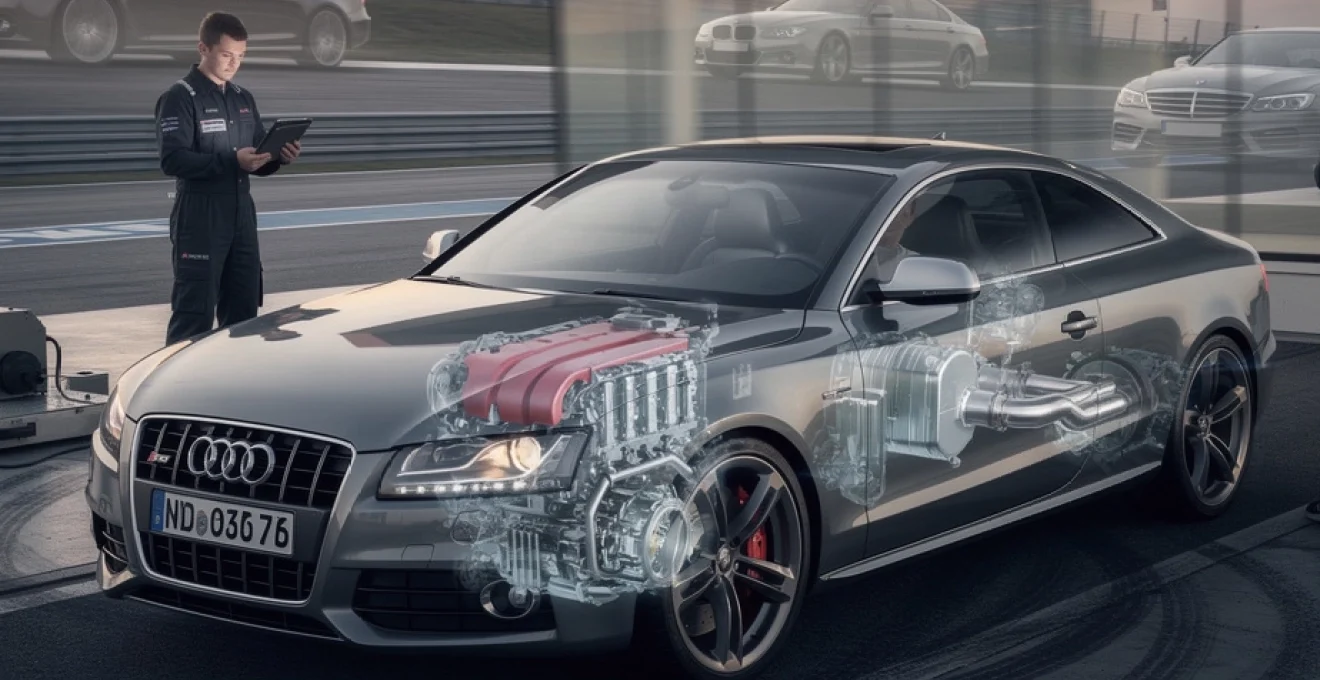
The 2008 Audi S5 4.2 sits at a fascinating crossroads in performance car history. It blends a classic naturally aspirated V8 with modern direct injection, quattro all‑wheel drive and grand tourer comfort in a way that few current models can match. If you are looking at a used S5 V8 today, you are probably drawn to the idea of an everyday coupe with a hint of Lamborghini soundtrack, long‑legged autobahn pace and the solidity of the early MLB platform. Understanding how this car delivers its performance – and what that looks like in real‑world driving nearly two decades on – helps you decide whether it fits your expectations for a fast yet refined coupé.
2008 audi S5 4.2 powertrain architecture: naturally aspirated V8, FSI injection and torque delivery
B7 RS4-derived 4.2-litre V8 FSI: block design, valvetrain, compression ratio and redline
At the heart of the 2008 Audi S5 4.2 lies a 4.2-litre V8 FSI closely related to the engine from the B7 RS4. Displacement stands at 4163 cm³, achieved through an 84.5 mm bore and 92.8 mm stroke, giving the unit a slightly undersquare configuration that favours torque. The all‑aluminium block keeps mass under control, while the 90‑degree bank angle delivers the traditional V8 character and a naturally balanced firing order. A compression ratio of 11.0:1 is high for a naturally aspirated petrol engine of its era, enabled by precise fuel and ignition control through direct injection.
The valvetrain uses double overhead camshafts with 4 valves per cylinder, for a total of 32 valves, and variable valve timing to broaden the power band. Peak output is quoted at 354 PS (349 bhp / 260 kW) at 7000 rpm, with the redline set at roughly the same point. In practice, you feel the engine come alive from about 4000 rpm, surging with increasing intensity up to its 7000 rpm crescendo. Compared with the RS4’s harder-edged tune (414 bhp), the S5’s calibration is slightly softer, focusing more on mid‑range flexibility than on chasing the final few horsepower at the top end.
Fuel stratified injection (FSI) system: high-pressure injectors, fuel rail pressures and combustion efficiency
The key to the S5’s blend of performance and relative efficiency is Audi’s Fuel Stratified Injection system. Instead of injecting fuel into the intake ports, the FSI system fires atomised fuel directly into the combustion chamber at very high pressure. This direct injection allows more precise control of mixture formation, especially under part load, and supports the engine’s elevated compression ratio without detonation.
In engineering terms, the high‑pressure pump and fuel rails deliver fuel at pressures several times higher than conventional port injection, with multi‑hole injectors designed to shape the spray according to operating conditions. Under light loads, the engine can run with a leaner mixture and greater ignition advance, boosting combustion efficiency and low‑end response. Under full throttle, injection is richer and carefully phased to cool the combustion chamber and maximise power. For you as a driver, the benefit is a V8 that feels sharp and eager from the first touch of the throttle, while still achieving official combined consumption of around 12.4 L/100 km (about 23 mpg UK).
Torque curve and power band analysis: 354 PS at 7,000 rpm and 440 nm at 3,500 rpm in real-world driving
On paper, the 2008 Audi S5 4.2 delivers 440 Nm (324 lb ft) of torque at 3500 rpm. In practice, the curve is broad and flat, with strong pull from around 2500 rpm and no abrupt steps in delivery. Think of it as a wide plateau rather than a single peak; you can surf the torque in a high gear or chase the redline for more drama. The factory claim of 0–100 km/h in 5.1 seconds aligns with independent tests that typically show 0–60 mph in 5.1–5.5 seconds, depending on surface and driver technique.
On a B‑road, this power band means you can choose between lazy third‑gear torque and more committed second‑gear bursts. The engine’s usable mid‑range is particularly noticeable during rolling accelerations from 50–80 mph, where you do not need to downshift aggressively to access meaningful thrust. Because the S5 is naturally aspirated, there is no turbo lag; response is immediate but linear, which some drivers find more predictable and satisfying than the sudden surge of a turbo V6.
Drivetrain layout: longitudinal engine placement, torsen-based quattro system and centre differential characteristics
The 2008 S5 was one of the first models to benefit from Audi’s new MLB architecture with a refined front‑mid engine layout. The V8 is mounted longitudinally but pushed further back relative to the front axle compared with earlier B‑platform cars. This shift improves weight distribution, reducing the heavy‑nose feel that earlier Audis were known for. With a kerb weight of about 1630 kg, the S5 is not light, but the repositioned engine helps agility and steering feedback.
Power is sent to all four wheels via a Torsen-based quattro centre differential. The default torque split is rear‑biased compared with older systems, with roughly 40:60 front to rear, but the Torsen unit can vary distribution dynamically as grip levels change. Under hard acceleration out of a corner, you feel the car claw forward with impressive traction, even in damp conditions. Unlike modern torque‑vectoring setups, the system is entirely mechanical, which gives a very consistent and predictable response as you lean on the drivetrain.
Acceleration, in-gear performance and real-world pace of the 2008 audi S5 4.2
0–60 mph and 0–100 km/h measured times versus audi S4 B7, BMW 335i E92 and mercedes C350
Officially, Audi quotes 0–100 km/h in 5.1 seconds for the manual S5, matching what many independent tests have recorded on dry tarmac. Measured 0–60 mph times typically fall between 5.1 and 5.5 seconds, depending on launch technique and surface quality. For context, the contemporary B7 Audi S4 V8 sits in a similar range, while the twin‑turbo BMW E92 335i often records around 5.0 seconds, and a naturally aspirated Mercedes C350 Coupe trails at roughly 6.0 seconds.
The S5’s advantage lies in its ability to reproduce these figures consistently in poor weather. With quattro traction, you can launch hard without overwhelming the rear tyres. Where a powerful rear‑wheel‑drive coupe might spin through first and second in the wet, the S5 simply digs in and goes. If you value repeatable real‑world performance rather than a single headline number on a perfect day, the S5 V8 makes a compelling case.
In-gear acceleration (30–70 mph, 80–120 km/h) in 3rd and 4th: motorway overtaking and b-road performance
For daily driving, in‑gear acceleration matters more than stand‑still sprints. Independent testing and owner logs suggest that 30–70 mph in third gear takes around 5.0–5.5 seconds, with 50–75 mph in fourth taking roughly 6–7 seconds. These figures put the 2008 S5 squarely in modern warm‑GT territory, even today. When you slot the manual into third at 40 mph and squeeze the throttle, the car responds with a firm, linear shove, building speed with minimal fuss.
On the motorway, this translates into relaxed overtaking from 60–90 mph without the need to drop multiple ratios. You simply choose between third for urgency or fourth for a more measured surge. On a flowing B‑road, the broad spread of torque means you spend more time focusing on lines and braking points rather than constantly rowing the gearbox. If you are used to a high‑revving four‑cylinder, the S5’s ability to accelerate briskly from 2500 rpm upwards feels like stepping into another class of car.
Standing quarter-mile and 0–200 km/h runs: trap speeds and launch characteristics with quattro
Quarter‑mile performance gives another angle on the S5’s capability. Period tests show standing quarter‑mile runs of around 14.1–14.3 seconds with trap speeds close to 100 mph. These numbers align neatly with the claimed 354 PS and the car’s 1630 kg kerb weight, confirming that the factory figures are realistic rather than optimistic. The 0–200 km/h (0–124 mph) sprint typically lands in the mid‑20‑second range.
The quattro system shapes the launch characteristics more than raw power alone. The sharp clutch engagement means you need a balance of revs and smooth pedal modulation to avoid either bogging down or spinning the tyres. Once the car hooks up, acceleration remains strong but never frantic. It feels more like a junior GT than a spiky sports car, with the drivetrain prioritising stability and traction over theatrical wheelspin.
Performance impact of manual vs tiptronic automatic on shift times and usable acceleration
The 2008 Audi S5 4.2 was offered with either a 6‑speed manual or a 6‑speed Tiptronic automatic with torque converter and paddle shifters. Independent figures and manufacturer claims suggest the automatic is approximately 0.3 seconds slower to 62 mph, largely due to slightly softer launches and longer shift times. The manual’s direct connection gives you sharper response and a touch more involvement, especially if you enjoy managing the engine right up to its 7000 rpm limit.
However, the Tiptronic has advantages in certain scenarios. In manual mode, the paddles deliver brisk, smooth gear changes that keep the V8 in its sweet spot between 3500 and 6500 rpm. For high‑speed cruising or heavy traffic, the auto’s relaxed behaviour reduces fatigue. If outright acceleration is the priority, the manual has the edge; if you want effortless long‑distance pace with the option of manual control, the Tiptronic remains a credible choice, even if it lacks the lightning‑quick feel of modern dual‑clutch units.
Chassis dynamics and handling characteristics of the 2008 audi S5 4.2
MLB platform and suspension geometry: multi-link front/rear setup, subframes and weight distribution
The 2008 S5 debuts on the then‑new MLB platform, with a layout designed to improve handling balance versus older Audis. The front suspension uses a multi‑link design with an aluminium subframe and components to cut unsprung mass, while the rear also uses a multi‑link arrangement for better wheel control under load. Compared with the B7 S4, the front axle is moved forward, allowing the engine to sit further back and bringing the car closer to an ideal front‑rear weight distribution.
On the road, this translates into a chassis that feels inherently stiff and composed. Over poor surfaces, the suspension works quietly and effectively, absorbing bumps without corrupting the body’s overall poise. Even with large 19‑inch wheels, the ride is firm but not punishing, suiting the car’s grand tourer brief. The S5 flows best on fast, sweeping roads where its stability and long wheelbase (2750 mm) come into their own.
Steering calibration and front-end grip: turn-in behaviour, understeer tendencies and tyre setup (19-inch vs 18-inch)
Steering feel in the 2008 Audi S5 4.2 is a recurring talking point. The rack offers decent precision and a natural weighting once on the move, but feedback is more muted than in rear‑drive rivals. Initial turn‑in is competent rather than razor sharp, reflecting a chassis tuned more for stability than for playful rotation. If you enter a tight corner too fast and carry power, the front will eventually push wide into mild understeer, especially with ESP left fully on.
Tyre choice and wheel size influence the front‑end response significantly. Many cars left the factory on 18‑inch wheels with 245/40 R18 tyres, while others received 19‑inch options. The larger setup sharpens steering response but can add a little harshness on broken tarmac. If you plan to use an S5 V8 primarily on British B‑roads, a high‑quality 18‑inch tyre with a performance‑oriented compound often delivers the best blend of grip, feedback and ride comfort. Keeping geometry properly aligned and tyre pressures accurate makes a noticeable difference to turn‑in and mid‑corner balance.
quattro all-wheel-drive dynamics: torque split behaviour versus rear-biased systems in BMW E92 335i and lexus IS F
Compared with the rear‑drive BMW E92 335i or the more overtly rear‑biased Lexus IS F, the S5’s quattro system creates a different dynamic flavour. The Torsen diff’s rear‑biased default split gives some rear‑wheel‑drive character, but the car remains inherently neutral to mild understeer rather than adjustable and tail‑happy. On wet or greasy surfaces, you feel a sense of security that encourages confident pace, even when the road surface is uneven or cambers unpredictably.
For enthusiastic drivers, the question is often: can the S5 be made playful? With stability control relaxed and deliberate weight transfer, it is possible to coax a hint of rear‑end rotation on corner exit, but the system rapidly shuffles torque to whichever axle offers most grip. Performance is measured less in oversteer angles and more in how quickly you can cover ground. For cross‑country runs in mixed weather, this all‑weather security suits the S5’s character perfectly, even if it never feels quite as interactive as the best rear‑drive performance coupes.
Braking hardware: disc dimensions, calliper design and fade resistance in repeated high-speed stops
The S5’s braking hardware consists of large vented front discs with single‑ or dual‑piston sliding callipers (specification varies by market) and solid or vented rear discs. In independent tests, 60–0 mph stopping distances average around 130–140 feet, with one well‑documented set of runs indicating about 137 feet. This is respectable rather than outstanding for a 1630 kg coupe, and pedal feel can be slightly soft with noticeable ABS pulsing under hard repeated stops.
Fade resistance under typical fast‑road use is good, thanks to the substantial disc sizes and cooling airflow, but prolonged track driving can reveal the limits of standard pads and fluid. If you intend to use an S5 for frequent high‑speed driving or occasional track days, upgrading to performance pads and a high‑boiling‑point brake fluid offers a worthwhile improvement in pedal consistency and confidence.
Transmission options and gearing strategy in the 2008 audi S5 4.2
6-speed manual gearbox: gear ratios, final drive and clutch feel at high load
The 6‑speed manual transmission suits the S5’s character well, but it has its quirks. The gearshift is relatively short in throw but can feel notchy if rushed, especially when cold. Learning to apply deliberate, slightly slower movements between second and third gears helps avoid baulking. The clutch itself bites quite aggressively; the first centimetre of pedal travel does most of the work, which can lead to a jerky getaway until you adapt your technique.
Gearing sits on the long side, with first stretching beyond 40 mph and second running out close to 70 mph. This aligns neatly with the engine’s broad torque curve, allowing strong 30–70 mph pulls in a single gear. The final drive ratio supports relaxed cruising, holding the engine around 2500 rpm at typical motorway speeds in sixth. If you enjoy interacting with the car and extracting the full character of the V8, the manual gearbox offers the more engaging choice.
6-speed tiptronic automatic: torque converter behaviour, manual mode and shift logic under full throttle
The 6‑speed Tiptronic automatic uses a conventional torque converter rather than a dual‑clutch system. In everyday use, the calibration prioritises smoothness; upshifts are quick but unobtrusive, and downshifts under partial throttle are well judged. Under full throttle, the gearbox holds gears to near the 7000 rpm redline before snapping the next ratio in with a brief interruption in power delivery.
In manual mode, the steering‑wheel paddles give you control over gear selection, and the system is generally obedient, resisting unwanted upshifts until very near the limiter. The torque converter’s multiplication helps low‑speed response, compensating for the lack of turbo torque off idle. For long‑distance commuting or heavy traffic, the Tiptronic can make the S5 feel more like a refined GT than a high‑strung sports coupe, which may be precisely what you want from a daily‑driven V8.
Gearing versus power band: rpm drop between shifts and optimisation for UK motorway cruising
With either transmission, gearing is matched closely to the engine’s usable band between 2500 and 6500 rpm. The rpm drop between first and second keeps the engine firmly in its torque plateau, maintaining strong acceleration without falling into a dead zone. Shifts from third to fourth likewise maintain momentum, making 50–90 mph overtakes feel seamless.
For UK motorway cruising, sixth gear is effectively an overdrive. At 70 mph, the engine turns over at a relaxed rate, reducing noise, vibration and fuel consumption. If you want more immediate response, simply dropping to fifth places the engine closer to 3500 rpm, where 440 Nm is readily available. This dual‑nature gearing strategy – relaxed in top, urgent in the mid‑gears – is one reason the S5 works so well both as a daily car and as a weekend cross‑country machine.
Exhaust note, NVH tuning and high-rpm character of the 4.2 FSI V8
Factory exhaust layout: manifold design, catalytic converters and backbox configuration
The factory exhaust system on the 2008 Audi S5 4.2 uses a cross‑over layout with equal‑length style manifolds feeding into dual catalytic converters and resonators before exiting via quad tailpipes. The design aims to balance flow efficiency with noise control, respecting the car’s premium GT aspirations. The manifolds prioritise packaging and emissions compliance rather than outright race‑car scavenging, but the combination is still free‑breathing enough to support the 354 PS output without undue backpressure.
Downstream, the central resonators and rear backboxes shape the car’s acoustic character. At idle and low revs, the system keeps volume subdued, with only a subtle burble hinting at the V8 beneath. Under load, internal baffles and chambers allow more of the engine’s natural frequencies to emerge, especially around 4000–6000 rpm. Many owners choose aftermarket systems to enhance this soundtrack, but the stock setup already delivers a satisfying blend of refinement and character.
Acoustic character: idle burble, mid-range resonance and 7,000 rpm soundtrack compared with RS4 B7
How does the S5 V8 actually sound from the driver’s seat? At idle, there is a gentle, even thrum with a hint of off‑beat character, though less pronounced than a classic American cross‑plane V8. As revs build through the mid‑range, a more pronounced growl and resonance develop, accompanied by a tangible increase in intake noise. At full throttle near 7000 rpm, the note hardens into a metallic snarl that, as some testers have observed, has shades of a detuned exotic.
Compared with the RS4 B7, the S5’s soundtrack is slightly more muted and less frenetic. The RS4 features a more aggressive exhaust tune and higher‑revving calibration, producing a racier, almost motorsport‑like shriek at the top end. The S5 stays more cultured, reflecting its grand tourer positioning. If you want a V8 coupe that can be discreet early in the morning yet entertaining on an empty slip road, the S5 strikes an appealing balance.
Cabin NVH profile: sound insulation, tyre roar and wind noise at 70–90 mph
Inside the cabin, noise, vibration and harshness are tightly controlled for a car with such performance potential. At 70–80 mph, wind noise remains low, with only a gentle rustle around the A‑pillars. Road roar depends heavily on tyre brand and wheel size; 19‑inch wheels with aggressive performance rubber can introduce more low‑frequency hum on coarse surfaces, while 18‑inch setups are generally quieter.
Engine noise is well judged. At a gentle cruise, the V8 recedes into the background, allowing you to enjoy conversation or audio without raising your voice. Press the throttle deeper, and a measured portion of that V8 timbre enters the cabin, particularly from 3500 rpm upwards. For long‑distance touring at continental speeds between 80–90 mph, this NVH balance keeps fatigue low while still reminding you that you are driving something special.
Fuel consumption, emissions and long-term performance durability of the 2008 audi S5 4.2
Official vs real-world mpg: urban, extra-urban and mixed-cycle fuel usage in UK conditions
Official NEDC consumption figures for the 2008 S5 4.2 list 17.8 L/100 km (16 mpg UK) in the city, 9.2 L/100 km (31 mpg UK) extra‑urban and 12.4 L/100 km (23 mpg UK) combined. Real‑world owner reports in the UK align fairly closely with these numbers. Expect 18–22 mpg in mixed driving, mid‑20s on steady motorway runs at legal speeds, and low‑ to mid‑teens in heavy traffic or spirited use. The 64‑litre fuel tank gives a realistic range of around 300–350 miles between fills if driven sensibly.
If you are transitioning from a modern turbo‑four or mild‑hybrid, these consumption figures may feel steep, but they are typical for a naturally aspirated 4.2‑litre V8 with this performance level. Driving style has a huge impact: maintaining momentum instead of accelerating hard out of every junction can lift your average significantly, while frequent full‑throttle runs will quickly drag it down into the low‑teens.
CO₂ emissions, VED bands and congestion charge implications for the 4.2-litre V8
CO₂ emissions for the S5 4.2 are quoted at 298 g/km, placing the car firmly into the highest UK VED bands for its era. Annual road tax is therefore considerably higher than for a smaller turbocharged engine. In areas with congestion charging or low‑emission zones, the 4.2‑litre V8 may attract additional charges or be subject to tighter restrictions over time, depending on evolving regulations.
From a broader environmental perspective, the S5 V8 represents an older generation of performance engineering, predating current fleet‑average CO₂ requirements and electrification strategies. If you are considering the car as a low‑mileage weekend toy, total annual emissions impact may be manageable. For daily commuting in urban environments, both fuel and tax costs add up quickly, so factoring these into your budget is essential.
Known performance-related reliability points: carbon build-up on intake valves, timing chain wear and oil consumption
Long‑term reliability of the 4.2 FSI is generally solid if maintained properly, but several known issues affect performance and ownership costs. The most discussed is carbon build‑up on intake valves, a by‑product of direct injection. Because fuel no longer washes the intake ports, oily vapours from the crankcase ventilation can deposit on the valve backs over time, restricting airflow and reducing power. Symptoms include rough idle, hesitation and a noticeable drop in mid‑range punch.
Media blasting (often with walnut shells) of the intake valves every 60,000–80,000 miles is a common preventative measure among enthusiasts. Other areas to monitor include timing chain wear and tensioner health; although less notorious here than on some later Audi engines, age and poor oil change discipline can cause noise and eventual failure. Modest oil consumption is not uncommon in high‑revving V8s; regular level checks and high‑quality synthetic oil are crucial. Addressing these points promptly keeps the S5 performing close to factory numbers.
Performance retention with age: dyno results, compression tests and maintenance regimes on high-mileage examples
How well does the 2008 Audi S5 4.2 hold its performance after 15+ years? Dyno results from well‑maintained cars often show figures in the 320–340 bhp region at the crank when corrected, suggesting that many examples retain a large proportion of their original 354 PS, even at 100,000 miles or more. Cars that have had regular intake cleaning, timely oil changes and proper servicing of ignition components fare particularly well.
Compression tests on healthy engines usually return even readings across all eight cylinders, indicating good sealing and ring health. To maximise long‑term performance durability, several practical habits help:
- Use high‑quality 98 RON fuel to support the high compression ratio and knock control strategy.
- Change oil and filter more frequently than the extended service interval, especially if you drive hard.
- Allow the engine to reach full operating temperature before sustained high‑rpm use to protect chains and bearings.
- Plan periodic intake valve cleaning to combat direct‑injection carbon build‑up and maintain airflow.
With this level of care, the 2008 S5 4.2 remains capable of delivering the same blend of velvety V8 thrust, composed chassis behaviour and long‑legged GT ability that made it stand out when new, turning every well‑chosen journey into an opportunity to exercise a naturally aspirated powertrain that is increasingly rare in the modern performance landscape.