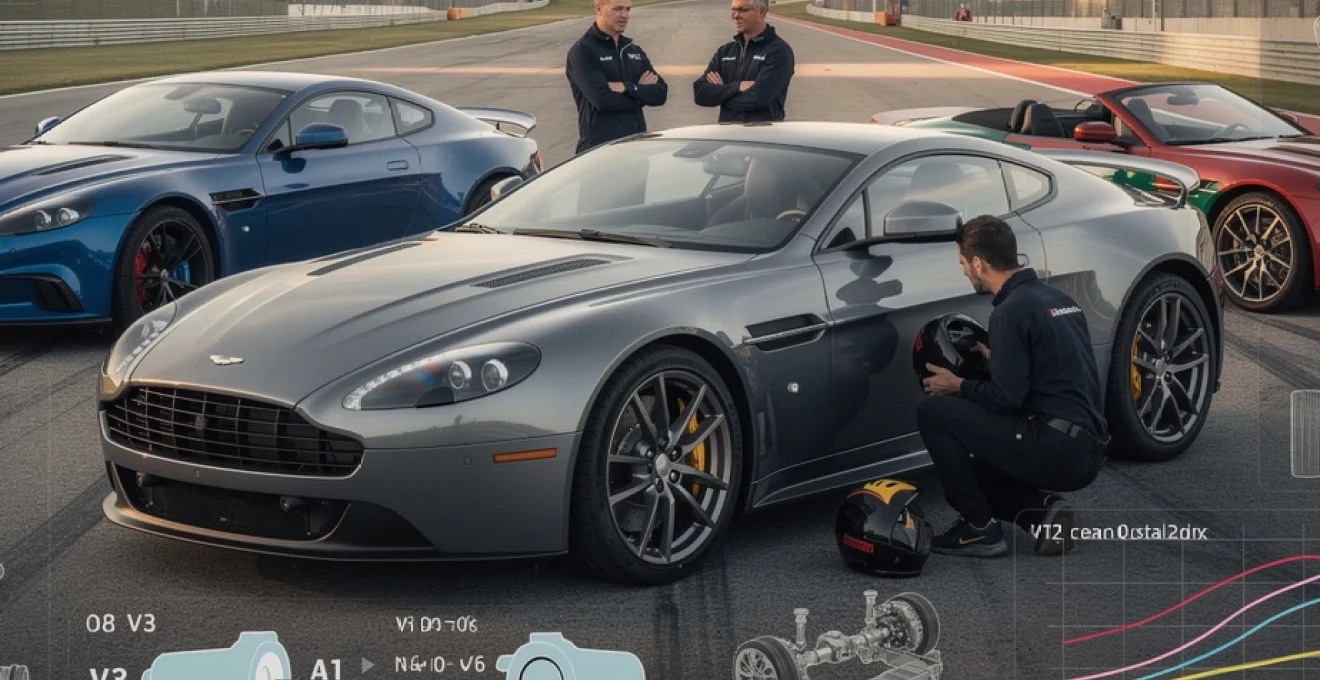
The 2015 Aston Martin Vantage sits at a fascinating crossroads between traditional grand tourer and modern performance car. It blends a hand-built, naturally aspirated engine with a bonded aluminium chassis and a cabin that still feels special years after launch. For anyone considering a used performance car with genuine character, the 2015 Vantage – especially in V8 or V12 guise – offers an unusually pure driving experience in a market now dominated by turbocharged and electrified rivals.
Instead of chasing headline numbers at all costs, the 2015 Aston Martin Vantage focuses on how those numbers feel from behind the wheel. The hydraulic steering, front mid‑engined layout and rear transaxle work together to create a balance more associated with classic sports cars than modern GTs. That makes the 2015 Vantage highly relevant today, particularly if you value engagement and long-term desirability as much as raw speed.
2015 aston martin vantage model range overview: V8, V12, S and N430 variants
By 2015, the Aston Martin Vantage model range had matured into a diverse line-up aimed at slightly different driver profiles. At its core sat the V8 Vantage, using the 4.7‑litre `AMV8` engine. Above it, the V8 Vantage S sharpened the formula with more power and more focused chassis tuning. Parallel to the S, the N430 (GT in North America) delivered a track‑inspired special edition with distinctive graphics, lightweight components and a more extroverted personality. Sitting at the top, the V12 Vantage and V12 Vantage S transformed the compact Vantage shell into a genuinely brutal supercar.
V8 vs V12 vantage powertrain hierarchy and target driver profiles
The 2015 V8 Vantage uses a 4.7‑litre naturally aspirated V8 producing 430 hp and 361 lb ft in GT/S form, with slightly lower figures for the earliest 4.3‑litre cars. This engine suits drivers who want a usable, characterful sports car that feels fast rather than overwhelming. The V8’s power delivery is progressive, with a strong pull from 3,000 rpm and a sweeter, harder edge above 4,000 rpm, encouraging you to explore the top of the rev range on every drive.
The 6.0‑litre V12 – still closely related to the earlier `AM11` and later `AM28` units – changes the character completely. With around 565 hp and 457 lb ft, the V12 Vantage S is aimed squarely at enthusiasts who prioritise drama and intensity over daily comfort. The torque plateau from about 1,000 rpm makes the car feel muscular in any gear, while the ability to rev with almost race‑car urgency provides the addictive high‑rev character missing from many turbocharged rivals. If you prefer a car that is always on the brink of feeling slightly unhinged, the V12 is the obvious choice.
Key differences between standard vantage, vantage S and N430 special edition
Understanding the hierarchy between standard Vantage (sometimes called “non‑S”), Vantage S and N430 is key to choosing the right 2015 Aston Martin Vantage. The regular V8 Vantage benefited from a major update around 2012.25 model year, borrowing much of the S’s chassis hardware: a quicker steering rack, 380 mm two‑piece front discs with six‑piston callipers and wider tyres. Power remained at 420–430 hp depending on market, but response and grip stepped up considerably.
The Vantage S adds more than a badge. It uses the 430 hp tune of the 4.7‑litre V8, the `Sportshift II` 7‑speed transmission as standard, and more aggressive aero with a deeper front splitter and rear diffuser. Spring and damper settings are stiffer, and the steering is quicker again, producing a car that feels notably more alert on track and on fast A‑roads. The N430 (and GT in the US) takes the S’s hardware and adds lighter forged wheels, carbon fibre interior trim and distinctive contrast paint schemes inspired by GT3 racing Vantages, appealing to buyers who want rarity and visual drama without stepping into V12 territory.
Coupe vs roadster body styles: chassis stiffness and performance impact
The 2015 Aston Martin Vantage was offered in both coupe and Roadster forms. The coupe’s bonded aluminium tub delivers excellent torsional rigidity, which supports precise suspension tuning and predictable behaviour at high speed. This is the variant that tends to feel more cohesive on track, with a slightly sharper turn‑in and marginally better feedback through the floor and steering column.
The Vantage Roadster adds the drama of open‑top motoring, especially with the V8’s rumble or V12’s wail just behind your ears. Inevitably, some stiffening is required in the floorpan and sills, adding a little weight and slightly softening the overall structure. In practice, the Roadster remains impressively tight, with only a small loss in ultimate precision. For drivers who prioritise sound and sense of occasion over tenths on a lap time, the Roadster body style is extremely compelling.
UK, EU and US market specifications and homologation differences
Between UK, wider European and US markets, the 2015 Vantage range remains broadly consistent in ethos but differs in certain details and emissions calibrations. Power outputs for the V8 (420–430 hp) and V12 (around 565 hp) are very similar, but some regions quote slightly different figures due to measurement standards and `DIN` vs `SAE` ratings. US cars typically include side marker lights, different instrument calibration (mph/°F) and some additional federal safety equipment, adding a few kilograms.
EU and UK cars conform to `Euro 5` emissions regulations with specific catalytic converters and ECU mapping, while US models meet EPA and CARB requirements. This means there can be small variations in fuel consumption and CO₂ ratings, though performance differences are marginal in real‑world driving. In all markets, the 2015 V8 Vantage manual returns around 13 mpg city / 19 mpg highway (US EPA), translating to combined consumption in the mid‑teens mpg for spirited driving.
Engine specifications and performance data for the 2015 aston martin vantage
The engine line‑up is central to the appeal of any 2015 Aston Martin Vantage. Both V8 and V12 units are naturally aspirated, hand‑assembled and dry‑sumped, prioritising throttle response and a low centre of gravity. For drivers choosing a used Vantage today, understanding the power and torque characteristics of each engine helps match the car to the kind of driving most enjoyed – whether that is relaxed grand touring or focused track driving on circuits such as the Nürburgring Nordschleife.
4.7-litre AMV8 technical specs: power, torque curve and compression ratio
The 4.7‑litre `AMV8` is based on an all‑aluminium block first seen in the earlier 4.3‑litre Vantage but extensively reworked. In 2015 GT and S applications, it produces 430 hp at 7,300 rpm and 361 lb ft at 5,000 rpm. The compression ratio is a relatively high 11.3:1, helping to deliver strong mid‑range torque and crisp throttle response when running on premium unleaded. Dry‑sump lubrication allows the engine to sit lower in the chassis, reducing the bonnet line and improving weight distribution.
On the road, the torque curve feels progressive rather than peaky. Below 2,000 rpm, response is civilised, ideal for town driving and long‑distance cruising. From 3,000 rpm upwards, the V8 starts to pull more urgently, and above 4,000 rpm it hardens into a more feral, American‑style rumble, one of the reasons many enthusiasts rate the 4.7‑litre V8 as one of the most characterful engines in this price bracket.
6.0-litre AM11 V12 specification: naturally aspirated characteristics and rev behaviour
The 6.0‑litre V12, closely related to the `AM11` and later updated `AM28`, is effectively two V6 banks sharing a common crankcase, originally derived in concept from Ford’s modular architecture but heavily re‑engineered by Aston. In 2015 V12 Vantage S tune, it produces around 565 hp and 457 lb ft, with a substantial 376 lb ft available from just 1,000 rpm. The compression ratio is similarly high, aiding both efficiency and response given the absence of turbocharging.
What sets this engine apart is the way it revs. Despite its capacity, it spins keenly towards its redline, with a linear increase in volume and intensity rather than a sudden spike. In Sport mode, the exhaust valves open earlier, adding crackles on overrun and a more aggressive edge under load. For many drivers, this naturally aspirated V12 offers an experience that modern turbocharged supercars simply cannot replicate, especially on fast, flowing roads.
0–60 mph, 0–100 km/h and in-gear acceleration figures for V8, V8 S and V12 models
On paper, the 2015 Vantage range delivers performance that still feels entirely contemporary. Aston Martin quotes a 0–60 mph time of 4.6 seconds for the V8 Vantage GT Roadster with manual gearbox, with similar figures for the coupe. V8 Vantage S models with `Sportshift II` 7‑speed typically reach 60 mph in around 4.5 seconds. Converted to 0–100 km/h, both variants sit in the mid‑4 second bracket, depending on conditions.
The V12 Vantage S cuts those times further, with estimated 0–60 mph runs of around 3.8 seconds and 0–100 km/h in approximately 3.9–4.0 seconds. More telling for road use is in‑gear acceleration. Thanks to the V12’s abundant torque, rolling acceleration from 50–75 mph in 4th gear feels explosively strong, whereas the V8 encourages a downshift to 3rd or even 2nd to access its best performance. For many drivers, that need to work the V8 makes it more involving, while others will prefer the effortless shove of the V12.
Top speed, gearing and final drive ratios across 6-speed and 7-speed transmissions
Top speeds reflect both power and gearing strategy. Typical official figures look as follows:
| Model | Transmission | Top speed | 0–62 mph (0–100 km/h) |
|---|---|---|---|
| V8 Vantage (4.7) | 6‑speed manual | 174 mph (280 km/h) | ≈ 5.0 s |
| V8 Vantage S / GT | 7‑speed Sportshift II | 190 mph (305 km/h) | ≈ 4.8 s |
| V12 Vantage S | 7‑speed Sportshift III | 205 mph (330 km/h) | ≈ 3.9 s |
The 6‑speed manual uses relatively long ratios, favouring relaxed cruising and allowing 2nd gear to stretch to motorway speeds. The 7‑speed `Sportshift II` has closer spacing, keeping the V8 in its sweet spot more of the time and aiding track performance. Final drive ratios differ slightly between V8 and V12, with the V12 typically using shorter overall gearing to exploit its torque and maintain strong acceleration even at higher speeds.
Real‑world fuel consumption, CO₂ emissions and euro 5 emissions compliance
Fuel economy is not a strong suit of the 2015 Aston Martin Vantage, but that is hardly the reason to buy one. The V8 Vantage manual carries US EPA ratings of 13 mpg city / 19 mpg highway / 15 mpg combined. That equates to an Energy Impact Score of about 22.0 barrels of oil per year and CO₂ emissions of 9.6 tonnes annually for typical US driving patterns. European combined consumption for the V8 sits roughly in the 13–14 l/100 km range in mixed use.
V12 models are thirstier again, often dropping into the low‑teens mpg when driven enthusiastically. All 2015 cars meet `Euro 5` emissions standards in EU markets, with appropriate particulate and NOx controls despite the lack of direct injection. For anyone planning regular long‑distance touring, budgeting realistically for fuel is sensible; think in terms of 19–20 mpg for gentle motorway use in a V8 and significantly less for track days or mountain-road blasts.
Transmission, drivetrain and differential technology in the 2015 vantage
The drivetrain layout is one of the technical highlights of the 2015 Aston Martin Vantage. A front mid‑mounted engine paired with a rear transaxle gives a near‑perfect weight balance, while the choice between a traditional 6‑speed manual and a 7‑speed automated manual allows you to tailor the car to driving style. Understanding how the gearbox and limited‑slip differential interact under load helps make sense of why the Vantage feels so planted and confidence‑inspiring when driven hard.
6-speed graziano manual gearbox ratios and shift mechanism design
The 6‑speed manual, built by Graziano, uses a transaxle layout mounted at the rear. The shift quality is not quite as silk‑smooth as a contemporary Porsche 911, but owners often describe a very mechanical, reassuring action. Throws are medium in length, with a slightly firm but positive engagement that suits the V8’s character. The clutch has noticeable weight yet remains manageable in daily traffic once familiar.
Gear ratios are chosen to let the engine stretch its legs. First is relatively long, reducing the need for an early upshift, while 2nd and 3rd cover the core of B‑road and twisty driving. Sixth is effectively an overdrive, keeping revs low at motorway speeds for refinement and marginal fuel savings. For drivers who value interaction and a more analogue feel, the 6‑speed manual is the preferred option and often commands a premium in the used market.
Sportshift II 7-speed automated manual: single-clutch architecture and shift logic
`Sportshift II` is Aston Martin’s name for the 7‑speed automated manual available in V8 Vantage S and GT. It uses a single clutch and electro‑hydraulic actuation rather than a dual‑clutch system. That means it behaves more like a very fast robotised manual than a conventional automatic. In full Sport mode with aggressive throttle input, upshifts are `banged` through quickly, especially near the rev limiter, giving a race‑car‑like feel.
At partial throttle and low speeds, there can be a perceptible pause and lurch, something highlighted by several testers. For smoother progress in town, short‑shifting and easing off the throttle during upshifts makes a noticeable difference. Many enthusiasts view Sportshift II as best suited to spirited driving and track use, where its direct connection and fast high‑rpm shifts outweigh its low‑speed compromises.
Rear mid‑mounted transaxle layout and weight distribution optimisation
Both manual and Sportshift gearboxes are mounted as part of a rear `transaxle` unit, sharing housing with the differential. This layout helps achieve an approximate 49:51 front‑to‑rear weight distribution in V8 models, and a near‑ideal balance even in heavier V12 variants. With the engine placed behind the front axle line, the Vantage behaves very differently from traditional nose‑heavy GTs.
The result is a car that rotates cleanly into a corner and remains stable under both power and trail‑braking. During fast transitions, the mass is felt centrally rather than concentrated at either end, giving a sense of security that encourages you to use more of the chassis. For anyone coming from a front‑heavy performance saloon, this balance can feel revelatory, especially on fast, flowing roads.
Limited-slip differential calibration and traction characteristics under load
The limited‑slip differential is tuned to complement the transaxle’s balance. Under acceleration out of tight corners, the diff progressively locks, sending more torque to the wheel with grip. On a dry surface with warm tyres, this gives the Vantage strong traction and the ability to put its power down earlier than many rivals. On wet or uneven roads, the behaviour remains predictable, especially if throttle inputs are smooth.
For drivers who enjoy exploiting power oversteer on track, the calibration allows graceful, controllable slides once the rear tyres are past their limit. It is not as spiky or snappy as some mid‑engined cars, which makes the Vantage an excellent tool for learning high‑performance driving techniques at circuits and driver training events.
Chassis, suspension and braking system engineering
The 2015 Aston Martin Vantage chassis reflects the brand’s `VH` (Vertical/Horizontal) philosophy, focusing on a stiff, lightweight aluminium structure as a basis for precise suspension tuning. Over its production life, the V8 Vantage received continuous improvements, culminating in a 2012.25 update that imported many of the Vantage S components into the standard model. This means a 2015 car offers significantly better body control, steering and braking than early 4.3‑litre examples, making it an excellent choice for track days and demanding UK B‑roads.
VH (Vertical/Horizontal) bonded aluminium platform and torsional rigidity figures
The `VH` platform uses extruded aluminium sections bonded and riveted together to create a stiff but relatively light structure. While exact torsional rigidity figures for the Vantage are not widely publicised, independent testing has repeatedly praised its feeling of solidity and lack of scuttle shake, particularly in coupe form. The platform was originally co‑developed with input from chassis experts involved in other high‑end performance cars, which shows in the way it responds to bumps and lateral loads.
This stiffness allows the suspension to be tuned for both comfort and control without needing excessively stiff springs. It also contributes to the Vantage’s sense of `indestructibility` mentioned by several long‑term testers, who note that even high‑mileage cars feel tight and free of rattles if properly maintained and free from accident damage.
Double-wishbone suspension geometry, spring rates and anti-roll bar tuning
The 2015 Vantage uses double‑wishbone suspension at all four corners, with coil springs, monotube dampers and anti‑roll bars front and rear. Double wishbones enable better control of camber and toe under load than simpler MacPherson struts, maintaining a larger tyre contact patch during cornering. Spring rates are firm enough to keep body roll in check but not so stiff that the car feels harsh on imperfect surfaces.
Anti‑roll bar tuning is one of the areas in which later Vantage models differ from earlier cars. The S and updated standard Vantage benefit from bars that better balance front grip with rear traction, making the car more neutral mid‑corner. Pushed hard on a circuit, the car can still feel slightly `elastic` as the chassis gently loads and releases, but this progressive behaviour is part of its charm and gives experienced drivers more room to work with the rear axle.
Adaptive damping, sport mode mapping and ride compliance on UK b-roads
V12 Vantage S and some later V8 variants are fitted with adaptive damping, offering modes such as Normal, Sport and Track. In Normal, the car rides with a firm but controlled suppleness that suits British B‑roads surprisingly well, especially when compared to some German rivals with ultra‑stiff setups. Potholes and patchwork repairs are absorbed without excessive crashiness, allowing you to cover ground quickly without constant steering corrections.
Engaging Sport or Track stiffens the dampers and often coincides with sharper throttle mapping and a more vocal exhaust. On smoother circuits, these modes transform the Vantage into a much more aggressive machine, reducing body roll and sharpening responses. On rough public roads, especially in the UK, Sport is usually the sweet spot, giving extra composure without crossing into discomfort.
Brembo braking package: disc diameters, caliper specs and fade resistance
Braking hardware is another area where the 2015 Aston Martin Vantage benefitted from trickle‑down improvements. Updated V8 models use 380 mm two‑piece cast‑iron front discs with six‑piston fixed callipers, and large ventilated rear discs with four‑piston callipers. The two‑piece design reduces unsprung mass and improves heat dissipation, aiding fade resistance during repeated hard stops.
On track, the brakes can show signs of fade after several hard laps, particularly on heavier V12 models. However, easing the pace for a lap or two allows them to recover well. For anyone planning regular circuit use, high‑temperature pads and uprated fluid provide a cost‑effective upgrade, while still retaining good pedal feel for road driving.
Wheel and tyre setups: 19-inch forged alloys, pirelli P zero sizes and grip levels
Standard wheel fitment for the 2015 Vantage includes 19‑inch alloy wheels, often forged on higher trims and special editions such as the N430. Tyre sizes typically sit at 245/40 ZR19 front and 285/35 ZR19 rear, giving a wide, square stance and a generous contact patch. From the factory, many cars left on Bridgestone Potenza or Pirelli P Zero tyres, with some owners later switching to Michelin Pilot Sport 4 S for improved wet grip and ride.
Grip levels are high but not so extreme that the chassis feels numb at legal speeds. On the road, the car communicates the onset of slip progressively, while on circuit, the wider tyres from the S and special editions resist overheating better than earlier, narrower rubber. For a used buyer, checking tyre age and specification is a key step, as old or mismatched tyres can significantly blunt the Vantage’s dynamic abilities.
Aerodynamics, exterior design and bodywork details of the 2015 aston martin vantage
The 2015 Aston Martin Vantage design remains one of its strongest selling points. Low, compact and beautifully proportioned, the Vantage looks as fresh today as when it launched. Subtle evolutions over the years have added more purposeful aero elements, particularly on the Vantage S, N430 and V12 variants. These changes were not only cosmetic; they also help manage airflow at high speed for improved stability and cooling.
Front splitter, rear diffuser and underbody airflow management on vantage S and V12
Vantage S and V12 Vantage models gain more aggressive front splitters and rear diffusers compared with the standard V8. On the S, the splitter and diffuser are typically finished in high‑quality black plastic, with optional carbon fibre pieces available. These components help manage airflow under the car, reducing lift at speed and improving stability during fast motorway or Autobahn running.
While the aerodynamic downforce generated is modest compared to full GT3‑style packages, the combination of splitter, diffuser and underbody panels means the Vantage feels reassuringly planted even as speeds climb. On fast circuits, this stability translates into greater confidence through high‑speed corners, allowing more consistent lap times.
Bodywork variations: N430 graphics pack, carbon fibre aero add-ons and lightweight panels
The N430 special edition is particularly distinctive visually. Inspired by racing Vantages, it uses contrast colours around the grille surround, mirror caps and roof line, often paired with lightweight forged wheels and exposed carbon fibre trim. These visual tweaks give the car a more motorsport‑derived appearance without substantially altering the underlying structure.
Optional carbon fibre packages across the range cover side strakes, mirror caps, rear lamp infills and front splitters. While the weight savings from these parts are relatively modest, they do lower mass slightly at the extremities of the car, contributing marginally to agility. More importantly, they stand up well to ageing, resisting corrosion and adding to long‑term visual appeal.
Drag coefficient, lift balance and high‑speed stability on the nürburgring nordschleife
Official drag coefficients for the 2015 Vantage family sit in the region typically occupied by low‑slung sports cars, balancing visual drama with acceptable high‑speed efficiency. The shape prioritises a clean, flowing roofline and tightly packaged rear, which helps maintain a stable `lift balance` between front and rear axles. Anecdotal feedback from drivers on the Nürburgring Nordschleife highlights the Vantage’s composure over high‑speed crests and compressions.
Compared with some mid‑engined supercars, the Vantage may not generate as much outright downforce, but the predictability of its aero behaviour is a strength. At 150+ mph, the steering retains reassuring weight and precision, which is crucial for confidence on fast, flowing European circuits and derestricted motorway sections.
Interior, ergonomics and in-car technology in the 2015 model year vantage
Inside, the 2015 Aston Martin Vantage feels unmistakably like a hand‑built British sports car. Deep, aromatic leather covers most surfaces, with piano black or optional carbon fibre trims on the fascia and centre console. The driving position places you low and slightly reclined, with a view down that long bonnet that instantly sets the tone. It feels more intimate and cocooning than many modern GTs, which often prioritise space over atmosphere.
Instrumentation uses clear, analogue dials with `organic electroluminescent` backlighting, giving a fine‑watch aesthetic rather than digital minimalism. The chunky, leather‑wrapped steering wheel adjusts for reach and rake, and the main controls carry a satisfying weight, from indicator stalks to metal‑finish air‑conditioning knobs. It is not perfect; some surfaces show wear relatively quickly, and the pop‑up navigation screen is now decidedly behind the curve. Many owners either retrofit modern systems – often using upgrades that repurpose the factory screen for Apple CarPlay – or simply rely on a smartphone mount.
Seats are firm, well‑bolstered sport buckets with 6‑way electric adjustment and memory in many 2015 cars. Heating is available and useful in Roadsters, while the cabin remains reasonably quiet at motorway speeds given the performance on tap. Practicality is moderate: coupe luggage space is around 5.0 cubic feet, enough for weekend bags but not full family holidays. For in‑car entertainment, base cars receive a 160‑watt Aston Martin audio system, while an optional 1,000‑watt Bang & Olufsen BeoSound system offers much richer sound quality for those who care about audio as much as engine note.
2015 aston martin vantage on-road dynamics and track performance impressions
On the road, the 2015 Vantage feels like a true driver’s car first and a grand tourer second. The hydraulic power steering is a highlight, with a beautifully linear build‑up of effort and enough feedback to sense grip changes without constant micro‑movement. Compared with the ultra‑filtered steering of many modern electric‑assist systems, the Vantage’s helm can feel almost analogue, in the best sense of the word.
On typical UK B‑roads, the car quickly settles into a natural flow. The front‑engine, rear‑drive layout and rear transaxle encourage confident commitment into corners, with the chassis feeling planted yet adjustable. As one long‑term tester put it, the Vantage is “balanced, able and unambiguous”, rewarding precise inputs without punishing small mistakes. For anyone upgrading from a hot hatch or executive saloon, the step in involvement is significant without being intimidating.
Driven at any sensible road speed, the 2015 Aston Martin Vantage feels like an extension of the driver, translating inputs into motion with clarity and intent.
On track, the differences between V8, V8 S and V12 variants become more obvious. The V8 Vantage S might actually be the sweet spot for many, as its slightly lower weight, quicker steering rack and improved brakes combine with the 430 hp V8 for a balanced, exploitable package. The V12 Vantage S, by contrast, turns every straight into a licence‑threatening opportunity. The soundtrack, particularly with Sport mode engaged, is unforgettable, but the added mass over the front axle requires more respect under heavy braking and sudden direction changes.
The V12 Vantage S is “extreme in its nature” and best reserved for full‑commitment drives or track days where its abilities can be safely explored.
In daily use, Sportshift transmissions can occasionally frustrate in traffic, but on a favourite road or during a track session they make sense, freeing both hands for steering and allowing consistent, perfectly timed shifts. The manual remains the purist’s choice, with a tactile sense of `mechanical` connection that few modern performance cars offer. For anyone considering a 2015 Aston Martin Vantage as a long‑term enthusiast car, that interaction – from crystal key insertion to V8 or V12 bark – is what ultimately defines the ownership experience and continues to set the Vantage apart in a rapidly changing performance‑car landscape.