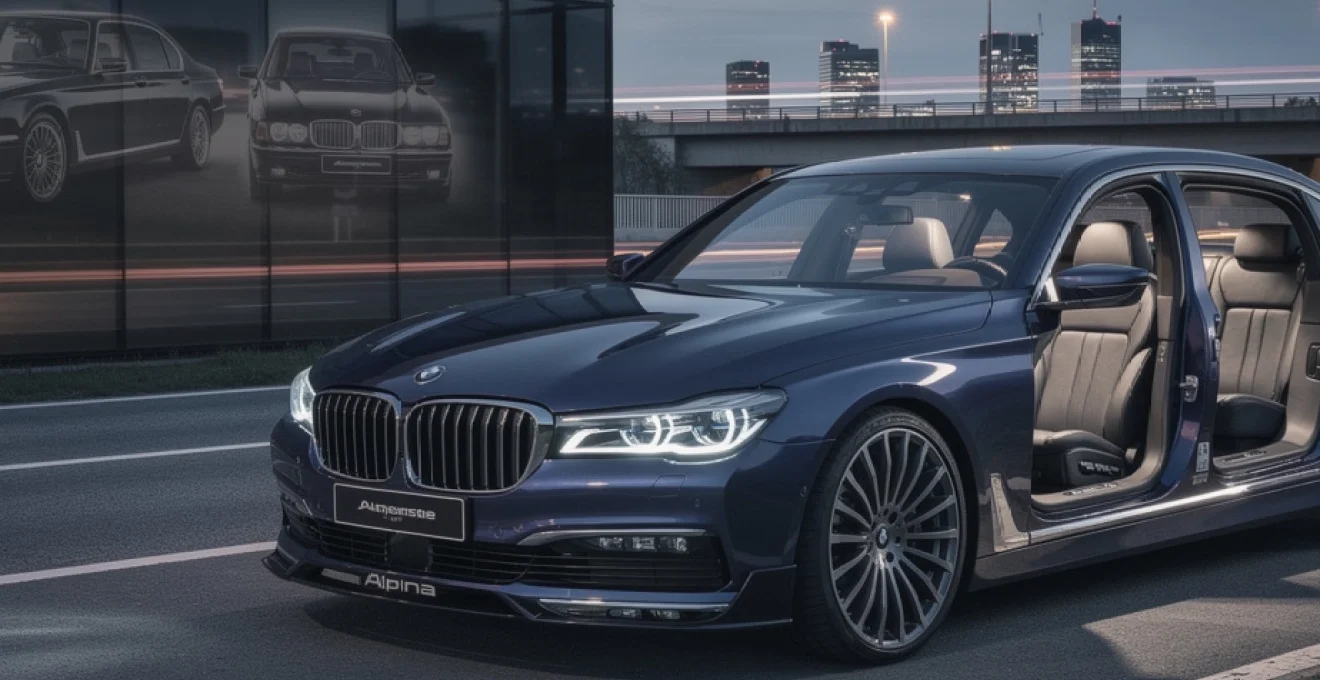
The 7 Series BMW Alpina occupies a rare niche where handcrafted luxury meets autobahn-grade performance. It is not simply a tuned 7 Series; it is a series of carefully engineered grand tourers that blend super-saloon pace with limousine refinement. If you are looking at a 7 Series BMW Alpina as an alternative to a conventional flagship like the S-Class or Audi A8, you are effectively choosing a car that sits between OEM and motorsport culture, with one foot in each world. That unique position explains why values, desirability and collectability of models like the Alpina B7 continue to rise, especially as V8 and high-performance ICE flagships become increasingly scarce in a market shifting towards electrification.
BMW 7 series alpina lineage: from B7 turbo to the latest g70-based alpina B7
E12 and E28 alpina B7 turbo: engineering roots of modern 7 series BMW alpina models
The story of the 7 Series BMW Alpina lineage really begins with the E12 and E28-based B7 Turbo models, even though they were technically 5 Series derivatives. These early cars established the engineering template that would later be applied to the BMW 7 Series Alpina: forced induction, bespoke suspension tuning and understated styling. With power outputs exceeding 300 hp in the late 1970s and early 1980s, a B7 Turbo could outrun most contemporary supercars while still offering four-door practicality. That dual character – business sedan outside, race car underneath – is exactly what you feel today when you step into a modern B7 and experience the way it surges from low revs yet cruises in silence.
E65/E66 alpina B7 (2004–2008): supercharged V8 flagship for the BMW 7 series
The E65/E66 Alpina B7 represented the first full-fat 7 Series BMW Alpina sold in significant global numbers. Instead of using a standard BMW turbocharged engine, Alpina developed a 4.4-litre supercharged V8 producing around 500 hp and 700 Nm. The choice of a belt-driven compressor rather than bi-turbocharging delivered instant throttle response and a distinctive, linear surge that felt very different to the later N63-based cars. If you drive one today, the B7 feels like a bridge between analogue and digital eras: hydraulic steering, traditional torque-converter automatic and a characterful, mechanical soundtrack that many enthusiasts still consider the most emotive 7 Series BMW Alpina powertrain to date.
F01/F02 alpina B7 (2010–2015): bi-turbo V8 evolution and long‑wheelbase luxury focus
With the F01/F02 generation, the 7 Series BMW Alpina moved to a twin-turbocharged 4.4-litre V8 based on BMW’s N63 architecture. Power climbed to roughly 540–540+ hp over the life cycle, with torque figures well above 700 Nm. Crucially, Alpina placed renewed emphasis on the long‑wheelbase models, recognising that many B7 buyers wanted chauffeur-grade rear comfort with super-saloon acceleration. Adaptive dampers, rear-axle air suspension and 20 or 21-inch Alpina Classic wheels were integrated into a chassis that felt lighter and more agile than a comparable 750Li. For motorway and autobahn use, the F01/F02 B7 set the template for effortless 250–300 km/h cruising with almost eerie stability and low noise levels.
G11/G12 and G70 alpina B7: latest-generation 7 series platform integration
The G11/G12 Alpina B7, launched in 2016 and heavily updated in 2019, became one of the most accomplished 7 Series BMW Alpina variants ever built. Using a revised 4.4-litre bi-turbo V8 delivering up to 600 hp and 590 lb-ft (800 Nm), it reached 0–100 km/h in 3.6 seconds and a top speed of around 330 km/h (205 mph). The G11-based B7 also saw more integrated electronics: Integral Active Steering, two-axle air suspension, active anti-roll bars and BMW’s latest driver-assistance suite. Looking ahead, industry sources suggest an upcoming G70-based Alpina B7 revival with the S68 mild-hybrid V8, potentially around 617 hp. That car would not only become the most powerful 7 Series BMW Alpina with a combustion engine, but also one of the last V8 flagships before BMW’s luxury range becomes predominantly electrified.
Powertrain engineering in the 7 series BMW alpina: bi-turbo V8, ZF 8HP automatic and xdrive calibration
N63 and N63TU 4.4-litre V8 architecture in the alpina B7 vs standard BMW 750i
The heart of the modern 7 Series BMW Alpina is the 4.4-litre V8 derived from BMW’s N63 and N63TU engines. While the block, basic architecture and hot-vee layout are shared with the 750i, the Alpina B7 receives extensive hardware and software changes. These include reinforced pistons, upgraded cooling circuits and bespoke engine management calibration to handle sustained high-load operation. In standard BMW 750i form, the N63 typically produces around 450–530 hp. In the G11 B7, power rises to 600 hp and torque to 590 lb-ft, available from approximately 2,000 to 5,000 rpm. That broad, flat torque plateau is one of the reasons you feel such effortless thrust in any gear, at almost any speed.
Alpina-specific twin-turbocharging, intercooling and boost pressure strategies
Where the 7 Series BMW Alpina really diverges from the stock 7 Series is in the twin-turbocharging and intercooling system. Alpina uses two, twin-scroll turbochargers with larger impellers (for example 54 mm instead of 50 mm on some iterations) and model-specific intercooler layouts featuring an interconnection between cylinder banks to reduce pressure pulsations. Boost pressure is calibrated not just for peak power, but for sustained repeatability at Vmax. High-capacity water coolers, enlarged charge-air radiators and a dedicated transmission oil cooler form an integrated thermal management package. For you as a driver, that means consistent performance on a derestricted autobahn in summer conditions, rather than the power fade or heat soak that can affect less specialised luxury performance saloons.
ZF 8HP automatic transmission software mapping, torque converter and shift logic tuning
Alpina is one of the few manufacturers given deep-level access to ZF’s 8HP transmission software. In the 7 Series BMW Alpina, the 8HP76 variant receives Alpina-specific SWITCH-TRONIC programming, altered torque converter lock-up behaviour and different clutch pressures to handle 800 Nm without resorting to torque reductions during upshifts. Gear spacing remains the same as the standard 7 Series, but shift logic in Sport and Sport+ is more assertive, with quicker multi-gear downshifts and more intelligent use of engine braking. If you drive a B7 back-to-back with a 750i, you will notice that the Alpina’s gearbox feels more intuitive when you commit to overtakes; it anticipates your throttle inputs and pre-selects lower gears earlier, giving you a sharper response without sacrificing refinement in Comfort mode.
Xdrive all-wheel-drive torque distribution and DSC calibration for high-speed stability
The BMW xDrive system in the 7 Series BMW Alpina is not simply a copy-paste of the 750i xDrive calibration. Alpina reprogrammes the centre clutch logic and traction control thresholds to deliver a more rear-biased torque split, especially in dynamic modes. This yields better throttle adjustability mid-corner and more neutral handling at the limit. Dynamic Stability Control (DSC) thresholds are relaxed compared with a standard luxury-focused 7 Series, allowing small, progressive slip angles rather than cutting power abruptly. At 250–300 km/h, this calibration contributes to the B7’s stability and confidence; micro-corrections from the xDrive hardware help keep the car arrow-straight without the nervousness that some high-powered rear-drive limousines exhibit at similar speeds.
Performance figures: 0–62 mph, in-gear acceleration and top speed compared with BMW M760Li
From a performance standpoint, the 7 Series BMW Alpina B7 competes directly with the BMW M760Li V12. Comparative figures are instructive:
| Model | Power | Torque | 0–62 mph | Top speed |
|---|---|---|---|---|
| Alpina B7 (G11, 2019‑) | 600 hp | 590 lb-ft | ≈3.6 s | ≈205 mph (330 km/h) |
| BMW M760Li xDrive | ≈600 hp | 627 lb-ft | ≈3.7 s | ≈189 mph (optional) |
Although the M760Li’s V12 offers slightly more torque, the B7’s lower weight, higher Vmax and more aggressive gearing give it an edge in the 124–186 mph range. In-gear acceleration from 50–75 mph in top gear feels almost identical, but the Alpina’s willingness to rev and its freer top-speed capability make it the more engaging car if you regularly exploit high-speed, long-distance performance.
Chassis, suspension and braking: alpina-tuned dynamics for the 7 series platform
Adaptive air suspension, active anti-roll bars and integral active steering setup
The chassis of the 7 Series BMW Alpina combines two-axle air suspension, adaptive dampers and Active Comfort Drive with Road Preview as standard. Active anti-roll bars reduce body roll in corners while still allowing a supple, compliant ride in Comfort+ mode. Integral Active Steering adds up to three degrees of rear-wheel steer: opposite-phase at low speeds for tighter manoeuvring, and same-phase at higher speeds for increased stability. The result is a large luxury saloon that can feel almost mid-size in tight city streets yet completely unflustered on a sweeping autobahn curve taken at 200 km/h. For everyday use, you notice this as a sense of light-footedness that is rare in a five-metre-plus limousine.
Alpina-specific spring rates, damper curves and ride height settings for autobahn use
Beyond BMW’s factory setup, Alpina engineers refine spring rates, damper curves and ride height control for sustained high-speed driving. At speeds above around 225 km/h, or in ALPINA Sport+ mode, the car automatically lowers itself by 15 mm to reduce the centre of gravity and improve aero efficiency. Conversely, you can raise the car by 20 mm up to approximately 32 km/h to clear ramps or rough access roads. The tuning philosophy is clear: prioritise long-distance comfort at 160–200 km/h while preserving enough body control for spirited driving on a mountain pass. Compared with a 760i or M Sport 7 Series, the B7 rides with a touch more pliancy in its softest modes, yet resists pitch and roll more effectively when fully loaded.
Brembo-based high-performance braking system and fade resistance at vmax
Braking is a critical safety component when a car is capable of more than 200 mph. The 7 Series BMW Alpina uses a Brembo-based system with four-piston front calipers and large diameter discs – around 395 mm at the front and over 395 mm equivalent at the rear. Modern versions also employ brake‑by‑wire technology to maintain consistent pedal feel even as temperatures rise. At repeated high-speed stops, this setup demonstrates excellent fade resistance, a point that becomes very clear if you use a B7 on an unrestricted stretch of autobahn or a fast track day. The calibration balances powerful initial bite with progressive modulation, so you can bleed off speed smoothly without unsettling passengers in the rear Executive Lounge Seating.
Wheel and tyre package: alpina classic wheels, staggered fitment and pirelli P zero homologation
Signature 20 or 21‑inch Alpina Classic wheels play a structural role in how a 7 Series BMW Alpina drives. Forged construction reduces unsprung mass by more than 20% compared with some cast OEM alternatives, improving both ride comfort and steering precision. Tyre choice is equally critical: many B7 generations use bespoke, non-runflat Michelin or Pirelli P Zero tyres tuned specifically for the weight and top speed of the car. A staggered fitment with wider rear tyres helps traction and stability under full-throttle acceleration. You may notice the absence of runflats; this is deliberate, trading the convenience of limp‑home capability for superior comfort, grip and noise levels – a sensible compromise if you value authentic grand touring characteristics.
Luxury craftsmanship and interior specification in the 7 series BMW alpina
Lavalina leather upholstery, contrast stitching and bespoke trim inlays
Inside a 7 Series BMW Alpina, the most immediate difference from a regular 7 Series is the material quality. Many B7s feature Lavalina leather, a softer and more natural hide than standard BMW leather options. It is hand-finished in Buchloe, often with contrast stitching in Alpina’s blue and green signature colours. Trim inlays can be specified in high-gloss Piano black, Myrtle wood or other bespoke finishes, giving you an interior closer to a coachbuilt limousine than a mass-produced executive saloon. If you appreciate fine details such as leather-wrapped dashboard top sections, individually numbered plaques and embroidered headrests, a 7 Series BMW Alpina will feel like a more artisanal alternative to mainstream luxury flagships.
Alpina steering wheel, digital instrument cluster graphics and model-specific displays
The steering wheel of a 7 Series BMW Alpina is more than a cosmetic element. Thicker rim padding, Lavalina leather covering and blue/green stitching improve both tactile feel and visual identity. Behind it, the fully digital instrument cluster adopts Alpina‑specific graphics, with classic blue dials in Comfort mode and sportier layouts in Sport and Sport+. Model-specific displays highlight unique B7 information such as bespoke shift indicators and performance data. Thanks to BMW’s iDrive 7 and later operating systems, these digital elements integrate cleanly with modern driver-assistance visualisations, so you always know when systems like Active Cruise Control, Lane Keeping Assist or Extended Traffic Jam Assistant are engaged.
Rear executive lounge seating, ambient lighting and bowers & wilkins / harman kardon audio options
If you plan to spend significant time in the rear, the 7 Series BMW Alpina really comes into its own. The optional Rear Executive Lounge Seating package offers electrically adjustable, reclining rear seats with massage and ventilation, individual climate control zones and an Executive Lounge centre console. Combined with the Theatre Screen option on the latest G70 platform, rear passengers enjoy a 31.3‑inch display with streaming capability, controlled via door-mounted touchscreens or a detachable tablet. High-end audio systems such as Bowers & Wilkins Diamond or Harman Kardon surround complement this environment, turning the cabin into a rolling concert hall. Carefully tuned ambient lighting and increased sound insulation – 5 mm laminated glass on all sides, plus additional wheel-arch shielding – create a cocooned, almost studio-like atmosphere at motorway speeds.
Individual BMW options vs alpina-exclusive packages for long-wheelbase 7 series
Choosing a 7 Series BMW Alpina also means navigating both BMW Individual and Alpina-specific options. On long‑wheelbase models, you can layer BMW Individual upholstery and paint finishes over Alpina’s own specification, creating a car that is effectively one-of-one. From a practical perspective, it is wise to prioritise packages that enhance daily comfort and resale value: Executive Lounge Seating, advanced driver assistance, top-tier audio and the latest infotainment hardware. Alpina-exclusive details such as bespoke piping, coloured stitching and special woods tend to appeal strongly to collectors later, supporting residual values. When specifying your car, thinking like a future buyer is a smart approach, especially if you view the B7 as part of a long-term collection rather than just a daily driver.
Aerodynamics and exterior design: functional alpina styling on the BMW 7 series body
Front spoiler, rear lip spoiler and underbody airflow optimisation at 300 km/h
The styling of a 7 Series BMW Alpina is deliberately subtle, yet every element serves a functional purpose. A redesigned front bumper with deeper air intakes, integrated splitter and free-floating Alpina lettering reduces front-axle lift at high speeds. At the rear, a discreet lip spoiler on the bootlid and reprofiled bumper work with an optimised underbody to balance downforce. Wind-tunnel development targets stability at up to 300–330 km/h, not just headline drag coefficients. That is why a B7 feels so composed in crosswinds and during lane changes at autobahn pace. The stainless-steel sports exhaust, with dual or quad outlets integrated neatly into the bumper, hints at the performance without resorting to the overt aggression of some AMG or M-branded rivals.
Alpina classic multi-spoke wheel design, brake cooling and unsprung mass considerations
The iconic Alpina Classic wheel design – with its multi-spoke, turbine-like pattern – is more than a stylistic signature. The open spoke layout aids brake cooling by directing airflow across the discs and calipers, useful when shedding speed from 200 mph. Forged construction lowers unsprung mass, improving both grip and ride quality. From a dynamic standpoint, reducing each wheel’s weight by even 2–3 kg has a noticeable impact on how quickly the suspension can respond to bumps and how accurately the steering communicates surface changes. If you are choosing between standard BMW M Sport wheels and Alpina Classics on a 7 Series platform, the Alpina option is not just a design preference but a technical upgrade.
Paint finishes, alpina blue, alpina green and hand-applied alpina pinstripes
Alpina Blue and Alpina Green metallic finishes are reserved exclusively for BMW Alpina models and have become visual shorthand for the brand. These deep, lustrous paints change tone in different lighting, highlighting the 7 Series BMW Alpina’s surfacing without shouting for attention. Hand-applied pinstripes – usually in silver or gold – run along the shoulder line and lower body, accentuating the car’s length and giving a nod to classic coachbuilt limousines. If you value discretion, you can delete the stripes and opt for a more muted BMW Individual colour, but from a collector’s perspective, traditional Alpina liveries tend to hold the strongest appeal. They signal authenticity and reinforce the idea that this is not just another M Sport package, but a full Buchloe-built machine.
Market positioning, pricing and collectability of the 7 series BMW alpina
Alpina B7 vs BMW 760i/M760Li, Mercedes-AMG S 63 and audi S8 in the luxury performance segment
In the modern luxury performance saloon market, the 7 Series BMW Alpina B7 sits in a competitive field with the BMW 760i/M760Li, Mercedes‑AMG S 63 and Audi S8. Pricing typically positions the B7 slightly above a comparably equipped 760i but often below a heavily optioned S 63. The value proposition is clear if you want exclusivity and character rather than outright badge recognition. The S 63 offers a more overtly aggressive, sport-oriented experience; the S8 delivers understated efficiency with Quattro composure; the M760Li leans into V12 smoothness and BMW heritage. The B7, by contrast, combines a uniquely tuned V8, distinct aesthetics and a more boutique ownership narrative. That mix appeals strongly if you see your car as part of your identity rather than just transport.
UK and EU market availability, production volumes and bespoke ordering process
Availability of the 7 Series BMW Alpina varies significantly by market. In the UK and much of the EU, B7 models are typically imported in small numbers, with annual production often limited to a few hundred units globally across all markets. That inherently low volume makes early ordering important if you want a current-generation car built to your exact specification. The bespoke ordering process usually involves close consultation with the dealer and, in some cases, direct liaison with Alpina in Buchloe to confirm options, lead times and paint or trim feasibility. If you are configuring a car today, factoring in registration cut-off dates for emissions regulations and potential model switchover to future G72-coded Alpina variants is advisable, particularly in markets tightening CO₂ rules.
Depreciation curves, long-term reliability considerations and classic alpina investment trends
From an investment and ownership perspective, the 7 Series BMW Alpina follows a distinctive depreciation and value curve. Like most high-end luxury saloons, the first three to five years can see substantial depreciation – often 40–50% of list price – making nearly new examples attractive buys if you value rational cost of ownership. However, unlike mainstream 7 Series models, older B7 generations often stabilise and then appreciate slightly as they become recognised modern classics. Well-kept E65 B7s and early F01 B7s have already started to climb in price, especially in rare colours or high-spec long‑wheelbase configurations. For long-term reliability, regular, high-quality maintenance is essential: timely oil changes, cooling system checks and careful attention to turbo and transmission servicing will help the complex N63-based powertrain deliver six-figure mileage without major issues. If you approach ownership with that mindset, a 7 Series BMW Alpina can serve as both a satisfying daily driver and a future collectible, rewarding you with a blend of luxury, power and craftsmanship that is becoming increasingly rare in the age of electrification.