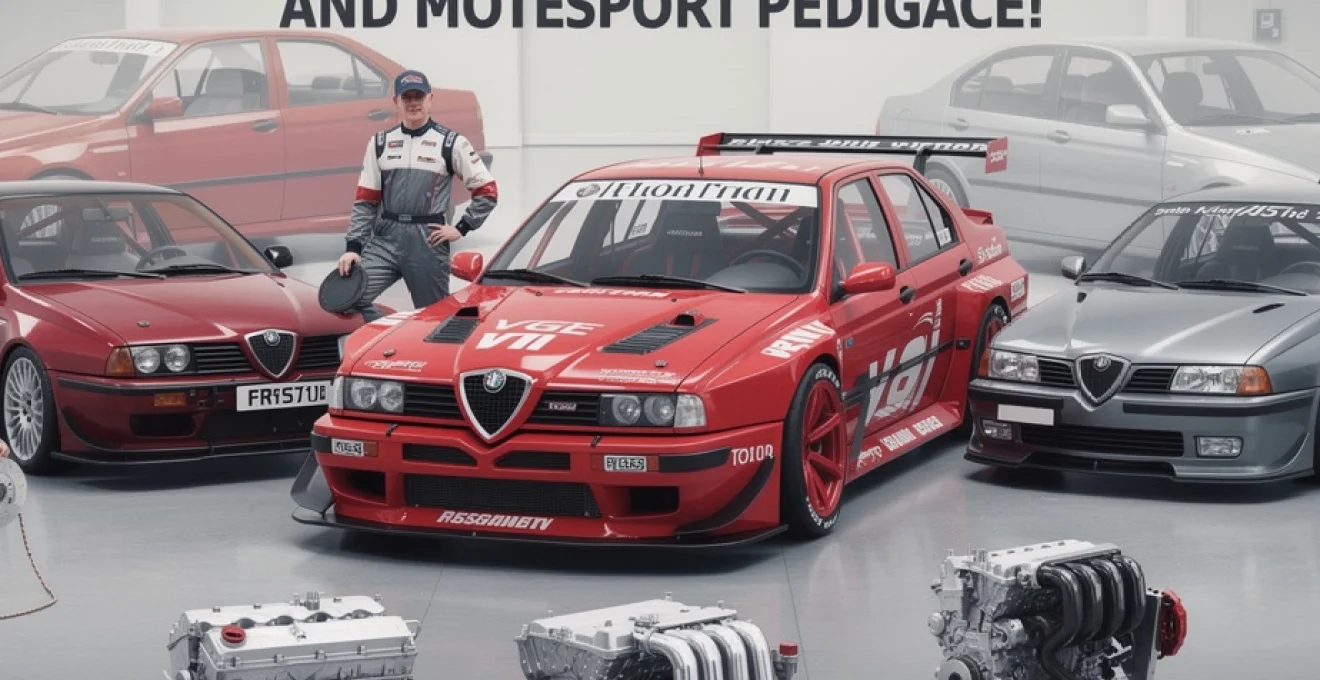
The Alfa Romeo 155 sits in a fascinating moment of the brand’s history, bridging the soulful, rear‑wheel drive era and the more rational, platform‑shared age under Fiat. On the surface it looks like a sharp‑edged early‑1990s saloon, but beneath the crisp creases lies a mix of innovative Twin Spark engines, motorsport‑driven chassis tweaks and one of the most extreme touring cars ever built. If you are considering an Alfa 155 as a classic daily driver, a weekend toy or a track‑biased project, understanding how this car evolved from Tipo‑based repmobile to DTM monster will help you choose the right example and maintain it intelligently.
Values remain accessible compared with other period icons, yet the 155’s motorsport pedigree, distinctive styling and increasingly rare wide‑body models are pushing demand, especially in the UK and Europe. Rust, maintenance‑heavy timing belts and ageing electrics can bite, but with the right preparation the Alfa 155 still delivers a uniquely tactile, analogue driving experience that modern compact saloons no longer attempt to replicate.
Design evolution of the alfa romeo 155: from tipo 3 platform to DTM aero kit
The Alfa Romeo 155 was the final evolution of Fiat’s Tipo 3 platform, shared with the Fiat Tipo and Lancia Dedra. Released in January 1992 as the replacement for the Alfa 75, it abandoned the old rear‑wheel drive transaxle layout for a transverse, front‑wheel drive configuration. Design house IDEA gave the 155 its unmistakable wedge, with a high boot line tapering down to low, slim headlamps. Straight lines, strong shoulders and a cab‑forward stance made the car look more modern than the 75, even if some enthusiasts initially missed the classic Alfa curves.
Early “narrow‑body” cars share the same basic profile as later models but appear more upright and formal. Subtle changes came quickly: in 1993 the grille was recessed, softening the front, and in 1994 the limited‑run Silverstone edition arrived with its trick aerodynamic additions supplied in the boot. In period road tests, reviewers often noted that the 155 looked like a sober fleet saloon from a distance, yet up close the chamfered surfaces and tight overhangs gave it an almost touring‑car‑for‑the‑road attitude, especially when sitting on factory alloys with the suspension in good health.
Boxy sedan proportions versus aerodynamic optimisation on the 155 V6 TI DTM
Visually, the production 155 can look boxy next to more curvaceous rivals, but its sharp edges conceal careful aerodynamic tuning for its time. The real transformation came with the legendary 155 V6 TI DTM car. Here, the basic three‑box silhouette was exaggerated into a pure racing machine: hugely flared arches, deep splitters, towering wings and flattened underbody panels combined to generate serious downforce on track. The V6 TI ran carbon‑fibre bodywork and sat impossibly low, turning the already wedgy saloon into something that looked more like a silhouette racer than a touring car.
The contrast between road car and DTM machine highlights Alfa’s philosophy. The showroom 155 prioritised stability and low drag for motorway work, while the racing counterpart was all about cornering grip and high‑speed aero balance. If you study both side‑by‑side, you see how the straight‑lined production shape gave race engineers a relatively clean canvas for bolt‑on extensions, scoops and splitters without fighting compound curves. That makes the 155 an interesting base today for period‑inspired aero upgrades if you are building a track car while wanting to keep the original design language intact.
Impact of the “wide body” facelift (155 super and Q4) on stance, track width and handling
In 1995, Alfa Romeo introduced the Series 2 “wide body” facelift. Officially, the change improved stability and road holding; unofficially, many enthusiasts believe it was driven by homologation rules that demanded at least 25,000 cars share a wider track to legitimise race‑car geometry. The front track increased by a couple of inches, with blistered front wings and subtly reshaped rear arches to cover the wheels. Models like the 155 Super and Q4 benefitted most visibly, gaining a squat, planted stance that visually linked the road car more directly to the success of the DTM and BTCC programmes.
On the road, the wide‑body 155 feels tangibly more confidence‑inspiring. A faster steering rack (2.5 turns lock‑to‑lock on many four‑cylinder cars) and broader footprint sharpen initial turn‑in and reduce the nervousness some drivers noticed in early cars on bumpy B‑roads. If you want the most agile and precise 155 for enthusiastic driving, a facelifted 2.0 Twin Spark 16V with the “Sport Pack” suspension is often regarded as the sweet spot, combining lighter weight than the V6 with the updated geometry that owes more than a little to Alfa’s touring‑car engineering.
Alfa romeo 155 versus 75 and 156: styling transition from rear‑wheel drive classic to front‑wheel drive era
Comparing the 155 with its predecessor, the Alfa 75, and successor, the 156, highlights how Alfa’s design language shifted through the 1990s. The 75 wears its rear‑wheel drive layout on the outside: long bonnet, cab‑backward proportions and a narrow tail. The 155, by contrast, moves the cabin forward and shortens the nose to suit its transverse engine arrangement. It signals the start of a more modular, platform‑shared Alfa era, even though traditionalists initially criticised the car for losing the 75’s mechanical character.
The later 156, launched in 1997, softened the 155’s razor‑edged styling into more organic, flowing forms with hidden rear door handles and a “coke‑bottle” waistline. Visually, the 156 is more romantic and instantly recognisable as an Alfa, but many 155 fans appreciate the earlier car’s structural honesty and squared‑off aggression. For enthusiasts seeking a classic Alfa saloon that bridges these eras, the 155 delivers a unique mix: it retains analog switchgear and clear analogue instruments reminiscent of the 75 while hinting at the more refined, ergonomic direction that culminated in the 156.
Period aerodynamic details: rear spoiler, front splitter and underbody airflow management
Even in standard form, the Alfa 155 incorporated meaningful period aerodynamic details. Many models came with a discrete rear spoiler that helped calm high‑speed lift and added a subtle sporting flavour. The Silverstone special edition went much further: it included an extendable front splitter and a height‑adjustable rear wing supplied in the boot so owners could fit them at home. These parts existed primarily to homologate racing components, but they also offered road drivers a tangible way to tweak high‑speed stability, even if most cars were never set up to full touring‑car extremes.
The underbody on production cars was not fully flat like the V6 TI, but Alfa Romeo did invest in smoothing key airflow areas to reduce drag and cabin noise. Simple measures such as careful bumper shaping, under‑tray panels and skirt angles made the 155 a refined motorway cruiser for its class. If you are restoring or upgrading a 155 today, ensuring that original under‑trays and spoiler elements are intact can noticeably improve stability, fuel economy and wind noise, especially compared to neglected examples with missing plastic guards or ill‑fitting aftermarket bumpers.
Engine range and powertrains: twin spark, V6 and Q4 turbo in technical detail
The engine line‑up is central to the Alfa Romeo 155’s character. Depending on market and model year, buyers could choose from a wide spread of powertrains: Twin Spark four‑cylinders in 1.7, 1.8 and 2.0 guise, the soulful 2.5‑litre V6 and, at the top of the tree, the Q4’s turbocharged 2.0 with four‑wheel drive. Early cars used Alfa‑designed two‑valve Twin Sparks; from 1995, four‑valve Fiat‑derived blocks with Alfa cylinder heads and variable inlet cam timing took over. Across the range, the mix of responsive naturally aspirated engines and one highly tuned turbo unit gives the 155 a wide variety of driving personalities, from relaxed cruiser to rally‑style missile.
Alfa romeo twin spark 1.7, 1.8 and 2.0 DOHC architecture, variable inlet geometry and ignition mapping
The Twin Spark engines in the Alfa 155 are classic Alfa fare: double overhead camshafts, alloy heads and two spark plugs per cylinder. Capacity started at 1.7 litres in some continental markets, with 1.8 and 2.0 versions more common in the UK. Early units were 8‑valve, with characterful mid‑range torque and a gritty exhaust note. Later 16‑valve versions used a Fiat block but Alfa‑designed heads plus variable inlet cam timing for improved breathing at high revs. Power for the 2.0 16V reached about 150 bhp at 6,200 rpm, with 138 lb ft around 4,000 rpm, good for 0‑60 mph in roughly 8.9 seconds and a top speed of about 130 mph.
The Twin Spark concept offers cleaner combustion and more efficient burn across the chamber, which is particularly valuable on relatively large‑bore four‑cylinders. Modern tuners often re‑optimise ignition mapping and fuel delivery through the factory ECU to extract a little extra power and throttle response. With a well‑maintained timing belt system and healthy variator, a 2.0 Twin Spark 16V feels eager, rev‑happy and surprisingly flexible in everyday use, especially paired with the light, positive 5‑speed gearbox that makes cog‑swapping something you actually look forward to in city traffic.
2.0 Q4 turbocharged four‑cylinder: garrett turbocharger, intercooler layout and boost control strategy
The Alfa Romeo 155 Q4 is the halo road car for many enthusiasts. It effectively marries the Lancia Delta Integrale’s four‑wheel drive system with a 2.0‑litre, 16‑valve turbocharged engine. Using a Garrett turbocharger and front‑mounted intercooler, the Q4 developed around 190 bhp in road trim, with substantial tuning potential. The drivetrain routed power through a central differential and viscous coupling, giving impressive traction in poor conditions and making the Q4 a genuine all‑weather performance saloon. When boost builds properly, the car surges forward with an urgency that feels very much like a rally car in saloon clothing.
Boost control and heat management are critical on these engines. Factory boost levels are relatively conservative for longevity, but owners frequently upgrade wastegates, intercoolers and ECU mapping to release more mid‑range torque. Care must be taken: poor mapping can raise cylinder pressures and exhaust gas temperatures, risking head gasket failure or turbo damage. If you are considering a Q4, thorough documentation of turbocharger servicing, cooling system health and fuel system integrity is essential, especially given the age of these cars and the temptation many previous owners had to chase big power figures.
2.5 V6 12V “busso” engine characteristics: intake resonance, cam profiles and torque curve
The 2.5‑litre 12‑valve V6 in the 155 is part of the renowned “Busso” family, sharing architecture with the larger units found in the 164 and GTV. In the 155, it trades outright power for smoothness and sound, producing around 165 bhp with a rich, sonorous exhaust note that many consider one of the best of any six‑cylinder saloon of its time. Distinctive intake resonance from the multi‑plenum manifold gives the engine a layered soundtrack as revs rise, while relatively mild cam profiles deliver a broad, usable torque curve rather than a peaky top‑end rush.
Under load, the V6 pulls cleanly from low revs and feels more refined than the four‑cylinders, particularly at motorway speeds. However, belt changes on the V6 are more complex and labour‑intensive than on the Twin Sparks, and cracked water pump impellers or failing downpipes are known weak points. For many enthusiasts this is a price worth paying for the combination of character, refinement and that unmistakable metallic wail above 4,000 rpm, especially if the car is used for longer journeys where the extra cylinders make the 155 feel like a mini‑executive saloon rather than a warmed‑over family car.
ECU management systems (magneti marelli) and common remapping upgrades for classic ownership
Engine management across the Alfa 155 range is handled by Magneti Marelli ECUs. These systems were advanced for the early 1990s, offering multi‑point fuel injection, knock sensing and adaptive strategies to cope with different fuels and driving styles. For classic ownership today, the Marelli units provide a relatively straightforward platform for gentle performance tuning. Reputable specialists can adjust ignition timing, fuelling and, on 16‑valve engines, variator behaviour to sharpen throttle response and eliminate flat spots without compromising reliability.
Common upgrades include recalibrated chips, modern lambda sensors and, on turbo Q4 models, revised boost maps. Viewed like updating the operating system on a computer, a careful ECU refresh can make a stock engine feel younger and more responsive. It is important, however, to treat the original programming with respect: aggressive maps that chase headline dyno numbers may stress ageing mechanical components. A sensible target for most naturally aspirated Twin Sparks is an extra 5–10 bhp with crisper response rather than trying to turn the 155 into a pseudo‑race car at the expense of driveability.
Comparative performance metrics versus BMW E36 320i, mercedes 190E 2.3 and ford sierra RS cosworth
Contemporaries for the Alfa Romeo 155 included the BMW E36 3 Series, Mercedes‑Benz 190E and, in performance terms, cars like the Ford Sierra RS Cosworth. On paper, a 155 2.0 16V broadly matches a BMW E36 320i: both offer around 150 bhp, similar 0‑60 mph times near 9 seconds and top speeds just above 130 mph. The Alfa, however, delivers its performance through front‑wheel drive and a rev‑happy four‑cylinder, whereas the BMW uses a smoother straight‑six and rear‑wheel drive layout.
Compared with the Mercedes 190E 2.3, the 155 feels more agile and eager, but the Benz counters with superior build quality and refinement. The Sierra RS Cosworth, particularly in its high‑boost guises, simply outguns the 155 in straight‑line performance, yet the Alfa claws back credibility with its touring‑car‑inspired chassis balance and, in Q4 form, four‑wheel drive security. For drivers seeking a compact sports saloon with character rather than outright speed, the Alfa Romeo 155 offers a compelling blend: not the fastest in a straight line, but deeply engaging, especially when driven on tight, technical roads where steering feel and front‑end bite matter more than raw horsepower figures.
Chassis, suspension and braking: handling behaviour on road and circuit
The chassis of the Alfa 155 combines mainstream Fiat Tipo underpinnings with targeted Alfa‑specific tuning and, after 1995, lessons learned from the DTM and BTCC paddocks. MacPherson struts up front and trailing arms at the rear sound ordinary on paper, yet the result is a car that, in good condition, feels poised, communicative and surprisingly capable on circuit. The wide‑body facelift, faster steering racks and meticulous brake calibration all contribute to a handling package that rewards smooth, committed driving. Enthusiasts who maintain bushes, dampers and alignment to a high standard are often surprised how modern a sorted 155 still feels on a demanding stretch of road.
Front MacPherson strut and rear trailing arm suspension geometry on the fiat tipo platform
The use of MacPherson struts at the front and trailing arms at the rear is typical of the Tipo platform. In the 155, Alfa tuned spring and damper rates to favour driver involvement over absolute comfort, especially on sport‑pack cars. Front geometry delivers a good compromise between steering accuracy and impact absorption, while the rear setup, though relatively simple, provides predictable behaviour on the limit. Bushes and ball joints are effectively consumables; tired components lead to wandering, vague handling and creaks that can spoil what should be a crisp, light‑footed drive.
Replacing worn wishbones, anti‑roll bar bushes and dampers transforms the car. The 155’s suspension responds well to quality aftermarket dampers matched with factory‑equivalent or slightly uprated springs, but harsh, over‑lowered setups can upset geometry and ride comfort. Think of the car as a precision instrument: slight tweaks sharpen the response, but drastic changes can throw the whole chassis out of tune. For fast road use, many specialists recommend staying close to OE ride height and concentrating on bush quality and alignment rather than chasing extreme stance.
Steering rack ratios, turning circle and feedback compared with alfa 75 and 156
Steering feel is one of the Alfa 155’s standout qualities, especially on post‑1995 cars. The faster rack, with about 2.5 turns lock‑to‑lock, gives the car an almost kart‑like eagerness when changing direction, especially noted in period as “ultra‑quick” and “almost alive in your hands.” Compared with the Alfa 75, which has a weightier, more old‑school helm, the 155’s power‑assisted system is lighter but still rich in feedback. Relative to the later 156, the 155 feels more direct and less filtered, a trait many keen drivers prefer for spirited back‑road driving.
The turning circle is reasonable for a compact saloon and makes the 155 easy to position in urban environments, although wide‑body cars on larger wheels require a little more awareness of kerbs and tight parking spaces. If the steering feels heavy, inconsistent or vague around the straight‑ahead, suspect worn front suspension components or incorrect alignment. Correctly set up, the 155’s steering encourages you to “surf” roundabouts and flowing bends with minimal steering input, a quality that underpins the car’s reputation as one of the sharpest‑feeling front‑wheel drive saloons of its era.
Standard brake setup versus performance upgrades: vented discs, brembo calipers and braided lines
From the factory, the Alfa 155 used servo‑assisted discs all round, with ventilated fronts. Pedal effort is light, so much so that early testers joked about drivers “plastering themselves on the windscreen” during first acquaintance. As with any 1990s performance‑oriented saloon, time, corrosion and cheap replacement parts can dull braking performance. High‑quality pads, fresh fluid and properly sized discs restore much of the original bite and modulation. For drivers planning regular trackdays, there is a healthy ecosystem of performance upgrades.
Popular enhancements include larger vented discs, four‑piston Brembo calipers from later Alfa models, braided brake lines for a firmer pedal and high‑temperature fluids. These changes bring the 155 closer to its touring‑car cousins in terms of stamina under heavy use. For everyday classic driving, however, the stock system in good condition is entirely adequate. It is worth remembering that over‑braking a lightly modified road car can upset balance; focusing first on tyres and suspension before chasing huge multi‑piston setups tends to yield a more cohesive and enjoyable overall package.
Tyre sizes, wheel offsets and period‑correct setups: speedline, OZ racing and factory alloys
Tyres and wheels play a major role in how an Alfa Romeo 155 feels. Factory alloys varied from modest 14‑inch designs on entry models to more purposeful 15‑ and 16‑inch wheels on sporting versions. Period‑correct fitments from Speedline and OZ Racing complement the 155’s straight‑edged styling and connect the car visually to its DTM and BTCC counterparts. Maintaining original or near‑original offsets preserves steering feel and avoids rubbing on wide‑body arches, while sensible tyre widths help the chassis rotate rather than simply digging into understeer.
For most fast‑road cars, a modern 195 or 205 section tyre on a 15‑ or 16‑inch wheel gives a sweet balance between grip, ride comfort and steering precision. Oversized rims and ultra‑low‑profile tyres may look dramatic but can introduce tramlining and harshness that conflict with the car’s finely judged factory tuning. Choosing a quality tyre with a progressive breakaway characteristic matters more than chasing the absolute widest rubber; the 155 is about flow and feedback, not just lateral G figures on a data logger.
Interior, ergonomics and build quality: living with an alfa romeo 155 today
Inside, the Alfa Romeo 155 presents a sober yet distinctly driver‑focused environment. Clear analogue instruments, a thick‑rimmed steering wheel and firmly bolstered seats give the cabin a sporting ambience without the flamboyance found in later Alfas. Velour upholstery dominates in many models, with higher‑spec Super versions gaining wood trim elements that bring a subtle executive flavour. Ergonomically, the 155 benefits from its switch to front‑wheel drive: the driving position is more conventional than the slightly offset stance in the old 75, with pedals, wheel and gearlever comfortably aligned for longer journeys.
For day‑to‑day classic use, you will appreciate the light clutch, slick 5‑speed gearbox and excellent visibility. The boot is deep and practical, making the 155 a viable family car even today. Yet build quality is very much early‑1990s Italian: plastics can creak, dash tops may fade and electrical quirks, especially around relays and window switches, are common. If the car has a sunroof, checking smooth operation and drainage channels is vital to avoid leaks that can damage headlinings and cause hidden corrosion. A damp smell in the cabin or boot is an immediate prompt to inspect seals and carpets carefully.
Electrical reliability can usually be improved with patient cleaning of contacts, relays and earth points. Treat the wiring like a vintage hi‑fi system: good connections and clean power transform performance and reduce background “noise” in the form of glitches. As a driver, you will likely find that the 155’s interior feels refreshingly simple compared with modern infotainment‑heavy cabins. Climate controls are straightforward, instruments are easy to read at a glance and, aside from period radios, there is little to distract you from the act of driving. For anyone wanting an analogue daily classic with usable ergonomics, the 155 makes a persuasive case.
Motorsport pedigree: DTM, BTCC and superturismo dominance
The Alfa Romeo 155’s competitive record in touring car racing is central to its legend. Between 1992 and 1996, various 155‑based racers claimed titles across Europe, including major victories in Germany’s DTM, the British Touring Car Championship and Italian Superturismo. These successes not only boosted Alfa Romeo’s image after a difficult 1980s but also fed back directly into road‑car development. Changes such as the wide‑body track increase, quicker steering racks and homologated bodywork elements came straight from race engineers seeking an edge under evolving regulations. For enthusiasts today, that history makes the 155 far more than just another early‑1990s saloon; it is a genuine motorsport icon in disguise.
Alfa romeo 155 V6 TI in the deutsche tourenwagen meisterschaft: 2.5 V6 24V, 11,500 rpm and four‑wheel drive
The most extreme expression of the Alfa 155 concept was the 155 V6 TI built for the Deutsche Tourenwagen Meisterschaft. Using a 2.5‑litre 24‑valve V6 producing up to 420 bhp, this car revved to around 11,500 rpm and drove all four wheels through a six‑speed sequential gearbox. The body was constructed largely from carbon fibre, with aggressive aero including deep splitters, vast wings and dramatically flared arches. On its debut, the V6 TI won, and in 1993 it secured the DTM championship against intense German competition, cementing Alfa’s reputation as a touring‑car powerhouse.
Performance was astonishing: estimates suggest 0‑62 mph in under three seconds and a top speed around 190 mph, all from an engine displacing less than many contemporary road‑going sixes. The combination of shrieking naturally aspirated V6, four‑wheel drive traction and radical aero made the 155 V6 TI one of the most memorable touring cars of the 1990s. Its rarity and historical significance are reflected today in auction estimates often exceeding £500,000, placing it firmly in the realm of blue‑chip motorsport collectables rather than trackday toys.
Gabriele tarquini, nicola larini and key championship seasons (1993–1996) in DTM and ITC
Drivers such as Gabriele Tarquini and Nicola Larini became closely associated with the Alfa 155’s touring‑car exploits. Larini’s 1993 DTM title win showcased both his skill and the V6 TI’s performance potential, while Tarquini later carried the torch in the British Touring Car Championship. Between 1993 and 1996, the 155 was a constant presence at the sharp end of DTM and the subsequent International Touring Car Championship, regularly battling works Mercedes and Opel entries for race wins.
These seasons were formative years for modern touring‑car racing, with advanced aerodynamics, increasingly sophisticated electronics and escalating budgets. The 155’s successes helped re‑establish Alfa Romeo as a serious motorsport brand after patchy results in previous decades. For many fans, the image of a red 155, nose down and rear wing slicing through the air in a high‑speed corner, is as iconic as any period Formula 1 car, and it continues to inspire liveries and builds in contemporary historic series across Europe.
Alfa romeo 155 in BTCC and italian superturismo: 2.0 class 2 touring car specification
In the British Touring Car Championship and Italian Superturismo, the Alfa 155 competed under the Class 2 (later Super Touring) regulations, using a naturally aspirated 2.0‑litre four‑cylinder engine. In BTCC, Tarquini and his team turned heads not only with pace but with occasional controversy, including protests over aerodynamic aids homologated via special editions like the Silverstone. The 155’s combination of power, lightness and handling precision made it one of the cars to beat during its tenure, ultimately delivering the BTCC title in the mid‑1990s.
Italian Superturismo saw similarly strong results, with the 155’s agility and balance well suited to tight, technical circuits. The success of these 2.0‑litre touring cars fed into road‑going development, influencing elements such as suspension tuning, steering ratios and aero tweaks on the facelifted 155. For owners today, this racing heritage adds depth: restoring or modifying a 2.0 Twin Spark or Q4 with period‑correct suspension and wheel setups allows you to echo the look and feel of those Super Touring heroes without needing a full race shell and support crew.
Technical link between race cars and road‑going 155 Q4: drivetrain, suspension concepts and aero
While the DTM V6 TI shared little directly with the showroom 155 beyond its silhouette, the Q4 model offers clearer technical links to Alfa’s touring‑car and rally programmes. Its four‑wheel drive system and turbocharged 2.0‑litre engine owe much to the Lancia Delta Integrale, which itself dominated rallying. Concepts such as torque distribution, limited‑slip differentials and the importance of cooling under sustained load migrated from motorsport to the Q4’s road specification, giving buyers a genuinely sophisticated drivetrain for the early 1990s.
Suspension layouts and aero ideas also trickled down. The emphasis on stable high‑speed behaviour, responsive turn‑in and reduced lift informed the wide‑body track increase and stiffer suspension options on later cars. Homologation specials like the Silverstone essentially turned racing components into showroom accessories, enabling teams to exploit rules that required production‑car origins for aero addenda. For today’s enthusiast looking to build an Alfa 155 track car, studying those historical connections provides a strong blueprint: focus on balanced aero, robust cooling and compliant yet controlled suspension rather than simply chasing power figures.
Reliability, rust points and classic ownership costs in the UK and europe
Owning an Alfa Romeo 155 as a classic in the UK or Europe involves balancing emotional appeal with practical realities. On the positive side, parts availability for common service items remains decent, and many independent specialists know the Tipo‑based platform well. Purchase prices for usable cars are still lower than for some contemporaries like the BMW E36 or Ford Sierra RS Cosworth, though the best wide‑body and Q4 examples are climbing. On the downside, rust deserves serious attention. Wheelarch lips, especially at the rear, are notorious corrosion spots, and under‑sealed areas from the factory sometimes received only cursory protection.
A thorough pre‑purchase inspection should include lifting the car and probing the underside with a screwdriver, checking sills, suspension mounting points and boot floors. A damp smell in the boot or cabin often signals leaks that may have already triggered hidden rust. Paint issues are also common, with fading, lacquer peel and blistering all seen on neglected cars; a full respray can easily exceed the car’s market value. Treat the 155 like a classic Italian suit: stylish and rewarding, but needing tailored care and, occasionally, some structural reinforcement.
Mechanical reliability is generally better than Alfa’s older reputation suggests, especially on well‑maintained cars. Timing belts on Twin Spark and V6 engines must be changed every 36,000 miles or three years, including tensioners and, ideally, water pumps. Ignoring this schedule is a false economy; a snapped belt can write off an engine. Crank position sensors and variators on 16‑valve engines are known weak points but relatively affordable to replace. For Q4 owners, the complexity of the four‑wheel drive system and turbocharger adds cost, so budgeting a contingency fund for drivetrain work is wise, particularly if you plan spirited use or light tuning.
Running costs sit between everyday hatchback and full‑fat performance car territory. Fuel economy for a 2.0 Twin Spark 16V averages in the mid‑30s mpg when driven sensibly, while V6 and Q4 models consume more but reward you with richer performance. Insurance remains manageable for most age brackets, especially when using classic policies with limited mileage. The biggest long‑term threats are neglect and poor‑quality modifications. Many 155s were cheap for years, so some examples were run into the ground or “modified” on tight budgets. Prioritising cars with comprehensive history, sympathetic upgrades and visible evidence of careful rust repair will save you thousands over time and allow you to enjoy the Alfa 155’s unique mix of sound, steering feel and motorsport‑infused character for years to come.