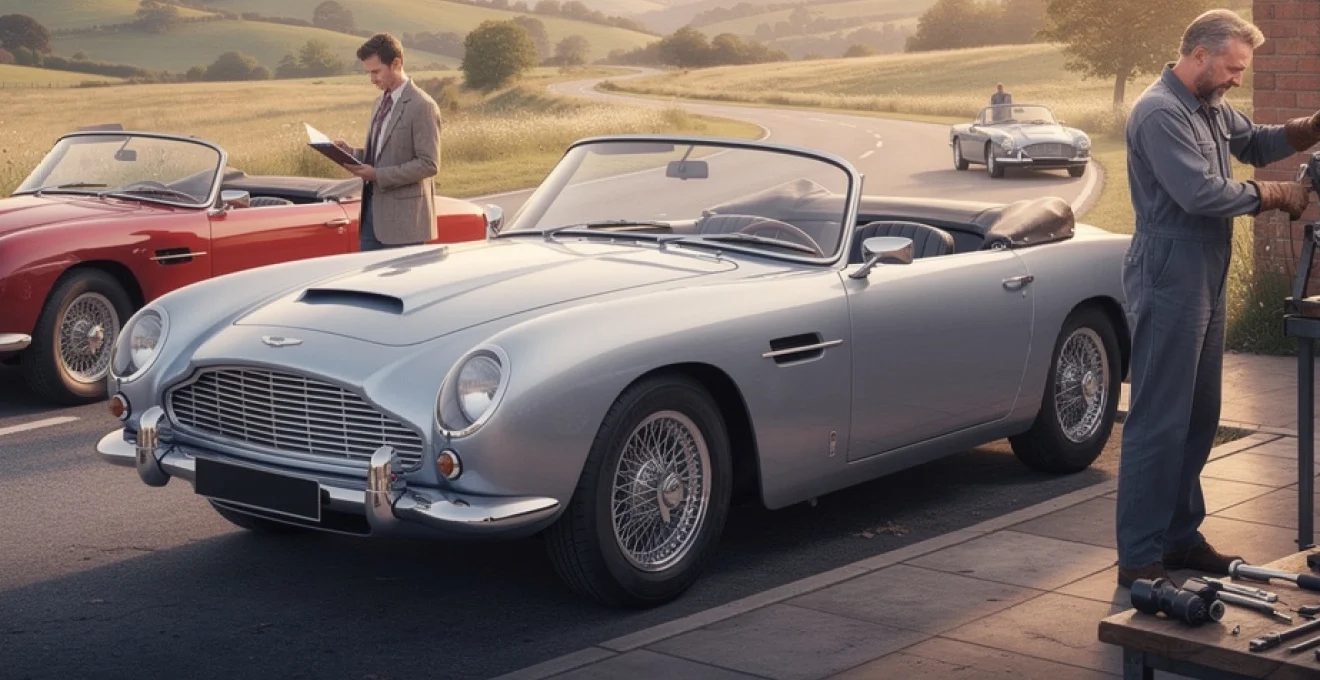
The Aston Martin DB6 Volante sits at a sweet spot in the classic car world: recognisably related to the DB5 hero car, yet more refined, more usable and, for now, often better value. For anyone who loves open‑air grand touring, this elegant 1960s convertible brings together hand‑built craftsmanship, a charismatic straight‑six and genuine four‑seat practicality. Understanding where the DB6 Volante fits in the DB bloodline, how it evolved technically and what to look for when buying or restoring one will help you decide whether this is the right classic Aston for you – or simply deepen your appreciation of one of Britain’s most glamorous ragtops.
Aston martin DB6 volante evolution: from DB5 convertible to mk2 ragtop icon
DB5 convertible vs DB6 volante: chassis stretch, superleggera bodywork and touring influence
The DB6 Volante can look, at first glance, like a lightly revised DB5 Convertible, but the differences run deeper than a new tail and a fresh badge. The DB5 still used Touring’s Superleggera system, with a lattice of small steel tubes clothed in aluminium. By the time the DB6 arrived in late 1965, Aston Martin had moved to a stronger, unitary platform with folded steel box sections, retaining aluminium outer panels but abandoning the full Superleggera structure.
To create more space, the DB6 wheelbase was stretched by 95mm over the DB5, to 2585mm. This allowed a higher roofline, more rear legroom and, crucially for the Volante, genuine 2+2 seating rather than occasional perches. The DB6 also gained a steeper windscreen and a reprofiled front apron with a larger oil‑cooler opening. If you compare the two side by side, the DB6 Volante looks more mature and more obviously a grand tourer, while the DB5 Convertible has a slightly more delicate, sporting stance.
Series 1 vs series 2 DB6 volante: mk1, mk2 and late “vantage‑spec” production changes
Production of the DB6 Volante ran from 1966 through to 1970, overlapping both the original DB6 (often informally called Series 1) and the DB6 Mk2. Early Volantes share the slimmer arches and narrower wheels of the DB6 coupé. From July 1969, the DB6 Mk2 brought wider wheels, DBS‑style hubs and subtly flared arches, along with standard power steering and the option of AE Brico fuel injection, although very few Volantes used that system.
Only 38 Volantes were Mk2s, and just nine of those carried the high‑output Vantage tune with triple Weber carburettors. These late cars combine the most developed chassis with the strongest engine, and command a noticeable premium in the market. Period road tests quoted 0–60 mph in around 8.4 seconds for standard Volantes and stronger numbers for Weber‑equipped cars, though contemporary testers focused as much on refinement and high‑speed stability as on raw acceleration.
Factory “short chassis volante” (SCV): rarity, chassis codes and collectability
Before the full DB6 Volante launched, Aston Martin produced a run of 37 cars now known as the Short Chassis Volante or SCV. These used leftover short‑wheelbase DB5 Convertible platforms combined with early DB6 styling cues, including the revised front end. As the first Aston to carry the Volante name, they sit in a special niche: part DB5, part DB6, and very rare.
For you as a buyer or historian, SCV cars are identified by their unique chassis numbering sequence and by the shorter rear overhang and DB5‑style rear structure. Because of that rarity and their “bridge” status in the DB lineage, SCVs are usually valued above regular DB6 Volantes. If an example is presented as a Short Chassis car, close examination of the chassis code and confirmation from Aston Martin Heritage Trust records is essential.
Key design signatures: kamm tail, faired‑in headlights and chrome brightwork detailing
The DB6 Volante’s most obvious visual signature is the Kamm tail, with an integrated lip spoiler derived from Aston’s DP212, DP214 and DP215 Le Mans prototypes. This truncated rear reduces lift and improves high‑speed stability compared with the DB5’s more flowing tail, which is especially relevant if you intend to use the car at sustained motorway or autobahn speeds.
Other design hallmarks include faired‑in headlights, split quarter bumpers front and rear, and tasteful chrome brightwork that accentuates the car’s lines rather than dominating them. Quarter‑light windows add ventilation and a more spacious feel. In profile, the longer chassis and higher screen give the Volante a slightly more formal stance than a DB5 Convertible, which many owners find better suited to long‑distance grand touring.
DB6 volante technical specification: engine, transmission and chassis engineering
Tadek marek 4.0‑litre straight‑six: SU carburettors vs weber, vantage high‑compression tune
At the heart of every DB6 Volante lies Tadek Marek’s 3995 cc straight‑six, an alloy block and head unit with dual overhead camshafts. In standard guise, with three SU HD8 carburettors and 8.9:1 compression, it produces around 282 bhp at 5500 rpm and roughly 280 lb ft of torque at 4500 rpm. This specification is flexible, relatively smooth and well suited to relaxed touring.
The Vantage option transforms the character. Swapping to triple Weber 45 DCOE carburettors, revising cam profiles and increasing compression to 9.4:1 lifts output to a quoted 325 bhp. Torque remains broadly similar but arrives higher up the rev range, giving a more urgent, sporting feel. From a practical perspective, you should expect slightly higher fuel consumption and more finicky cold‑running with Webers, but also a sharper throttle response and a harder edge to the exhaust note that many enthusiasts find irresistible.
ZF 5‑speed manual vs Borg‑Warner automatic: gear ratios, drivability and touring capability
Most DB6 Volantes left Newport Pagnell with the ZF five‑speed manual gearbox. It is a robust, slightly heavy unit with fairly long gearing, ideal for high‑speed cruising. Once fully warmed, shift quality is precise and satisfying, though cold changes can feel baulky. In the context of a 1960s grand tourer, the manual box gives the most engaging driving experience and is favoured by the majority of collectors.
The alternative was a three‑speed Borg‑Warner automatic, offered as a no‑cost option when new. Period testers noted that it dulled mid‑range response and robbed some of the engine’s sparkle, but for urban use and relaxed touring it can suit drivers who prefer wafting to rowing through gears. If you are considering an automatic DB6 Volante today, it is worth checking whether the car has been converted to a later, more efficient auto, or whether an original box has been retained for originality.
DB6 volante chassis and suspension: longitudinal frame, de dion rear axle and coil spring set‑up
Unlike the earlier DB4/DB5’s Superleggera substructure, the DB6 uses a stronger unitary platform with longitudinal box‑section members and cross‑bracing. The front suspension remains independent with double wishbones, coil springs, telescopic dampers and an anti‑roll bar. At the rear, Aston opted for a live axle located by parallel trailing arms and a Watt linkage, with helical coil springs and lever‑arm dampers, rather than the more complex De Dion arrangement tested on development car MP219.
This relatively straightforward layout keeps costs under control and is easier to maintain, while still giving the DB6 Volante predictable, secure handling. The extended wheelbase aids stability, and the car’s quoted kerb weight of around 1466 kg (Volante) means that damping and bush condition have a noticeable impact on ride quality. If you value precise steering and tight body control, a thorough suspension refresh can make the car feel decades younger.
Hydraulic girling disc brakes, braking bias and period brake servo upgrades
Braking is handled by servo‑assisted Girling discs all round, 11.5‑inch front and 10.8‑inch rear. For a 1960s GT, stopping performance was excellent, although by modern standards you will notice longer pedal travel and a more progressive feel rather than a sharp initial bite. Maintaining correct brake bias front to rear is important; badly set‑up systems can feel wooden or prone to premature front lock‑up.
Many cars have received period‑style servo upgrades or modern replacement servos to improve feel and reliability. If you are evaluating a DB6 Volante, check for consistent pedal pressure, absence of pulling under braking and smooth operation after repeated stops. Well‑maintained Girling hardware is entirely adequate for spirited road use, even on today’s faster roads.
Factory performance data: 0–60 mph, top speed and fuel consumption in contemporary road tests
Factory figures for the DB6 in standard form quote 0–60 mph in approximately 6.4 seconds and a top speed around 150 mph; the Volante’s slightly less aerodynamic bodywork brings that down to roughly 140–148 mph depending on tune and test conditions. Contemporary road tests typically recorded 0–60 mph between 6.5 and 8.4 seconds, with faster times for Weber‑equipped Vantage cars.
Fuel consumption in period was usually reported in the 13–17 mpg range for mixed driving, dropping into single figures if the straight‑six was fully exercised. For today’s owner planning long‑distance touring, budgeting for 15 mpg as an average is realistic. In exchange, you gain performance that still feels brisk in modern traffic and a cruising ability that makes pan‑European trips entirely plausible.
DB6 volante body, trim and hood: exterior and interior specification guide
Superleggera construction vs open volante shell: touring’s influence and corrosion hotspots
Although the DB6 no longer uses full Superleggera construction, Touring’s influence remains in the combination of steel structure and aluminium panels. The result is a stiff, relatively light shell for such a luxurious four‑seater. However, the mix of metals creates ideal conditions for electrolytic corrosion if paint and sealants are neglected.
On a DB6 Volante, critical rust areas include the steel sills hidden beneath aluminium covers, the jacking points, bulkhead feet, side members and the Watt linkage mounting structure behind the rear seat. At the same time, the aluminium outer panels can bubble where they meet steel frames, particularly around door bottoms and the rear valance. Any visible bubbling or uneven paint should prompt deeper investigation, as the underlying corrosion is usually more extensive than first appears.
Convertible hood mechanisms: mohair vs vinyl, frame adjustment and weather sealing
The DB6 Volante hood was power‑operated from new, a luxury feature in the mid‑1960s. The frame is a complex assembly that must be correctly aligned to avoid chafing, wind noise and leaks. Many restored cars now use mohair hoods rather than the vinyl commonly seen in period, offering better durability and a more upmarket appearance.
When inspecting a car, watch the hood cycle from fully down to fully up and back again. It should move smoothly, without graunching or hesitation, and latch securely at the header rail. Water ingress over time can lead to corrosion in the rear floor and around the hood well, so checking carpets and underfelt for damp patches is essential if you intend to use the car in real‑world weather rather than purely as a fair‑day toy.
Original paint and colourways: silver birch, dubonnet rosso, caribbean pearl and period palettes
Part of the Aston Martin DB6 Volante’s appeal lies in its elegant period colours. Silver Birch is famous thanks to its DB5 connections, but DB6 Volantes also looked superb in deeper shades such as Dubonnet Rosso, Pacific Blue or Caribbean Pearl. Period greens and subtle metallics can give a DB6 a more understated, aristocratic presence than the brighter hues often chosen for modern sports cars.
If originality matters to you, checking the build sheet or factory records to confirm the original paint code is worthwhile. Cars repainted in their factory shade or another period‑correct colour tend to sit more comfortably in prestigious events such as Pebble Beach and Villa d’Este, where authenticity and taste are closely scrutinised. Non‑standard colours are not necessarily a deal‑breaker, but may affect concours scores and, in some markets, long‑term values.
Interior trim and dashboard layouts: connolly leather, smiths gauges and period switchgear
Slide into a DB6 Volante cabin and the impression is more gentleman’s club than minimalist sports car. Deeply padded Connolly leather seats, Wilton carpets and a full suite of Smiths instruments create an ambience that later plastic‑rich interiors rarely match. The raised roofline and longer wheelbase free up extra head and legroom, making the rear seats genuinely usable for children or adults on short trips.
The dashboard is dominated by large speedometer and rev counter dials, with an ammeter between them and flanking pods for fuel, water temperature, oil pressure and oil temperature. Toggle switches and a centrally mounted clock complete the layout. While electric windows and aerial were standard, radios were extra, so period‑correct audio equipment is often missing or replaced. If you are planning an interior restoration, authenticity in switchgear and instrument finishes can significantly enhance the car’s perceived quality.
Wire wheels, borrani rims and tyre specifications for authentic stance and handling
Fifteen‑inch wire wheels are integral to the DB6 Volante’s stance. Original cars often wore 6.5‑inch‑wide Borrani rims shod with Avon tyres. Correct wheel and tyre choice does not just influence appearance; it also affects steering weight, ride quality and breakaway characteristics. Radial tyres in period‑style sizes preserve the car’s balanced, slightly progressive handling, whereas overly wide modern rubber can make the steering feel heavy and nervous.
If authenticity is important, choosing high‑quality wire wheels of the correct pattern and offset is wise. Cheap reproductions can suffer from poor trueness and spoke tension, leading to vibration and compromised safety. A professional inspection of wheels and hubs is a sensible investment, particularly on a car that has spent long periods in storage.
DB6 volante buying guide: inspection, provenance and market valuation
Chassis and body inspection: rot points, poor restorations and structural integrity checks
Because Aston Martin DB6 values have risen strongly since 2020 – with DB6 Volantes achieving public sale prices from around £330,000 up to over £950,000 – many cars have undergone restoration of varying quality. For you as a prospective buyer, distinguishing between a carefully rebuilt example and one filled with filler and patch plates is crucial.
Key checks include the sills and jacking points, rear suspension Watt linkage mounts, bulkhead corners, door hinge mounts, pedal box area and the boot floor, including under the spare wheel. Evidence of sagging around jacking points often indicates internal sill corrosion. Look for inconsistent panel gaps, ripples along the flanks and overspray on rubbers as signs of rushed work. A car that presents beautifully on top but sits on a compromised structure may prove vastly more expensive to rectify than a scruffier but solid example.
Engine and driveline assessment: compression testing, oil analysis and gearbox condition
A proper rebuild of a Tadek Marek straight‑six can run into five figures, so mechanical health deserves serious scrutiny. Warm oil pressure around 100 psi at cruising speeds is a healthy sign; readings closer to 50 psi may signal wear. Rapid overheating at idle can suggest blocked water passages around the iron liners, while oil and coolant mixing near liner bleed apertures points to failing O‑ring seals.
For a car at the top end of the market, commissioning a compression test and possibly an oil analysis is good practice. On the ZF manual, listen for bearing whine and check for jumping out of gear under load. Automatics should shift smoothly with a properly functioning kickdown. Some differential whine is common, but loud clunks or excessive backlash under on‑off throttle transitions merit further investigation and may require a rebuild.
Matching‑numbers verification: build sheets, newport pagnell records and aston martin heritage trust
With only around 140 DB6 Volantes built, including 29 Vantage examples and 38 Mk2 cars, matching‑numbers status and documented provenance carry significant weight. Engine, chassis and body numbers should align with factory build sheets from Newport Pagnell. These can usually be sourced via the Aston Martin Heritage Trust or official marque archives.
Discrepancies are not always fatal; engines were sometimes replaced in period, and accident repairs could lead to body swaps. However, for the most desirable cars – especially Short Chassis Volantes and Mk2 Vantage ragtops – factory‑correct components and a clear historical trail make a substantial difference to long‑term desirability and investment potential. If a seller claims a notable previous owner, such as a celebrity, corroborating paperwork is indispensable.
Right‑hand drive vs left‑hand drive: factory conversions, export markets and desirability
The DB6 Volante was built in small numbers for both right‑hand drive (RHD) and left‑hand drive (LHD) markets. Factory LHD cars are particularly sought‑after in continental Europe and North America, where they suit local driving conditions and event participation. Conversions from RHD to LHD, or vice versa, are not uncommon but vary considerably in quality.
If you are assessing a converted car, check that pedal box, steering column, dashboard, wiper sweep and headlamp beam patterns have been correctly adapted. Factory documentation showing original configuration is valuable in understanding what has been altered. RHD examples tend to hold a premium in the UK, especially among collectors who value originality and factory specification, whereas well‑executed LHD conversions can be more attractive in LHD‑dominant countries.
Price tiers and market trends: concours‑level cars, drivers, projects and recent auction results
Since 2020, average DB6 Volante values have hovered around £400,000–£410,000 in “good driver” condition, with a sell‑through rate of roughly 64% at public auctions. The lowest recorded sale sits just under £80,000 for a project‑grade example, while the most expensive publicly sold car has approached the £950,000 mark, typically a highly original or historically significant Volante.
The market segments roughly into four tiers: restoration projects, usable drivers, high‑quality restored cars and concours‑level or celebrity‑provenance examples. As a rule of thumb, buying the best you can comfortably afford remains wise, as cutting corners on acquisition often leads to greater expense in the workshop. Given ongoing enthusiasm for blue‑chip 1960s GTs and the limited production run, the DB6 Volante continues to be seen as a strong long‑term holding for serious collectors who also want to use their cars.
DB6 volante driving experience: real‑world touring and handling characteristics
Behind the wheel, the Aston Martin DB6 Volante feels every inch the classic grand tourer. Steering is relatively low geared by modern standards but accurate, with good feedback through the thin‑rimmed wheel. Cars equipped with power steering, standard on Mk2 models and optional earlier, are notably easier to handle at parking speeds while retaining sufficient feel on the move. On fast A‑roads, the longer wheelbase and Kamm tail give a planted, unflustered demeanour, particularly with the hood raised.
With the top down, the cabin is windier than a modern convertible, but still comfortable for sustained cruising at legal motorway speeds. The straight‑six pulls strongly from low revs, surging through the mid‑range with a cultured growl that hardens as the tachometer swings past 4000 rpm. Compared with a DB4 or DB5, the DB6 Volante rides more compliantly and feels more civilised over poor surfaces – like upgrading from a finely tailored sports jacket to a hand‑made overcoat: still sharp, but with extra comfort built in.
Restoration, upgrades and originality: preserving a classic aston martin volante
Body‑off restoration workflow: jigging, metalwork, lead‑loading and panel alignment
A full DB6 Volante restoration usually starts with mounting the bodyshell on a dedicated jig to ensure the platform remains square once corroded sections are removed. Steel box sections in the sills, jacking points and Watt linkage area are commonly replaced or extensively repaired. Skilled metalworkers then refit or remake aluminium outer panels, using traditional techniques such as lead‑loading instead of heavy filler to achieve correct shapes.
Panel alignment is especially critical on a convertible, where door fit and scuttle rigidity affect both appearance and hood sealing. A proper restoration will involve frequent trial‑fittings of doors, bonnet and bootlid as the structure is rebuilt, rather than treating metalwork and paint as separate stages. For you as an owner, requesting photographic documentation of these stages helps prove the quality of the work to future buyers and judges.
Engine rebuilding and tuning: hardened valve seats, unleaded fuel compatibility and vantage cam profiles
During an engine rebuild, most specialists now fit hardened valve seats to allow consistent use of unleaded fuel without additive. Renewed timing chains, oil pump and cooling passages are also standard practice. Balancing the rotating assembly can make the straight‑six smoother and more willing to rev, enhancing both refinement and longevity.
Some owners take the opportunity to adopt Vantage cam profiles or switch from SUs to Webers for extra performance. This can be done sympathetically, preserving the engine’s original character while unlocking more of its potential. For a road‑biased grand tourer, a mild tune that prioritises mid‑range torque over outright peak power often makes the car more enjoyable in real‑world conditions than a highly strung configuration.
Sympathetic upgrades: electronic ignition, cooling improvements and discreet power steering
Sympathetic upgrades can significantly improve usability without compromising period feel. Electronic ignition systems hidden within original‑style distributors, more efficient aluminium radiators, uprated fans and modern brake pad compounds are widely accepted, especially on cars used regularly for touring or rally events. These changes reduce the risk of roadside dramas while leaving the visual presentation largely untouched.
Discreet power‑assisted steering conversions are also popular, particularly on early non‑assisted cars. When well executed, they lighten low‑speed manoeuvres yet remain transparent at higher speeds. Think of such upgrades as fitting modern orthopaedic inserts into a pair of classic brogues: the look remains timeless, but day‑to‑day comfort improves markedly, encouraging you to drive the car more often and over longer distances.
Interior retrim standards: correct connolly hides, wilton carpets and period‑correct stitching
A DB6 Volante interior can be restored to an exceptionally high standard, but cutting corners is immediately obvious to anyone familiar with these cars. Correct Connolly grain and colour, authentic Wilton carpet weights and proper stitch patterns make the difference between a cabin that simply looks tidy and one that convincingly evokes Newport Pagnell craftsmanship. Overly thick padding, modern textures or inappropriate colours can jar with the rest of the car.
If you commission a retrim, keeping detailed records of materials used and patterns followed adds value. Subtle patina is often more desirable than showroom‑fresh perfection, particularly on well‑preserved cars. Judging standards at top concours events increasingly reward authenticity over over‑restoration, so preserving good original trim wherever possible is usually a wise choice.
Originality vs restomod: concours judging criteria and impact on long‑term values
The current market for DB6 Volantes clearly favours originality and period‑correct specification, especially for rare variants such as Vantage and Mk2 cars. Restomod conversions with modern drivetrains or radically altered interiors may appeal to some buyers, but typically sit in a different value bracket and can be excluded from prestigious events that prioritise historical integrity. For investment‑minded owners, sympathetic preservation and reversible upgrades offer the best balance of enjoyment and future liquidity.
Concours judges tend to look for correct fasteners, finishes, plating and component types, alongside broader factors such as panel fit and paint quality. A car that retains its original engine, transmission and major body structure, supported by a traceable history file, will almost always outrank a more cosmetically perfect but heavily altered example. If you are starting a restoration today, planning these details from the outset will pay dividends in both satisfaction behind the wheel and recognition in the wider classic car community.