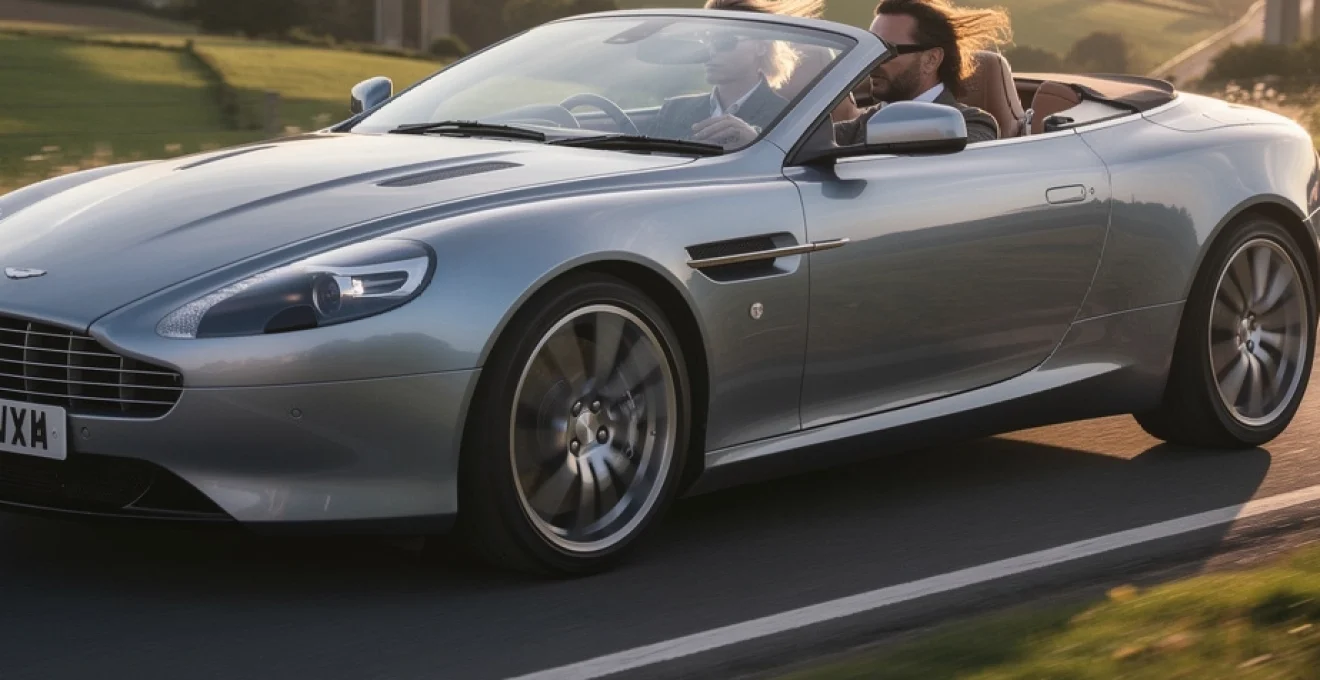
The Aston Martin DB9 Volante sits in a rarefied corner of the luxury convertible market where design, craftsmanship and a naturally aspirated V12 still matter more than lap times. For many enthusiasts, it represents the last era of genuinely analogue grand tourers: hand-built, beautifully balanced and shaped by designers rather than software. If you are evaluating a DB9 Volante as a used luxury cabriolet, you are looking at a car that blends continent‑crushing performance with old‑world glamour in a way very few rivals can match. Understanding how it looks, feels, drives and costs to run over the long term is essential before committing to ownership.
Aston martin DB9 volante design overview: ian callum styling, proportions and aluminium VH platform architecture
The DB9 Volante’s design still looks remarkably fresh for a car conceived in the early 2000s. Styled under Ian Callum and later refined by Marek Reichman, it is an object lesson in proportion: long bonnet, set‑back cabin, tight rear overhang and muscular haunches. Built on Aston Martin’s modular VH architecture, the DB9 uses extruded aluminium sections, bonded and riveted together, with carbon fibre elements for extra stiffness. This gives the convertible a kerbweight around 1,850kg, only about 100kg more than the coupé, impressive for a 2+2 luxury cabriolet with a full electric hood. Visually, the DB9 Volante manages to look both classic and modern, avoiding the aggressive excesses that date some rivals.
Exterior surfacing analysis: front grille, swan-wing doors and fabric roof integration on the DB9 volante
From the front, the DB9 Volante is defined by the iconic aluminium grille and slim, swept‑back headlamp clusters. The surfacing is clean and tightly controlled, with subtle power bulges over the front wheels and a defined shoulder line running to the rear lights. The famed swan‑wing doors open upwards slightly, not just for drama but also to clear kerbs, and contribute to a sense of theatre every time you get in. The fabric roof sits low when raised and folds neatly beneath a hard tonneau, giving the car a cohesive profile roof up or roof down. Some convertibles look compromised with the top in place; the DB9 Volante remains elegant, with no awkward roofline kinks or heavy‑handed buttresses.
Aerodynamic profile and drag characteristics compared with DB9 coupé and vantage roadster
Aerodynamically, the DB9 Volante inevitably trails the coupé. Typical drag coefficients are around 0.34–0.35 for the soft‑top versus approximately 0.33 for the DB9 coupé, largely due to the disturbed airflow over the open cockpit and fabric roof profile. Even so, careful shaping of the rear deck, underbody and diffuser area helps the Volante maintain stability at its near‑190mph top speed. Compared with the smaller Vantage Roadster, the DB9 Volante feels more planted at high speed, thanks to its longer wheelbase and broader track, which reduce pitch and lift over motorway crests. For sustained 150mph+ autobahn running, the coupé remains the optimal tool, but the Volante comes impressively close given its open‑top format.
Lighting technology, wheel designs and paint finishes: xenon headlamps, 20-inch alloys and Q by aston martin options
Throughout production, the DB9 Volante used projector‑style Xenon headlamps with LED signature elements, later adopting updated light graphics and Virage‑inspired units from 2012. Illumination performance remains strong by contemporary standards, particularly in main‑beam mode, although it lacks the adaptive LED matrix systems now found in newer GTs. Wheel designs progressed from elegant 19‑inch rims to more assertive 20‑inch alloys on later cars, offering sharper response at the expense of a firmer ride. Paint finishes are a highlight: deep metallics, understated solid tones and special Q by Aston Martin hues ensure almost endless variety. Commissioned cars often combine bespoke paint with contrasting brake calipers and unique wheel finishes to deliver a truly individual DB9 Volante.
Convertible roof engineering: multi-layer soft-top mechanism, sealing and wind management at motorway speeds
The DB9 Volante’s multi‑layer fabric soft‑top is one of its most impressive engineering achievements. Operated electrically in around 14–17 seconds and usable at speeds up to roughly 30mph, it folds compactly into the rear compartment without consuming excessive boot space. Multiple acoustic and thermal layers mean cabin noise with the roof up is comparable to many fixed‑roof GTs; owners frequently remark that motorway refinement surpasses some hardtops from the same era. Sealing around the windows and header rail is generally excellent, with water ingress rare if the car has been correctly maintained. At 70–80mph, wind buffeting is well controlled, especially with the wind deflector in place, allowing you to cruise long distances roof‑down without fatigue.
Handcrafted interior of the aston martin DB9 volante: materials, ergonomics and GT usability
Cabin architecture and seating: 2+2 layout, seat bolstering and driving position analysis
Inside, the DB9 Volante offers a classic 2+2 cabin layout, but functionally it is best considered a two‑seater with occasional rear perches. Front occupants benefit from generously adjustable seats with moderate bolstering, striking a sensible compromise between long‑distance comfort and lateral support. The driving position is low and laid‑back, with a slim‑rimmed steering wheel and clear analogue dials directly ahead. Pedal alignment is generally good, although taller drivers may find the footwell a little tight on early cars. Rear seats suit small children or adults for very short journeys; most owners use the rear bench as additional luggage space for soft bags and coats, especially on long cross‑Europe drives.
Leather, alcantara and veneer options: bridge of weir hides, wood trims and carbon fibre packs
Material quality is a major part of the DB9 Volante’s appeal. Each cabin uses around seven Bridge of Weir hides, hand‑stitched and matched for grain, delivering a rich leather aroma that is difficult to replicate. Standard finish combined leather with traditional wood veneers such as walnut or piano black, but later cars and Q‑specified examples often use carbon fibre or satin alloy packs for a more contemporary feel. Alcantara headlinings and bespoke stitching colours allow further individualisation. It is worth examining any used example closely for seat wear, particularly on bolsters and entry points, as re‑trimming to factory standards can be expensive. A well‑kept interior remains one of the clearest indicators of careful ownership.
Infotainment and connectivity: sat-nav, bang & olufsen vs aston martin premium audio and bluetooth integration
Infotainment is the area where the DB9 Volante feels most dated, especially when judged against modern luxury convertibles. Early cars used a Volvo‑derived sat‑nav system that is widely criticised for clunky menus and slow route calculation. Later updates improved software but never brought full smartphone‑style usability. Audio options ranged from Aston Martin Premium Audio to a 1,000W Bang & Olufsen BeoSound system, recognisable by the motorised dashboard tweeters that rise when powered on. For music lovers, the B&O setup transforms the cabin into an open‑air concert hall, especially roof‑down on a summer evening. Bluetooth phone integration is present on later cars but may be limited to calls rather than full media streaming, so many owners retrofit discreet modern modules.
Practicality in a luxury cabriolet: boot capacity, roof-down storage and everyday usability
Boot capacity in the DB9 Volante is officially around 187 litres, less than a Mercedes SL but usable for weekend bags or two medium suitcases. Roof operation does not steal additional space, so you can pack without worrying about luggage fouling the hood mechanism. Everyday usability is surprisingly good for a low‑slung GT: visibility is reasonable, front and rear parking sensors are common, and the car is narrow enough to thread through typical UK roads and car parks with care. However, it remains a long, valuable convertible, so planning routes that avoid tight multi‑storeys or very narrow lanes will save anxiety. For regular touring, a soft weekend bag is far easier to manage than hard suitcases.
V12 powertrain and performance: aston martin DB9 volante engine, transmission and exhaust character
Technical specification of the 5.9-litre (AM11) V12: power output, torque curve and compression ratio
At the heart of the DB9 Volante lies Aston Martin’s AM11 5.9‑litre V12, an all‑alloy, quad‑cam engine derived from Ford’s modular architecture but heavily re‑engineered. Early cars produced around 450bhp, later rising to 470bhp in 2009 and 510bhp from 2012, with torque figures hovering near 443lb ft. Compression ratio increased from roughly 10.3:1 to 10.9:1 over the model cycle, sharpening throttle response and mid‑range punch. The torque curve is pleasantly flat, delivering strong pull from 2,000rpm and building to a ferocious top‑end rush beyond 4,000rpm. Unlike modern turbocharged units, response is linear and predictable, making the DB9 Volante easy to meter on wet roads yet devastatingly quick when fully extended.
Touchtronic automatic gearbox calibration: gear ratios, shift logic and GT driving character
Most DB9 Volantes use the rear‑mounted six‑speed ZF automatic, badged Touchtronic. Gear ratios are chosen to keep the V12 spinning in its torque sweet spot, with a long top gear for relaxed motorway cruising at around 2,000–2,200rpm at 70mph. In default mode, shifts prioritise smoothness; in Sport, the gearbox holds gears longer, responds more keenly to throttle inputs and executes quicker upshifts and rev‑matched downshifts via the column‑mounted paddles. There is a noticeable step in character between modes, so you can genuinely tailor the car to mood and road. A rare six‑speed manual exists and is highly prized by purists, but for long‑distance GT use, the automatic suits the DB9 Volante’s character almost perfectly.
0–62mph, top speed and in-gear acceleration figures compared with bentley continental GTC and ferrari california
Performance figures place the DB9 Volante firmly in the serious GT bracket. Later 510bhp cars achieve 0–62mph in around 4.6 seconds, with an official top speed close to 183–186mph. Earlier, lower‑power versions sit in the high‑4s. For context, a Bentley Continental GTC W12 of similar vintage records about 4.8 seconds to 62mph and a 195mph top speed, while a Ferrari California (V8) can dip into the mid‑4s. In‑gear acceleration is where the Aston shines as a long‑legged grand tourer: strong roll‑on from 50–70mph in fourth or fifth allows effortless overtakes on French autoroutes or UK A‑roads. The car feels impressively rapid in real‑world use without ever being intimidating.
Exhaust system acoustics: intake resonance, valve control and the signature aston martin V12 soundtrack
The DB9 Volante’s exhaust note is one of its defining features. At low revs, the system remains relatively civilised, aided by exhaust valves that keep noise within long‑distance comfort levels. Press the Sport button or climb above a certain rpm threshold, and those valves open, unleashing a hard‑edged, metallic howl that echoes off tunnel walls and city buildings. Intake resonance adds another layer of drama, with an induction roar building as the tacho sweeps past 4,000rpm. Many owners describe the sound as a reason to choose the DB9 over more clinical turbocharged rivals; roof‑down, it becomes an addictive part of every journey. Any used car with an unusually muted or uneven exhaust tone warrants inspection by a specialist.
Chassis, dynamics and ride quality: evaluating the DB9 volante as an open-top grand tourer
VH bonded aluminium chassis tuning: torsional rigidity and structural bracing for the volante
Converting the DB9 coupé into the Volante required significant extra bracing to maintain acceptable torsional rigidity. Additional structural elements under the floor and around the bulkheads increase stiffness by roughly 10 percent versus early open‑top prototypes, resulting in a convertible that feels solid at typical UK road speeds. Some scuttle shake remains evident on poor surfaces, as with most soft‑tops, but far less than on many competitors from the same era. The bonded aluminium VH architecture proves its worth here: despite the roof removal, the DB9 Volante avoids the flex and rattles that can plague older steel‑based cabriolets, giving you confidence to use the full performance without the sense of the body twisting beneath you.
Adaptive damping (ADS), spring rates and ride comfort on UK b-roads and motorways
Later DB9 Volantes benefit from Aston Martin’s Adaptive Damping System (ADS), offering multiple modes to tailor the suspension response. In the standard setting, ride comfort is impressively supple for a car on 19‑ or 20‑inch wheels, rounding off sharp edges and dealing well with motorway expansion joints. Select the firmer mode and body control tightens noticeably, proving useful on fast, flowing A‑roads where undulations could otherwise unsettle the car. On broken UK B‑roads, the Volante can feel a little fidgety, especially on earlier non‑ADS cars with stiffer spring rates, but it rarely becomes harsh. As with many GTs, choosing the right tyre brand and pressures makes a significant difference to secondary ride and noise levels.
Steering feel, brake performance and tyre choices: pirelli P zero vs bridgestone potenza fitments
Steering in the DB9 Volante is hydraulically assisted, offering more natural feedback than many modern electric setups. Weighting is medium‑heavy at low speeds but relaxes slightly as pace builds, giving a reassuring sense of connection. Standard brakes use large steel discs, with later cars adopting carbon‑ceramic options that deliver outstanding stopping power and fade resistance, particularly useful on alpine descents or track days. Tyre choice is typically between Pirelli P Zero and Bridgestone Potenza fitments in the market; many owners report that P Zeros offer a more compliant ride and progressive breakaway, while Potenzas can feel a touch sharper but noisier. Regular alignment checks are critical, as uneven tyre wear often points to worn control arms or bushes.
Handling balance with roof up vs roof down: body control, roll behaviour and high-speed stability
With the roof up, the DB9 Volante behaves much like the coupé: neutral, predictable and slightly biased towards safe understeer when pushed hard. Body roll is well contained, especially on later ADS‑equipped cars, and the chassis encourages quick but smooth driving rather than sudden, aggressive inputs. Roof‑down, the car’s balance remains consistent, though you may feel a touch more vertical movement over big bumps due to the open structure. High‑speed stability is a standout strength; the long wheelbase and careful aero work keep the car planted on autobahns even approaching its top speed. For brisk cross‑continent touring, few open‑top GTs of the era feel as composed and confidence‑inspiring.
Luxury and technology features: GT comfort, driver assistance and customisation for the DB9 volante
Climate control, seat heating and wind deflector efficiency for top-down comfort in all seasons
Effective climate management is crucial in a luxury convertible intended for year‑round use. The DB9 Volante’s dual‑zone automatic climate control delivers strong heating and air‑conditioning performance, with generous vents aimed at both occupants. Seat heating is standard or common on most UK‑supplied cars, transforming chilly spring or autumn drives into cosy experiences, especially when combined with the wind deflector. This simple but effective accessory dramatically reduces cabin turbulence at motorway speeds, allowing normal conversation roof‑down at 70mph. With the right clothing, you can genuinely use the car with the hood lowered in temperatures as low as 5–7°C without discomfort, turning every journey into an occasion rather than reserving the car solely for summer.
Driver assistance and safety systems: stability control, traction control and brake assist
Electronic safety systems on the DB9 Volante focus on discreetly supporting the driver rather than intruding. Stability and traction control monitor individual wheel speeds and yaw rates, gently trimming power or applying brakes to maintain the chosen line if grip levels start to drop. Brake assist and ABS ensure consistent stopping performance on wet or variable surfaces, while the braking hardware itself is sized for repeated high‑speed use. Multiple airbags and a strengthened front structure contribute to passive safety, meeting stringent pedestrian impact regulations introduced during the DB9’s lifecycle. While the car lacks the full suite of modern driver‑assistance systems such as lane‑keeping or adaptive cruise, the fundamental chassis security means you rarely miss them in normal driving.
Personalisation via Q by aston martin: bespoke colours, tailored interiors and one-off commissions
For buyers seeking something beyond the standard options catalogue, Aston Martin’s Q by Aston Martin service opened up a world of personalisation. Bespoke paint colours, contrasting exterior details and unique wheel finishes allow you to create a DB9 Volante that stands apart from typical showroom cars. Inside, Q offers tailored leather and Alcantara combinations, custom embroidery, special veneers and even one‑off trim elements inspired by architecture, fashion or travel. On the used market, Q‑specified cars can be particularly desirable, provided the chosen specification remains tasteful and coherent. When evaluating a potential purchase, considering how unique options might affect future resale is sensible; some very bold commissions appeal to a narrower audience.
Running costs, reliability and ownership experience of the aston martin DB9 volante in the UK
Running a DB9 Volante in the UK requires eyes‑open awareness of costs, but not the fear reserved for some more exotic supercars. Average fuel economy hovers between 15–20mpg depending on driving style, with CO₂ emissions for later cars around 333g/km, leading to the highest UK road tax band. Annual servicing at a marque specialist typically falls in the region of £1,500–£2,000, rising if additional work is required. Reliability has improved steadily over the model’s life; the V12 engine and six‑speed automatic are fundamentally robust if maintained on schedule. Issues to watch include ageing coil packs, occasional electrical gremlins and corrosion around door bottoms, wheelarches and boot edges despite the aluminium body, due to poor historic repairs or moisture trapped at panel joins.
Tyres and brakes are major consumables. A set of quality 19‑ or 20‑inch tyres can easily exceed £1,000, and rear tyres in particular may last only 8,000–10,000 miles on spiritedly driven cars. Carbon‑ceramic brake discs, where fitted, command very high replacement costs, so checking remaining life is important. Insurance falls into the top UK groups, often producing four‑figure annual premiums, though specialist brokers can help for limited‑mileage policies. The upside is that, according to various market analyses, DB9 values have largely plateaued in recent years, with well‑cared‑for Volantes depreciating far more gently than a decade ago. Treated as a special‑occasion GT rather than a daily commuter, the ownership experience rewards with unmatched sense of occasion per mile.
Buying guide and market analysis: used aston martin DB9 volante prices, model years and key upgrades
For UK buyers, the DB9 Volante market now stretches from tempting high‑mileage early cars around £25,000 to immaculate late‑model examples nudging £60,000 or more. The cheapest cars often come with incomplete history or deferred maintenance; although the low entry price seems attractive, remedial work can quickly exceed any initial saving. A sensible budget for a well‑cared‑for Volante with full service records is typically £40,000–£45,000. Later 2012‑onwards cars with the 510bhp engine, visual refresh and updated interior materials usually command a premium and are widely regarded as the sweet spot between performance, reliability and modernity.
Key model‑year milestones help focus the search. The Volante launched in 2005 with around 450bhp and early electrical niggles that were progressively ironed out by 2006. A 2008–2009 update boosted power to 470bhp, introduced revised Bilstein dampers and improved gearbox software. A significant 2012 facelift brought sharper styling, 510bhp output and chassis revisions that moved the DB9 closer to the then‑new Vanquish in character. Special editions such as LM or GT variants are rarer and may command higher prices, particularly if paired with the scarce manual gearbox, but check that any collectible model has correct provenance and original specification.
| Model year | Power output | Notable changes | Typical UK price range* |
|---|---|---|---|
| 2005–2007 | ~450bhp | Launch cars, early electrics | £25,000–£35,000 |
| 2008–2011 | ~470bhp | Revised dampers, updated console | £30,000–£45,000 |
| 2012–2015 | ~510bhp | Facelift, chassis and tech updates | £40,000–£60,000 |
*Indicative figures, heavily dependent on mileage, condition and history.
When inspecting a potential purchase, a structured approach pays dividends. A pre‑purchase inspection by an independent Aston Martin specialist is strongly recommended; the cost is modest compared with the potential expense of hidden issues. Look for full service history, ideally with main dealers or recognised independents, and evidence of timely replacement of coil packs, consumables and any corroded exterior panels. Check that the soft‑top operates smoothly and seals properly, and that cabin electronics, including seat adjusters and infotainment, work as intended. Tyre brands and tread depths reveal much about an owner’s willingness to spend on upkeep; mismatched budget tyres on a 500bhp GT are an immediate red flag.
A well-chosen DB9 Volante, maintained correctly, offers one of the most immersive and emotionally rewarding open-top GT experiences available at this price level.
For long‑term enjoyment, planning how you will use the car is crucial. If you intend regular European road trips, prioritising later 510bhp cars with Adaptive Damping, Bang & Olufsen audio and comfortable seat options makes sense. For occasional weekend use and future collectability, a lower‑mileage earlier car in an iconic colour combination may be more appealing. In all cases, budgeting realistically for running costs, storage and detailing will preserve both value and enjoyment. Treated as a piece of rolling sculpture and a serious driver’s car rather than a mere status symbol, the Aston Martin DB9 Volante rewards every journey with a sense of occasion few modern machines can match.