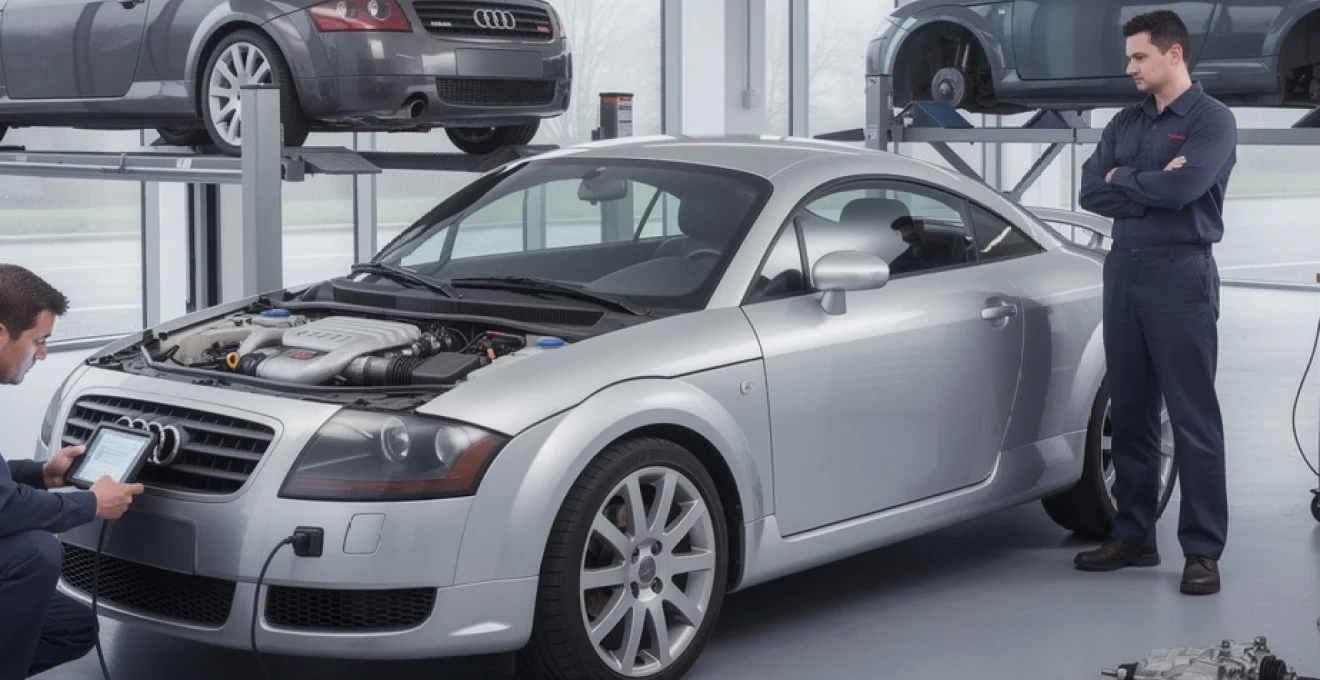
The 2003 Audi TT 1.8T sits at a sweet spot in modern-classic ownership. It still turns heads like a concept car that escaped the motor show, yet shares robust PQ34 Golf underpinnings and a huge aftermarket. For drivers who want a compact coupé or roadster that feels special every time you walk up to it, the first-generation TT offers a rare mix of design, usability and year-round usability thanks to quattro. Values for good cars are rising as production of the TT line ends, so choosing wisely in 2025 matters more than ever. Understanding the 1.8T engines, Haldex quattro system and known weak points will help you buy a 2003 TT that is more modern icon than money pit.
Audi TT 1.8 (8N, 2003) model overview: engines, trims and key technical specifications
Engine variants: 1.8T 150 bhp, 180 bhp and 225 bhp BAM unit compared
In 2003 the Audi TT range revolved around the 1.8-litre 20-valve turbocharged four-cylinder, known internally as the 1.8T. Three main outputs matter to you as a buyer: 150 bhp (front-wheel drive only), 180 bhp and 225 bhp. All share the same basic architecture but differ in turbocharger size, intercooling and internal components. The 150 produces adequate pace but is more style-led than performance-focused. The 180 bhp version uses a K03 turbo and usually comes with quattro, delivering brisk everyday performance and around 7.7 seconds 0–60 mph when healthy.
The 225 bhp engine (commonly the BAM unit in 2003 UK cars) is the enthusiast’s choice. It features a larger K04 turbo, twin intercoolers, stronger pistons and different manifolds. Factory figures quote 0–62 mph in about 6.4 seconds, with real-world in-gear shove that still feels modern. Many owners remap the 225 to 260–270 bhp on stock hardware; checks around condition and proof of maintenance become more important on any tuned example you view.
Quattro vs front-wheel drive (FWD): haldex generation 1 system on the 2003 TT
The 2003 TT 1.8T uses the first-generation Haldex on-demand all-wheel drive system on quattro models. In normal cruising, most power goes to the front axle; when the ECU detects slip, an electronically controlled clutch sends torque to the rear, up to roughly a 60:40 front–rear split. On UK roads with wet tarmac, standing water and the occasional snow day, that extra traction is one of the biggest reasons to favour a quattro TT 1.8 over a FWD 150. It also makes the car feel more planted when accelerating out of tight junctions or damp roundabouts.
However, quattro brings extra weight, more components to service and the need for regular oil and filter changes in the Haldex unit every 20,000–40,000 miles. Many neglected cars have never had this done, so service records on a used 2003 TT are critical. From a driving perspective the system is tuned for secure understeer rather than drift angles, but a healthy Haldex adds confidence and stability in poor weather without sacrificing everyday usability.
Manual vs tiptronic automatic gearboxes: 5-speed, 6-speed and reliability considerations
Most 2003 UK-market TT 1.8s use a 6-speed manual gearbox on quattro models and a 5-speed manual on the lower-powered FWD variants. The 6-speed suits the turbo engine’s torque curve, keeps motorway revs low and is generally robust if serviced with quality oil. Clutches can last 80,000–100,000 miles on standard power, but remapped cars or city-heavy use shorten that significantly. A heavy pedal, judder or slip in higher gears under boost suggests a clutch and possibly dual-mass flywheel bill in the near future.
A small number of 2003 cars use the conventional Tiptronic automatic (not DSG) on front-drive models. This torque-converter auto is smoother than sporting, adding weight and dulling responses. For most enthusiasts the manuals are the ones to target, especially the 6-speed mated to the 225 bhp engine. Gear selection should feel precise, without grinding or baulking; any refusal to engage a gear may point to internal wear that requires gearbox removal.
Coupe vs roadster (8N3 vs 8N9): chassis rigidity, weight and practicality differences
The fixed-roof TT is coded 8N3, while the Roadster carries the 8N9 designation. The coupé’s steel roof gives noticeably greater torsional rigidity, which benefits handling precision and refinement over broken UK B-roads. It also provides a useful hatchback with folding rear seats, giving genuine weekend-away practicality or space for trackday wheels and tyres. Rear seats are small 2+2 perches, but as occasional child or luggage space they outdo many rivals of the period.
The Roadster trades that practicality for open-air appeal. Additional bracing in the sills and bulkheads keeps scuttle shake surprisingly low for a 20+ year old convertible, but curb weight rises and luggage space shrinks. If you value a compact GT for year-round use, the coupé usually wins. If top-down driving matters more than ultimate sharpness, a well-maintained 2003 Roadster remains a charming alternative, as long as the roof system works flawlessly.
Standard equipment and option packs in 2003: bose audio, xenon headlights and heated leather
By 2003, Audi had started to bundle popular options into well-specced cars, especially in the UK where the TT sold in large numbers. Standard kit typically included climate control, sports seats, alloy wheels, front fog lights and traction control. Many 180 and 225 bhp cars also gained leather upholstery and heated seats, making the TT a very usable daily driver even in winter. A significant number of UK examples were ordered with the optional Bose sound system and factory Xenon headlights.
Bose audio adds a dedicated amplifier and upgraded speakers; when functioning correctly it still sounds respectable for a 2000s car. Xenon headlights deliver far superior night-time visibility but rely on level sensors and headlight washers, both of which can fail with age. Heated leather, rear parking sensors and upgrade wheels all increase desirability on the used market. When comparing two cars, well-documented options and a tidy interior often matter more than mileage alone.
Driving dynamics and performance of the 2003 audi TT 1.8 on UK roads
Real-world acceleration and in-gear performance: 0–60 mph and 30–70 mph figures
On paper, a 2003 Audi TT 1.8T 225 quattro covers 0–62 mph in around 6.4 seconds, with the 180 sitting nearer 7.7 seconds and the 150 in the low 8s. In practice, the more telling measure is 30–70 mph in-gear acceleration, particularly for overtakes on A-roads. A healthy 225 on boost feels urgent from 2500 rpm, pulling strongly through third and fourth gears; independent tests when new recorded 30–70 mph in roughly 6.5–7.0 seconds. Even today, that keeps pace with many modern hot hatchbacks.
The 180 bhp TT remains brisk enough for everyday driving, especially if you value smooth torque over headline figures. The 150 makes most sense for drivers focused on style, comfort and lower insurance, with respectable but not thrilling pace. Many UK owners have chosen a stage 1 remap; if you test-drive a tuned example, check for clean, consistent boost and no surging or misfiring at high load.
Handling characteristics: understeer, haldex torque transfer and ESP calibration
Early TT models famously required a handling recall after high-speed incidents on the autobahn. By 2003, cars left the factory with revised suspension, ESP and a fixed rear spoiler as standard, making the chassis inherently more stable. The default balance is safe understeer, especially on the front-drive variants, but the quattro cars can feel surprisingly neutral when driven smoothly. On a wet B-road, the Haldex system shuffles torque rearwards quickly enough to let you accelerate earlier out of bends.
ESP is tuned conservatively, cutting in earlier than keen drivers might like, but it can be switched off for dry-road enthusiasm. Even then, the TT is not a dance-partner in the way a contemporary Porsche Boxster or Nissan 350Z is. Instead, think of it as a compact GT: secure, predictable and very rapid cross-country when you work with its tidy, nose-led balance rather than trying to provoke oversteer.
Braking systems: 312 mm front discs on 225 models vs smaller setups on 150/180
All 2003 TT 1.8T models use single-piston calipers, but the 225 bhp quattro gains larger 312 mm front discs. This setup resists fade better on spirited drives and is worthwhile if you plan occasional trackdays. The 150 and 180 cars use smaller front brakes that are adequate for daily use but can feel underbraked during repeated hard stops, especially on heavier Roadsters. Many owners upgrade pads to performance compounds and fit fresh high-quality discs to improve bite and consistency.
On a test drive, pay attention to any judder under braking, pulling to one side or a long pedal travel. These symptoms can indicate warped discs, sticky calipers or degraded brake fluid. Given the TT’s age and weight, a full brake refresh with uprated pads is often one of the most cost-effective ways to improve real-world stopping performance and driver confidence.
Ride comfort and NVH: motorway refinement, suspension noise and wind intrusion
The Mk1 TT rides on relatively short wheelbase Golf underpinnings, so the ride is firm but not punishing when the suspension is in good order. Over broken tarmac, tired dampers and snapped springs (very common on older TTs) can turn the ride brittle and crashy. Fresh OEM or quality aftermarket dampers transform comfort, especially on UK roads peppered with potholes and speed humps. Cabin noise at motorway speeds is respectably low for a 20-year-old coupé, helped by good aerodynamics and thick doors.
Roadster versions generate more wind noise past 70 mph, even with the hood up, but remain acceptable for long trips if seals and the glass wind deflector are in good condition. Any knocking or clunking over small bumps likely points to worn anti-roll bar bushes, drop links or top mounts rather than something more serious. A quiet, rattle-free car over rough surfaces usually indicates money already spent underneath.
Common mechanical issues on the audi TT 1.8T (2003) and how to diagnose them
1.8T engine weak points: coil pack failures, oil sludge and PCV system leaks
The 1.8T has earned a reputation as almost bombproof when serviced correctly, with many examples exceeding 200,000 miles. Ignition coil packs, however, are a known weak spot. Misfires under load, a flashing check engine light and lumpy idle often trace back to failing coils or old spark plugs. Replacement is cheap and straightforward, but persistent misfires should be investigated with diagnostics rather than guessing. Another long-term risk is oil sludge in the sump pickup, especially if oil changes were stretched to 10,000+ miles with poor-quality lubricants.
The breather and PCV (positive crankcase ventilation) system on the 1.8T is a maze of plastic hoses that become brittle with age. Unmetered air leaks here cause rough running, high fuel trims and oily residue around connections. During inspection, look for fresh rubber pipework and evidence of recent PCV parts; these are often signs of a diligent owner. Using quality 5W-30 fully synthetic oil at 5,000–6,000 mile intervals is a key preventative measure for engine longevity.
Haldex quattro service and faults: pump failures, filter neglect and AWD warning lights
Generation 1 Haldex units rely on clean oil and a functioning pump to engage the rear axle. Many used TTs show no record of Haldex servicing, yet the recommended intervals are 20,000 miles for oil and 40,000 miles for oil plus filter. Symptoms of trouble include front-wheel spin under hard acceleration, ABS/ESP warning lights and fault codes for the Haldex pump or pressure sensor. A noisy or inoperative pump can often be revived with a service and new filter if caught early; left neglected, a full replacement can easily exceed £700–£900 with labour.
During a test drive on a damp surface, accelerate hard from low speed with some steering lock. If the car scrabbles its front tyres excessively, the rear axle may not be contributing properly. An OBD-II scan with VCDS will quickly reveal Haldex-related faults and clutch duty cycles, allowing a much clearer picture of the system’s health before committing to purchase.
Timing belt and water pump service intervals: interference engine risks and OEM parts
The 1.8T is an interference engine, so a snapped timing belt means bent valves and usually a replacement cylinder head or complete engine. Audi’s original interval of 80,000 miles or 5 years is considered too optimistic by specialists; many now advise 60,000 miles or 4–5 years for belt, tensioners and idlers. The water pump sits behind the belt and uses a plastic impeller from the factory, which can crack or spin on the shaft. Upgrading to a metal-impeller pump during belt replacement is standard practice among good independent garages.
On a 2003 TT, any belt older than five years should be considered due regardless of mileage. Receipts for a full timing belt kit, not just the belt itself, matter when assessing value. A comprehensive job from a specialist typically runs £450–£700 depending on region and parts choice; walking away from a car without evidence of this work can save a far larger engine bill later.
Turbocharger problems: K03 vs K04 wastegate wear, boost leaks and smoke diagnostics
The smaller K03 turbos on 150/180 cars and the larger K04 on 225s can both suffer from age-related issues. Wastegate actuator wear leads to sluggish spool, low boost or overboost codes. Boost hoses and diverter valves split or stick, causing hissing noises, flat spots and a soft, inconsistent surge. A healthy 1.8T should build boost smoothly from around 2000–2500 rpm without whistles, sirens or whooshing beyond the normal turbo sound.
Exhaust smoke tells additional stories. Blue smoke on overrun points to valve stem seal or turbo bearing wear; blue smoke on boost more often indicates turbo oil seals failing. White smoke accompanied by coolant loss suggests head gasket or cracked head problems, though these are less common than in some rival engines. A post-drive inspection of the intercooler pipes for excessive oil is a worthwhile step when considering any older turbocharged Audi.
Cooling system checks: thermostat housings, radiators and coolant temperature sensors
The cooling system on the TT 1.8T is generally reliable but far from immune to age. Plastic thermostat housings and flanges can crack, leading to gradual leaks that are hard to spot without pressure testing. Radiators corrode, especially at the lower corners, and auxiliary pumps can fail on some variants. Pay attention to how quickly the engine warms up: it should reach a steady 90°C on the gauge within 5–10 minutes of gentle driving and stay there.
If the gauge drops back towards 70°C on the move, the thermostat is probably stuck open, hurting fuel economy. An erratic gauge, fans that run constantly or code P0118/P0117 often trace back to a failing coolant temperature sensor. Coolant should be pink/purple G12 or G13, not rusty brown or plain water. Any sign of mayonnaise under the oil cap on a fully warm engine should trigger deeper investigation.
Chassis, suspension and braking wear points specific to the 8N audi TT
The 8N TT rides on heavy hardware for its size, so suspension wear is a near-certainty on any 2003 car that has not been comprehensively refreshed. Front coil springs are notorious for snapping at the bottom coil, sometimes only visible once the strut is removed. Broken springs significantly affect MOT results and ride quality. Original anti-roll bars use plastic collars that crack, allowing lateral movement and clunks; many cars now run uprated bars with metal sleeves, which is a plus point when viewing a car. Ball joints, track rod ends and top mounts typically show play between 80,000 and 110,000 miles, with tell-tale knocks over low-speed bumps.
Rear suspension is simpler but still suffers from perished bushes and worn drop links. On a test drive, listen for a hollow thud from the rear over potholes or speed cushions. Tyre wear can also highlight geometry issues: excessive inner or outer shoulder wear, particularly on V6 or 225 models, suggests the car needs a proper four-wheel alignment or may have worn bushes. Brakes, as noted, are dependable but age-sensitive. At this point many cars benefit from fresh calipers, braided hoses and quality fluid; such work is a good sign that previous owners have invested, not cut corners.
Interior, electronics and convenience systems on the 2003 audi TT 1.8
Instrument cluster pixel failure, gauge errors and repair options in the UK
Instrument cluster (dashpod) faults are one of the best-known electrical issues on the Mk1 TT. Symptoms include dead or flickering LCD pixels, fuel or temperature gauges stuck at odd readings, or intermittent total failure of the cluster on cold mornings. Rather than replacing the entire unit at main-dealer prices, several UK specialists now offer refurbishment services, typically around £200–£300 including removal and refit.
When inspecting a TT, watch the cluster through a full start-up cycle: all warning lights should illuminate briefly, then extinguish. Compare the fuel gauge reading with the range shown in the Driver Information System. Heavy condensation inside the cluster or missing pixels often indicates a repair will soon be needed, which can be a useful bargaining point if the rest of the car is strong.
Climate control panel faults, fan resistors and blend flap motor issues
The TT’s climate control unit is shared with several other VW Group models and suffers familiar age-related problems. Failing fan resistors or blower motors cause fans that only work on certain speeds or not at all. Blend flap motors can seize or lose calibration, leading to air only blowing hot, only cold or only from certain vents. A properly functioning system should allow you to set 20–22°C and maintain a comfortable cabin quickly without unusual noises from behind the dashboard.
Button backlighting can fail, but this is largely cosmetic. Replacements and repairs are widely available via independent specialists and refurbished units. On a test drive, cycle through all modes (screen, face, feet) and temperature extremes to confirm both heater matrix and air conditioning perform as intended.
BOSE sound system, factory head units and bluetooth retrofit possibilities
Many 2003 TTs left the factory with the optional Bose sound system, identifiable by branding on the speaker grilles and a different EQ curve. When working correctly it delivers solid, if not modern hi-fi, performance. Age can catch up with Bose amplifiers, causing intermittent channels or total silence. Testing every speaker with balance and fader controls is an easy way to check. Factory head units lack modern connectivity, but discreet Bluetooth retrofits are now common, preserving the original look while allowing hands-free calls and music streaming.
Aftermarket double-DIN units fit neatly into the TT’s dash with the correct fascia and loom adapters, but some buyers prefer originality. If you value OEM appearance, budget for a quality Bluetooth module that integrates with the original head unit; this upgrade significantly improves daily usability without hurting collector appeal.
Electric roof (roadster) diagnostics: hydraulic rams, microswitches and recalibration
On Roadster models, the electric soft top is a key system to check thoroughly. It relies on hydraulic rams, a pump, position sensors and numerous microswitches. Slow operation, uneven movement or warning lights suggest issues that can quickly become expensive. A healthy roof should complete its cycle smoothly in around 20 seconds, with no grinding noises or pauses. Hydraulic fluid leaks near the pump or rams are a red flag and often require expert attention.
Drainage channels around the rear storage area can block, leading to damp carpets and corrosion in hidden areas. During inspection, feel the carpets behind the seats and in the footwells for moisture. Many roof issues stem from failed microswitches rather than major hydraulic faults; specialist diagnostics can recalibrate the system and identify the culprit, but factor potential costs into any offer on a tired Roadster.
Rust, bodywork and structural inspection checklist for a used audi TT 1.8 (2003)
The TT’s galvanised body shell resists rust well, yet certain areas deserve close scrutiny. Roof rails on coupés can show bubbling where aluminium trim meets steel, a known early-life warranty issue that occasionally resurfaces now. Rear wheelarches, particularly where the arch meets the sill, may develop rust from stone chips and trapped dirt; run a hand along the inner lip and check for roughness or fresh paint edges. Around the fuel filler cap and lower door edges can also hide early corrosion. Underneath, the front subframe and suspension mounting points should be checked for flaking coatings or welding evidence.
Uneven panel gaps, overspray on rubbers and mismatched orange peel in the paint suggest accident repairs; a clear HPI check helps but does not tell the whole story. Headlights often suffer from UV clouding, which can be polished back, and condensation inside lamps points to failed seals rather than major accidents. On Roadsters, pay particular attention to the condition of the rear deck where the hood meets the body; poorly adjusted roofs can rub through paint over time.
Running costs, insurance groups and real-world fuel economy for the audi TT 1.8
Running a 2003 TT 1.8T in the UK is broadly comparable to other early-2000s performance coupés, with some areas cheaper thanks to shared parts with mainstream VW Group models. Insurance groups vary with output: the 150 tends to sit several groups lower than the 225, which is important if you are under 25 or in a high-risk postcode. Real-world fuel economy for a standard 225 quattro typically falls between 28–32 mpg combined, with 35+ mpg possible on gentle motorway runs. The 150 and 180 bhp cars can edge a few mpg higher, particularly in FWD form.
Servicing from a good independent specialist is sensible: typical annual servicing starts around £180–£250, with larger jobs like cambelt changes costing more as covered earlier. Consumables such as tyres, pads and discs are straightforward; a set of decent 17–18 inch tyres usually costs £400–£550. Road tax for most 2003 cars falls into pre-2006 CO₂ bands, so expect mid-tier rates rather than the very highest bands newer performance cars attract. Overall, a sorted TT 1.8T is not the cheapest small coupé to run, but owners migrating from heavier, thirstier V6s or V8s often find it refreshingly affordable.
Buyer’s checklist: how to inspect and test drive a 2003 audi TT 1.8T like a specialist
Pre-purchase documentation audit: service history, haldex stamps and MOT records
Before even seeing the car, ask the seller to confirm key elements of its paperwork. A thick folder of invoices is far more valuable than a partially stamped book. On a quattro TT, look for specific line items for Haldex oil and Haldex filter changes at least every 40,000 miles. Timing belt and water pump receipts, including tensioners, are non-negotiable for peace of mind. MOT histories (via the DVSA website) reveal patterns of advisories for tyres, suspension or corrosion, helping you spot cars that have been run on a tight budget.
If several major services or repairs seem to cluster around particular mileages with missing bills, consider whether the documentation is complete. A car with 120,000 miles and flawless records is often a safer bet than a 70,000-mile example with big gaps and vague stories.
Cold start and test drive procedure: idle quality, boost delivery and drivetrain noises
Whenever possible, insist on a cold start. A healthy 1.8T should fire quickly, settle to a smooth idle around 800–900 rpm and show no blue smoke from the exhaust. Tappet noise for a second or two is acceptable; persistent rattles are not. As the engine warms, listen for hunting idle, misfires or rattles from auxiliary components. On the move, build speed gently at first, then test full-throttle acceleration in second and third once warm; boost should come in cleanly without surging or flat spots.
During the drive, pay attention to drivetrain shunt, clonks on gearchange or judder when pulling away, all of which can point to worn mounts or clutch issues. At urban speeds, deliberately drive over small bumps and rough surfaces to provoke any suspension knocks. On an empty stretch, test braking from 60 mph with hands loosely on the wheel; any pulling or vibration indicates braking or geometry concerns worth addressing.
OBD-II scan with VCDS or OBDeleven: fault codes, readiness monitors and live data
An OBD-II scan is one of the most powerful tools you can use when buying a 2003 Audi TT 1.8T. Using VCDS, OBDeleven or another VW Group-capable tool, scan all modules for stored and pending fault codes. Recurrent codes for misfires, lambda sensors, MAF or boost control can highlight issues not obvious on a short test drive. Readiness monitors show whether the car has been driven enough since codes were last cleared; a freshly cleared ECU with incomplete readiness can be a subtle warning sign.
Live data such as fuel trims, intake air temperature, coolant temperature and requested vs actual boost helps confirm the engine is fuelling and boosting correctly. Logging a short third-gear pull on a safe road can reveal if boost is hitting target or being limited by limp modes. A seller comfortable with a diagnostic scan usually has less to hide than one who objects.
Verifying originality: VIN plate locations, option codes (PR codes) and accident repairs
Authenticating the car’s identity and spec protects you from cloned or heavily accident-damaged examples. The TT’s VIN appears under the windscreen, in the engine bay and on a sticker in the boot under the carpet, along with a list of PR codes that detail its original options. Matching these across locations and to the logbook confirms the shell and identity are consistent. Using online PR-code decoders, you can verify whether the car left the factory as a 150, 180 or 225 bhp model, with or without Bose, Xenon lights and specific suspension packages.
Check for signs of reshelling or major structural repairs: inconsistent welds, overspray on loom plugs, missing or misaligned sound deadening. A high-quality, fully documented repair is not necessarily a deal-breaker, but a car with unclear history and obvious structural work is best avoided if you want a solid long-term keeper.
Red flags and walk-away signs: misfires, overheating, uneven panel gaps and mismatched paint
Certain symptoms justify immediate caution, if not an outright walk-away. Persistent misfires under light and heavy load, especially when combined with oil consumption or blue smoke, suggest deeper engine or turbo issues than simple coil packs. Any indication of overheating – fans running constantly, temperature rising above 90°C in traffic, coolant loss – requires more investigation than is sensible during a casual viewing. Structural red flags include visibly twisted panel gaps, creased inner wings or distorted boot floors.
Mismatched paint shades between panels, especially across one side of the car, may signal previous accident damage that has not been repaired to a high standard. Water in the cabin (particularly on Roadsters), repeated MOT advisories for corrosion or suspension, and sellers who refuse independent inspections all add up to risk. The used market for the Mk1 TT is wide enough that you can afford to wait for a well-maintained, honest 2003 1.8T that rewards careful selection with years of enjoyable, characterful driving.