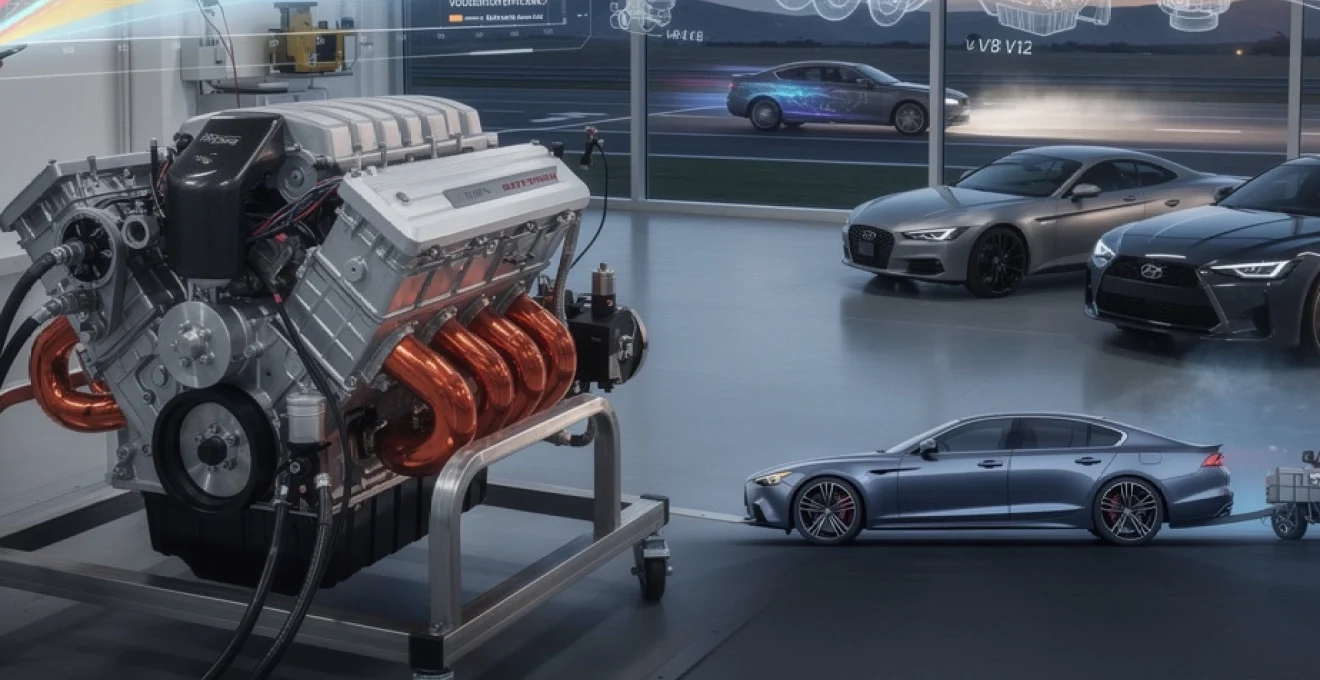
Large-capacity engines still hold a unique appeal in an increasingly electrified, efficiency-obsessed world. The deep reserves of torque, instant response and effortless acceleration that a 5.0‑litre V8 or 6.2‑litre V8 delivers are difficult to replicate with smaller, downsized units. Yet big engines sit under intense scrutiny from regulators and engineers alike, as brands try to balance emotional performance with strict CO₂ and emissions targets. Understanding how large engines generate power, how they behave in real-world driving and why they face growing regulatory pressure helps you decide whether a big-displacement car genuinely fits your needs or simply satisfies curiosity and passion.
Engine displacement and cylinder configuration: how big engines generate torque and power
Displacement, bore–stroke ratio and swept volume in 3.0L, 5.0L and 6.2L engines
Engine displacement is the foundation of what most drivers call a “big engine”. Technically, displacement is the total swept volume of all cylinders as their pistons move from top dead centre to bottom dead centre. It is usually expressed in litres (L) or cubic centimetres (cc). A 5.0L V8, for example, typically has eight cylinders with around 625cc each, while a 6.2L unit stretches that closer to 775cc per cylinder. The larger the displacement, the more air–fuel mixture can be burned per cycle, which naturally boosts torque and power potential.
Two key geometric parameters define how this swept volume is achieved: bore (cylinder diameter) and stroke (how far the piston travels). Many 5.0L and 6.2L V8s use an over-square design, meaning bore is larger than stroke. This allows higher engine speeds, larger valve area and better breathing at high rpm. By contrast, some 3.0L six‑cylinder engines target a more balanced bore–stroke ratio to optimise both low‑end torque and rev capability. The choice of geometry shapes the torque curve, efficiency window and maximum safe rpm.
V6 vs V8 vs V12 architecture: packaging, balance and firing order characteristics
Displacement is only half the story; the way cylinders are arranged has a major influence on refinement and responsiveness. A V6 engine fits neatly in smaller bays and is lighter, making it ideal for modern SUVs and performance saloons that must also meet strict efficiency targets. However, V6 engines can need balance shafts and clever mounting to match the smoothness of a traditional V8. A V8 layout, especially with a 90‑degree bank angle and cross‑plane crankshaft, is renowned for its creamy low‑frequency vibrations and iconic exhaust note, plus strong low‑rpm torque.
Move to a V12 and the experience changes again. With 12 smaller cylinders firing more frequently, a V12 offers near‑silky power delivery and very low rotational imbalance, which suits ultra‑luxury cars and high‑end GTs. The trade‑off is weight, complexity and cost. Firing order also matters: a flat‑plane V8 such as those used in some track‑focused supercars favours rapid revving and sharper throttle response, but can exhibit more vibration and less of the classic burbling sound many drivers expect from a big engine.
Large naturally aspirated engines vs smaller turbocharged units: specific output and drivability
The most intense debate in modern powertrain development concerns big naturally aspirated engines versus small turbocharged units. Naturally aspirated 5.0L or 6.2L engines often deliver relatively modest specific output (for example 80–100 bhp per litre), but provide wonderfully linear power delivery and immediate response to the throttle. By contrast, 2.0L turbocharged fours may exceed 150 bhp per litre, but rely on boost pressure and sophisticated engine management to match the peak numbers. For drivers, the result can feel very different despite similar headline outputs.
In daily driving, a large displacement engine rarely needs to exceed 3,000–3,500 rpm to deliver decisive acceleration. Small turbo engines can require more rpm and thoughtful gear selection to access their performance, especially when loaded. Modern variable geometry turbos and electrically assisted compressors have reduced lag dramatically, yet the effortless nature of a big V8 cruising at low revs remains hard to imitate. If you value relaxed, low‑rpm thrust more than ultimate efficiency, a larger engine still has a compelling case.
Case studies: ford coyote 5.0 V8, GM LT2 6.2 V8, Mercedes-AMG M177 4.0 V8 biturbo
The Ford Coyote 5.0 V8, used in the Mustang and F‑150, is a good example of a modern, high‑revving naturally aspirated engine. With dual overhead cams, variable valve timing and a relatively large bore, it produces around 450–480 bhp while remaining tractable at low revs. The GM LT2 6.2L V8 in the mid‑engined Corvette C8 takes a slightly different approach, favouring huge mid‑range torque and a wide, usable powerband, with up to 495 bhp and around 637 Nm in some trims.
Then there is the Mercedes‑AMG M177 4.0L V8 biturbo, which demonstrates how a smaller displacement with forced induction can rival or exceed classic big‑block performance. With its “hot‑inside‑V” twin‑turbo layout, direct injection and advanced cooling, outputs range from around 469 bhp up to well over 600 bhp in the most aggressive tune. These three case studies underline how displacement, aspiration and layout interact to produce very different character traits, even when peak numbers appear comparable on paper.
Combustion efficiency in large-displacement engines: from volumetric efficiency to BSFC
Volumetric efficiency in big-block designs: intake port geometry, valve area and camshaft profiles
Large engines must move a vast volume of air efficiently to justify their capacity. Volumetric efficiency (VE) expresses how effectively an engine fills its cylinders, typically as a percentage relative to theoretical capacity. High‑output 5.0L–6.2L engines frequently achieve VE above 100% at certain rpm ranges thanks to tuned intake runners, optimised port shapes and clever camshaft timing that exploits pressure waves in the intake and exhaust. The result is more charge entering the cylinder than its static volume would suggest.
Achieving this requires careful attention to intake port cross‑section, valve diameter and lift profile. Aggressive camshafts with long duration and high lift favour high‑rpm power, but may reduce idle quality and low‑speed torque. Many modern big engines use variable valve timing and even variable lift to deliver multiple “personalities”: docile and efficient at low loads, then ferocious at high rpm. Intake manifold design also plays a huge role; dual‑length runners or active flaps can switch between torque‑biased and power‑biased geometries depending on driver demand.
Brake-specific fuel consumption (BSFC) curves for high-capacity petrol and diesel engines
To understand why big engines can be both efficient and thirsty depending on use, brake‑specific fuel consumption (BSFC) is critical. BSFC measures how much fuel an engine consumes to produce a set amount of power, usually in g/kWh. A well‑designed large petrol V8 may show its best BSFC figures (for example 230–260 g/kWh) at moderate rpm and mid‑range torque, precisely where a grand tourer often operates on the motorway. By comparison, large diesel engines can dip under 200 g/kWh at their sweet spot, explaining their dominance in heavy‑duty and long‑haul applications.
The problem is that test cycles such as WLTP and EPA city phases rarely keep big engines in that ideal efficiency window. Under light urban loads, a 5.0L or 6.2L engine is effectively under‑used; BSFC rises because of pumping and frictional losses relative to output. This is one reason downsized turbo engines sometimes appear more efficient on paper: they operate closer to their optimum BSFC range in normal driving, whereas large engines often cruise far below their potential load.
Compression ratio, knock control and ignition timing in large bore cylinders
Large-bore cylinders, typical in 5.0L and 6.2L engines, present additional challenges for combustion efficiency and knock control. A larger bore increases the surface area exposed to combustion, which can raise heat losses and encourage knock if not managed carefully. Compression ratio is a key lever; modern high‑output naturally aspirated V8s often run ratios around 12:1 with direct injection, while turbocharged units might sit closer to 9.5–10.5:1 to maintain knock resistance under boost.
Ignition timing and advanced knock detection are crucial to extracting maximum efficiency. High‑resolution knock sensors, ionisation current detection and fast ECU strategies allow timing to be pushed very close to the knock limit in each cylinder. Combined with high‑octane fuels, this lets large engines run more aggressive spark maps without damaging detonation. For you as a driver, the benefit is stronger mid‑range torque and improved fuel economy when using the recommended fuel grade.
Direct injection, stratified charge and swirl/tumble management in modern big engines
Direct fuel injection has revolutionised how big engines manage combustion. By injecting fuel directly into the cylinder at high pressure (often above 200 bar), engineers can generate intense swirl and tumble motion, promoting rapid, complete burning. Some systems operate in stratified charge mode at low load, concentrating a richer mixture near the spark plug while keeping overall air–fuel ratio lean, which improves part‑load efficiency. At higher loads, modes switch to homogeneous mixture formation for maximum power and knock control.
Careful design of piston crowns, intake ports and injector spray patterns is essential. The goal is to minimise wall wetting, control soot and particulate formation, and ensure even combustion across the large bore. While this technology adds cost and complexity, it allows big displacement engines to meet stringent emissions standards that, a decade ago, would have rendered such powertrains impractical.
Performance metrics: torque curves, power delivery and real-world acceleration
Low-end torque and mid-range pull in 5.0L+ engines vs small turbo fours
For most drivers, the subjective appeal of a big engine comes down to torque – the “push in the back” when accelerating. A naturally aspirated 5.0L V8 might produce 500–550 Nm, often from as low as 2,000 rpm and sustaining that plateau towards 5,000 rpm. A 2.0L turbo four can reach similar peak torque figures, but often in a narrower band, for example 1,600–4,000 rpm, and with more dependence on boost management. The result is that big engines feel less strained and more predictable.
If you tow, carry passengers frequently or drive in hilly regions, that broad torque spread can make day‑to‑day driving far more relaxed. There is less need for frequent downshifts and fewer situations where the engine suddenly “comes on boost”. This is especially relevant in heavy SUVs and pick‑ups, where a large-displacement V6 or V8 can maintain momentum with small throttle inputs, improving comfort and, in some cases, actually reducing real‑world fuel consumption compared with a smaller engine working hard.
0–100 km/h, in-gear acceleration and towing performance in vehicles like BMW M5 and ford F‑150
Headline 0–100 km/h times remain an easy benchmark. Modern big‑engined performance saloons such as the BMW M5 and Mercedes‑AMG E 63 regularly record sub‑3.5‑second sprints thanks to 4.0L–4.4L twin‑turbo V8s and all‑wheel drive. However, what you experience most often is in‑gear acceleration: how quickly a car moves from 80–120 km/h for overtakes. Here, big engines shine because they can deliver strong thrust in higher gears without downshifting, particularly when combined with fast multi‑gear automatics.
Towing performance tells a similar story. A Ford F‑150 equipped with a 5.0L V8 or 3.5L EcoBoost V6 can tow upwards of 5,000–6,000 kg when properly configured, thanks to massive torque at low revs and strong cooling. A smaller four‑cylinder turbo might manage decent numbers on paper, but sustained towing up long grades exposes its limitations in thermal capacity and durability. If you regularly tow caravans, boats or trailers, a larger engine still provides extra margin and longevity.
Power-to-weight ratio vs torque-to-weight ratio in GT, SUV and pick-up applications
Power-to-weight ratio is often quoted in brochures, but for large GTs, SUVs and pick-ups, torque‑to‑weight can matter more. A grand tourer like a Bentley Continental GT W12 may not match a lightweight sports car’s power-to-weight figures, yet its colossal torque output relative to mass delivers imperious, effortless progress in any gear. In heavy SUVs, torque-to-weight directly affects how quickly the vehicle responds to throttle inputs and how easily it copes with gradients when fully laden.
For everyday use, a simple rule of thumb helps: if you value brisk, high‑rpm excitement and track driving, prioritise power-to-weight. If you focus on towing, off‑road capability or long‑distance comfort with luggage and passengers, torque-to-weight becomes the more relevant metric. When comparing specifications, looking at both ratios gives a more realistic sense of how a big-engined car will behave in real conditions.
Track performance: nürburgring lap times of big-engined cars (porsche 911 GT3 RS, chevrolet corvette Z06)
On track, especially at demanding circuits like the Nürburgring Nordschleife, large engines contribute not only to straight‑line speed but also to drivability between corners. The Porsche 911 GT3 RS, though “only” 4.0L, uses a high‑revving naturally aspirated flat‑six with exceptional power density and throttle response to achieve sub‑7‑minute lap times. The Chevrolet Corvette Z06, with its 5.5L flat‑plane V8, combines displacement with advanced aerodynamics and lightweight construction for similarly impressive results.
However, simply bolting in the biggest engine does not guarantee a faster lap. Weight distribution, cooling, braking capacity and tyre technology are equally important. Engineers increasingly talk about “systems performance”: the engine is one component in a tightly integrated package. A well‑designed 4.0L V8 with hybrid assistance can outrun a heavier, older‑tech 6.2L big‑block because it deploys its energy more intelligently and recovers more under braking.
| Model | Engine | Approx. power | Nordschleife lap time* |
|---|---|---|---|
| Porsche 911 GT3 RS (992) | 4.0L NA flat‑six | 386 kW (525 bhp) | ≈ 6:49 |
| Chevrolet Corvette Z06 (C8) | 5.5L NA V8 | 500+ kW (670+ bhp) | < 7:00 (est.) |
*Times vary by driver, conditions and tyre specification, but illustrate the capability of big, track‑oriented engines.
Fuel economy and emissions: why big engines struggle under WLTP and euro 6d regulations
Impact of engine size on CO₂ output under WLTP and EPA test cycles
CO₂ emissions are broadly proportional to fuel consumed. Under WLTP and EPA cycles, larger engines almost always post higher g/km CO₂ figures because they have higher internal friction and pumping losses at low load, even when operating efficiently at cruise. For example, a modern 4.0L twin‑turbo V8 in a performance saloon may emit around 230–260 g/km CO₂ under WLTP, whereas a 2.0L turbo four in a lighter vehicle might sit nearer 150 g/km. These differences directly influence taxation in many markets and fleet average compliance with CAFE or EU CO₂ targets.
The testing protocols themselves are becoming more stringent. The move from NEDC to WLTP increased test cycle duration, average speed and dynamic load changes, making it harder for big engines to hide behind unrealistic low‑load conditions. Real Driving Emissions (RDE) testing using portable measurement systems has further closed the gap between lab and road. For you as a buyer, this helps ensure the quoted fuel consumption and CO₂ numbers better reflect actual usage, but it also forces manufacturers to rethink how many large-displacement engines they can afford to offer in each segment.
Part-load efficiency, pumping losses and cylinder deactivation (GM active fuel management, audi COD)
At light throttle, big engines suffer from “pumping losses”, essentially the work required to draw air past a mostly closed throttle plate. One effective strategy is cylinder deactivation, used widely in GM’s Active Fuel Management and Audi’s COD (cylinder on demand) systems. Under steady low‑load cruising, half the cylinders temporarily shut down, improving part‑load efficiency by raising the effective load on the remaining active cylinders while reducing frictional losses.
On a 6.2L V8, running as a 3.1L four‑cylinder at motorway speeds can cut fuel consumption by up to 10–15% in favourable conditions. Transitions are managed so subtly by modern ECUs and active engine mounts that you rarely notice when cylinders switch on or off. Still, if you frequently drive in urban environments with stop–start traffic, the benefit shrinks; the engine spends more time accelerating and idling than in its deactivation window.
Exhaust aftertreatment systems for high-output engines: GPF, SCR and multi-brick catalytic converters
Meeting Euro 6d and forthcoming Euro 7 standards requires sophisticated exhaust aftertreatment, particularly for high‑output engines that can flow enormous exhaust gas volumes. Petrol particulate filters (GPF) now appear on many turbocharged V8s to control fine particle emissions, while multi‑brick three‑way catalytic converters manage NOx, CO and unburned hydrocarbons. For large diesel engines such as heavy‑duty 6.7L units, selective catalytic reduction (SCR) with AdBlue is essential to reduce NOx to acceptable levels.
These systems add cost, weight and packaging complexity. Exhaust back‑pressure must be managed to avoid choking the engine at high load, particularly on track or when towing. Engineers often employ dual‑stage catalysts and carefully tuned mufflers to keep noise within legal limits without smothering the characteristic sound that many buyers expect from a big engine. From a driver’s perspective, the main trade‑off is slightly lower peak power and additional maintenance (for example, keeping AdBlue topped up), but the environmental gains are significant.
Downsizing vs rightsizing strategies: mazda skyactiv, mercedes M256 inline‑6 and large-capacity diesels
While many brands have aggressively downsized, others pursue a rightsizing strategy: choosing displacement that allows high efficiency without over‑reliance on boost. Mazda’s Skyactiv‑G and Skyactiv‑X engines are well-known petrol examples, using relatively large displacement and high compression rather than tiny turbocharged units. Among big engines, the Mercedes M256 3.0L inline‑six with integrated starter‑generator shows how a moderate capacity combined with mild hybridisation can deliver both strong performance and competitive efficiency.
In heavy-duty sectors, “downsizing” has limits. Long‑haul trucks and large SUVs powered by engines like the Cummins 6.7L or Ford Power Stroke V8 still rely on big displacement to maintain low BSFC at high continuous loads. Here, rightsizing means refining combustion, aftertreatment and gearing rather than slicing displacement. If you need a vehicle for serious towing or commercial use, a larger diesel may remain the most efficient choice over the long term, despite increasing emissions pressure.
Big engines in modern powertrains: hybrids, plug‑in systems and mild hybrid assistance
48‑volt mild hybrid V8 systems (Mercedes-AMG M176, audi 4.0 TFSI) for torque fill and coasting
To reconcile performance with tightening regulations, many manufacturers now pair big engines with 48‑volt mild hybrid systems. In units such as the Mercedes‑AMG M176 and Audi 4.0 TFSI, an integrated starter‑generator can add up to 12–16 kW of electric assistance and significant torque for brief periods. This torque fill smooths the response while turbos spool and enables extended coasting with the engine off at motorway speeds.
For you as a driver, the benefits are subtle but meaningful: crisper throttle response from rest, smoother stop–start operation and a few percent improvement in fuel economy. Mild hybrids do not offer electric‑only driving, but they reduce the workload on the combustion engine, especially in urban traffic, where constant restarting and creeping would otherwise be inefficient for a large V6 or V8.
High-performance hybrid V8 powertrains: ferrari SF90 stradale, McLaren artura, porsche panamera turbo S E‑Hybrid
At the top end of the market, high‑performance hybrids show how electric assistance can transform big‑engine capability. The Ferrari SF90 Stradale combines a turbocharged V8 with three electric motors for a system output above 730 kW (around 1,000 bhp), delivering hypercar acceleration while still allowing limited electric‑only operation in city centres. The McLaren Artura, although using a V6, follows a similar philosophy of using hybridisation to augment a relatively compact combustion core.
The Porsche Panamera Turbo S E‑Hybrid pairs a 4.0L V8 with a potent electric motor to produce about 514 kW (700 bhp) and huge combined torque, yet its plug‑in capability enables daily commutes on electric power alone if journeys are short. For large saloons and GTs, this blend of effortless long‑distance performance and local zero‑emissions driving potentially represents the sweet spot between tradition and future regulation.
Electric superchargers and e‑boost systems to complement large-displacement engines
Another growing trend involves electric superchargers or e‑boost systems. These small, electrically driven compressors spin almost instantly to provide boost before exhaust‑driven turbos have time to respond. In big engines, especially those with multiple turbos, this technology removes much of the remaining lag and allows taller gearing for better fuel economy without sacrificing response.
The analogy is like having a sprint coach giving a push at the start of a race before the athlete finds full stride. Once the conventional turbochargers reach their ideal speed, the electric compressor can switch off, reducing overall energy use. For drivers, the payoff is near‑instant throttle response from low rpm, even in heavy vehicles, making big-engined SUVs feel more like agile sports cars when called upon.
Series and parallel hybrid architectures in big SUVs and pick‑ups (RAM 1500 etorque, toyota tundra i‑FORCE MAX)
In larger vehicles, hybrid systems are tailored around towing and load-carrying needs. The RAM 1500 eTorque uses a mild hybrid arrangement that adds up to around 130 Nm of torque to its V6 and V8 engines during launch and gear changes, improving refinement and slightly reducing consumption. The Toyota Tundra i‑FORCE MAX goes further with a parallel hybrid V6, delivering over 430 bhp and around 790 Nm of torque, ideal for pick‑up owners who demand serious pulling power.
These architectures support features like electric launch, regenerative braking and, in some cases, short periods of electric‑only manoeuvring. Although the electric components add weight, the net effect under real‑world, load‑heavy conditions can still be a clear efficiency gain compared with an equivalent, non‑hybrid big engine pushed to work harder.
Use cases for big engines: sports cars, grand tourers, luxury saloons and heavy-duty vehicles
Grand touring applications: bentley continental GT W12, aston martin DB12 V8 and long-distance refinement
For grand touring, large engines remain a near‑perfect match. A Bentley Continental GT W12 uses its 6.0L twelve‑cylinder to deliver extraordinary refinement at 130 km/h; the engine turns at low rpm, barely audible, while enormous torque reserves make overtakes effortless. Similarly, the Aston Martin DB12 V8 relies on a 4.0L twin‑turbo engine to provide a blend of performance and comfort that suits long European drives or cross‑country journeys.
If you regularly cover long distances at motorway speeds with passengers and luggage, a big GT engine can actually feel more restful than a smaller one working at higher rpm. Driver fatigue reduces because there is less noise, fewer gear changes and a constant sense of performance “in hand”. In this specific role, the advantages of a large, high‑torque engine often outweigh its higher fuel consumption.
Performance saloons: BMW M5, Mercedes-AMG E 63 and audi RS 7 drivetrain characteristics
Performance saloons such as the BMW M5, Mercedes‑AMG E 63 and Audi RS 7 demonstrate how big engines can be domesticated for family life while still offering supercar performance. Their 4.0L–4.4L twin‑turbo V8s deliver between 441 and 463 kW (600–630 bhp) and well over 750 Nm of torque, channelled through sophisticated all‑wheel drive systems that balance traction and agility.
Launch control systems, adaptive damping and torque vectoring mean you can enjoy 0–100 km/h times under 3.5 seconds one moment, then quiet, stable cruising the next. For many enthusiasts, this “dual personality” is a core reason to choose a big‑engined performance saloon over a lighter but more compromised sports car. The drivetrain is calibrated to be unobtrusive in daily use yet ferocious when requested, a combination that still favours larger displacement engines.
Heavy-duty and commercial uses: ford super duty power stroke, cummins 6.7L and long-haul efficiency
In heavy‑duty sectors, large diesels such as the Ford 6.7L Power Stroke and the Cummins 6.7L inline‑six remain essential. These engines routinely produce over 900 Nm of torque, with some high‑output versions exceeding 1,400 Nm, allowing pick‑ups and medium‑duty trucks to haul enormous trailers and equipment. At constant motorway speeds with heavy loads, their BSFC figures can rival or beat smaller engines because they operate close to their peak efficiency zone for long periods.
If your work involves frequent towing of multi‑axle trailers, plant machinery or horseboxes, choosing a big diesel engine is less about acceleration bragging rights and more about safety margins and durability. Lower specific stress per cylinder, robust cooling and heavy‑duty transmissions collectively mean the powertrain can handle sustained abuse without overheating or premature wear, an area where downsized alternatives still struggle.
Off-road and towing: toyota land cruiser V8, range rover V8 and torque delivery off‑idle
Off‑road situations reward instant, controllable torque more than peak power. Vehicles like the Toyota Land Cruiser V8 and Range Rover V8 have traditionally paired big displacement with low‑range gearing to climb steep gradients at walking pace, even when fully loaded. Torque delivery just off idle – for example 600+ Nm available below 2,000 rpm – allows precise modulation over rocks, mud or sand without constantly slipping the clutch or working the gearbox.
From a technical standpoint, the analogy is pulling away on a bicycle in a very low gear: progress is slow but extremely controlled, and each pedal stroke feels powerful. Hybrid systems can assist here too, as electric motors provide excellent low‑rpm torque, but the combination of a big combustion engine with well‑chosen gearing still offers one of the most satisfying and reliable solutions for serious off‑road enthusiasts who travel far from charging infrastructure.
Future of big engines: synthetic fuels, downsized v8s and regulatory-driven evolution
Efuels and sustainable petrol for legacy large-displacement engines (porsche and HIF global projects)
One of the most intriguing developments for big-engine fans is the rise of synthetic fuels, often called eFuels. Projects led by companies such as Porsche and HIF Global aim to produce drop‑in petrol alternatives made from captured CO₂ and renewable electricity. While still at pilot scale, with production costs far above conventional fuel, early demonstrations suggest these fuels can power existing 4.0L–6.0L engines with drastically lower lifecycle CO₂ emissions.
If eFuels become commercially viable, they could extend the usable life of large-displacement performance cars long after pure combustion engine sales cease. From your perspective as an enthusiast, that might mean being able to drive a cherished V8 or V12 in zero‑carbon zones or under stricter climate policies, provided the fuel supply meets regulatory criteria for sustainability and traceability.
Shrinking v8s and high-efficiency sixes: AMG 4‑cylinder hybrids vs traditional big-capacity engines
At the same time, engine downsizing is moving upmarket. Mercedes‑AMG, for instance, has introduced high‑output 2.0L four‑cylinder hybrids producing over 480 kW (around 650 bhp) when combined with electric assistance, rivaling outgoing 4.0L V8 models. High‑efficiency six‑cylinder engines with sophisticated hybrid systems now power vehicles that previously relied exclusively on large V8s, delivering comparable performance with lower CO₂ and improved fuel consumption.
This shift raises a key question: do you prioritise the emotional qualities of a large engine – the sound, the feel, the cultural cachet – or is outright performance and efficiency more important? For some buyers, a finely tuned inline‑six with hybrid torque will be preferable to a thirsty V8. For others, the presence of a big displacement engine under the bonnet remains integral to the car’s identity, even as power outputs converge.
Regulatory pressures: euro 7, CAFE standards and the phase-out of large internal combustion engines
Regulatory frameworks such as forthcoming Euro 7 standards in Europe and tightening CAFE targets in North America place continuous pressure on manufacturers to reduce fleet CO₂ and harmful emissions. Many regions have already announced dates for banning the sale of new pure internal combustion cars, typically around 2035. In this environment, big engines become niche offerings, often confined to halo models or markets with more lenient rules.
Engineering a compliant 5.0L or 6.2L engine for Euro 7, which may demand far lower NOx and particulate limits over a wider range of operating conditions, could be prohibitively expensive relative to the small number of units sold. As a result, brands are more likely to invest in electrification and smaller hybrid engines, relegating large-displacement powertrains to specialist or limited‑run applications.
Collector value and enthusiast demand for big engines in an electrified market
As big engines become rarer in showrooms, interest in existing V8, V10 and V12 models is likely to grow. History suggests that the final generations of a technology often become the most sought‑after by collectors: think of the last air‑cooled sports cars or the last naturally aspirated supercars. If you are considering a big‑engined car today, long‑term desirability and potential appreciation may be part of the equation, especially for limited‑production variants.
Enthusiast demand will not disappear overnight. Track days, touring events and specialist clubs ensure that the culture around large-displacement engines remains vibrant even as new sales dwindle. For many owners, the combination of instant torque, mechanical character and a distinctive exhaust note offers a driving experience that electric cars – however fast – replicate differently rather than replace. Understanding both the technical strengths and regulatory challenges of big engines helps you decide how they might fit into future plans, whether as a daily driver, a weekend escape machine or a carefully preserved collector’s piece.