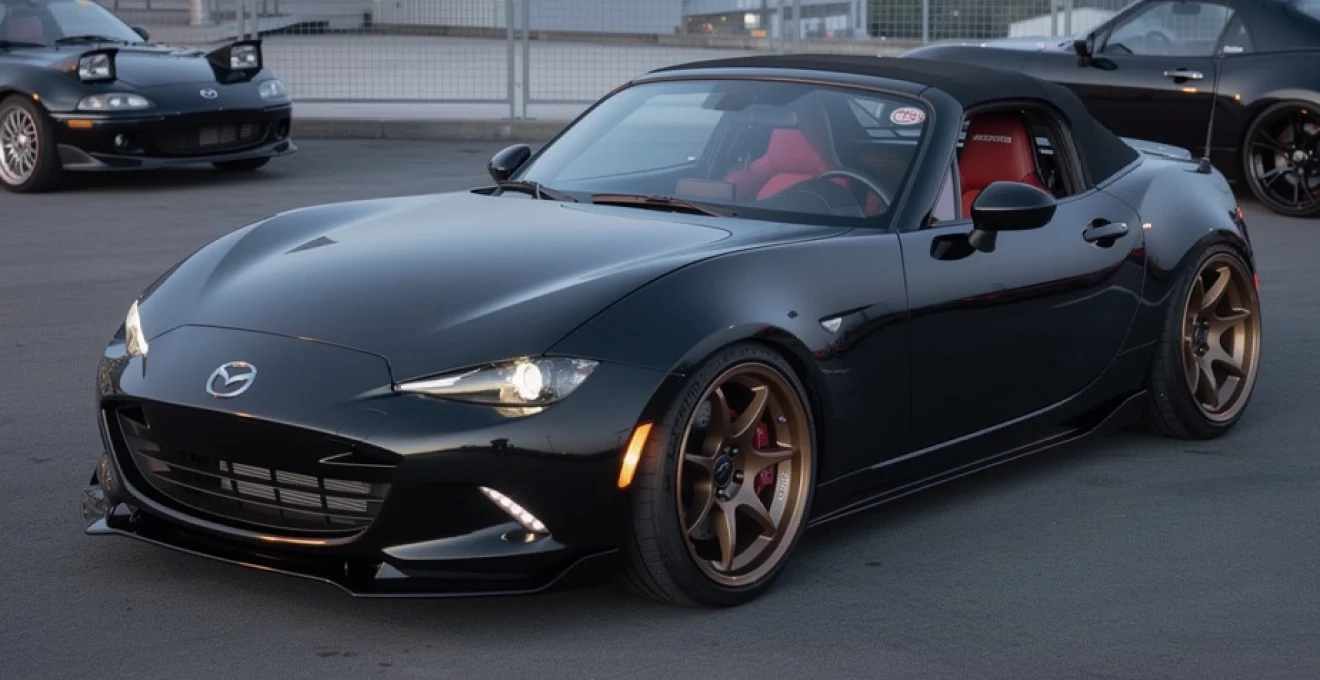
The black Mazda MX‑5 Miata sits in a sweet spot between classic roadster purity and modern stealth styling. On a small rear‑drive chassis, deep gloss or satin black turns every curve and shadow into part of the design, amplifying the cab‑rearward stance, the short overhangs and that instantly recognisable MX‑5 silhouette. For enthusiasts, a black Miata is more than a colour choice: it is a statement about subtle aggression, timeless design and a focus on driving rather than ornament. If you enjoy details—wheel fitment, light reflections, paint depth—black bodywork rewards careful tuning and meticulous care in a way few other colours can match.
With more than one million MX‑5s sold globally and strong representation at track days, cars & coffee meets and time‑attack paddocks, black examples are constantly photographed, modified and shared online. That visibility shapes how you perceive “the perfect” Miata stance, how you judge black paint quality and even how you imagine your own build path. Whether you prefer an OEM+ look or a full aero, track‑inspired machine, understanding how black paint interacts with the MX‑5’s proportions, surfacing and details helps you make smarter styling decisions.
Design DNA of the black mazda MX‑5 miata: proportions, surfacing and stance
Low-slung cab-rearward proportions and wheelbase-to-track ratios on the NA, NB, NC and ND MX‑5
The MX‑5 recipe has stayed remarkably consistent across NA, NB, NC and ND generations: front‑mid engine, rear‑wheel drive, two seats and a cab‑rearward layout. On a black Miata, this proportion set reads even more strongly because the dark body visually shrinks, pushing your eye toward the wheelbase and track rather than the body volume itself. The original NA and NB feature relatively narrow tracks and short wheelbases, giving a “light on its feet” vibe; the NC and ND broaden the stance, especially at the rear, adding a planted, almost mini‑muscle‑car feel when viewed from behind.
Wheelbase‑to‑track ratio is one of the key reasons a black MX‑5 feels so purposeful. A compact wheelbase with a comparatively wide track suggests agility and grip. On black paint, the negative spaces above and around the wheels appear deeper, so any extra track width from wider wheels or lower offset stands out more clearly. You notice this especially in side profile: the cabin appears to sit slightly further back over the rear axle, emphasising classic sports‑car balance in a way that rewards careful ride‑height tuning.
Body surfacing, character lines and shoulder definition on jet black mica and brilliant black examples
Black paint acts like a live “contour map” of the MX‑5’s body surfacing. On Brilliant Black NA and NB cars, the simple, mostly organic forms read as pure light and shadow: the soft shoulder over the front wheel arch, the subtle tumblehome at the doors, the rounded rear deck. On some early cars the lack of heavy creasing actually benefits black paint, because there are fewer edges where swirl marks and sanding traces catch the light.
Later Jet Black Mica finishes on NC and ND models add metallic flake, increasing depth and sparkle under strong sun. This gives the more sculpted ND, in particular, a distinct character line running from the headlights through the door and into the rear haunch. In black, that line only appears when light hits at certain angles, making the car feel almost liquid. If you enjoy photographing your MX‑5, this “now you see it, now you don’t” quality is one of the main reasons a deep black paint correction pays off.
Stance, ride height and wheel fitment: OEM vs lowered black ND2 MX‑5 on 17‑inch alloys
Ride height transforms how a black ND or ND2 reads on the road. At stock height, especially with the standard 16‑ or 17‑inch wheels, the car can look slightly tall, with more arch gap than the muscular fenders deserve. On a black car this gap appears even more pronounced because the dark paint hides body contours while the wheel arch outline stays clear. A modest 25–30 mm drop on quality springs or coilovers immediately tightens the relationship between tyre and arch, visually locking the wheels into the body.
Seventeen‑inch alloys remain the sweet spot for real‑world driving on a black ND2 MX‑5. They fill the arches just enough without overwhelming the compact body. With the right offset (typically ET35–40 on 7–7.5J wheels) you can achieve a near‑flush look that reads as aggressive without straying into stance‑show territory. Because the body is black, wheel design and spoke colour pull extra weight in the overall composition; this is where silver, bronze or satin black choices change the car’s character in a single afternoon.
Impact of soft-top vs RF (retractable fastback) roofline on the visual balance of a black miata
Few styling decisions affect the silhouette of a black Miata as much as the choice between soft‑top and RF (Retractable Fastback). With the fabric roof up, the classic soft‑top keeps a lower, more flowing roofline with a clear visual separation between body colour and black canvas. On a Brilliant Black or Jet Black Mica shell, the roof effectively “disappears” into the body at a distance, leaving the glasshouse hovering above the beltline like a minimalist canopy.
The RF, inspired by fastback coupes, adds more visual mass over the rear axle, particularly noticeable on a black ND. Because roof, buttresses and body usually share the same dark paint, the car reads as a solid monolithic volume from some angles, almost like a scaled‑down GT coupe. For some drivers, that extra visual weight pairs perfectly with track‑ready wheels and aero; for others, the softer, more traditional look of the fabric roof better matches the MX‑5’s lightweight roadster ethos. Either way, black paint turns the roof choice into a key element of the car’s overall visual balance.
Factory black paint options on the MX‑5: shades, codes and visual characteristics
Classic brilliant black (PZ) on NA/NB miata: solid gloss, clarity and swirl visibility
Brilliant Black (PZ) on NA and NB Miatas is a non‑metallic solid black that rewards meticulous detailing but punishes neglect. Its strengths are clarity and depth: when properly corrected and protected, the reflection sharpness rivals a piano finish, making even modest bolt‑on modifications look more expensive. However, the same clarity exposes wash marring, holograms and bird‑etching very quickly. Some owners report visible swirl marks within weeks of poor washing techniques.
This sensitivity is not unique to Mazda, but older clear coats can be relatively soft, especially on early NA cars that have seen frequent polishing. For you as an enthusiast, that means any plan for a “show‑car” black NA or NB must include disciplined wash routines, periodic machine polishing and, ideally, a modern ceramic or graphene coating to add sacrificial hardness. The reward is a classic, almost vintage motorsport look when paired with silver wheels and period‑correct aero.
Jet black mica and blueish black mica on NC MX‑5: metallic flake, depth and light reflection
NC‑generation MX‑5s often feature Jet Black Mica or Blueish Black Mica, both of which add fine metallic flake suspended in the base paint. Under overcast light, these colours read as simple black, but under sun or strong artificial lighting they reveal a subtle sparkle. Jet Black leans neutral; Blueish Black adds a faint cool blue tint, particularly noticeable on the car’s shoulder lines and along the rear quarter panels at golden hour.
Metallic blacks on the NC serve two purposes. First, they visually break up large, flatter areas of bodywork such as the bonnet and decklid, preventing them from looking like featureless slabs. Second, they hide minor wash marring slightly better than pure solid black, because the flake scatters light. In practical terms, you gain a touch more forgiveness while retaining that deep, pool‑like finish when fully corrected. For daily‑driven NCs, this is often a smart compromise between show‑car drama and real‑world maintenance.
Jet black mica (41W) and eternal blue mica contrasts on ND MX‑5 body lines
The ND’s KODO design language emphasises tension and motion, and Jet Black Mica (41W) plays a distinct role here. The long hood, drawn‑back cabin and pronounced rear haunches create a series of S‑shaped curves that appear and disappear as light moves across the surface. On an ND finished in Jet Black, those curves emerge almost like ink strokes on glossy paper, subtly highlighting the beltline and door scallops without obvious creases.
Contrast this with Eternal Blue Mica, which many owners compare directly against Jet Black when ordering new. Eternal Blue highlights the surfacing more obviously because the lighter hue reflects more light, making every crease visible at a glance. Jet Black, by comparison, feels more mysterious and stealthy, revealing detail only under close inspection. For you as a driver choosing between the two, the decision becomes philosophical: do you want a car that constantly shows off its design, or one that reveals its shape slowly as you walk around it?
Comparing OEM black paint hardness, orange peel and correction potential across generations
Across NA to ND, black OEM paint shows variations in hardness, orange peel and response to polishing. Earlier NA/NB clear coats tend to be slightly softer, which means light defects are relatively easy to remove with a dual‑action polisher but also easier to introduce. NC paints often sit in the middle, while ND Jet Black Mica is generally considered moderately hard, requiring more aggressive pads and compounds for deep defect removal.
Orange peel—the subtle texture that reduces mirror‑like reflection—is present to some degree on all factory finishes. On black MX‑5s, heavy orange peel can make the car look less glossy than it could be, especially under street lighting. Advanced enthusiasts sometimes pursue wetsanding and multi‑stage correction to reduce peel and create a “show car” finish, but such processes remove clear coat and should be approached cautiously. A measured approach—one to two correction cycles over the car’s life—usually strikes a good balance between perfection and paint longevity.
Aerodynamic styling features and how black enhances the MX‑5’s flow
Front bumper intakes, air dams and blacked-out grille treatment on ND2 MX‑5
The ND2’s front bumper integrates subtle aerodynamic features—lower air dam, side intakes and central grille—that contribute to both cooling and drag management. On a lighter colour, each intake stands out; on black paint, these openings merge visually into a single dark “mouth”, lending the car a more aggressive, unified face. Many owners enhance this effect with blacked‑out grille inserts or mesh, turning the front of the car into one cohesive shadow punctuated only by the Mazda badge and number plate.
Beyond pure aesthetics, a well‑designed front air dam can reduce front‑end lift at speed, improving stability. Black plastic or painted extensions under the bumper also visually lower the car, even at stock ride height. Think of the lower edge of the car as the underline in a sentence: in black, that line becomes thicker and more assertive, making the MX‑5 look closer to the tarmac than the tape measure might suggest.
Side sill contours, door scallops and how black paint visually slims the MX‑5 profile
The MX‑5’s side sills and door scallops help manage air flow along the flanks, but they also sculpt the profile visually. On a black shell, the lower sill area often falls into deep shadow, while the upper shoulder catches sky reflections. This contrast can make the car appear slimmer and lower, almost like it has been “pinched” in the middle. It is a similar optical trick used in fashion tailoring: darker side panels can make a jacket look narrower and more athletic.
Adding aftermarket side skirts or sill extensions in black emphasises this effect by deepening the shadow area under the doors. For you, that means a subtle sill kit can make a stock‑height car look tastefully lowered while also smoothing underbody airflow. The key is avoiding overly boxy or protruding designs that disrupt the KODO‑style sweep from front wheel arch to rear haunch.
Rear diffuser elements, exhaust tip finishes and light play on a black NC/ND bumper
At the rear, NC and ND models often feature integrated diffuser‑style lower bumpers, sometimes with contrasting textures. On a black MX‑5, the difference between glossy painted upper bumper and matte or satin lower section becomes a study in light play. Street lamps and following headlights skim across these surfaces at night, breaking the rear view into distinct layers of reflection and shadow. Properly cleaned and dressed plastics here can change how “finished” the entire rear end feels.
Exhaust tips are the one bright element in this zone, and the choice between polished stainless, burnt titanium or black‑ceramic tips significantly alters the car’s message. Polished tips provide a classic motorsport look; dark or black‑coated tips create a stealthier, almost OEM‑concept‑car impression. On a full black‑on‑black build, leaving just the inner wall of the tip polished can be a tasteful way to keep some visual interest without breaking the stealth theme.
Functional aero add-ons in black: front splitters, ducktail spoilers and RX‑7‑inspired lips
Functional aero components—front splitters, ducktail spoilers, small canards—are almost always more subtle in black. A gloss, satin or bare plastic splitter on a black MX‑5 rarely dominates the design; instead, it reads as a fine line under the bumper. This is useful if you want real aerodynamic benefit at track days without giving the car an overly aggressive show‑car face for daily use.
Ducktail and RX‑7‑inspired rear lips pair especially well with black paint, echoing early JDM sports cars yet blending with the body at a distance. Because black hides panel gaps and edge transitions more effectively, you can integrate aftermarket aero pieces with fewer visual compromises. The result is a car that looks like a cohesive whole rather than a collage of add‑ons, particularly once reflections and contours have been carefully aligned through test‑fitting and adjustment.
Wheel, tyre and brake aesthetics on a black miata MX‑5
Contrast vs stealth: silver BBS, bronze TE37, and satin black RPF1 wheel setups
Wheel choice is where a black Miata MX‑5’s personality really comes alive. High‑contrast wheels—bright silver BBS mesh, for instance—create a classic road‑racer look that harks back to Group A touring cars. The crisp outline of each spoke stands against the dark body, making the car appear lighter and more agile. For many NA/NB owners, silver multi‑spokes on Brilliant Black are the default “timeless” combination.
Bronze forged wheels such as TE37‑style designs add a warmer, JDM‑inspired flavour. On Jet Black Mica or Blueish Black Mica, bronze reads as sophisticated and motorsport‑oriented without looking flashy. In contrast, satin black wheels (for example, RPF1 in matte black) push the car toward a full stealth or “murdered‑out” theme. However, if both body and wheels are black, you may want polished lips, coloured centre caps or visible calipers to prevent the design from becoming a featureless dark mass.
Tyre profiles, sidewall lettering and contact patch width as styling cues
Tyres are often overlooked as styling elements, yet on a black MX‑5 the relationship between sidewall height, tread width and lettering plays a huge visual role. A moderate 45–50 profile on 16–17‑inch wheels keeps the car looking purposeful and usable, with enough sidewall to suggest compliance and real‑world grip. Ultra‑low‑profile setups can look edgy but sometimes clash with the MX‑5’s inherently organic shapes, especially in side view.
Raised white lettering or subtle outlined branding can reinforce a track‑focused aesthetic, particularly when paired with semi‑slick compounds. On a black car, these bright rings draw the eye outward, emphasising wheel diameter and stance. Wider tyres (205–225 section rather than the stock 195) also make the car look more substantial, but in black the change can be deceptive: much of the extra width hides in shadow, so onlookers often only notice the transformation when following the car from behind.
Big brake kits, painted calipers and drilled rotors behind dark wheels
Because black paint pulls the body visually into the background, the brake setup behind the wheels becomes an important focal point. A big‑brake kit with larger rotors and multi‑piston calipers immediately raises the car’s perceived performance ceiling, even for casual observers. On a black MX‑5 with dark wheels, brightly painted calipers—red, yellow, even acid green—deliver a motorsport flavour reminiscent of GT endurance cars.
Cross‑drilled or slotted rotors also contribute to the visual story, suggesting heat management and track use. While the performance benefits are context‑dependent, the styling signal is clear. If you prefer a more understated aesthetic, leaving calipers in OEM silver or black but upgrading to larger, plain‑faced rotors can provide a quietly serious look that only enthusiasts will truly appreciate.
Fitment terminology: flush, poke, camber and how it reads visually on a black MX‑5
Fitment language—flush, poke, camber—is more than scene slang; it describes how the wheel and tyre sit relative to the body. On a black Miata, a flush fitment (wheel outer face nearly aligned with the arch lip) gives a muscular, factory‑plus appearance that suits both daily use and spirited driving. A small amount of negative camber (‑1.5 to ‑2.0 degrees) visually tucks the top of the tyre slightly under the arch, adding a purposeful stance without excessive tyre wear.
More extreme poke (wheel and tyre visibly outside the arch) and aggressive camber create a show‑oriented “stance” look. In black, this can swing between sinister and cartoonish depending on how far you push it. Because black hides panel edges, the contrast between tyre sidewall and arch lip defines the aesthetic boundary; if you prefer a cleaner, OEM+ theme, staying within the arch line keeps the design cohesive.
Lighting design and black-body contrast: headlamps, tail lamps and DRLs
Pop-up headlight styling on black NA miata vs fixed units on NB, NC and ND
Pop‑up headlights give black NA Miatas a distinctive dual personality. With lights down, the car appears simple and almost toy‑like, the bonnet surface unbroken and the front end dominated by the grille opening. With lights up, the character changes instantly into something more mechanical and expressive. On black paint, the contrast between the raised pods and the surrounding glossy surface makes each motion feel theatrical, which partly explains the cult status of pop‑up NAs among younger enthusiasts.
Fixed headlights on NB, NC and ND models trade that theatre for aerodynamic efficiency and modern lighting performance. Projector‑style units, especially with blacked‑out internals, integrate neatly into black bodywork, emphasising the lens outlines rather than chrome reflectors. This suits a stealth build where you want the car’s “eyes” to be sharp and focused rather than wide and friendly.
Smoked vs clear indicators, side markers and rear lenses on dark bodywork
Indicator and marker lens choice heavily influences how “clean” a black MX‑5 appears. Clear or lightly tinted lenses provide crisp highlights at the car’s corners, making the lighting elements part of the design. Smoked or dark‑tinted lenses lean into a stealth theme, reducing the number of visible bright elements on the body. The risk, of course, is over‑doing it and compromising both legality and day‑time visibility.
On many black builds, a balanced approach works best: clear front indicators for maximum signalling performance, lightly smoked side markers to tidy the flanks, and subtly darkened rear lenses that maintain strong brake‑light output. Because black paint already absorbs so much light, keeping functional lighting strong ensures the car remains visible at night and in poor weather while still delivering that low‑key aesthetic.
LED DRL signatures, projector lenses and halo retrofits on black ND MX‑5
Modern LED daytime running lights (DRLs) change the way a black ND MX‑5 is perceived on the road. A crisp LED signature, often integrated around projector lenses, draws clear outlines of the headlamp clusters, giving the car a higher‑end, almost premium feel. On dark bodywork, these bright elements act like the highlights on a graphite sketch, defining the “eyes” even from a distance.
Enthusiasts sometimes retrofit halo rings or custom DRL patterns to personalise this signature. On black paint, such modifications stand out more starkly than on lighter colours, for better or worse. If you lean toward a motorsport or OEM+ theme, consider keeping DRL designs simple and functional; complex patterns can clash with the MX‑5’s essential design simplicity and risk dating the car stylistically within a few years.
Night-time presence: reflectivity, specular highlights and silhouette definition
At night, a black Miata’s presence depends on how it reflects artificial light. Specular highlights—those sharp, bright lines along the bonnet edge, shoulder and fender peaks—essentially draw the car’s shape with light alone. After a proper polish and coating, black paint turns these highlights into precise, continuous lines that “read” the design to anyone watching the car pass under street lamps or paddock floodlights.
The overall silhouette remains dark, sometimes nearly invisible against unlit backgrounds, which can be both dramatic and a practical consideration. High‑quality headlamps, reflective markers and clean, unscratched tail lamps are not just styling details; they are crucial for safety. Regularly restoring plastic lenses and keeping reflectors clean helps maintain that crisp, confident night‑time presence that complements the car’s daytime stealth.
Detailing, paint correction and finish types specific to black MX‑5s
Machine polishing black MX‑5 paint: dual-action vs rotary, pad and compound selection
Machine polishing is the foundation of any serious black MX‑5 detailing routine. Dual‑action (DA) polishers offer a safer learning curve for enthusiasts, reducing the risk of holograms and localised burn‑through. Rotary machines deliver faster correction but demand more skill, especially on curved panels like the ND’s front wings and rear quarters. Think of a DA as a sharp chef’s knife and a rotary as a professional whetstone—both valuable, but the latter requires more experience.
For most black Miatas, a two‑step process works well: a medium‑cut compound on a foam or microfibre pad, followed by a fine polish to restore maximum gloss. Softer NA/NB paint may even respond to a single refining step if defects are mild. Always measure paint thickness where possible and prioritise preserving clear coat; black cars invite constant correction, but clear coat is a finite resource.
Ceramic coatings, graphene sealants and long-term gloss retention on black miatas
Protection products dramatically affect how long a black MX‑5 stays glossy and swirl‑free. Ceramic coatings, with their high silica content, create a hard, hydrophobic layer that resists micro‑marring better than traditional wax. Some modern graphene‑infused sealants claim additional slickness and anti‑static properties, potentially reducing dust attraction—a useful trait on dark paint where every speck shows.
For a daily‑driven black Miata, a properly applied ceramic coating can reduce visible defect build‑up by 30–50% over the first two years compared with standard wax maintenance.
If you enjoy regular detailing, a hybrid approach—ceramic base layer topped with spray sealant—offers both long‑term protection and easy gloss “refreshes” before meets or track days. The key is correct surface preparation: decontamination, polishing and thorough panel wipe are non‑negotiable before any high‑end coating application.
Matte, satin and gloss black vinyl wraps vs respray on older NA/NB shells
For ageing NA/NB shells with tired Brilliant Black paint, the choice often comes down to full respray or vinyl wrap. A quality respray in gloss black restores depth and OEM character but can be expensive and time‑consuming. Vinyl wraps in matte or satin black, by contrast, allow dramatic visual changes with reversible installation and, in many cases, lower initial cost. Matte finishes mute reflections entirely, turning the MX‑5 into a shape defined almost solely by outline and shadow.
Satin black wraps strike a middle ground: reduced shine but enough sheen to reveal surfacing under strong light. One professional observation: on a small, curvy car like the MX‑5, satin often complements the lines better than full matte, which can sometimes make the car look like an unfinished prototype. Wraps also protect the underlying paint from chips and UV, valuable if you plan a future concours‑level restoration.
Decontamination routines: iron fallout removers, clay bars and minimising micro-marring
Because defects show so readily on black paint, careful decontamination is essential. Iron fallout removers chemically dissolve embedded metallic particles, reducing the amount of physical abrasion needed later. A gentle clay bar or synthetic clay mitt then removes bonded contaminants such as tar and tree sap. The key is lubrication and technique: straight‑line motions, frequent rinse and light pressure minimise micro‑marring that would otherwise require additional polishing.
A structured decontamination routine can cut the frequency of major correction details on a black MX‑5 from annually to every two to three years, preserving clear coat and saving significant time.
Many owners adopt a decon schedule of twice yearly, aligned with seasonal changes. Paired with proper two‑bucket washes and high‑quality drying towels, this routine keeps the car’s surface close to “correction ready” without constantly removing paint. For anyone building a long‑term relationship with a black MX‑5, that balance is crucial.
Custom exterior styling themes for black miata MX‑5 builds
OEM+ black MX‑5 styling: MazdaSpeed aero, subtle lips and period-correct wheels
OEM+ styling aims to look like something the manufacturer might have offered from the factory. On a black MX‑5, MazdaSpeed front lips, side skirts and small rear spoilers achieve this effect beautifully, enhancing the car’s form without shouting for attention. Period‑correct wheels—be they BBS, Enkei or MazdaSpeed alloys—complete the look, particularly when finished in bright silver or subtle gunmetal for contrast.
This approach works especially well for NA and NB cars, where the goal is often to preserve the original character while gently sharpening the visuals. Think of it as dressing the car in a tailored suit rather than a race suit: everything fits closely, lines are clean, and nothing feels out of place or era.
Jdm-inspired street builds: garage vary, KG works, zoom engineering and runabout parts
JDM‑inspired street builds lean into Japanese aftermarket heritage, with parts from brands such as Garage Vary, KG Works, Zoom Engineering and Runabout. On black Miatas, these components—vintage‑style front lips, retro mirrors, unique grilles and ducktail spoilers—often appear more integrated than on bright colours because their shapes rather than their colours become the focal points.
For example, a Garage Vary front lip in black almost melts into the bumper, leaving only the new lower line visible. KG Works tail lamps stand out more starkly against black paint, their shapes echoing classic sports cars. The overall effect is a subtle transformation that rewards close inspection rather than immediate, in‑your‑face drama.
Track-focused aesthetics: tow hooks, roll bars, canards and time-attack style livery
Track‑focused black MX‑5s often adopt visual cues from time‑attack and club racing scenes: brightly coloured tow hooks, visible roll bars, small canards and sponsor decals. Black paint provides an ideal canvas for high‑contrast graphics—white numbers, red stripes, neon accent lines—while keeping the underlying car visually compact. Compared with lighter colours, black reduces visual noise, allowing purposeful hardware to stand out.
A black MX‑5 with functional aero and visible safety gear often appears 10–15% more “serious” to paddock onlookers than an otherwise identical car in a bright colour, purely due to visual psychology.
If you enjoy track days but still use the car on the road, restraining livery to removable door numbers and a few key logos helps maintain flexibility. Painted or powder‑coated roll bars visible above the beltline also signal intent without compromising day‑time subtlety when stickers are removed.
VIP and café racer influences: polished lips, wire wheels and minimalist de-badging
While less common, VIP and café racer themes can be adapted to black MX‑5s with interesting results. Polished lips on deep‑dish wheels introduce a touch of luxury, especially when combined with lowered but not slammed ride heights. Minimalist de‑badging, smoothed panels and shaved number‑plate recesses push the car toward a cleaner, almost concept‑car aesthetic.
Some builders experiment with neo‑classic touches—wire‑style wheels, aero mirrors, even subtle pinstriping—to create a café racer‑inspired roadster. Black paint supports these experiments by acting as a neutral background; the risk is over‑decoration. A strong guiding principle helps: choose two or three standout details and let the rest of the car remain simple and uncluttered.
Interior ambience in a black-bodied MX‑5: colour, trim and perceived sportiness
Black exterior with red nappa, tan or recaro alcantara interiors on ND MX‑5
The cabin of a black‑bodied ND MX‑5 sets the emotional tone every time you open the door. Red Nappa leather interiors provide a dramatic, high‑contrast pairing that recalls European GT cars; the deep black exterior gives nothing away until the door opens, then the red seats and panels deliver an immediate visual hit. Tan leather offers a more classic roadster feel, especially in daylight, creating a warm, club‑like environment that contrasts with the exterior’s stealth.
Recaro seats trimmed in Alcantara, often with red or white stitching, skew the car toward track‑day and fast‑road use. Their sculpted bolsters and grippy surfaces support spirited driving while visually echoing the taut, athletic shapes of the exterior. If you value daily comfort and long‑distance usability, combining supportive Recaros with a slightly softer suspension tune can deliver a surprisingly refined yet focused package.
Steering wheels, gear knobs and handbrakes: nardi, momo and MazdaSpeed touchpoints
Interior touchpoints—steering wheel, gear knob, handbrake—define how you physically interact with your MX‑5. Upgrading to a Nardi or Momo wheel brings heritage motorsport vibes, particularly in leather‑rimmed, slightly downsized forms that quicken steering response. On a black car, a wheel with brushed spokes and subtle stitching ties neatly into the exterior’s understated aggression.
MazdaSpeed accessories, where available, maintain OEM ergonomics while improving tactile feel. A weighted gear knob shortens perceived throw and can make each shift feel more deliberate, mirroring the precision of a well‑set‑up chassis. Matching leather or Alcantara handbrake sleeves complete the tactile trilogy, creating a cohesive, driver‑centric cockpit that feels special every time you climb in.
Roll hoops, harness bars and visible cagework as visual extensions of the black shell
Roll hoops, harness bars and partial cages are safety components first, but on a black MX‑5 they also become design elements. Satin black bars visually extend the exterior colour into the cabin, making the car feel like a single, unified shell around you. Painted bars in contrasting colours—white, red, or even body‑colour on lighter cars—stand out more, but on a black shell they still read as purposeful hardware against the dark background.
A visible harness bar behind the seats signals track use and allows proper mounting of multi‑point harnesses. When combined with bucket or semi‑bucket seats, it transforms the interior into something closer to a club‑sport special. The key for road‑biased builds is maintaining rear visibility and avoiding excessive clutter; a well‑designed bolt‑in hoop or bar provides both safety and aesthetic focus without overwhelming the compact cabin.
Ambient lighting, brushed aluminium accents and contrast stitching against dark cabins
Subtle ambient lighting can significantly change how a black‑bodied MX‑5 feels at night. Low‑intensity LED strips or factory footwell lights add a modern, premium touch without veering into garish show‑car territory. On a dark cabin, these glows echo the way street lights skim across the black exterior, creating a cohesive atmosphere between inside and out.
Brushed aluminium accents—on vents, switchgear surrounds and door pulls—introduce small points of contrast that catch the eye, preventing the interior from feeling like a black hole. Contrast stitching in red, grey or even tan on seats, steering wheel and shifter boots further breaks up large areas of dark material. Viewed as a whole, these details make the cockpit feel tailored and intentional, perfectly matching the disciplined, detail‑driven approach required to keep a black Miata looking sharp from every angle.