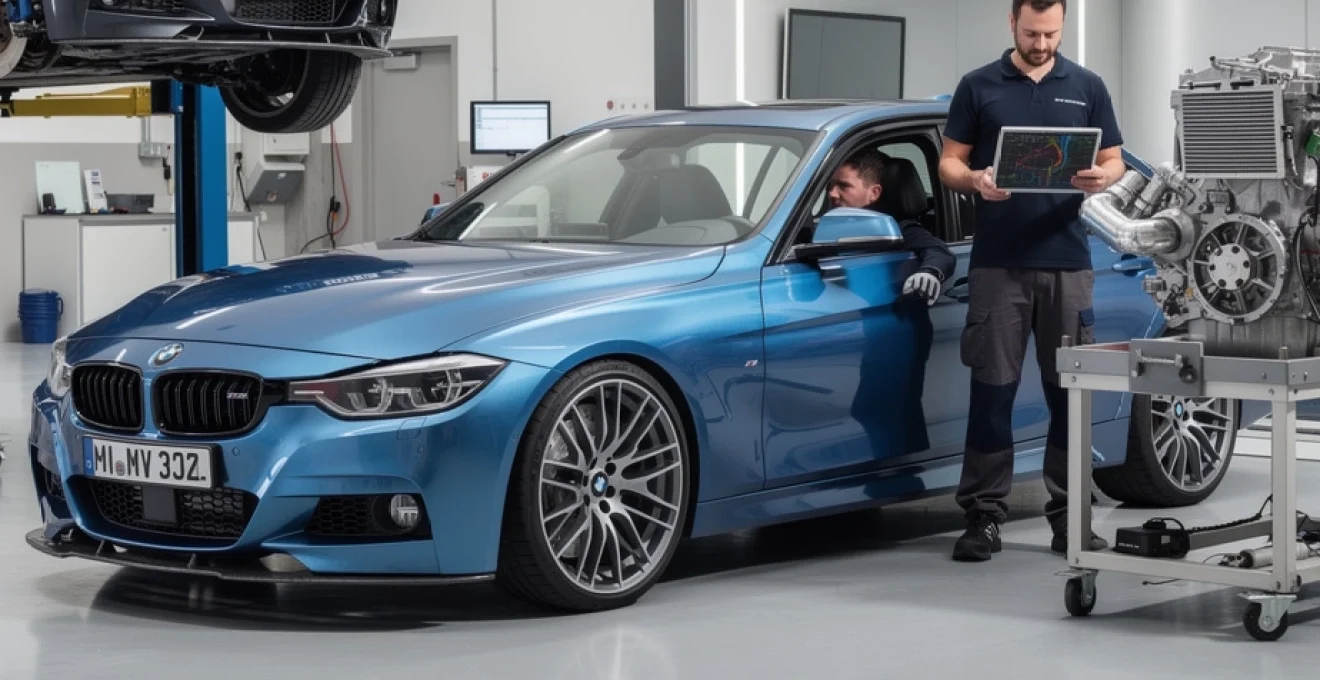
The BMW B3 Alpina Biturbo occupies a rare space in the performance car world: as fast as a super-saloon, as composed as a long‑distance GT and as discreet as a well‑specced 3 Series Touring. For anyone passionate about high‑performance BMW tuning, the B3 Biturbo is a fascinating case study in how to extract serious power and torque while preserving daily usability and reliability. Instead of chasing lap times at any cost, Alpina focuses on effortless thrust, high‑speed stability and a refined driveline calibration that feels hand‑finished rather than mass‑produced. Understanding how this package works, and how it reacts to further tuning, gives you a real advantage if you plan to buy, modify or optimise an Alpina B3 for fast road, autobahn or even track use.
BMW B3 alpina biturbo overview: lineage, e9x vs G21 platforms and positioning against M3/M340i
The BMW B3 Alpina Biturbo lineage starts with the E9x‑generation B3 BiTurbo based on the E90/E92/E93 3 Series, using the legendary N54 straight‑six with twin turbochargers. Power started around 360 hp and 500 Nm, rising to 400 hp and 540 Nm in the later B3 S. On paper these figures sit just below a contemporary M3, yet real‑world mid‑range acceleration often feels stronger thanks to the forced‑induction torque plateau from roughly 1,500 rpm. The philosophy is clear: an Alpina B3 aims to deliver rapid, repeatable in‑gear performance rather than chasing a screaming redline.
Moving forward, the F30/F31 generation B3 BiTurbo climbed to 409 hp and around 600 Nm, while the G20/G21 B3 (based on the latest 3 Series) uses a bespoke version of the B58 single twin‑scroll turbo architecture, tuned to more than 460 hp and 700 Nm in some specifications. Compared with an M3 or M340i, the B3 slots into a unique space: similar peak power to an M car, but a softer character, more relaxed damping and a stronger emphasis on long‑distance refinement and high‑speed stability. In terms of price and exclusivity, the B3 also appeals to buyers who value low‑volume craftsmanship as much as raw lap‑time capability.
On the technical side, E9x‑generation cars combine hydraulic steering, a more analogue chassis balance and the older six‑speed automatic. Later F3x and G2x versions gain electrically assisted steering, a stiffer body‑in‑white and the ZF 8HP transmission, which becomes fundamental to Alpina’s performance tuning strategy. The result is that tuning an earlier E9x B3 feels closer to modifying a classic performance BMW, while the G21 B3 Biturbo responds more like a modern turbocharged M‑lite platform with complex torque management and many intertwined control modules.
Alpina-specific engine tuning: N54/N55/B58 biturbo architecture, boost mapping and internal upgrades
Forged internals, mahle pistons and crankshaft tolerances on the B3 alpina biturbo engine
Under the blue rocker covers, the BMW B3 Alpina Biturbo engine receives more than cosmetic tweaks. Earlier N54‑based B3 engines benefit from BMW’s inherently strong closed‑deck block, but Alpina pays close attention to internal components to handle sustained autobahn loads. Forged crankshafts are retained, while Mahle pistons with optimised crown geometry and ring packs help manage higher cylinder pressures at extended top‑speed cruising. Bearing clearances and crankshaft tolerances are selected to balance longevity with minimal friction, critical when an engine is expected to sit at 5,000+ rpm for long periods.
On later B58‑based B3 models, the block casting and crank are already heavily reinforced from the factory. Alpina focuses instead on meticulous balancing and quality control. Pistons and conrods are weight‑matched, and rotating assemblies are balanced to tighter tolerances than mass‑production norms. For an enthusiast considering aftermarket forged pistons or rods, this is an important detail: the engine arrives from Buchloe already prepared for “Stage 2” levels of stress. Any changes you make must at least match, if not exceed, Alpina’s OE‑plus standard in terms of material quality and machining accuracy.
Alpina twin‑turbocharger selection, turbine wheel sizing and boost pressure strategy vs stock BMW
The Alpina B3 Biturbo turbocharger setup illustrates how thoughtful hardware can outperform a crude “more boost” approach. E9x and F3x B3 models use a parallel twin‑turbo configuration derived from BMW’s N54/N55 family, but with compressor and turbine wheels optimised for smoother airflow and a broader efficiency island. Compared with stock BMW 335i turbos, Alpina units typically run slightly larger compressor wheels and carefully chosen turbine sizing to balance low‑rpm response and high‑rpm flow. As a result, boost builds early yet maintains strong delivery past 6,000 rpm without the “choked” feeling some OEM units show at higher power levels.
Boost pressure strategy is deliberately conservative at peak figures, often sitting between 1.1 and 1.3 bar on many B3 Biturbo calibrations, but the key difference lies in how that boost is sustained. Wastegate duty is tuned to avoid excessive overshoot, with the ECU targetting smooth, flat torque. This approach enhances drivability, protects the gearbox and significantly reduces thermal stress on the catalysts and exhaust valves. For anyone considering a hybrid turbo upgrade, understanding this base strategy is essential; most reputable tuners retain a similar torque curve shape, simply raising the plateau by 15–25% rather than trying to create a dramatic “big turbo” spike.
High‑pressure fuel pump, injector calibration and AFR targets under full load
Modern BMW direct‑injection engines depend on a robust high‑pressure fuel pump (HPFP) and carefully calibrated injectors. Alpina calibrations often increase maximum rail pressure compared with the standard BMW map, but not to the extreme levels seen in some aftermarket tunes. Typical full‑load air–fuel ratios (AFR) hover in the 11.8–12.2:1 region on petrol B3 Biturbo engines, balancing knock resistance, exhaust gas temperatures and fuel consumption. Under very high load at sustained Vmax, enrichment increases slightly to keep combustion chambers and exhaust components within a safe thermal window.
Injector calibration is fine‑tuned to ensure smooth idle and precise transient fueling. Partial‑load AFRs remain relatively lean, sometimes around 14.7–15:1, with stratified charge strategies used in specific operating zones to reduce fuel consumption. This is one reason real‑world fuel economy on an Alpina B3 can rival, or even slightly beat, a standard M340i when cruising. When planning aftermarket tuning, a healthy HPFP and injectors are non‑negotiable; any hint of pressure drop under load can quickly lead to lean conditions and knock, especially once boost is increased beyond Alpina’s own targets.
Charge‑air cooling, intercooler core design and intake air temperature management
Charge‑air cooling is a critical part of the B3 Biturbo package, particularly for drivers using the car at high speed in warmer climates. Alpina typically specifies a larger‑than‑standard intercooler core, with improved end‑tank design and a denser, yet efficient, fin structure. The aim is to keep intake air temperatures (IATs) as close as possible to ambient, even after repeated acceleration runs. In independent testing, Alpina intercoolers often show 5–10°C lower IATs than stock BMW units at comparable boost levels, which directly translates into more stable power and less aggressive ignition retard due to knock control.
Think of the intercooler as the lungs of the forced‑induction system: the freer and cooler the airflow, the easier it becomes for the engine to breathe. For tuned cars running higher boost, an upgraded intercooler is often the first supporting modification after a remap. On the B3 Biturbo, this step is already partially “baked in”, but track drivers or those running hybrid turbos still benefit from even larger front‑mount cores and improved ducting. Lower IATs also help maintain consistent performance during hot‑weather track days, where some OEM BMW setups can lose up to 15% of peak power after a few hard laps.
ECU remapping on bosch MEVD/MG1: ignition timing, knock control and torque limiters
Modern B3 Alpina Biturbo engines run on Bosch MEVD or MG1 ECUs, depending on generation. Alpina’s in‑house remap addresses not just fuel and boost, but also a complex web of torque limiters, ignition timing tables and knock control strategies. Ignition timing is advanced where knock sensitivity allows, but the focus remains on smooth torque delivery rather than the aggressive “on/off” power feel that some aftermarket tunes exhibit. Knock control is calibrated to react quickly yet proportionally, minimising unnecessary timing pull while still protecting the engine on lower‑octane fuel.
Multiple torque limiters govern how much power the ECU is allowed to request, including driver demand maps, gearbox torque caps and traction system constraints. Alpina systematically understands and re‑aligns these limits with the upgraded hardware. For owners looking at additional ECU remapping, working with a tuner experienced in Bosch MG1/MEVD on Alpina‑specific variants is essential, because a generic BMW 335i or M340i map will rarely respect Alpina’s bespoke boost and temperature strategies. A high‑quality custom remap can still unlock 40–70 hp and 80–100 Nm over stock Alpina figures when combined with supporting hardware.
Transmission and drivetrain calibration: ZF 8HP automatic, xdrive, and alpina Switch‑Tronic software
ZF 8HP torque converter lock‑up strategy and shift logic under sport and manual modes
The ZF 8HP automatic gearbox is a cornerstone of the B3 Alpina Biturbo driving experience. Alpina collaborates closely with ZF to develop unique Switch‑Tronic software, giving gearshifts a character distinct from both standard BMW and M Performance models. Torque converter lock‑up occurs earlier than on stock cars, particularly in Comfort and Sport modes, which reduces slip and improves both efficiency and throttle response. In higher gears at motorway speeds, lock‑up is almost permanent, creating a direct mechanical feel similar to a dual‑clutch gearbox but with far smoother low‑speed behaviour.
Shift logic under Sport and Manual modes is tuned to make the most of the broad torque band. Kickdown is decisive yet not abrupt, and the gearbox is reluctant to upshift mid‑corner, prioritising stability. Manual shifts via the buttons on the steering wheel or the gear selector itself are crisp and occur in around 200 ms on many calibrations. For drivers interested in transmission tuning, this means the base software is already highly optimised. Some aftermarket ECU/TCU packages still adjust shift points and torque reduction strategies, but gains are subtle compared to the leap from a standard BMW map to Alpina’s Switch‑Tronic logic.
Final drive ratios, limited‑slip differential options and traction control tuning
Alpina selects final drive ratios to suit the torque‑rich character of the B3 Biturbo. Ratios are often slightly longer than on equivalent M3 or M340i models, allowing a higher theoretical Vmax while keeping revs relaxed at cruising speeds. For example, G21 B3 Touring models can comfortably sustain an indicated 280 km/h on unrestricted autobahn sections, with the engine turning well below the redline. This long‑legged gearing is integral to the “GT‑plus” personality of the car.
Limited‑slip differentials (LSDs) vary by generation and market. Earlier E9x Alpina B3 models often used mechanical LSDs either as standard or as a popular upgrade, while later xDrive cars rely more heavily on sophisticated traction and stability control algorithms. An aftermarket clutch‑type LSD can still transform traction on powerful rear‑drive B3s, especially for tuned cars exceeding 500 hp. Traction control tuning from Alpina is generally less intrusive than BMW’s default calibration, allowing a small degree of slip before intervention, which feels more natural in spirited driving and when accelerating out of tight bends.
Launch control configuration, torque management and gearbox thermal protection
Launch control on the B3 Alpina Biturbo is calibrated to protect the drivetrain while delivering consistent 0–100 km/h figures. Rather than using an aggressive clutch‑dump style launch, Alpina maps a carefully controlled torque curve as the car leaves the line. Torque converter stall speed, boost pre‑loading and initial timing are orchestrated so that wheelspin is minimal yet the engine reaches the heart of its torque band almost immediately. On dry tarmac, many B3 models achieve 0–100 km/h in around 4.0–4.3 seconds, depending on body style and drivetrain configuration.
Thermal protection is embedded into the gearbox and engine control units. Fluid temperatures, clutch slip and repeated launch events are monitored; if thresholds are exceeded, torque is progressively reduced to prevent damage. For owners who use launch control frequently—during drag strip runs, for example—regular fluid changes and gearbox servicing are recommended. Treat the transmission like a high‑precision mechanical athlete: with enough cooling and maintenance, it will deliver impressive performance for hundreds of thousands of kilometres.
Chassis, suspension and braking tuning: alpina springs, adaptive dampers and high‑speed stability
Alpina‑spec eibach springs, bump stop tuning and ride height changes vs OEM BMW
Chassis tuning is where Alpina’s philosophy diverges most visibly from that of BMW M. The B3 Alpina Biturbo tends to sit slightly lower than a standard M340i but not as aggressively as an M3, with Alpina‑spec Eibach springs chosen for progressive rates rather than ultra‑stiff track‑biased behaviour. Bump stop tuning is equally important: longer, more compliant stops allow the suspension to use more of its travel without harsh impacts, especially useful on imperfect European roads at high speeds.
Ride height changes are subtle—typically around 10–20 mm compared with non‑M 3 Series models. This modest drop reduces roll and pitch, sharpens turn‑in and lowers the centre of gravity, yet preserves enough compression travel for comfortable long‑distance touring. The result is a car that feels composed and planted at 250+ km/h, without the vertical harshness that can fatigue occupants in some stiffly sprung sports saloons. For owners considering lowering springs or coilovers, retaining sufficient bump travel and respecting Alpina’s bump stop strategy is essential to avoid degrading both comfort and stability.
Adaptive damper valving, comfort vs sport mapping and nürburgring development data
Many B3 Alpina Biturbo models use adaptive dampers with custom valving and control software. Comfort mode focuses on supple low‑speed compliance and damping of high‑frequency bumps, ideal for daily use and poor‑quality roads. Sport mode tightens body control significantly, especially in roll and pitch, but without the brittle ride that some factory “Sport+” setups exhibit. The key lies in Alpina’s custom damper curves, which typically provide more mid‑stroke support while still allowing softer initial movement to absorb sharp edges.
Development frequently includes high‑speed testing on the Nürburgring Nordschleife and on unrestricted autobahn stretches. Track data shows that B3 models achieve cornering g‑forces broadly comparable to M340i variants, despite softer nominal spring rates, largely due to more sophisticated damper tuning and tyre selection. An enthusiast focusing on fast road driving rather than pure track times will likely find the Alpina compromise more usable in everyday conditions. When upgrading dampers, a quality adjustable kit with carefully matched front‑rear balance tends to work best, ideally tested back‑to‑back against the stock Alpina setup.
Front axle geometry, negative camber settings and roll‑steer characteristics
Front axle geometry on the B3 Alpina Biturbo is subtly revised through alignment and, in some cases, hardware changes. Modest increases in negative camber, often in the region of −1.2° to −1.5° at the front, help maintain tyre contact patches during hard cornering. Toe settings are biased towards stability, with a slight front toe‑in that calms reactions at autobahn speeds. Rear geometry typically preserves a mild degree of passive rear‑steer, allowing the car to rotate naturally without feeling nervous on lane changes.
Roll‑steer characteristics—how the car steers as it leans in a corner—are carefully tuned to avoid sudden oversteer. On the limit, a B3 usually transitions into mild, predictable understeer, which can be trimmed with throttle thanks to the abundant torque. For track‑oriented drivers, a slightly more aggressive alignment with added negative camber and marginally reduced toe‑in can sharpen response, but every change should be validated with tyre temperature readings and test drives to maintain Alpina’s distinctive balance between agility and security.
Brembo multi‑piston brake system, disc sizing and fade resistance at track temperatures
Stopping power on the B3 Alpina Biturbo is delivered by a high‑performance braking system, often with Brembo multi‑piston front calipers and large ventilated discs. Typical front disc sizes range from 348 to over 370 mm, depending on generation, with rear discs sized to maintain appropriate brake balance. At fast‑road and moderate track‑day pace, this setup provides strong, consistent stopping with good pedal feel and minimal fade, especially when combined with high‑quality pads and fluid.
Repeated high‑speed stops, such as 250‑0 km/h runs, place enormous thermal stress on discs and pads. Fade resistance at track temperatures can be improved with performance pads and high‑boiling‑point fluid; many owners choose motorsport‑grade pads for occasional track days while retaining Alpina’s OE discs. Brake disc skimming, when carried out with on‑car lathes, can restore perfectly flat mating surfaces and remove judder, extending disc life and enhancing pad bedding. As a rule of thumb, if discs are thin or heavily cracked, replacement is more effective than repeated skimming for safety reasons.
Tyres, wheel fitment and aerodynamics: alpina classic wheels, michelin pilot sport and lift reduction
Tyres and wheels are central to the B3 Alpina Biturbo character. Iconic Alpina Classic multi‑spoke alloys are not just a styling statement; they are engineered with specific offsets and widths to optimise scrub radius, track width and airflow around the brakes. Typical sizes run from 19 to 20 inches, with staggered fitments on rear‑drive cars to handle the 600–700 Nm of torque. Tyres are usually Michelin Pilot Sport or comparable ultra‑high‑performance (UHP) rubber, selected after extensive testing for grip, noise and wet‑weather performance.
Aerodynamically, Alpina front splitters, rear diffusers and subtle boot‑lid spoilers are designed to reduce lift rather than generate aggressive downforce. At 250–300 km/h, even modest reductions in front‑axle lift significantly improve steering feel and crosswind stability. Independent wind‑tunnel and track data suggest that Alpina bodywork can reduce front and rear lift by 20–30% compared with a standard M Sport 3 Series body kit at high speed. For drivers who frequently use autobahn or track environments, maintaining correct tyre pressures and high‑speed‑rated tyres is as important as the underlying aero package.
| Model | Power (hp) | Torque (Nm) | 0–100 km/h | Top speed |
|---|---|---|---|---|
| E9x B3 BiTurbo | 360–400 | 500–540 | 4.9–5.2 s | 285–300 km/h |
| F30/F31 B3 BiTurbo | 409 | 600 | 4.3–4.5 s | 300+ km/h |
| G20/G21 B3 Biturbo | 462+ | 700 | 4.0–4.1 s | 300+ km/h |
From a tuning perspective, tyre choice becomes even more crucial once power climbs beyond 500 hp. Wider rear tyres, stickier compounds and, where legal, semi‑slicks can unlock more of the engine’s potential, especially in lower gears. However, for mixed street use, a premium UHP tyre balanced between grip and aquaplaning resistance remains the smartest choice, maintaining the dual‑use ethos that defines the B3 Alpina Biturbo.
Performance figures and real‑world metrics: 0–100 km/h, in‑gear acceleration and autobahn vmax
Performance metrics for the BMW B3 Alpina Biturbo tell only part of the story, but they still impress. Depending on generation, factory‑quoted 0–100 km/h times range from about 5.2 seconds for early E9x B3 BiTurbo saloons to around 4.0 seconds for the latest G21 B3 Touring xDrive. Independent tests occasionally record even quicker sprints, particularly in cool conditions with pre‑conditioned transmissions and tyres. Yet straight‑line benchmarks are not the only reason the B3 feels special.
Real‑world in‑gear acceleration—say 80–120 km/h in third or fourth gear—is where the high‑torque biturbo engine shines. Measurements often show times in the low 3‑second range for modern B3 models, which rivals or exceeds some contemporary supercars in everyday overtakes. Consider an analogy: where a peaky naturally aspirated engine feels like a sprint athlete, needing the right gear and revs, the B3’s turbocharged straight‑six behaves more like a powerful diesel‑electric locomotive, providing seemingly endless shove from modest revs without frantic downshifts.
The hallmark of the B3 Alpina Biturbo is not just how quickly it reaches 100 km/h, but how effortlessly it continues to pull far beyond that point.
Autobahn Vmax is another core metric. Many B3 models are de‑restricted or lightly limited, reaching indicated speeds north of 300 km/h with surprising composure. At such velocities, even small changes in alignment, tyre condition or brake balance become magnified, which underscores why Alpina invests heavily in high‑speed testing. For drivers who primarily use the B3 on regular roads, the same stability translates into relaxed, secure behaviour at 130–160 km/h motorway cruising, with low engine revs and minimal cabin noise.
Advanced aftermarket tuning: remaps, hybrid turbos and supporting modifications for the B3 alpina biturbo
Aftermarket tuning for the B3 Alpina Biturbo is a balancing act between extracting extra performance and preserving the carefully engineered character that defines the car. Because the B3 starts from a higher baseline than a standard BMW 335i or M340i, “Stage 1” remaps usually add slightly smaller absolute numbers, but the results are still significant. Gains of 40–70 hp and 80–100 Nm are common on healthy engines running high‑quality 98 RON fuel, with some tuners offering multiple maps and the ability to tune and detune from home via handheld devices. For daily use, modest boost increases combined with refined ignition and torque limit calibration often give the best compromise.
Hybrid turbo upgrades form the next step. Using CNC‑machined compressor wheels and, at higher stages, larger turbine sections and reinforced bearings, power levels of 480–550 hp and 750–800 Nm are realistic on N54/N55‑based B3 engines with the right supporting mods. At this point, a larger intercooler, freer‑flowing exhaust, uprated HPFP and, ideally, a performance clutch pack or gearbox reinforcement become essential. Without these, the risk of driveline slip and excessive transmission temperature rises sharply under full‑load acceleration.
- Prioritise a thorough engine health check and walnut blasting before ECU remapping on higher‑mileage B3 Alpina Biturbo engines.
- Choose intercooler and exhaust upgrades that preserve low‑rpm torque and noise levels suitable for daily use.
- Work only with tuners experienced in
MEVD/MG1Alpina calibrations to maintain correct torque management and protection strategies.
Another key element in advanced tuning is software integration. Because modern B3 models interact with traction control, gearbox, xDrive and even active differential systems via shared torque requests, a poorly calibrated tune can generate drivetrain errors, limp modes or inconsistent behaviour. High‑quality tuning sessions log not only power and AFR on a dyno but also gearbox temperatures, knock retard, fuel pressure and IATs under repeated runs. A comprehensive session might involve several hours of calibration, road testing and data analysis to arrive at a robust, repeatable map.
Effective Alpina B3 tuning is less about chasing the biggest dyno number and more about building a coherent package of hardware, software and chassis setup.
From a reliability perspective, many specialists suggest treating 550 hp and 800 Nm as a sensible long‑term ceiling for most B3 Biturbo road cars on stock internals, provided that servicing is meticulous and cooling upgrades are in place. Above that threshold, forged rods and pistons, upgraded head studs and reinforced transmission components become highly advisable. Oil analysis, frequent fluid changes and careful warm‑up routines are simple but powerful habits that help a tuned B3 Alpina Biturbo live a long, hard‑driven life, allowing you to enjoy its unique blend of refinement and explosive in‑gear acceleration day after day.