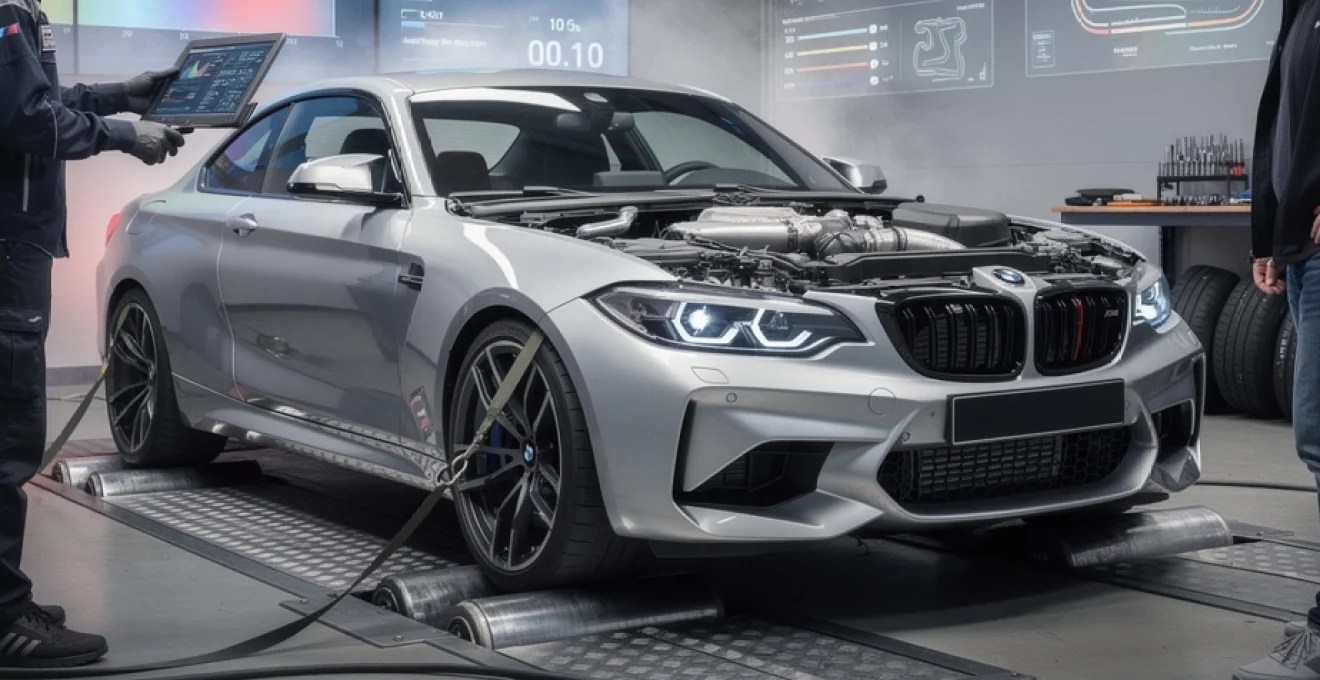
The BMW M2 Competition sits at a sweet spot in the modern performance car world. Compact dimensions, rear‑wheel drive and a highly tuneable twin‑turbo straight‑six give you a package that feels as close as possible to a classic M car, but with contemporary performance and safety. Understanding its bhp figures, torque curve and tuning potential helps you decide whether the M2 Competition, in stock or modified form, really fits your expectations for a fast road or track car. For anyone considering a purchase, a remap or a move up from the original M2, knowing how the numbers translate into real‑world speed and reliability is just as important as the badge on the boot.
BMW M2 competition bhp figures: stock power output, torque curve and rev range
S55 twin‑turbo straight‑six engine architecture and official BMW M2 competition bhp rating
Under the bonnet of the BMW M2 Competition sits the S55 3.0‑litre twin‑turbo straight‑six, derived directly from the M3 and M4 of the same era. Officially, BMW rates the M2 Competition at 410 hp (or 405 bhp in UK literature) and 550 Nm of torque. That output is available between 5,250 and 7,000 rpm, with the engine redline set at around 7,600 rpm. Compared with the original M2’s N55 single‑turbo engine (365 bhp, 465 Nm), the S55 brings not only more power but also stronger internals, closed‑deck construction and a far more motorsport‑oriented cooling package.
The S55 uses two rapid‑response MonoScroll turbochargers, High Precision Injection, VALVETRONIC variable valve lift and Double‑VANOS variable cam timing. This combination allows the engine to build boost quickly from low rpm and maintain a relatively linear push all the way to peak power. Cooling is handled by a central radiator, two side radiators and an additional oil cooler, plus a transmission oil cooler on DCT cars, giving the M2 Competition the thermal headroom to sustain full bhp output on track, not just in short bursts on the road.
Peak horsepower vs usable power band: bhp delivery from 2,000–7,600 rpm on the M2 competition
Raw peak figures only tell part of the story. What you feel every time you drive is the breadth of the usable power band. In the M2 Competition, meaningful boost arrives from roughly 2,000 rpm and the car starts to pull with conviction by 2,300–2,400 rpm. From there, acceleration builds rapidly, with the engine feeling strongest from about 3,000 rpm to just over 6,500 rpm, where it combines maximum torque with rapidly rising power.
From a driver’s perspective, that means you can leave the car in third or fourth and still overtake briskly without frantic downshifts. Even though the official 410 hp peak sits high in the rev range, you rarely need to chase the limiter to extract strong performance. For fast road use, short‑shifting at around 6,500 rpm in the lower gears gives an ideal balance of acceleration and refinement, while still keeping the engine inside its core power band. On track, letting it rev out closer to the 7,600 rpm redline gives you more flexibility with gear choice through longer corners.
Torque plateau characteristics: 550 nm from 2,350–5,200 rpm and real‑world acceleration impact
The headline figure for the M2 Competition is not just 410 hp, but the 550 Nm torque plateau spread broadly from 2,350 rpm to 5,200 rpm. In simple terms, that plateau means the engine delivers near‑maximum shove across a very wide range of engine speeds instead of building to a single spike. On the road, that gives you instant response when rolling on the throttle out of bends or when joining motorways; there is less need to search for one “magic” rpm.
In everyday driving, this plateau translates into impressive in‑gear flexibility. A typical 50–75 mph pull in fourth gear feels as strong as many larger‑capacity V8 saloons, even though the M2 Competition uses a relatively compact 3.0‑litre block. On track, the broad torque band lets you concentrate on lines and braking points rather than constantly chasing the right gear; if you exit a corner a little higher or lower in revs than ideal, the car still drives hard because 550 Nm is effectively standing by for most of the mid‑range.
Comparing M2 competition bhp with original BMW M2 N55 and M2 CS S55 calibrations
From a bhp perspective, the M2 Competition sits squarely between the original M2 and the later M2 CS. The first‑generation M2 N55 delivered 365 bhp and 465 Nm, while the M2 Competition jumps to 410 hp and 550 Nm. That increase of around 45 bhp and 85 Nm makes a noticeable difference in straight‑line pace: 0–62 mph drops from about 4.5 seconds in the standard M2 manual to 4.4 seconds (manual) or 4.2 seconds (DCT) for the Competition.
The M2 CS raises the game even further, with 450 hp and 550 Nm from a more aggressive S55 calibration, revised intercooler and additional lightweight components. Officially, the M2 CS sprints from 0–62 mph in 4.0 seconds with the DCT gearbox. Effectively, the Competition feels like a slightly detuned M3/M4, while the CS is closer to a track‑special derivative. If you are cross‑shopping these cars, the M2 Competition delivers the majority of the CS’s performance at a significantly lower cost, particularly on the used market.
WLTP vs DIN vs SAE bhp figures: understanding quoted outputs for the BMW M2 competition
BHP figures can be confusing due to different measurement standards. BMW traditionally quotes power in metric horsepower and under DIN conditions, which include engine accessories such as alternator and water pump, but not drivetrain losses. Some UK sources round the 410 hp metric figure to 405 bhp, which is simply a conversion difference, not a different tune. North American publications sometimes refer to SAE net horsepower, which is broadly comparable to DIN and results in similar quoted numbers.
WLTP, by contrast, relates to fuel consumption and emissions, not pure bhp. M2 Competition WLTP figures for fuel use sit at approximately 30.7 mpg combined for the DCT and 28.5 mpg for the manual, with CO2 emissions from 209–225 g/km depending on transmission. These numbers highlight an important nuance: official horsepower ratings stay fixed, but real‑world performance and economy vary with conditions, ambient temperature and fuel quality. If you use low‑octane fuel or drive repeatedly in hot weather, the ECU can pull timing to protect the engine, effectively lowering output temporarily even though the official bhp figure remains unchanged.
Real‑world performance metrics: how M2 competition bhp figures translate to speed
0–62 mph (0–100 km/h), 0–124 mph (0–200 km/h) and in‑gear times for DCT vs 6‑speed manual
On paper, the BMW M2 Competition manual reaches 0–62 mph in 4.4 seconds, while the 7‑speed M DCT dual‑clutch version cuts that to 4.2 seconds thanks to launch control and seamless upshifts. Independent tests have seen some DCT cars dip into the high 3.9‑second region under ideal conditions. From 0–124 mph (0–200 km/h), figures around 14.0–14.5 seconds are typical, placing the car firmly in serious performance territory.
In‑gear times show the real value of the 550 Nm plateau. Independent rolling tests commonly record 50–75 mph in fourth gear in under 4 seconds, and 30–70 mph in third in the low 3‑second range. The manual car demands a little more finesse to achieve those numbers, but rewards with a more involving experience. The DCT, on the other hand, makes full use of the bhp by keeping the engine in its sweet spot and shifting far more quickly than a human, especially in SPORT+ shift logic.
Power‑to‑weight ratio calculations for M2 competition coupé with and without M driver’s package
Kerb weight plays a major role in how bhp figures translate to real‑world pace. The M2 Competition weighs around 1,550–1,575 kg DIN depending on options, which gives a power‑to‑weight ratio in the region of 260–265 bhp per tonne. That figure already puts the car ahead of many hot hatchbacks and close to larger performance coupés.
The optional M Driver’s Package does not change the actual bhp figure but raises the top speed from an electronically limited 155 mph to around 170 mph. From a calculation standpoint, power‑to‑weight remains unchanged; what alters is how long the car can continue to accelerate before hitting an artificial ceiling. On unrestricted autobahn sections, that additional top‑end allows the M2 Competition to fully exploit its 410 hp, provided sufficient space and suitable tyres.
Autobahn and track telemetry: GPS‑verified top speed and acceleration runs from sport auto and EVO
Independent German and UK tests using GPS and VBox telemetry confirm that the M2 Competition is capable of exceeding its official performance claims. On derestricted autobahn sections, DCT cars equipped with the M Driver’s Package frequently indicate 175 mph on the speedometer, with GPS‑verified true speeds around 170 mph, aligning with the raised limiter.
Track telemetry from specialists has recorded 100–200 km/h (62–124 mph) sprints in the low‑to‑mid 10‑second range. On circuits such as Hockenheim and Bedford Autodrome, sector times show that the car’s acceleration out of medium‑speed corners is one of its key strengths, aligning with the torque plateau data. These figures illustrate how the M2 Competition’s bhp is not just a marketing number; when logged carefully, the acceleration traces show a strong, sustained climb without major flat spots.
Dyno‑tested bhp vs factory claims: results from maha and dynojet rolling roads
Owners and tuners frequently place the M2 Competition on rolling roads such as Maha and Dynojet dynos to verify output. Many stock cars measure slightly above BMW’s rated 410 hp, with corrected flywheel figures of 420–430 hp not uncommon on healthy engines and quality 98–99 RON fuel. That over‑delivery is consistent with BMW M’s traditional conservatism with power ratings.
Wheel horsepower figures typically land in the 360–380 whp region, depending on the dyno type and correction method. That implies drivetrain losses of around 12–15%, which is reasonable for a rear‑wheel‑drive coupé with a robust differential and performance‑oriented tyres. When comparing dyno results, it is essential to focus on the shape of the curve and consistency between runs rather than chasing a single magic bhp number, especially if planning subsequent tuning stages.
S55 engine tuning potential: remaps, hardware upgrades and safe bhp limits on the M2 competition
Stage 1 ECU remaps (e.g. bootmod3, MHD, evolve) and typical bhp/torque gains on 99 RON fuel
The S55 is well‑known in the tuning community for responding strongly to software changes. A high‑quality Stage 1 ECU calibration from platforms such as Bootmod3, MHD or a bespoke tuner can typically raise output to around 480–500 bhp and 650–700 Nm on 98–99 RON pump fuel, with no hardware changes. Those gains come primarily from increased boost pressure, revised ignition timing and more aggressive torque targets, while still keeping factory knock control strategies in place.
For road use, a Stage 1 tuned M2 Competition feels noticeably more urgent from low to mid‑range, with in‑gear acceleration that can rival super‑saloons. Traction, rather than outright bhp, becomes the main limiting factor in the lower gears. If considering Stage 1, a sensible step is to log parameters such as ignition timing, intake air temperature and fuel trims to ensure the engine is running comfortably within safe margins, especially during hot weather or on sustained track days.
Stage 2 setups with downpipes and intercoolers: 500+ bhp capability on stock M2 competition turbos
Stage 2 packages usually combine an ECU remap with hardware such as a high‑flow downpipe, upgraded charge‑cooler radiator or front‑mount intercooler and sometimes an intake system. On the M2 Competition’s S55, Stage 2 levels can deliver 520–540 bhp and 750+ Nm while still retaining the stock turbos. The additional hardware reduces backpressure and intake temperatures, allowing the engine to sustain higher boost targets without triggering protective strategies.
For frequent track work, the intercooler upgrade is particularly valuable, as heat soak quickly robs turbocharged engines of power. At these higher bhp levels, the clutch on manual cars and the DCT clutches can become a durability consideration if subjected to repeated hard launches. Many experienced owners treat Stage 2 as the upper limit for fast‑road and occasional‑track use when aiming to preserve long‑term reliability.
Hybrid turbocharger upgrades (e.g. pure turbos, TTE) and 600+ bhp builds on the S55 platform
For enthusiasts chasing supercar‑level performance, hybrid turbochargers from suppliers such as Pure Turbos and TTE offer a route to 600–700+ bhp on the S55. These units use larger, more efficient compressor and turbine wheels within housings that fit the standard footprint, often paired with reinforced bearings and improved aerodynamics. With appropriate fuelling and supporting modifications, 600–650 bhp is a realistic target on high‑octane pump fuel plus ethanol blends.
At these outputs, the character of the car changes significantly. Low‑end response can remain strong thanks to modern turbo design, but mid‑range and top‑end thrust become exceptionally fierce. Chassis setup, tyre choice and driver skill start to matter as much as peak bhp. For road use, such builds can feel extravagant; for drag‑strip or time‑attack applications, they offer compelling performance for the money compared with much more expensive supercars.
Fuel system constraints: HPFP, injectors, E30/E85 blends and knock control on high‑bhp tunes
The stock S55 high‑pressure fuel pump (HPFP) and injectors are capable up to roughly the high‑500 bhp range on pure pump fuel, but become a limiting factor on high‑ethanol blends or very aggressive boost targets. Many 600+ bhp builds move to upgraded HPFPs, supplementary low‑pressure pumps or multi‑pump basket solutions to ensure stable fuel delivery at high load and rpm.
Ethanol blends such as E30 or full E85 offer higher octane and improved knock resistance, allowing more timing and boost for a given safety margin. However, ethanol’s higher volume demand and hygroscopic nature require careful calibration and regular monitoring. The M2 Competition’s knock control is sophisticated, but relying solely on factory safeguards at extreme bhp levels is unwise. Regular data logging and, ideally, wideband AFR monitoring provide an extra layer of confidence when pushing the S55 beyond its stock envelope.
Engine internals, head gasket and crank hub reliability considerations beyond 550 bhp
From the factory, the S55 uses forged pistons and a closed‑deck block, which helps it tolerate higher cylinder pressures better than many performance engines. Nevertheless, once power levels climb beyond around 550–600 bhp, mechanical risks increase. Known areas of concern on heavily tuned S55s include head gasket longevity under sustained high boost, connecting rod bearing wear and particularly the crank hub assembly.
Crank hub slip has been documented on tuned and even some stock S55 engines, leading to timing drift and potentially severe engine damage. Many high‑power builds therefore incorporate a pinned or one‑piece crank hub solution as preventative insurance. For frequent track use at elevated bhp levels, stronger rod bearings, upgraded oil coolers and more regular oil analysis are prudent steps. Essentially, the further power is pushed beyond the OEM 410 hp, the more chassis and drivetrain hardware must be viewed as part of a complete, balanced package rather than in isolation.
Chassis, drivetrain and braking hardware engineered for M2 competition bhp output
M3/m4‑derived suspension, subframes and differential tuning for 404 bhp rear‑wheel drive
BMW engineers did not simply drop an S55 into the original M2 shell. The M2 Competition inherits major chassis hardware from the M3/M4, including forged aluminium control arms, a stiffer five‑link rear axle and a rigidly mounted rear subframe. A carbon‑fibre reinforced plastic (CFRP) front strut brace links the suspension turrets, increasing front‑end rigidity and steering precision. These components are crucial for harnessing 410 hp through the rear wheels without the car feeling overwhelmed.
The suspension uses adaptive dampers tuned specifically for the shorter wheelbase and weight distribution of the M2 platform. Front and rear spring rates, anti‑roll bar stiffness and bushing choices create a balance between sharp turn‑in and acceptable ride comfort. For fast road use, Comfort mode already allows the car to breathe with the surface, while Sport and Sport+ settings tighten body control for track work or smooth tarmac. Think of the chassis as the skeleton designed to carry the bhp safely; it stays composed even when that power is increased moderately via tuning.
Active M differential torque vectoring and traction control strategies under full‑bhp launches
The rear axle of the M2 Competition features an electronically controlled multi‑plate Active M Differential. This unit can vary locking from 0 to 100 per cent in as little as 150 milliseconds, based on factors such as steering angle, throttle position, wheel speed and yaw rate. Under full‑bhp launches, the diff apportioning torque across the rear axle is what transforms raw power into forward motion instead of smoke and tyre noise.
Dynamic Stability Control (DSC) and M Dynamic Mode (MDM) offer layered strategies for managing traction. In full DSC, the system intervenes early to keep slip modest, ideal for wet conditions. MDM relaxes thresholds, allowing moderate oversteer and wheelspin while still catching gross slides, which suits enthusiastic road driving or learning the car’s balance on circuit. Completely disabling DSC transfers full responsibility to the driver; at that point, 410 bhp feels very different, demanding progressive throttle application and an understanding of how the diff will react as grip builds or falls away.
Brake system specification: M compound brakes, heat management and fade resistance at track bhp loads
With 410 hp and a kerb weight over 1.5 tonnes, the M2 Competition requires serious braking hardware. The car uses large M compound brakes, with 400 mm front discs clamped by 6‑piston fixed calipers and 380 mm rear discs with 4‑piston calipers. Compared with the standard M2, these brakes feature larger pads, thicker discs and uprated cooling ducts, all of which contribute to better fade resistance during extended hard use.
On track, repeated 120–40 mph stops generate enormous heat, and this is where the M2 Competition’s motorsport‑inspired cooling pays dividends. Nevertheless, enthusiasts who do frequent track days often switch to higher‑temperature brake fluid, track‑focused pads and occasionally more aggressive disc designs. Brake‑by‑wire is not used here; pedal feel is hydraulic and reasonably consistent, although some drivers prefer the Comfort mode brake setting on road and the sharper Sport calibration on track for crisper initial bite. At OEM bhp levels, the standard braking system is well‑matched; with 600+ bhp builds, upgrading brakes becomes as important as uprating power.
BMW M2 competition vs rivals: bhp figures and performance benchmarking
Power and performance comparison with audi RS3 8V, Mercedes‑AMG A45 S and porsche 718 cayman GTS
In the compact performance segment, the M2 Competition faces some strong rivals. The Audi RS3 8V produces around 400 PS (395 bhp) from its charismatic five‑cylinder turbo engine and uses quattro all‑wheel drive for brutally effective launches. The Mercedes‑AMG A45 S goes further, with 421 PS (416 bhp) from a 2.0‑litre four‑cylinder, currently one of the highest bhp‑per‑litre production engines. Both hatchbacks are devastatingly quick from a standstill in all conditions thanks to their traction advantage.
The Porsche 718 Cayman GTS 4.0 offers 400 PS from a naturally aspirated flat‑six, with lower kerb weight and mid‑engine balance. In raw acceleration, the Cayman roughly matches the M2 Competition, but the delivery character differs: linear, screaming revs versus turbocharged punch. From a bhp standpoint, the M2 Competition is competitive with all three; from a driving perspective, it delivers a more traditional rear‑drive coupe experience, with a greater emphasis on steering from the rear axle and throttle‑adjustable balance.
Lap time and sector analysis: nürburgring nordschleife, hockenheim and bedford autodrome
Lap times provide a more rounded picture than straight‑line figures alone. Around the Nürburgring Nordschleife, manufacturer and independent tests have placed the M2 Competition’s BTG (Bridge‑to‑Gantery) laps in the low 7:50s in experienced hands, with full official laps (which are longer) still significantly faster than the original M2. At Hockenheim short circuit, magazine tests commonly report times a few tenths behind the M2 CS but ahead of many hot hatchbacks with similar nominal power.
On UK circuits such as Bedford Autodrome, telemetry shows that the M2 Competition’s strength lies in corner‑exit acceleration and high‑speed stability rather than hairpin agility. The slightly nose‑heavy balance and shorter wheelbase demand more precise inputs in fast direction changes, but once settled, the car can carry very high speeds. Here, 410 hp works in concert with the chassis; more bhp without chassis re‑tuning can start to unbalance lap‑time gains, especially for less experienced drivers.
Bhp‑per‑litre and bhp‑per‑tonne comparisons with BMW M3 F80, M4 F82 and M2 CS
Within BMW’s own M line‑up, the M2 Competition’s S55 output aligns closely with the F80 M3 and F82 M4 Competition Package cars, which also deliver around 450 PS (444 bhp) and 550 Nm. In terms of bhp‑per‑litre, the S55 sits at roughly 136–147 hp per litre depending on calibration, a strong figure for a factory‑warranted engine. The M2 CS nudges this higher with 450 hp from the same displacement and hardware, achieved through mapping, cooling tweaks and slightly less exhaust backpressure.
When comparing bhp‑per‑tonne, the lighter M2 CS naturally comes out on top within the 2‑Series family, but the M2 Competition remains close enough that, on road, the difference often feels marginal. Against the larger M3 and M4, the M2 Competition gives away some outright power but claws back time with its shorter wheelbase and slightly lower mass, especially on tighter circuits. If value, tunability and compact size are priorities, the M2 Competition offers one of the best all‑round balances in this trio.
Ownership, reliability and maintenance at OEM and tuned bhp levels
Oil, cooling and spark plug service intervals for sustained high‑bhp track use
For daily use at stock bhp levels, BMW’s official service intervals are acceptable. However, for a car used frequently on track or running higher‑than‑stock power, more proactive maintenance pays dividends. Many experienced owners change engine oil every 5,000–7,000 miles or after every 3–4 track days, using high‑quality fully synthetic oil that meets BMW’s LL‑01 or LL‑04 spec. Regularly inspecting the charge‑cooler system for leaks and ensuring radiators are free from debris helps maintain cooling efficiency under sustained high load.
Spark plugs on tuned S55 engines are often replaced earlier than factory schedules suggest, sometimes every 20,000–25,000 miles or after a defined number of track hours, and gapped slightly tighter to prevent misfires under high boost. Keeping an eye on coolant levels, oil consumption and any changes in exhaust smoke or idle quality provides early warning of potential head gasket or turbo issues. Treat the car as a high‑performance machine, not a generic 2‑Series, and it will respond with greater reliability.
Common S55 issues in the M2 competition: charge‑cooler leaks, crank hub slip and coil pack failures
Like any complex performance engine, the S55 has some known weak points. Charge‑cooler leaks, typically from the integrated water‑to‑air intercooler or its associated pipework, can lead to gradual performance loss, misfires or, in severe cases, hydro‑lock if coolant enters the intake. Regular visual checks and pressure testing if symptoms appear are wise, particularly on older or heavily tuned cars.
Crank hub slip, mentioned earlier, remains a concern at both stock and tuned power levels, though statistically it affects a minority of engines. Symptoms include timing‑related error codes, rough running and loss of power; early diagnosis is critical to avoiding major damage. Coil pack and high‑pressure fuel pump failures are less catastrophic but can still cause misfires and limp modes. Keeping a spare coil in the boot is not unheard of among track enthusiasts, who value minimising downtime.
Viewed objectively, the BMW M2 Competition is not a fragile car, but it is a concentrated performance machine that rewards owners who take inspection, servicing and early fault detection seriously.
Warranty, BMW M performance power & sound kit vs aftermarket tuning and bhp‑related exclusions
For buyers who want more character without diving deep into the aftermarket, BMW’s own M Performance parts catalogue offers exhausts, cosmetic upgrades and some software tweaks on other models. However, for the M2 Competition specifically, factory‑sanctioned power upgrades are limited compared with some earlier cars. Most meaningful bhp increases therefore come from third‑party tuners, and these nearly always affect the new‑car warranty or any remaining insured warranty on used vehicles.
From a legal and financial standpoint, any modification that alters the ECU calibration can provide grounds for a warranty claim to be denied if the fault is plausibly linked to increased stress—turbochargers, pistons, drivetrain components and even cooling hardware can fall under this umbrella. For that reason, some owners choose conservative maps designed to stay within OEM‑like cylinder pressures and EGTs, or opt for packages from highly reputable tuners who provide their own limited warranties. Ultimately, the decision hinges on risk tolerance: if maximum factory‑backed peace of mind matters most, staying close to stock bhp and using OEM‑approved parts is the safer path; if outright performance takes priority, a careful, data‑driven tuning strategy, paired with enhanced maintenance, is the more appropriate route.