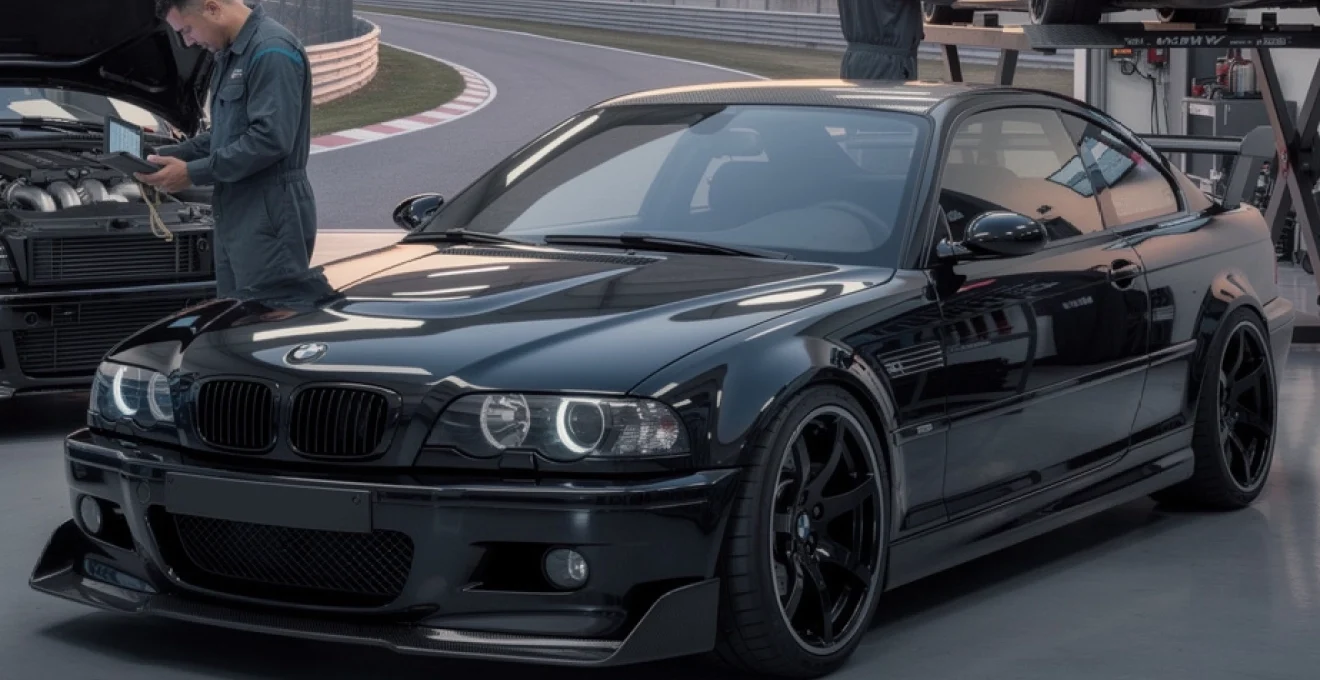
The black BMW E46 M3 sits in a sweet spot between analogue driver’s car and modern performance coupé. It is compact, understated and, in a dark colour, almost sinister, yet it carries genuine motorsport DNA and everyday usability. Two decades after launch, a well-sorted black M3 E46 feels as special as many new performance cars, while offering a level of mechanical feedback that newer models simply filter out. Whether you are hunting for a collector-grade example, planning a track-focused build or restoring a tired daily, understanding how colour, specification and engineering details come together on this generation makes the difference between an average car and an exceptional one.
Black paint also does what few other colours can: it acts like a spotlight for every design line and every flaw. On the M3 E46, it emphasises the swollen arches, the powerdome bonnet and the quad exhausts, but it also highlights poor bodywork, tired trim and neglected detailing. Treat a black M3 right and it looks like a factory homologation special; cut corners and it quickly looks flat and forgotten. The following sections break down what you need to know if you want a black E46 M3 that lives up to the badge.
BMW M3 E46 in black: factory colour codes, paint finishes and OEM exterior specifications
Schwarz II vs jet black vs carbon black: decoding BMW E46 M3 black paint codes
BMW offered several black or near-black finishes on the E46 M3, and knowing exactly which one sits on the car in front of you matters for authenticity, resale and restoration. The “standard” solid black is typically Schwarz II (paint code 668), a deep, non-metallic black with a classic gloss finish. It suits the car’s understated character and, when polished correctly, gives mirror-like reflections. However, it also shows every swirl mark, stone chip and sanding error, so any repaint or correction work must be meticulous if you want the car to present at a high level.
Many enthusiasts gravitate towards Carbon Black Metallic (code 416), which is technically a very dark blue-black. Under neutral light it appears solid black; in strong sun or under petrol station lighting it reveals a rich blue flip. Carbon Black was heavily associated with M cars of the era and pairs especially well with CSL-style upgrades because it accentuates edges and surfaces. Another less common but noteworthy shade is Jet Black on some markets, again a solid finish but with slightly different tonality. Confirming the exact paint via the VIN decode and the build sticker in the engine bay helps you match panels and order the correct touch-up or respray materials.
| Paint name | BMW code | Type | Visual character |
|---|---|---|---|
| Schwarz II | 668 | Solid | Neutral deep black, unforgiving of defects |
| Carbon Black | 416 | Metallic | Black with blue metallic flip in strong light |
| Jet Black / Schwarz | varies by market | Solid | Slightly softer, “ink-like” appearance |
If you plan a full respray on a tired black M3, it is sensible to stay with the original paint code for provenance, especially as values for well-documented cars have risen sharply since around 2019. That said, for a track-focused build, some owners accept a colour change to more exotic dark shades, provided the job is done shell-out rather than a cheap exterior-only blow-over. The key is consistency: mismatched panels or poor blending are immediately obvious on black, even at a distance.
Shadowline high-gloss trims, kidney grilles and OEM black exterior details
Factory Shadowline trim transforms a black M3 E46 from quietly handsome to genuinely menacing. High-gloss black window surrounds, dark grille surrounds and model-specific M3 mirrors visually lower the car and tie the glasshouse to the body. Many non-Shadowline cars have since been “converted” with aftermarket black trims and grilles; if authenticity is important to you, it is worth checking that the parts and finish match BMW specifications rather than cheaper paint or vinyl.
Small details such as the side gills, the CSL-style mesh front grilles and the rear diffuser insert also benefit from careful colour choice. Leaving them in OEM metallic finishes creates subtle contrast against a Schwarz body; refinishing them in gloss or satin black gives a monochrome, almost stealth look. Just as on the original CSL and GTR, functional components like the front intake grilles and brake ducts should not be over-filled with mesh or plastic—it restricts air flow to radiators and brakes, which matters if the car sees hard road or track use.
Coupe vs convertible black E46 M3: body styles, roof options and aerodynamics
The majority of iconic black E46 M3 builds you see online are Coupés, and for good reason. The fixed roof boosts torsional rigidity and saves around 85 kg compared with the Convertible, which in turn makes suspension tuning more predictable and improves high-speed stability. For a purist driver or someone planning a cage installation, the Coupé is the more natural choice. Its roofline also frames the powerdome bonnet and the flared rear arches in a way that feels very reminiscent of the homologation E30 M3.
The black M3 Convertible has its own appeal, combining the straight-six soundtrack with open-top driving and a more relaxed grand touring character. However, the additional weight and slightly softer body mean you need to be more selective with coilover and bushing choices if you want sharp handling without a crashy ride. In both body styles, black paint works like a visual shrink-wrap, making the E46 appear smaller and tighter than the numbers suggest—useful if you want a fast road car that does not shout about itself in traffic.
Headlights, tail-lights and CSL-style exterior upgrades on black M3 E46 builds
Lighting and subtle CSL-inspired upgrades can freshen a black M3 E46 dramatically without ruining its factory character. Post-2003 cars gained LED rear clusters, which look sharper and respond faster; many owners retrofit these to earlier cars using OEM parts. At the front, well-restored xenon headlights with clear lenses avoid the “cloudy” look that plagues neglected examples and significantly improve night visibility, which is especially important on darker rural roads.
CSL-style bumpers, bootlids and diffusers suit black paint almost unnervingly well. The deeper front bumper with its enlarged intakes hints at the track-bred nature of the CSL without appearing gaudy, and a carbon CSL bootlid with integrated lip spoiler blends into a dark body as if it left the Regensburg factory that way. Keeping panel alignment tight and ensuring all mounting points are properly reinforced makes the difference between a car that feels OEM+ and one that rattles like a replica track toy. If you add a front splitter or rear wing, consider how they interact aerodynamically at 150–250 km/h, not just how they look at a cars and coffee meet.
S54 engine in the black BMW M3 E46: performance, reliability and tuning potential
S54B32 technical overview: individual throttle bodies, VANOS and compression ratio
At the heart of every E46 M3, black or otherwise, sits the S54B32, a 3246 cc straight-six that blends race-derived hardware with road-going reliability. Power output in standard form is 343 hp (252 kW) at 7900 rpm and 365 Nm of torque at 4900 rpm, with US cars very slightly detuned to around 338 hp due to emissions hardware. The engine is a development of the E36 M3’s S50, but in reality almost every critical component is new or significantly revised.
The S54 uses a cast-iron block for strength, an aluminium twin-cam head, and individual throttle bodies (ITBs) for razor-sharp response. A high 11.5:1 compression ratio, finger-follower valvetrain and BMW’s Double VANOS variable cam system enable the high-rev character that made this engine a multiple “Engine of the Year” winner. Electronic throttle control offers Normal and Sport modes, giving you a choice between smoother part-throttle behaviour and more aggressive mapping. When healthy and maintained correctly, the S54 is capable of 200,000+ mile service lives, even with spirited driving.
Common S54 issues and preventative maintenance: rod bearings, VANOS and head gasket
Despite its reputation as one of the finest naturally aspirated six-cylinders ever fitted to a road car, the S54 is not without weak points. Early engines suffered from rod bearing wear, which prompted factory recalls and revised bearing shells and clearances. On any E46 M3 that is now 20+ years old, rod bearing replacement is considered preventative maintenance, especially if you intend to hit the 8000 rpm redline regularly. It is not a cheap job, but it is significantly cheaper than a failed bottom end.
The VANOS system requires attention too. Solenoids, seals and the VANOS hub itself can all cause issues, leading to rough idle, loss of mid-range torque or fault codes. Experienced independent BMW specialists will often suggest a VANOS overhaul at around 100,000 miles or when symptoms appear. Head gasket failure is rarer but can occur on hard-used examples, particularly those that have been overheated or run low on coolant. Regular oil changes using quality 10W-60, proactive cooling system servicing and occasional oil analysis provide early warning of many of these problems and give you a clear picture of engine health.
On an ageing high-performance engine, preventative maintenance is not a luxury; it is an essential investment that protects both performance and long-term value.
OEM vs tuned S54: ECU remaps, CSL airbox conversions and exhaust manifold upgrades
In stock form, the S54 is already highly optimised, but sensitive tuning can unlock more of its character. A well-calibrated ECU remap alone typically adds 10–15 hp and, more importantly, improves throttle response and mid-range torque. When combined with a CSL-style carbon airbox and appropriate software (including the CSL’s alpha-N strategy), gains of 25–30 hp at the wheels are achievable, along with an induction sound that rivals motorsport machinery. This “CSL airbox conversion” remains one of the most coveted upgrades for black E46 M3 track and fast road builds.
Aftermarket exhaust manifolds and high-flow cats can reduce backpressure and shave a few kilos, but quality and noise levels vary widely. Cheaper systems often drone at motorway speeds or trigger emissions warnings. For a dual-purpose car that still has to pass annual inspections, it is generally wiser to retain OEM cats and select a freer-flowing cat-back system. That balance between outright power and everyday usability is one reason the S54 continues to be a favourite among tuners and track drivers alike.
Track-focused engine builds: forged internals, oiling system upgrades and cooling mods
If your black E46 M3 is destined for the Nürburgring, Spa or regular track days, a more aggressive engine build starts to make sense. Forged pistons and rods increase safety margin at sustained high rpm or under forced induction, while also allowing compression ratio tweaks. An upgraded oil pump, baffles or a full baffled sump kit help prevent oil starvation under long high-g corners, something that can be an issue on sticky tyres and modern aero.
Cooling is another critical area. A fresh aluminium radiator, uprated water pump and a thermostatically controlled oil cooler keep temperatures in check during 30-minute sessions. Think of it like training gear for an athlete: the stock setup copes with fast road driving, but extended competition use pushes every system harder. Building in headroom means you can lap consistently instead of backing off when oil temps climb or coolant flashes a warning light.
Real-world examples: imola red interior with black E46 M3 track cars and dyno figures
Black E46 M3s with contrasting Imola Red interiors have become something of a cult configuration, especially for track-focused builds. The dark exterior hides road grime, tyre pick-up and rubber marks, while the red leather or cloth inside brings a motorsport feel without appearing like a stripped-out racer. A typical naturally aspirated track build—CSL airbox, remap, quality exhaust, fresh bearings and VANOS work—will usually show between 330 and 350 hp at the wheels on a modern dyno, depending on measurement method and drivetrain losses.
On track, the difference between a tired, stock S54 and a refreshed, lightly tuned example feels larger than the dyno numbers alone suggest. Stronger mid-range, cleaner throttle transition and more consistent temperatures let you concentrate on lines and braking points. It is similar to swapping from worn running shoes to fresh, correctly fitted ones: the raw speed may only improve modestly, but confidence and consistency increase dramatically, and that is what ultimately drops lap times.
Chassis dynamics of the black BMW M3 E46: suspension, steering and handling characteristics
Factory suspension geometry: MacPherson struts, multi-link rear and weight distribution
The E46 M3 chassis is a classic front-engine, rear-wheel-drive layout honed by Motorsport-specific hardware. The body is around 70% more rigid than the preceding E36, and the wheelbase was stretched to 2731 mm, helping stability without killing agility. Up front, MacPherson struts with revised geometry sit on forged control arms, while at the rear a sophisticated multi-link setup uses steel ball joints instead of rubber at key points to sharpen response. BMW targeted an almost perfect 50/50 weight distribution, which gives the car its neutral baseline balance.
Standard springs and Sachs dampers strike a surprisingly modern balance between comfort and control, provided they are still in good condition. Many cars now have 80,000–150,000 miles on original suspension, which inevitably leads to float and vague steering. Replacing tired components with OEM-equivalent parts immediately restores the car’s famous blend of ride and handling. Widened tracks, thicker anti-roll bars and a front strut brace (added from 2002) further differentiate the M3 from regular E46 models and explain why it feels so much more planted on fast B-roads.
Upgrading the black E46 M3 with coilovers: öhlins, KW V3 and bilstein B16 setups
For enthusiastic road driving and occasional track use, high-quality coilovers make the already capable chassis outstanding. Premium kits from brands such as Öhlins, KW V3 and Bilstein B16 allow height, rebound and often compression adjustment, giving you the tools to tailor the car to personal preference and tyre choice. On a black M3, subtle lowering of 20–25 mm combined with correct alignment reduces arch gap and visually emphasises the muscular stance without creating a “slammed” look.
However, not all coilovers are equal. Cheaper kits may offer extreme lows but lack proper bump and rebound control, leading to a crashy ride and unpredictable behaviour over mid-corner bumps. When you factor in geometry setup, corner weighting and, if necessary, reinforcement plates for the front top mounts, a quality package costs more up-front but saves you money in the long term by protecting tyres and chassis components. For a car that might still cross continents or commute occasionally, comfort on poor surfaces remains as important as lap-time potential.
Subframe and rear axle carrier panel reinforcement on E46 M3 track and road cars
One of the most discussed structural concerns on the E46 platform is cracking around the rear axle carrier panel, commonly called the “subframe issue”. This manifests as cracks in the boot floor where the rear subframe mounts, especially on cars that have seen repeated hard launches, potholes or track use. BMW addressed some cases under goodwill campaigns, but today most cars are long out of any manufacturer support, so professional inspection is vital.
Reinforcement typically involves removing the rear subframe, fuel tank, exhaust and heat shields, then welding in steel plates at the mounting points and treating the entire area for corrosion. On a black M3, many specialists then refinish the underside with protective coatings and fresh paint, effectively performing a mini-restoration. The job is labour-intensive and can cost several thousand pounds, but it turns a known weakness into a strength and significantly enhances long-term structural integrity—especially if you plan to fit sticky semi-slick tyres or uprated rear anti-roll bars.
A reinforced rear axle carrier panel is the difference between constantly listening for creaks and confidently exploiting the M3’s rear-driven balance on every drive.
Wheel and tyre fitment on a black M3 E46: OEM 19-inch style 67 vs BBS, apex and CSL wheels
Wheel choice has a surprisingly large impact on both dynamics and aesthetics, particularly on a dark car. The factory 18-inch M Double Spoke II wheels (8J front, 9J rear) with 225/45 and 255/40 tyres are arguably the sweet spot for real-world driving: lighter than the optional 19-inch Style 67s and paired with taller sidewalls that improve ride comfort and progressive breakaway. Many drivers who switch from 19s back to 18s report a more fluid, confidence-inspiring feel, especially on poor UK B-roads.
That said, a black M3 on OEM 19s, CSL-style 19s, or high-quality aftermarket wheels from BBS or Apex can look sensational. The key is maintaining sensible offsets and widths so that geometry remains correct and tyres clear arches under load. Modern ultra-high-performance tyres—Pirelli P Zero PZ4, Michelin Pilot Sport 4S, or similar—offer grip levels far beyond what was available in the early 2000s, so you can safely aim for slightly more neutral alignment without making the car nervous. Proper wheel balancing and alignment after any change are essential; an out-of-balance front wheel at motorway speeds will make the car feel older and more tired than it really is.
Interior and spec choices: contrasting cabins for a black BMW M3 E46
Interior specification has a huge influence on how a black E46 M3 feels from behind the wheel. The standard cabin layout is familiar 3-Series territory, with Motorsport-branded 300 km/h (or 180 mph) dials, red needles and an oil temperature gauge that warms from a cold zone to normal as you drive. Electric M sport seats, tri-colour stitched steering wheel and subtle M3 sill trims deliver just enough theatre without crossing into flashiness. When preserved well, the quality of materials still impresses compared with many modern cars.
For a black exterior, contrasting interiors such as Imola Red, Cinnamon or two-tone schemes create a dramatic effect, while black or grey leather keeps things understated and has proven popular with buyers who prefer a sleeper appearance. Alcantara or cloth retrims on heavily used cars make sense if you plan spirited driving; they grip better and wear more gracefully than shiny, cracked leather. Options such as factory navigation look dated visually but can be kept in place for originality while you hide a modern Bluetooth or CarPlay solution. For a dual-purpose street and track car, combining OEM rear seat delete kits, discreet half-cage installations and fixed-back bucket seats preserves the classic dashboard while tailoring ergonomics for serious driving.
Iconic black BMW M3 E46 case studies: CSL inspiration, GTR replicas and famous builds
BMW M3 CSL (E46) sapphire black inspiration: carbon roof, CSL bumper and bootlid swaps
The limited-run M3 CSL is often held up as the ultimate evolution of the E46 platform, and its visual cues work superbly on a black base car. While the CSL itself was never offered in solid Schwarz, many enthusiasts build “CSL-inspired” black cars using genuine or high-quality replica parts: the lighter front bumper with its distinctive intake, carbon or carbon-look roof, thinner glass and that iconic bootlid with integrated spoiler. Sapphire Black CSLs provide a useful reference for how the combination should look when executed properly.
If you are tempted by a CSL-style build, prioritise functional upgrades before purely cosmetic ones. A real carbon roof, while not cheap, reduces weight high up and lowers the centre of gravity. A CSL-style airbox and associated ECU calibration bring the powertrain closer to the CSL experience, while the bumper and bootlid tie the visuals together. Think of the genuine CSL as a benchmark rather than something to mimic bolt-for-bolt; a well-balanced black Coupé with a curated set of CSL upgrades can be more usable on the road while still feeling special every time you walk towards it.
Black E46 M3 GTR-style builds: wide-body kits, aero packages and nürburgring setups
For some owners, the ultimate goal is a black M3 that channels the brutal presence of the V8-powered M3 GTR race car. That usually means wide-body kits, aggressive front splitters, towering rear wings and track-focused suspension and brake setups. When done with motorsport-grade parts and engineering, such a car can lap the Nürburgring well under eight minutes and mix it with far more powerful machinery. The combination of flared arches over 18 or 19-inch motorsport wheels and a deep black paint finish gives an almost GT racer aesthetic.
However, GTR-style conversions are unforgiving of shortcuts. Fibreglass panels that are not properly fitted or reinforced will crack and flex; poorly designed aero can add drag without reliable downforce. If you are aiming at this level, approach the project more like building a race car than modifying a road car. That means budgeting for corner weighting, damper tuning, brake cooling, fire safety and seat/harness certification, not just the visual kit. The reward is an M3 that feels totally at home on track days and endurance events while still turning heads when you drive it through town at 30 mph.
Detailing show-quality black paint: machine polishing, ceramic coatings and PPF
Achieving and maintaining show-level gloss on black paint is both an art and a science. Because black reflects light so directly, every scratch, buffer trail and sanding mark is multiplied. If your M3’s paint is fundamentally sound, a multi-stage machine polish using diminishing abrasives can safely level defects and restore clarity. Working panel by panel, using appropriate pads and keeping panel temperatures under control, is essential to avoid holograms and burn-through.
Once corrected, protection choices matter. A high-quality ceramic coating adds depth, increases chemical resistance and makes wash maintenance easier, especially on daily driven cars. For high-impact areas—front bumper, bonnet leading edge, mirror caps and rear arches—modern paint protection film (PPF) is worth serious consideration. Think of it as a physical shield: on a black car more than most, preventing new stone chips and swirl marks saves you repeated heavy polishing and preserves clear coat thickness for the long term.
- Adopt a strict two-bucket wash method on black paint to minimise swirl marks.
- Use soft, high-quality microfibre towels and dedicated drying aids rather than chamois.
- Schedule periodic light correction instead of waiting for severe defects to build up.
Street vs track preparation: cage installations, bucket seats and harness configurations
Balancing street comfort and track safety in a black E46 M3 is a challenge that rewards careful planning. For fast road use and occasional trackdays, a bolt-in half-cage that ties into reinforced rear mounts offers roll-over safety and harness mounting points without making the car unusable for luggage or rear passengers. Fixed-back bucket seats on proper side mounts and subframes hold you securely and also lower your hip point, improving helmet clearance and driving position.
Harness choice depends on use. For a road-legal car, 4-point or 6-point harnesses with quick-adjust mechanisms make sense, but it is also vital to keep functional three-point belts for daily driving. Airbag compatibility, seat occupancy sensors and MOT regulations must all be considered when changing seats and belts. Treat the cabin like a workstation: everything you touch while driving—wheel, shifter, pedals—should feel precise and confidence-inspiring, while non-essential distractions are pared back. In a black M3, the contrast between a clean, purposeful interior and the deep, glossy exterior only adds to the sense of a focused driver’s machine.
Buying, restoring and valuing a black BMW M3 E46 in the current market
The market for E46 M3s has shifted from used performance car to recognised modern classic, and black examples in strong condition command a premium. Production numbers for the entire run sit at just over 84,000 units, with Coupés outnumbering Convertibles. However, attrition from accidents, neglect and track misuse means the pool of genuinely good cars is shrinking every year. Prices for honest, well-maintained cars began climbing noticeably around the late 2010s, with exceptional, low-mileage or rare-spec cars achieving figures that would have seemed unlikely a decade ago.
When buying, you face a choice: pay more for a fully sorted car with documented subframe reinforcement, fresh suspension, healthy S54 and strong paint, or pay less for a cosmetically appealing but mechanically tired example and budget £5,000–£10,000 for catch-up work. Rust is a growing concern even on German-built cars; front wings, rear arches, sills and the underside all deserve careful inspection on a ramp. A black car can hide early corrosion under shine and underseal, so ask for photos of the bare floorpan if a seller claims recent restoration.
- Start with a comprehensive inspection focusing on subframe, rust and engine health.
- Prioritise mechanical and structural work before cosmetic upgrades or power tuning.
- Document all work with invoices and photos to support future valuation and resale.
Restoration strategy depends on your end goal. For a long-term keeper, investing in underside refurbishment, OEM-quality paint correction or respray in the original black code, and a major mechanical refresh pays dividends in reliability and driving pleasure. For a track project, you might accept more patina on the exterior and channel funds into engine, cooling and chassis upgrades instead. Either way, a well-sorted black BMW M3 E46 now sits at the intersection of enthusiast passion and appreciating asset, offering an experience that modern turbocharged, heavily assisted cars rarely replicate and a level of character that rewards every kilometre you choose to drive.