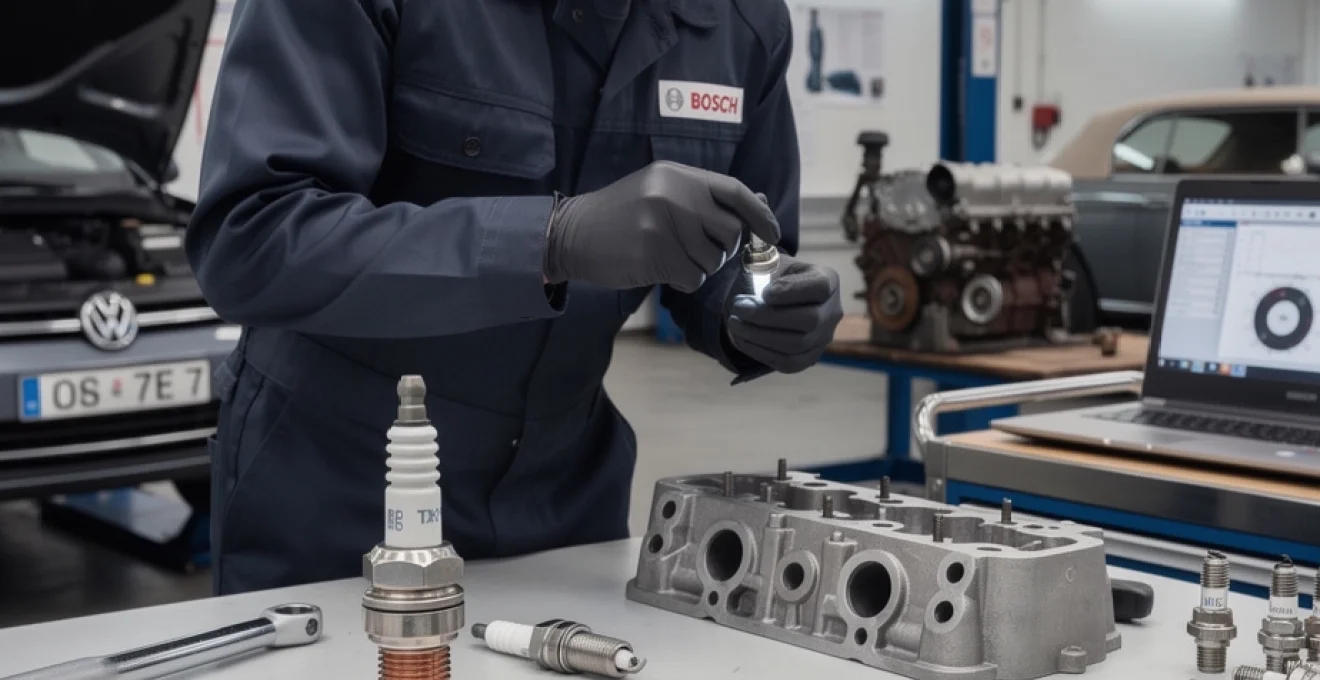
Bosch R6 spark plugs sit in a sweet spot for many European petrol engines, balancing durability, clean combustion and reliable ignition under real-world driving conditions. Whether you daily-drive a late‑1990s VW Golf, look after a classic BMW M20, or tune an early 1.8T, choosing the correct R6 reference has a direct impact on cold starts, knock resistance, fuel economy and even long-term engine health. A spark plug may look simple, yet the heat range, thread reach, seat type and resistor design interact closely with your cylinder head and ignition system. Understanding how Bosch R6 plugs are coded, how they compare with NGK and Denso equivalents, and how to install and maintain them properly gives you far more control over how your engine behaves on the road and on the dyno.
Bosch R6 spark plugs overview: heat range, construction and part number decoding
Decoding bosch R6 spark plug part numbers (e.g. WR6DC, FR6KI332S) and legacy cross-references
Bosch spark plug part numbers look cryptic at first glance, but each character tells you something important about fitment and performance. In a code like WR6DC, the initial letter describes the thread size and hex, the R identifies a resistor plug, the number 6 indicates the heat range, while the trailing letters define electrode and construction details. Higher numbers in the Bosch system generally mean a colder plug, so an R5 is hotter than an R6, which in turn is hotter than an R7. Legacy numbers such as W7DC or WR6DP still appear in older manuals, and many of them cross-reference directly to modern multi-ground designs such as FGR6HQE0 or to fine-wire variants like FR6KI332S. When cross-checking against NGK BKR6E or Champion N9YC, treating the R6 index as the anchor point avoids most compatibility mistakes.
Internal construction of bosch R6 plugs: copper core, nickel alloy shell and insulator design
Under the ceramic and hex, Bosch R6 spark plugs share a broadly similar internal architecture aimed at stable combustion over long service intervals. A central copper core is embedded inside the main electrode, surrounded by a nickel alloy shell that resists erosion and contributes to controlled heat transfer into the cylinder head. This copper core conducts heat away from the firing tip faster than a solid nickel design, helping the R6 family to operate safely in Euro 2–Euro 4 engines that often run leaner mixture strategies. The insulator is typically an aluminium oxide ceramic with high dielectric strength, shaped to provide an extended nose on hotter ranges and a shorter, more recessed form on colder versions. That nose length is vital: it fine‑tunes the self-cleaning temperature window, reducing fouling during cold urban use while guarding against glazing or cracking at motorway speeds.
Heat range characteristics of the R6 family vs R5, R7 and equivalent NGK and denso grades
The heat range rating is one of the most misunderstood aspects of spark plug selection, yet it dictates whether the firing tip runs cool enough to avoid pre-ignition and hot enough to burn off deposits. Bosch R6 plugs occupy a medium heat window: typically around the NGK 6 or Denso 20–22 equivalents. An R5 plug will run hotter at the tip, which can be useful for low-load, short-trip cars that rarely see sustained high speed, while an R7 is a step colder and often specified for turbocharged or hard-worked engines. For example, NGK BKR6E and Denso K20PR-U are common equivalent heat ranges to many Bosch R6 applications. Choosing a colder R7 or NGK 7 grade in a lightly-used city car can actually increase fouling risk; conversely, sticking with R6 in a high-boost track engine can squeeze the pre‑ignition margin too far. Heat range always needs to be matched to load, not just displacement.
Bosch R6 electrode configurations: standard single ground, multi-ground and resistor variants
The Bosch R6 family covers multiple electrode configurations that alter service life and ignition consistency. Traditional copper-core references such as WR6DC use a single ground strap, offering sharp spark focus and easy gapping. Multi-ground versions like FGR6HQE0 employ three or four ground electrodes, which allows the spark to jump to the path of least resistance on each firing event and spreads erosion over more metal. This does not multiply the spark, but it does help maintain a consistent gap for longer, especially in high-mileage engines or under harsh conditions. Resistor variants, flagged by the R in the code, integrate a suppression element in the core to reduce electromagnetic interference with sensitive ECUs, ABS modules and modern infotainment systems. Non‑resistor types are still used on some classic engines with simple ignition, but for any car with a catalytic converter and lambda control, a resistor R6 plug is strongly recommended.
Engine compatibility and fitment: matching bosch R6 plugs to specific vehicles and engines
Common bosch R6 applications in VW group engines (1.4 MPI, 1.6 8v, early 1.8T, seat, skoda, audi)
Many VW Group petrol engines from the mid‑1990s to mid‑2000s were designed around Bosch R6 heat range spark plugs as an OEM or Approved Equivalent choice. Typical examples include the 1.4 MPI and 1.6 8‑valve units found in VW Golf, Polo, Seat Ibiza and early Skoda Fabia models, where M14 x 1.25, 19 mm reach, gasket seat plugs with an R6 heat code provide the right thermal behaviour. Early longitudinal 1.8T engines (150–180 bhp) in Audi A4 and A6, as well as transverse 1.8T units in Golf GTI and Audi TT, also commonly specify R6 heat range references in standard tune. For these turbocharged applications, multi-ground versions such as FGR6KQE0 often appear in factory documentation to support longer service intervals of 30,000–40,000 km without excessive gap growth. Always confirming the exact engine code (such as AGU, AUQ or AWT) is the safest path to the correct Bosch R6 part number.
Fitment guides for BMW M10, M20 and early M40 engines using bosch R6 heat range plugs
Classic BMW four- and six‑cylinder engines provide another strong use case for R6 spark plugs, particularly where modern fuels and motorway speeds place more thermal stress on the combustion chamber than in the 1970s and 1980s. The M10 four-cylinder and M20 straight-six families often use M14 x 1.25 plugs with 19 mm thread reach and gasket seats, with an R6 heat range representing a reasonable balance for mixed driving. Many tuners move older engines from original R5 or even R4 recommendations to R6 to gain a little more detonation resistance on today’s E5–E10 petrol. Early M40 engines, with their compact combustion chambers and higher rev potential, are particularly sensitive to pre-ignition and therefore respond well to the slightly cooler R6 range. When installing in aluminium BMW heads, tightening torque around 25–28 Nm is usually advised, rather than relying on “feel” alone.
Mercedes-benz M102, M103 and classic M115 engines: OEM-equivalent bosch R6 part selection
Owners of older Mercedes-Benz petrol engines, such as the M102 four‑cylinder, M103 straight-six and classic M115 units, frequently look for Bosch R6 plugs that match or improve upon original specifications. These engines often run relatively low specific output but see long sustained cruise speeds, especially on autobahns, which makes heat range control critical. R6 copper-core plugs with nickel ground electrodes deliver reliable ignition and adequate self-cleaning for STP-rated fuels and modern low‑sulphur blends, while remaining sympathetic to ageing distributor-based ignition systems. Choosing a multi-ground R6 reference can be useful in city cars or taxis where extended idling and short trips increase deposit build-up. However, in older, lower‑tension ignition systems, a standard single-ground Bosch R6 with a conservative factory gap often provides a more reliable spark, particularly during cold, damp winter mornings.
Cross-referencing bosch R6 with NGK (e.g. BKR6E), denso (e.g. K20PR-U) and champion equivalents
Cross-referencing between Bosch R6, NGK, Denso and Champion spark plugs is common when regional availability or tuner preference dictates a specific brand. Typical equivalents include NGK BKR6E, Denso K20PR-U and Champion N9YC for many standard Bosch R6 fitments. However, only the heat range and general design are mirrored; seat type, thread reach and projected nose length can still vary. A Bosch R6 code that uses a projected insulator may cross to an NGK plug that sits slightly more recessed, altering flame kernel development. For that reason, cross-reference tables should be treated as guides, not gospel. When in doubt, comparing the old and new plugs side-by-side for overall length, seat design and tip projection is a simple but effective check before installation, especially on interference engines where piston-to-plug clearance is tight.
Assessing cylinder head design, thread reach and seat type before choosing an R6 reference
Cylinder head geometry has a direct influence on safe spark plug selection, and ignoring thread reach or seat type can result in expensive damage. Most Bosch R6 automotive plugs share an M14 x 1.25 thread, but reach can vary from 12.7 mm through 19 mm to 26.5 mm, and seats may be flat gasket or conical. Installing a 26.5 mm reach plug into a 19 mm head can leave exposed threads inside the combustion chamber, promoting hot spots and carbon build-up; using a gasket-seat plug in a tapered-seat head can lead to poor sealing and distorted heat transfer. Before committing to any R6 part number, verifying the correct thread reach and seat style against cylinder head casting data or a reliable parts catalogue avoids cross-threading and mechanical interference. For engines that have previously suffered helicoil or insert repairs, re-checking reach becomes even more critical.
Performance characteristics of bosch R6 spark plugs in naturally aspirated and turbocharged engines
Cold start performance and combustion stability in euro 2–euro 4 petrol engines
Euro 2–Euro 4 petrol engines were designed during a period when manufacturers balanced tightening emissions standards with relatively simple fuelling and ignition systems. Bosch R6 spark plugs support this balance by providing a firing tip temperature window that ensures reliable cold starts while maintaining clean running once the catalyst is active. In urban conditions, where engines can spend over 40% of driving time below full operating temperature, the self-cleaning characteristics of R6 plugs help reduce misfire rates and stabilise idle speed. A copper core with an optimised insulator profile supports fast heat-up in the first few minutes after start, while the resistor element mitigates electromagnetic noise that might otherwise disturb lambda and knock sensor readings during warm-up enrichment phases.
Ignition reliability under high cylinder pressures in mild turbo and supercharged setups
Forced-induction engines, even in mild factory trim, place extra demands on spark plug insulation and electrode design. Under boost, cylinder pressures rise significantly, making it harder for the ignition system to jump the spark gap, particularly if that gap has widened through wear. Bosch R6 plugs, especially multi-ground variants like FGR6HQE0, distribute erosion over several electrodes, slowing gap growth and helping maintain reliable ignition under high load. In many mild turbo and supercharged engines running up to 0.8–1.0 bar of boost, staying within the R6 heat range provides enough thermal headroom without sacrificing drivability. However, for engines regularly operating at high boost or with aggressive ignition timing, stepping down to an R7 heat range or equivalent NGK 7 grade can improve knock resistance while retaining similar construction and thread dimensions.
Knock resistance and pre-ignition margins when using R6 in tuned 1.8T and 2.0 turbo engines
When moving beyond stock maps into tuned 1.8T and 2.0 turbo engines, spark plug heat range and design become part of the knock control strategy. Higher boost and advanced timing elevate combustion chamber temperatures, reducing the margin between normal operation and destructive pre‑ignition. Using Bosch R6 copper-core plugs in a stage 1 or mild stage 2 tune is generally acceptable, provided air–fuel ratios are kept in check and intake charge cooling remains effective. For more aggressive setups, some tuners prefer a colder Bosch R7 or NGK 7 equivalent to widen the safety window. Nonetheless, an R6 plug with a correctly set gap and clean insulator can still support reliable power in the 220–260 bhp range on many early 1.8T engines. Monitoring plug colour, ground strap heat marks and any signs of glazing is essential feedback when adjusting ignition maps on the dyno.
Fuel economy and emissions impact of bosch R6 plugs in closed-loop lambda-controlled systems
In closed-loop lambda-controlled systems, the spark plug is effectively part of the emissions and economy strategy, even if indirectly. A fresh set of Bosch R6 plugs can reduce misfire events by several percentage points, which in turn stabilises oxygen sensor readings and allows the ECU to maintain tighter fuel trims. Studies from several OEMs indicate that consistent ignition can improve fuel economy by around 1–2% over a degraded plug set, especially in stop–start urban use. Clean, well-gapped R6 spark plugs also support faster catalyst light-off by reducing partial burns and raw hydrocarbon emissions during warm-up. On engines that already achieve over 35–40 mpg on the motorway, this may not translate into a dramatic headline saving, but over 20,000–30,000 km the combination of reduced fuel use and lower deposit formation has a tangible effect on running costs and engine longevity.
Choosing the correct bosch R6 variant: thread size, reach, seat type and resistor configuration
Identifying correct thread diameter and reach (m14x1.25, 19 mm vs 26.5 mm) for your cylinder head
Finding the correct Bosch R6 variant for your engine starts with mechanical basics: thread diameter, pitch and reach. Most automotive R6 plugs use an M14x1.25 thread, but the reach typically sits at either 19 mm or 26.5 mm. The shorter 19 mm reach appears frequently in older BMW, Mercedes and many naturally aspirated VW engines, while some later multi-valve or high-performance heads use the longer 26.5 mm design to position the spark deeper in the combustion chamber. Using a plug with insufficient reach can shroud the spark, reducing combustion efficiency, while excessive reach risks piston contact. If you do not have access to manufacturer data, carefully measuring an existing known-correct plug or comparing it against Bosch’s printed catalogues remains an effective safeguard before ordering a new R6 reference.
Conical vs gasket seat bosch R6 spark plugs in aluminium and cast-iron heads
The interface between the spark plug and cylinder head not only seals combustion gases, it also acts as a major heat path from the plug to the cooling system. Bosch R6 plugs are available with either flat gasket seats or tapered conical seats, and mixing them up can seriously compromise sealing and heat transfer. Aluminium heads, common on BMW M10/M20, VW 1.8T and many modern engines, typically expect a gasket seat, where a crush washer compresses to create an even contact surface. Some cast-iron heads, particularly on older American and Japanese engines, may use a conical seat that seals at an angled interface on the plug shell. Using a gasket plug in a conical head can leave gaps that leak combustion and overheat the plug, while the opposite combination can distort the cylinder head threads. Always matching seat type to OEM design ensures correct torque readings and predictable thermal behaviour.
Resistor vs non-resistor bosch R6 plugs for distributor, coil-pack and coil-on-plug ignition
Resistor design is often overlooked when choosing a spark plug, yet it has serious implications for both ignition reliability and electronic noise. Bosch R6 resistor plugs, identified by an R in the code, incorporate a suppression element that smooths the high-frequency spike generated when the spark fires. In distributor systems with copper-core HT leads, this helps protect radio reception and simple early ECUs from interference; in coil-pack and coil-on-plug systems, it is even more critical, as mis‑timed pulses can disturb crank sensors, knock sensors and CAN bus communication. Non‑resistor plugs may provide a marginally stronger spark if all else is equal, but in most modern applications the small theoretical gain is outweighed by the risk of interference. If your car uses any form of lambda control, OBD diagnostics or advanced ABS/ESP modules, a resistor-type Bosch R6 plug is the safer default.
Selecting bosch R6 heat range for daily driving, LPG conversions and light motorsport use
Heat range tuning allows you to tailor Bosch R6 plug behaviour to specific fuel types and driving patterns. For normal daily driving on standard petrol, the manufacturer’s specified R6 equivalent should usually be followed. LPG conversions often run slightly hotter combustion temperatures and drier mixture characteristics, which can justify a move one step colder in heat range to maintain similar electrode tip temperatures. For light motorsport use—such as track days or hill climbs—where your engine spends more of its time at high load and high revs, stepping to a colder R6-compatible range (or an R7 equivalent) can widen the pre‑ignition safety margin without sacrificing too much part‑throttle drivability. The key is to judge plugs after real use: ash colour, strap heat marks and deposit location offer better guidance than solely relying on catalogue charts.
Compatibility of bosch R6 with aftermarket ECUs (megasquirt, link, haltech) and high-output coils
Aftermarket ECUs such as Megasquirt, Link and Haltech allow for finely tuned ignition strategies, dwell control and boost management, which in turn influence how hard the spark plug is worked. Bosch R6 plugs are entirely compatible with these systems, provided you respect their mechanical limits and adjust spark gap accordingly when using high-output coils. Many tuners target a slightly tighter gap—around 0.6–0.7 mm instead of the factory 0.9–1.1 mm—when running elevated boost or coil-on-plug conversions to reduce misfire risk under high cylinder pressure. The resistor element in R6 plugs also helps keep ECU signal integrity clean, particularly when using sensitive digital knock detection. Implementing regular plug inspections as part of the mapping process is good practice: reading insulator colour and ground strap condition provides direct feedback on timing and mixture accuracy that wideband logs alone may not fully reveal.
Installation best practice: gapping, torque settings and tools for bosch R6 spark plugs
Factory gap specifications for bosch R6 in bosch motronic, siemens, marelli and delco systems
Factory gap specifications for Bosch R6 plugs vary slightly across ignition systems, but most late‑1990s and early‑2000s petrol engines using Bosch Motronic, Siemens, Marelli or Delco ECUs specify gaps in the 0.8–1.1 mm range. A typical VW 1.8T with Motronic may call for 0.9 mm, while some naturally aspirated Siemens-managed engines run closer to 1.0–1.1 mm for improved idle stability and lean-burn efficiency. Although many packaged plugs ship with a pre-set gap around 1.0 mm, production tolerances and transport can alter that measurement, so always verifying with a wire feeler gauge is good practice. Over‑gapping can raise misfire risk under load, whereas under‑gapping can increase NOx emissions and slightly roughen idle. For engines with individual coil packs, staying close to the upper end of the factory range normally offers the best compromise between driveability and emissions.
Adjusting spark plug gap for performance coils (MSD, bosch motorsport, NGK U-Groove coils)
Upgrading to performance coils from brands such as MSD, Bosch Motorsport or NGK often tempts owners to open plug gaps dramatically in pursuit of efficiency gains. While stronger coils can fire wider gaps, Bosch R6 plugs still operate within practical limits dictated by cylinder pressure, mixture quality and insulator design. For mild naturally aspirated engines, increasing gap by 0.1–0.15 mm over factory spec can sharpen throttle response and reduce unburned hydrocarbons. In turbocharged or supercharged applications, however, the trend is usually the opposite: tightening the gap by 0.1–0.2 mm improves spark reliability at high boost without significantly affecting light‑load economy. When adjusting gaps, always use dedicated tools that pull on the ground strap rather than prying against the centre electrode, and re‑check after the first heat cycle because minor shifts can occur as the plug beds into the seat.
Correct torque values for M14 bosch R6 plugs in aluminium vs cast-iron heads
Correct torque is vital for both sealing and heat transfer, and it also protects fragile threads in older heads. For M14 Bosch R6 plugs with a 19 mm reach and gasket seat, many manufacturers recommend around 25–30 Nm in aluminium heads and 35–40 Nm in cast iron, assuming clean, lightly oiled threads. Over‑tightening can distort the plug shell and insulator, altering the heat path and risking cracks, while under‑tightening can cause combustion gas leakage, local overheating and eventual thread erosion. Using a calibrated torque wrench rather than relying purely on feel is particularly important when working on aluminium heads from older BMW and Mercedes engines, where repeated over‑torque cycles over years may already have weakened the thread engagement.
Using anti-seize, dielectric grease and calibrated torque wrenches during installation
The use of anti-seize compound on spark plug threads is a debated topic, but with Bosch R6 plugs in aluminium heads, a thin, high‑temperature nickel or ceramic anti-seize can reduce galling and ease future removal. However, lubrication changes the torque–tension relationship, so if anti-seize is applied the torque figure should typically be reduced by around 10–20% to avoid over‑stretching threads. Dielectric grease, applied sparingly inside the coil-on-plug boot or spark plug cap, helps seal out moisture and prevent tracking, especially in climates with high humidity or road salt. Combining these materials with a properly calibrated torque wrench and clean, debris‑free plug wells turns plug installation into a controlled process rather than a guess, significantly lowering the risk of misfires or thread repairs later on.
Diagnosing cross-threading and seat damage when fitting bosch R6 into ageing heads
Ageing aluminium heads present a genuine challenge when changing spark plugs, particularly if older plugs have been over‑tightened or left in place for extended intervals. Cross-threading often begins subtly: increased resistance during the initial hand‑tightening phase or a plug that does not sit flush with the seat. If forced, the M14 x 1.25 thread can strip rapidly, requiring helicoil or timesert repair. Visual inspection with a borescope can reveal damaged seats, carbon build-up around exposed threads and even evidence of previous insert work. When fitting Bosch R6 plugs into such heads, starting each plug by hand for several full turns before applying a wrench, and using a length of hose as a flexible driver, are simple techniques that dramatically reduce cross-threading risk. Any suspicion of seat damage justifies removal and inspection before the engine is run under load.
Inspection, troubleshooting and maintenance of bosch R6 spark plugs
Reading bosch R6 plug colour and deposits for mixture, timing and oil consumption diagnosis
Spark plug reading remains one of the most direct diagnostic tools available, and Bosch R6 plugs provide clear visual cues when examined carefully. A healthy mixture usually leaves a light tan or grey‑brown colour on the insulator nose, with minimal fluffy deposits. Sooty black carbon indicates an excessively rich mixture, weak ignition or frequent short trips; bone‑white or blistered insulators suggest lean running or overly advanced timing. Oily deposits, especially on the outer shell and threads, point towards valve stem seal wear or ring blow‑by. Inspecting R6 plugs after a full‑load plug chop—lifting off and killing the engine at high rpm—can give a more accurate snapshot of WOT fuelling, while checking after extended idling helps diagnose city-driving behaviour. Each pattern tells a story, allowing you to refine ECU mapping, injector servicing or mechanical repairs accordingly.
Identifying detonation, pre-ignition and overheating marks on R6 electrodes and insulators
Detonation and pre-ignition leave distinct marks on Bosch R6 electrodes and insulators that should not be ignored. Light detonation often shows as peppered, speckled aluminium deposits on the insulator tip, where molten piston material has been blasted against the ceramic. More severe knocking can round off ground strap edges and leave a sand-blasted appearance on the firing surfaces. Pre‑ignition, which is more dangerous, tends to melt or even break the ground electrode and can crack the insulator, with discolouration extending further up the nose. Overheating without outright knock usually manifests as a glazed, shiny insulator and discoloured, blue‑straw ground straps. Spotting these signs early and responding—by enriching mixtures, retarding timing, improving charge cooling or fitting a colder plug grade—can prevent catastrophic piston or valve damage in highly stressed engines.
Service intervals for bosch R6 in city driving, motorway use and track-day conditions
Service intervals for Bosch R6 copper-core plugs depend heavily on usage patterns rather than a fixed mileage alone. In typical mixed driving, many manufacturers specify replacement between 30,000 and 40,000 km, though modern fuels and efficient ignition can sometimes push that further without obvious misfire. City driving with frequent cold starts and short journeys accelerates deposit build-up, making 20,000–25,000 km a more prudent interval. Long motorway use at stable speeds is actually easier on plugs, and an R6 set can often remain serviceable for 40,000–50,000 km if inspection suggests healthy colour and gap growth is controlled. Track-day or competition use is harsher again: high cylinder temperatures, rich enrichment strategies and frequent heat cycling justify inspection after every event and replacement every few events, even if the plugs still “look” acceptable.
When to upgrade from R6 copper-core plugs to bosch platinum or bosch double iridium references
Copper-core Bosch R6 plugs remain excellent value for many stock and mildly tuned engines, but some situations justify an upgrade to Bosch Platinum or Bosch Double Iridium references. Extended service intervals are one clear reason: fine-wire platinum or iridium tips resist erosion far better, maintaining a consistent gap over 60,000–90,000 km or more, which is attractive if your car has difficult plug access or a tightly scheduled maintenance plan. High-energy coil-on-plug systems and lean-burn strategies also benefit from the sharper, more concentrated spark typical of fine-wire designs, particularly during stratified or ultra-lean operation. On the other hand, if you frequently experiment with maps, fuels or boost levels, inexpensive R6 copper-core plugs provide a sacrificial, easy-to-read window into combustion behaviour, allowing you to inspect and replace them often without major cost, while preserving your more expensive platinum or iridium sets for final, proven calibrations.