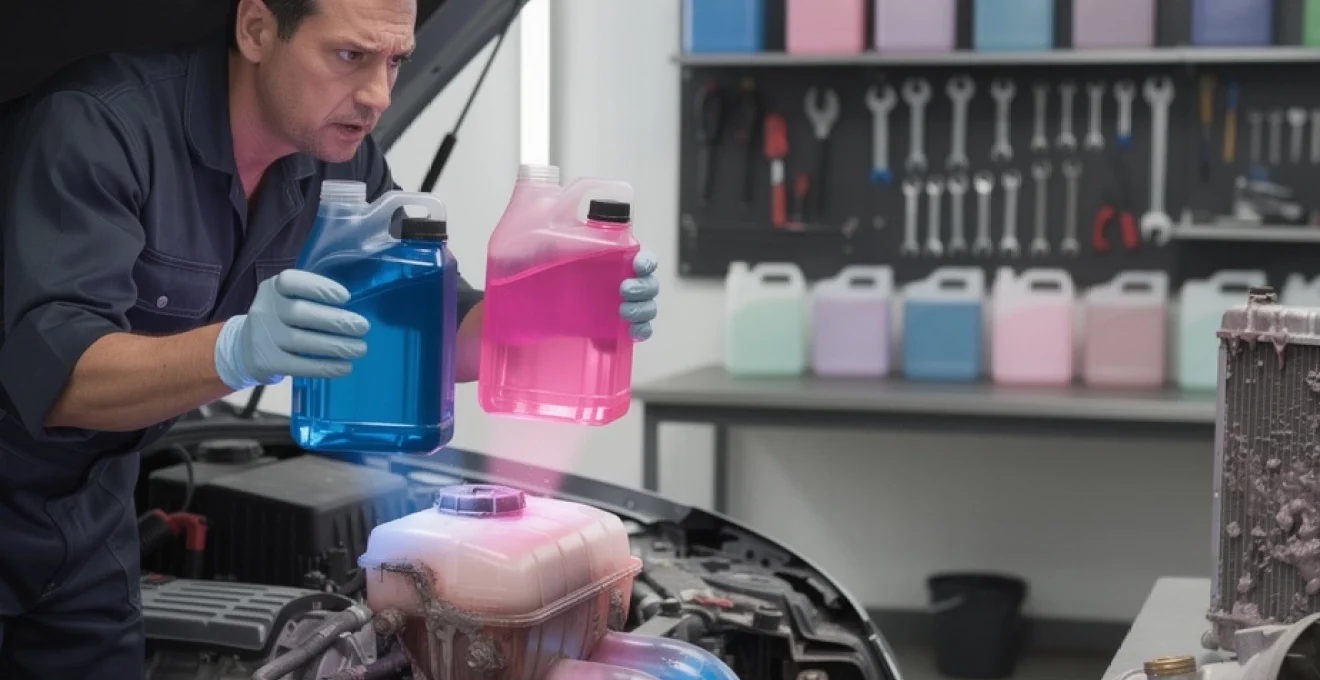
Standing over an expansion tank with a bottle of the “wrong colour” coolant in your hand is a nerve‑racking moment. Modern engines run hotter, use more aluminium and plastic, and rely heavily on very specific antifreeze chemistry. Mixing blue and pink coolant may look harmless, yet under the surface there can be complex reactions that shorten coolant life, strip away corrosion protection and, in the worst cases, create sludge that blocks galleries and heater cores. Understanding what each colour usually represents, what happens when they are combined, and how to recover a system that has been mixed already helps you protect your engine, avoid expensive repairs and choose the right coolant every time you top up or change it.
Understanding engine coolant chemistry: how blue and pink antifreeze formulations differ
Organic acid technology (OAT) vs inorganic additive technology (IAT): the chemistry behind pink and blue coolant
Although colour is only a dye, blue and pink coolant often indicate different inhibitor technologies. Traditional blue or green coolant is usually based on IAT (Inorganic Additive Technology), while many pink or red coolants are OAT (Organic Acid Technology) or hybrid OAT. Both start from similar glycols, but the corrosion‑inhibiting additives are very different. IAT coolant uses fast‑acting inorganic salts to coat metal surfaces rapidly. OAT relies on organic acids that react more slowly but last far longer. When you mix these systems, the additive packages can neutralise each other, turning a carefully balanced formulation into a compromised cocktail that no longer delivers the advertised long‑life protection.
Silicate, phosphate and borate inhibitor packages in blue coolant vs carboxylate inhibitors in pink coolant
Blue IAT coolant normally contains silicates, phosphates and sometimes borates. These compounds rapidly create a thin, protective film over iron, steel, brass and aluminium surfaces. Think of it as spraying a quick‑drying lacquer on bare metal. Pink OAT coolant, on the other hand, tends to use carboxylate inhibitors such as 2‑ethylhexanoic acid and other organic acids. Instead of coating every surface, OAT molecules target and passivate microscopic corrosion sites directly. This difference in strategy matters when you pour one on top of the other. When silicates meet certain organic acids, they can form gels and precipitates, removing both from solution and leaving metal surfaces exposed. Laboratory tests show that inhibitor depletion can accelerate by 30–40% when incompatible chemistries are mixed.
Ethylene glycol vs propylene glycol base fluids and their compatibility when mixing colours
Most blue and pink coolants for passenger cars use ethylene glycol as the base fluid. Some “eco” or low‑toxicity products use propylene glycol instead. From a purely thermal and freezing‑point perspective, ethylene and propylene glycol are compatible and will not react catastrophically when mixed. The trouble is not the glycol itself; it is the inhibitor package dissolved in it. Two coolants can share the same glycol yet have completely different additive chemistries and service lives. If you mix a propylene‑glycol pink OAT with an ethylene‑glycol blue IAT, you still end up with unpredictable inhibitor behaviour and uncertain corrosion resistance, even though the bulk fluid remains liquid and clear at first glance.
Service life, corrosion resistance and temperature stability of OEM blue vs pink long-life coolants
Service life is another area where blue and pink coolants often diverge. Classic blue IAT coolant typically has a change interval of around 2 years or 30,000 miles. Many pink OAT or hybrid OAT coolants are rated for 5 years or 150,000 miles, sometimes longer in ideal conditions. That extended life comes from the slower depletion rate of organic acids in modern mixed‑metal systems, especially aluminium engines and radiators. However, as soon as you mix blue and pink, you effectively downgrade the system to the shorter‑life product. Several OEM and aftermarket studies indicate that even a 10–15% contamination of long‑life coolant with conventional IAT can reduce expected life by half and raise corrosion rates noticeably on aluminium surfaces, water pump impellers and soldered joints.
OEM specifications and colour codes: how manufacturers define blue and pink coolant
Volkswagen G11 (blue/green) vs G12/G12+ (pink/red) vs G13 (lilac): what the standards actually mean
Many drivers associate blue coolant with older Volkswagen G11 and pink or red coolant with G12/G12+ standards. G11 was typically a silicate‑containing IAT or early hybrid, dyed blue or green. G12 moved to a silicate‑free OAT formula, often pink or red, while G12+ and G12++ introduced hybrid packages that improved compatibility and stability. G13, usually lilac, uses glycerine as part of the base fluid for lower environmental impact, combined with hybrid OAT inhibitors. The critical point is that Volkswagen warns against mixing G11 with G12/G12+ due to silicate precipitation and “may only be mixed in emergencies” guidance appears in many service documents. That guidance is echoed across European brands using similar chemistries, even when dye colours differ.
BMW blue coolant concentrate vs toyota super long life pink coolant: cross-compatibility risks
BMW factory coolant is usually a blue concentrate formulated to a specific HOAT (Hybrid Organic Acid Technology) pattern with low silicate content. Toyota Super Long Life Coolant is pink, silicate‑free OAT with phosphates. On paper, both are modern long‑life products, yet they are not designed to be combined. BMW systems generally avoid phosphates to reduce scale formation in European hard‑water regions. Toyota, aiming at global markets, uses phosphate but excludes silicates to protect specific gasket and seal materials. Mixing the two may not instantly sludge the system, but it undermines the carefully tuned balance of inhibitors. Over time you increase the risk of deposits on water pump seals and reduced protection at aluminium welds and brazed joints – exactly the areas these OEMs tested so extensively.
Mercedes-benz MB 325.x, ford WSS-M97 series and PSA B71 standards for coolant colours and chemistry
Mercedes‑Benz uses normative documents such as MB 325.0, MB 325.3 and MB 325.5 to define acceptable coolant chemistries. Some of these are traditionally blue or clear, others pink or yellow, yet the manufacturer emphasises specification rather than colour. Ford uses the WSS‑M97 series specifications, again covering different inhibitor blends and change intervals. PSA (Peugeot‑Citroën and now part of Stellantis) relies on B71 standards that align with particular OAT or hybrid OAT technologies. A professional observation here: OEM engineers build these specs around corrosion tests that run for thousands of hours at elevated temperatures, with mixed metals and real‑world solder flux residues. Colour is chosen mainly for identification and marketing, not as a universal chemical code.
Why relying on coolant colour alone is misleading across brands and aftermarket products
Across the aftermarket, colour has become even less reliable. Some suppliers dye a conventional IAT coolant blue, others green; OAT may be orange, red, pink, or even dark green. Universal and “multi‑vehicle” products muddy the waters further with their own branding colours. Two coolants of the same shade can be chemically incompatible, and two different colours can, in some cases, share the same base chemistry. That is why looking only at colour when deciding whether you can mix blue and pink coolant is almost guaranteed to mislead you. Reading the label for terms like OAT, HOAT, IAT, BS 6580 or OEM approvals, and checking the vehicle handbook, gives far more reliable guidance than the dye alone.
What happens chemically and mechanically if you mix blue and pink engine coolant?
Formation of gels, sludge and precipitates when silicated blue coolants meet OAT pink coolants
The most worrying failure mode when mixing blue and pink coolant is the formation of gel or sludge. When a silicate‑rich blue coolant meets a silicate‑free pink OAT, the organic acids can destabilise the silicate layer. Instead of staying dissolved, silicates and phosphates can drop out as fine particles, sometimes forming a cork‑like deposit. Independent workshops report cases in which mixed coolant produced a beige sludge blocking throttle‑body heaters and heater matrices within months. Once this process starts, simply topping up with the correct coolant rarely reverses it. A full flush, and sometimes component replacement, becomes the only reliable cure.
Even small percentages of incompatible coolant – often as little as 10–20% by volume – can start the precipitation process and reduce corrosion protection dramatically.
Impact of mixed coolants on aluminium cylinder heads, water pump seals and heater cores
Aluminium parts such as cylinder heads, radiators and heater cores depend on a stable protective film to resist pitting and erosion. Mixed coolants with depleted inhibitors leave localised hot spots where cavitation and micro‑boiling occur. That combination of heat and turbulence can erode aluminium in a way similar to sandblasting from the inside. Water pump seals and bearings also suffer. If gel or sludge develops, it can abrade seal faces and restrict flow through tiny bleed passages designed to keep seals lubricated. In practical terms, you might see a water pump that should last 150,000 miles begin leaking after 60,000–80,000 miles following repeated top‑ups with the wrong colour coolant.
Electrolysis and galvanic corrosion issues in mixed-coolant systems with mixed metals (aluminium, cast iron, brass)
Modern engines often combine cast‑iron blocks with aluminium heads, plus brass or copper heater cores and steel fittings. This mix of metals creates galvanic corrosion risks whenever coolant chemistry falls outside its design window. Poor inhibitor balance, elevated conductivity and low pH accelerate electron transfer between dissimilar metals, effectively turning your cooling system into a weak battery. Mixed coolants that have lost buffering capacity can see pH drift from a healthy 8–9 down toward 6–7, significantly increasing corrosion rates. In fleet trials, systems running degraded or contaminated coolant showed up to 50% higher mass loss on aluminium coupons compared with correctly maintained long‑life coolant, even when temperature and load were the same.
Real-world failure scenarios: clogged radiators, overheating, and water pump erosion after coolant mixing
Real‑world workshop experience backs up the chemical theory. Technicians dealing with cars that have had blue and pink coolant mixed frequently report partial blockages in the narrow passages of modern radiators and heater matrices. Drivers notice poor cabin heat, fluctuating temperature gauges or repeated overheating under load. In some documented cases, coolant passages in throttle‑body warmers and EGR coolers have been found “blocked solid with cork‑like sludge”, requiring several hours of back‑flushing and component replacement. Water pump impellers made from plastic or light alloys can lose efficiency as deposits build on blades, increasing operating temperature and, in extreme cases, leading to warped cylinder heads or failed head gaskets.
Once sludge or heavy scale has formed as a result of mixed coolant, the cost of rectification – new radiator, heater core, water pump and multiple flush cycles – can easily exceed the original vehicle value on older cars.
Diagnosing your existing coolant: tests before deciding to mix or change
Using hydrometers and refractometers to check glycol concentration before top-up
Before topping up a system that already contains an unknown mixture of blue and pink coolant, it is sensible to test what is in the engine. A basic hydrometer gives a rough indication of antifreeze concentration by measuring density, but a refractometer offers more precision. By placing a small drop of coolant on the lens, you can read off the freezing point directly. For UK and EU climates, a typical 50:50 mix of glycol and deionised water protects down to around −35 °C. If tests show a much weaker mix, you have a good reason to plan a full drain and refill instead of just adding more coolant of another colour and hoping for the best.
Ph testing, nitrite test strips and visual inspection for identifying coolant type and degradation
pH strips are a quick way to gauge coolant health. Fresh OAT or HOAT coolant usually sits around pH 8–9. Values dropping below 7.5 suggest inhibitor depletion or contamination. Nitrite or nitrate test strips (more common in heavy‑duty applications) can also provide clues, as many passenger‑car OAT coolants are nitrite‑free by design. Visual inspection is still extremely valuable. Cloudiness, brown tint, visible particles or an oily sheen indicate that the coolant is no longer in good condition. If you see any of these signs and you know different colours have been mixed in the past, a proactive flush is cheaper and safer than waiting for overheating or component failure.
Reading expansion tank labels, service records and OEM caps to confirm correct specification
Many modern vehicles carry valuable information directly on the expansion tank, radiator cap or a nearby sticker. You might see references such as “Use only G12++”, “Use silicate‑free OAT” or specific OEM part numbers. Service records often list the coolant type used at the last change. Taking a few minutes to cross‑check these details with the product label on the bottle in your hand can prevent long‑term compatibility issues. When in doubt, the safest option is to match the OEM specification exactly rather than basing the decision on the current colour in the tank, which may already be the result of past mixing.
Safe procedures if blue and pink coolant have already been mixed
Full cooling system flush: step-by-step methodology for gravity drain, back-flush and chemical flush
If blue and pink coolant have been mixed in anything more than a very small emergency top‑up, a thorough flush is the most reliable way to protect the engine. A professional‑grade procedure typically follows a structured sequence to clear old coolant and deposits from the entire circuit.
- Allow the engine to cool fully, then open the radiator drain and engine block drain (if fitted) for a gravity drain, capturing old coolant for safe disposal.
- Refill with clean water, run the engine with the heater on until warm, then shut down and drain again to dilute any remaining mixed coolant.
- Disconnect lower and, where accessible, upper hoses to back‑flush the radiator and heater core using low‑pressure water, reversing normal flow to dislodge debris.
- If sludge or heavy scaling is suspected, use a manufacturer‑approved chemical flush, running the engine as directed before a final thorough rinse with deionised water.
- Close all drains, reconnect hoses and refill with the chosen coolant mixture, then bleed air carefully according to the vehicle’s procedure.
Choosing a universal coolant vs returning to OEM-spec antifreeze after a flush
After a complete flush, you have two main options: return to a specific OEM‑approved coolant or use a high‑quality “universal” product that explicitly meets the required standards. Returning to OEM spec is usually best for vehicles still under warranty or those with complex cooling circuits, such as turbocharged or hybrid models. Universal coolants can be a practical choice in mixed fleets or older cars, provided the datasheet lists compatibility with the relevant BS 6580 and OEM approvals. The key is to choose one chemistry and stay with it, avoiding future top‑ups with random blue or pink products that may not share the same inhibitor technology.
Bleeding air from the system on modern engines with electric water pumps and bleed screws
Once the system is refilled, removing trapped air is crucial. Air pockets can cause localised hot spots and trigger warning lights even when the coolant itself is correct. Many modern engines have dedicated bleed screws on radiator hoses, thermostat housings or near the heater core. Others with electric water pumps require a specific bleed procedure via the instrument cluster or diagnostic tool, running the pump in a purge mode. Following the manufacturer’s instructions exactly helps you avoid overheating and ensures the new coolant reaches every part of the engine, heater and turbocharger cooling circuits.
Air in the cooling system can be as damaging as the wrong coolant: it creates hot spots, accelerates corrosion and can even crack aluminium heads if severe overheating occurs.
Best-practice coolant selection and maintenance to avoid mixing issues
Selecting the correct coolant based on VIN, OEM workshop manuals and manufacturer data sheets
The most reliable way to avoid blue‑and‑pink mixing problems is to start with the correct specification every time. Many manufacturers now publish coolant guidance based on the vehicle identification number (VIN), and dealer parts systems can pinpoint the exact product originally filled at the factory. OEM workshop manuals and technical service bulletins also specify whether the engine requires IAT, OAT, HOAT or a particular brand‑specific formulation. Reputable coolant manufacturers provide detailed data sheets listing OEM approvals and compliance with standards such as ASTM D3306 and BS 6580. Matching your purchase to these documents means you can ignore dye colour and focus on chemistry and compatibility instead.
Service intervals, replacement schedules and record-keeping for long-life and hybrid coolants
Even the best long‑life coolant does not last forever. Heat cycles, oxygen ingress and trace contamination slowly deplete inhibitors. Adhering to the specified replacement interval – typically 5 years for pink OAT, 2–3 years for blue IAT, and somewhere between for hybrid coolants – keeps corrosion rates low and avoids the grey area where someone is tempted to top up an ageing coolant with a different product. Good record‑keeping helps too. If you log the coolant type, brand, mixture ratio and change date, future you (or the next owner) will not be left guessing what is in the system and whether it is safe to mix or top up.
Using premixed vs concentrate coolant and correct deionised water ratios for UK and EU climates
Finally, the choice between premixed and concentrate coolant affects both protection and compatibility. Premixed products offer convenience and eliminate the risk of using hard tap water, which can contribute to scale and galvanic corrosion. Concentrates give more flexibility but must always be diluted with deionised or distilled water for best results. For most UK and EU climates, a 50:50 ratio of coolant concentrate to deionised water delivers an optimal balance of freeze protection, boiling point elevation and inhibitor concentration. Stronger mixtures do not necessarily protect better and can, beyond about 65% glycol, actually reduce heat transfer. By sticking to the recommended dilution, using the right water and never switching chemistry without a proper flush, you dramatically reduce the likelihood of problems when dealing with blue and pink engine coolant in any modern vehicle.