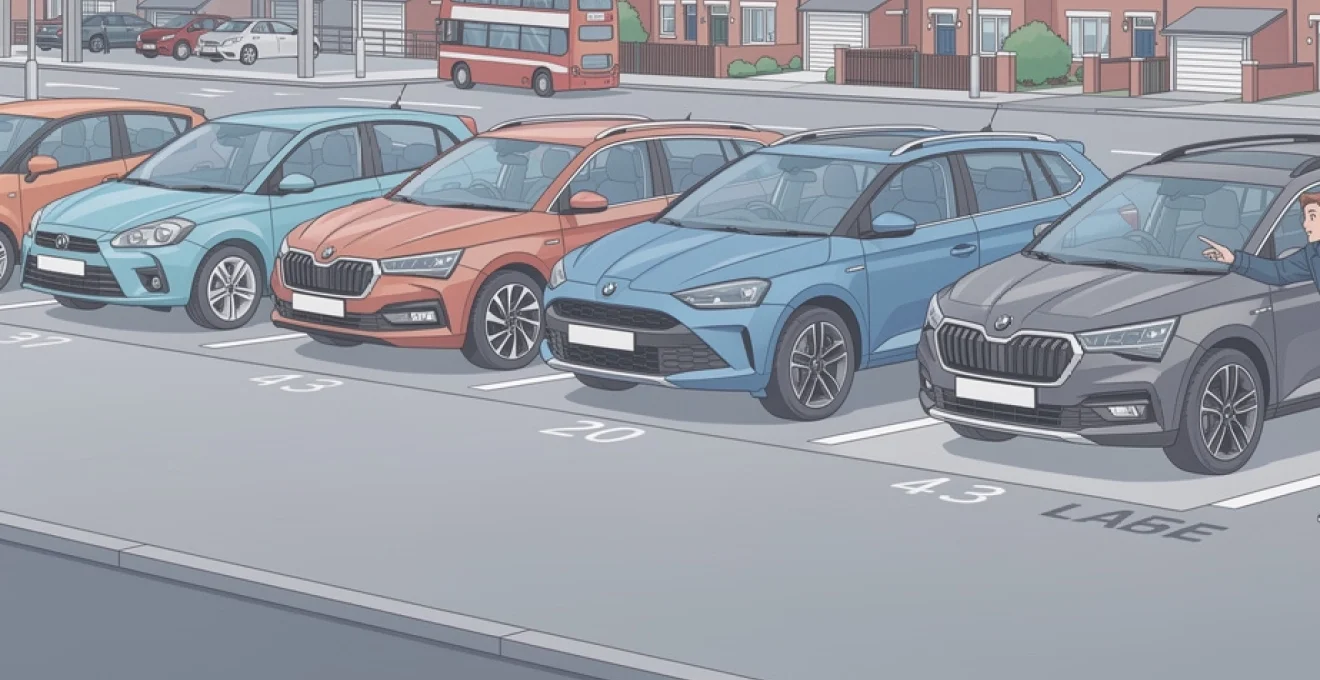
Car length is one of the most overlooked specs on a brochure, yet it dictates how easily you squeeze into an on‑street space, reverse into a tight garage or navigate a multi‑storey ramp. In the UK, where the average parking bay is around 4.8 metres long and many older garages are even shorter, choosing the wrong size can turn every journey into a manoeuvring exercise. If you live on a terraced street, have a short driveway or regularly use city‑centre parking, understanding how long different types of cars are becomes a practical necessity rather than a technical curiosity. Once you start comparing car lengths across city cars, hatchbacks, estates, SUVs and MPVs, the trade‑offs between cabin space, boot capacity and ease of use become much clearer.
UK car length categories explained: city cars, superminis, family hatchbacks, estates, SUVs and MPVs
UK cars are broadly grouped into size-based categories that correlate with typical length bands. These bands matter because most infrastructure – from 4,800 mm parking bays to 5,000 mm domestic garages – has not grown as quickly as modern vehicles. A typical car in the UK now measures around 4,399 mm long, 1,821 mm wide and 1,534 mm tall, which is already pushing the limits of older bays designed when cars were shorter and narrower. Thinking about length first helps you match a vehicle to your living situation, commute and local roads, before getting absorbed in trim levels and gadgets.
Manufacturers constantly stretch wheelbases and overhangs to add safety tech and boot space, which means a “small” car in 2025 is frequently longer than a family hatchback from the 1990s. The Ford Fiesta, for example, sits at about 4,040 mm, while a compact SUV like the Nissan Qashqai already reaches 4,425 mm. That is a meaningful difference when you are trying to reverse into a 4,800 mm supermarket bay without overhanging the white lines or blocking a footpath.
City car lengths in the UK: kia picanto, hyundai i10, toyota aygo X and comparable models
City cars are the shortest vehicles on sale, typically between 2,695 mm and 3,665 mm in length. In practical terms, that means a Kia Picanto or Hyundai i10 is almost a metre shorter than many SUVs, yet still capable of four‑seat use. The Toyota Aygo X is slightly longer than some rivals but remains comfortably under the 3.7 m threshold that defines the true “micro” class. If you frequently parallel park on congested streets, these dimensions make daily driving far less stressful.
Because city cars are so short, you gain generous buffer space in most standard UK parking bays. A 3,675 mm Hyundai i10 parked in a 4,800 mm bay leaves over a metre of spare length. That margin protects you from misjudged entries and makes it easier for others to manoeuvre around you. For new drivers or those sharing crowded residents’ bays, the compact footprint of city cars is often worth more than extra boot size.
Supermini segment lengths: ford fiesta, vauxhall corsa, renault clio and rivals
Superminis bridge the gap between tiny city cars and full‑size hatchbacks. Average lengths range from about 3,821 mm to 4,084 mm. The Ford Fiesta sits at 4,040 mm, the VW Polo at 4,074 mm, and the Vauxhall Corsa and Renault Clio follow close behind. These cars add usable rear legroom and boot capacity, yet remain short enough to be “narrow‑street friendly” in older UK towns and suburbs.
For many drivers, this length band is the sweet spot. A 4.0 m to 4.1 m car fits easily into on‑street spaces without pushing into the next bay, and still leaves enough room inside for child seats or weekly shopping. If you step up from a city car into a supermini, expect an extra 150–300 mm of length, which is noticeable when reversing but still manageable within a standard 4,800 mm bay.
Family hatchback and estate car lengths: volkswagen golf, ford focus, skoda octavia
Family hatchbacks like the Volkswagen Golf, Ford Focus and Toyota Corolla usually measure between 4,425 mm and 4,726 mm. This is the core of the UK market: spacious enough for families and motorway trips, yet just contained enough for most parking spaces and domestic garages. The VW Golf sits around the 4.3–4.4 m mark depending on generation, while newer models like the Hyundai i30 and Peugeot 308 push towards the upper end of this range.
Estate versions – such as the Skoda Octavia Estate or Ford Mondeo Estate at 4,867 mm – extend length for greater boot space. That extra 200–300 mm can be transformative for luggage but can also push you to the edge of many UK garages. If your drive is short or shared with gates and pillars, estate lengths need careful measuring against your available space.
Compact, mid‑size and large SUV lengths: nissan qashqai, kia sportage, BMW X5
SUVs have become the default family choice, but they also occupy more tarmac. Compact SUVs like the Nissan Qashqai come in around 4,425 mm, while a Kia Sportage reaches 4,660 mm. Mid‑size and large SUVs – think BMW X5, Volvo XC90 or Land Rover Discovery – frequently exceed 4,800 mm and can approach or pass the 5,000 mm mark, particularly in seven‑seat form. This is where basic parking bays start to feel restrictive.
Because many SUVs combine long bodies with taller, boxier shapes, they can feel “larger” than their numbers suggest. A typical SUV length of 4,400–4,800 mm fits into a bay on paper, but real‑world driving includes overhangs, kerbs, and opening tailgates. Height and width also interact with length: squeezing a broad, high SUV between pillars adds another dimension to the parking challenge.
Large MPV, people carrier and 7‑seater lengths: citroën berlingo, ford S‑MAX, seat alhambra
Large MPVs and people carriers focus on moving people and luggage rather than minimising size. Average lengths span from roughly 4,236 mm up to 5,130 mm. A Citroën Berlingo, Ford S‑MAX or Seat Alhambra will often be in the upper 4.7–5.1 m range, especially in seven‑seat guise. That additional length translates into genuine third‑row comfort and a usable boot even with all seats up.
For school runs, airport trips and business use, the extra space of an MPV is invaluable. However, you trade manoeuvrability: turning circles are wider, and overhangs front and rear are longer. Before committing to a large 7‑seater, it is worth measuring driveway length, garage depth and any tight turns near home, particularly if a dropped kerb or narrow lane is involved.
Standard car length ranges in the UK: data table structure and typical dimensions
To make sense of the wide spread of models on the market, it helps to group cars by standard length ranges. Most UK vehicles fall between 3,500 mm and 5,100 mm, but the real insight comes from dividing those into meaningful use‑case bands. Many modern comparison tools structure their data tables so you can filter by length in millimetres, then refine by body style, fuel type or boot capacity, effectively turning dimensions into a search criterion rather than an afterthought.
From a data perspective, length values come from manufacturer specifications and are usually measured from the front bumper to the furthest rear point. That might be the bumper or a spare‑wheel carrier on some SUVs. Because of this, two cars with similar wheelbases can have noticeably different overall lengths if one has longer overhangs. When reading a car length comparison table, it is useful to consider what those extra centimetres are buying you – often more crash structure or luggage room, but sometimes just styling.
Length ranges by body style: hatchback, saloon, estate, coupe and crossover
Different body styles naturally cluster around certain length bands. Hatchbacks usually occupy the 4,000–4,400 mm range, with larger models stretching towards 4,700 mm. Saloons (or sedans) such as the BMW 3 Series or Tesla Model 3 typically run from about 4,700 mm to just under 5,000 mm, giving that elongated profile and bigger boot volume. Estates tend to add 100–200 mm compared with their saloon or hatch equivalents to extend cargo space.
Coupes and crossovers muddy the picture by blending styles. A coupe may share its platform – and therefore wheelbase – with a hatchback, but a longer rear overhang or sloping bootlid can shift length by 50–150 mm. Crossovers often sit between hatchbacks and full SUVs, with lengths around 4,200–4,500 mm. When browsing a data table, grouping by body style helps you set realistic expectations about how long a given type of car is likely to be.
Typical wheelbase and overhang ratios for UK‑market vehicles
Overall length is only part of the handling and parking story; wheelbase – the distance between the front and rear axles – matters as well. In most modern cars, wheelbase accounts for 55–60% of the total length, with the rest split between front and rear overhangs. A city car might have a short wheelbase with minimal overhangs, making it feel agile and easy to place, while a long‑wheelbase saloon spreads its length more evenly for stability at speed.
From a manoeuvrability standpoint, shorter wheelbases usually mean tighter turning circles, which helps in multi‑storeys and tight residential streets. However, large overhangs can still catch kerbs or scrape on steep drive entrances. When you compare car lengths in a detailed table, it is worth noting whether extra length comes from wheelbase (which often aids interior space) or from decorative overhangs that offer little practical benefit.
Segmentation by overall length bands: under 3.7 m, 3.7‑4.2 m, 4.2‑4.6 m, over 4.6 m
Segmenting the UK market by overall length bands gives a quick sense of where a model sits:
- Under 3.7 m – classic city cars and microcars, ideal for dense urban environments
- 3.7–4.2 m – superminis and smaller hatchbacks, balancing space with compact footprints
- 4.2–4.6 m – mainstream family hatchbacks and compact crossovers
- Over 4.6 m – estates, large saloons, SUVs and MPVs with extended cabins
Around 4,200–4,600 mm is often considered the “average UK car length” band, aligning with many family hatchbacks and some compact SUVs. Once you cross 4,800 mm, you are entering territory where standard 4,800 mm parking bays leave almost no margin for error. When looking down a car length comparison table, that over‑4.6 m category is a clear signal to think carefully about storage and parking logistics.
Comparing length metrics: millimetres, inches and parking bay standards
In the UK, manufacturers publish dimensions in millimetres, but many property documents and garage measurements still use feet and inches. A car listed at 4,500 mm is 4.5 m, which converts to roughly 14 ft 9 in. A standard 4,800 mm bay is therefore about 15 ft 9 in long. Thinking in both mm and ft/in makes it easier to compare car length to your available space without constant mental arithmetic.
Several recent industry reports highlight that the typical UK parking bay remains 4,800 mm long, even as popular models like the Ford Mondeo Estate reach 4,867 mm. That discrepancy illustrates why accurate conversions matter. If your garage is listed as 16 ft internally, you are working with about 4,877 mm, leaving almost no spare space for shelves or walking room when parking an estate or large SUV.
How car length affects parking, manoeuvrability and turning circle in UK towns
Car length has a direct, often underestimated impact on daily usability in UK towns and cities. Longer vehicles need more space not only to fit in a bay but also to enter and exit it without repeated shuffling. The average UK car park was designed when cars were shorter, and council data consistently links minor bumps and scrapes to the growth in vehicle size. National Car Parks has already widened some bays in London, Manchester and Bournemouth because wider and longer cars were simply colliding more often.
A key consideration is turning circle. While not solely dictated by length, longer wheelbases typically increase the turning radius, making tight three‑point turns and multi‑storey hairpins more demanding. Picture steering a 5.0 m estate around a cramped Victorian mews; the car behaves like a long sofa being moved up a narrow staircase. For drivers in historic town centres, a shorter car length can dramatically reduce parking stress and potential damage.
Car length and UK regulations: parking bay sizes, on‑street spaces and car park design
Although there is no single national law dictating precise parking bay dimensions, British Standards and local authority guidance set out typical values that designers follow. For off‑street car parks, a standard bay is generally 4,800 mm long and 2,400 mm wide. Multi‑storey car parks must also consider vertical clearance, usually capped around 2,000 mm – crucial for taller SUVs and MPVs. These standards were established when the average car was shorter and narrower; many modern models now press against these limits.
On‑street parking schemes introduce further complexity. Councils often mark parallel spaces designed around typical hatchback lengths, not 5.0 m SUVs. Some cities have begun reviewing bay layouts as car fleets grow, but change is gradual. If you drive a longer car, it is wise to check local layouts rather than assume every marked space is suitable, especially in conservation areas and older suburbs where road geometry cannot be easily altered.
Typical UK parking bay dimensions: british standards and council guidance
For planning and design, many UK authorities follow a 2,400 mm by 4,800 mm guideline for standard bays, with slightly longer spaces near pillars or walls to aid access. Some documents suggest 5,000 mm length where feasible, but in practice, 4,800 mm remains very common, particularly in older developments. Data from several councils indicates that cars wider than about 1,900 mm and longer than 4,800 mm are significantly more prone to scuffs and minor collisions in these bays.
Height is another constraint in multi‑storeys. With typical maximum clearances of 2,000 mm, a tall SUV or MPV with roof bars or a box can come uncomfortably close to the ceiling. While this is primarily a height issue, length plays a supporting role because nose‑in parking often means pulling right up to a wall or barrier. If your car is long, it may not be possible to use every level or bay orientation without risk.
Supermarket and multi‑storey car park bay lengths versus large SUVs and estates
Supermarket car parks are often a mix of older, tighter bays and newer, slightly larger “family” spaces. However, 4,800 mm is still a common baseline. Large SUVs like a Land Rover Discovery or Volvo XC90, and estates approaching 4,900–5,100 mm, technically fit but leave very little margin. Tailgates can overhang into drive lanes, and front overhangs may project over kerbs or low barriers, limiting clearance and visibility when exiting.
In multi‑storey structures, spiral ramps and tight corners magnify the effect of length. A long‑wheelbase BMW 5 Series or Audi A6 might clear the bay length, yet feel cumbersome navigating between floors. This is one reason some drivers downsize from an estate to a hatchback despite similar boot volumes; the shorter overall length simply feels more manageable in daily use.
Parallel parking constraints in london, manchester, birmingham and other cities
Parallel parking is where length shows its sharpest edges. In central London, Manchester or Birmingham, on‑street spaces often consist of gaps between other cars rather than neatly painted boxes. A 3.7 m city car like a Toyota Aygo X can slot into a small gap with room to spare, while a 4.8 m SUV may need a space almost one and a half times its length to park without multiple reversals.
In dense urban grids, every extra 200 mm of car length makes parallel parking disproportionately harder, especially when traffic pressure forces quick decisions.
If you regularly park on busy arterial routes or narrow side streets, treating length as a primary selection factor pays off. A shorter car not only parks more easily but also exits spaces with fewer adjustments, reducing the risk of clipping wheels or bumpers on surrounding vehicles.
Driveway lengths and dropped kerb considerations for terraced and suburban homes
Many UK terraced and suburban homes have driveways that just meet or slightly exceed typical car lengths. Planning guidance often expects around 4,800–5,000 mm for a single car space, but real‑world drives can be shorter due to steps, garden walls or bay windows. A 4,399 mm family hatchback fits comfortably, while a 4,867 mm estate might leave its nose close to the pavement, raising visibility and obstruction concerns.
Dropped kerb regulations can also limit options. Councils sometimes stipulate that parked cars should not overhang the pavement, particularly where pedestrian or wheelchair access is affected. If your car length exceeds the usable driveway length, you risk complaints or fines. Measuring your hardstanding and comparing it against a detailed length table before upgrading to a larger vehicle can prevent expensive alterations later.
Comparing lengths of popular UK models: small cars, family cars and large SUVs
Looking at real model examples helps to anchor these length categories. Many popular UK cars cluster around the 4.0–4.7 m band, but outliers at both ends of the scale demonstrate how radically different cars can feel on the road and in a car park. Comparing car lengths within a model line-up – for example, between petrol, hybrid and electric versions – also reveals subtle differences hidden behind similar styling.
Recent trends show city cars shrinking slightly or being discontinued due to tightening emissions rules, while family cars and SUVs grow longer to accommodate larger batteries, more safety equipment and improved crash structures. The result is a market where extremes are more pronounced: very short urban cars at one end, and long seven‑seat SUVs at the other.
Shortest cars on sale in the UK: fiat 500, smart EQ fortwo, toyota aygo X
At the shortest end, models like the Fiat 500, Smart EQ fortwo and Toyota Aygo X demonstrate how compact a modern car can still be. Many of these sit well under 3,700 mm, with the Smart EQ fortwo measuring closer to 2,700 mm. In a standard 4,800 mm bay, that leaves vast unused length, but the benefit appears when parallel parking in cramped urban spaces or slotting into awkward on‑street gaps near junctions.
These ultra‑short cars are not for everyone; boot space and rear seating are compromised. Yet for single commuters or couples living in inner‑city flats without off‑street parking, their minimal length can transform daily driving. An Aygo‑class vehicle is also easier to manoeuvre through tight width restrictions, where a long bonnet can make judging distances harder.
Typical family car lengths: VW golf, toyota corolla, hyundai i30, peugeot 308
Family hatchbacks such as the VW Golf, Toyota Corolla, Hyundai i30 and Peugeot 308 typically occupy the 4,300–4,450 mm band. This length gives enough cabin and cargo space for children, luggage and weekly shopping while remaining compact enough for standard UK bays and garages. The average UK car length of about 4,4 m (14 ft 5 in) neatly reflects this category’s dominance.
For most households, these cars represent a sensible compromise. They fit into multi‑storeys without nervous inching, handle B‑roads comfortably, and park on small driveways without blocking pavements. When comparing them in a length table, variations of 50–100 mm rarely transform usability, but once a model crosses 4,600 mm, the step up in physical presence becomes more pronounced.
Long wheelbase saloons and executive cars: BMW 5 series, mercedes E‑Class, audi A6
Executive saloons such as the BMW 5 Series, Mercedes‑Benz E‑Class and Audi A6 are longer again, often in the 4,900–5,000 mm range. Their extended wheelbases improve rear legroom and high‑speed stability, which is ideal for motorway commuting and chauffeur work. However, that same length can feel unwieldy in tight city centres and older car parks.
Choosing a long‑wheelbase saloon is like opting for a larger office: the extra space is luxurious, but the building’s narrow corridors and lifts do not change to accommodate it.
Professional drivers generally factor in car length when planning pick‑up and drop‑off points, particularly at hotels and venues with limited forecourts. If you are considering an executive saloon as a family car, comparing its length against similar SUVs or estates can highlight whether a slightly shorter alternative might offer comparable practicality with less parking compromise.
Longest mainstream SUVs and 7‑seaters: volvo XC90, hyundai santa fe, land rover discovery
At the large end of the SUV spectrum sit models like the Volvo XC90, Hyundai Santa Fe and Land Rover Discovery. These vehicles frequently exceed 4,800 mm and can reach or surpass 5,000 mm, especially in seven‑seat or long‑wheelbase formats. That gives exceptional interior volume and towing ability but places drivers right at the limits of standard UK bay lengths.
In out‑of‑town retail parks or modern service areas, larger bays make life easier, but older suburban streets and period multi‑storeys remain challenging. The sheer length of a Discovery, combined with width and height, demands more planning when choosing routes and parking spots. If your lifestyle genuinely requires seven full‑size seats and large cargo capacity, measuring these models against your regular parking and storage environments is crucial.
Length differences between petrol, hybrid and electric variants of the same model
It is easy to assume that petrol, hybrid and electric variants of the same model share identical dimensions, but small differences are common. Battery packaging, revised bumpers and aerodynamic tweaks can add or subtract 10–30 mm of length. For example, some electric saloons optimise aerodynamics with extended rear ends, while plug‑in hybrid SUVs may gain slightly bulkier bumpers to accommodate charging hardware and cooling.
From a parking point of view, these differences are subtle but can matter if your garage fit is already tight. A car that just clears the door with one powertrain might nudge a wall with another. Using a length comparison table that lists variants separately, and paying attention to any footnote about mirrors folded or specific trims, is a practical step when moving between fuel types.
How to use a car length comparison table when choosing a vehicle in the UK
A well‑structured car length comparison table can turn guesswork into precise decision‑making. Start by measuring your key constraints: driveway or garage length in millimetres, plus any tight spots on your regular routes, such as width restrictions or steep ramps. Once you have those figures, filter the table to show only models that fall, for example, under 4,400 mm if you know a longer car will overhang your space. Treat length as a hard limit, just as you would budget or insurance group.
Next, compare short‑listed models not just on headline length but on their purpose. A 4,250 mm hatchback and a 4,250 mm crossover feel different because of height and seating position, even though they occupy the same footprint. Look at categories and length ranges together to understand whether you are trading ease of parking for extra boot height or 4×4 styling. If you are leasing or changing cars frequently, consider futureproofing: a slightly shorter choice now may accommodate a potential move to a house with tighter parking later.
Using a car length table effectively is less about chasing the “shortest” car and more about finding a realistic maximum length that works everywhere you need to drive.
Finally, cross‑reference length with other dimensions and practical notes. Many tables include comments like “wide body – check driveway width” or “long wheelbase – check parking depth”, which highlight potential pinch points. Combining this detail with your own measurements gives a grounded basis for choosing between city cars, superminis, hatchbacks, estates, SUVs and MPVs, ensuring that the car you pick fits not just your lifestyle, but also the real spaces you live and drive in every day.