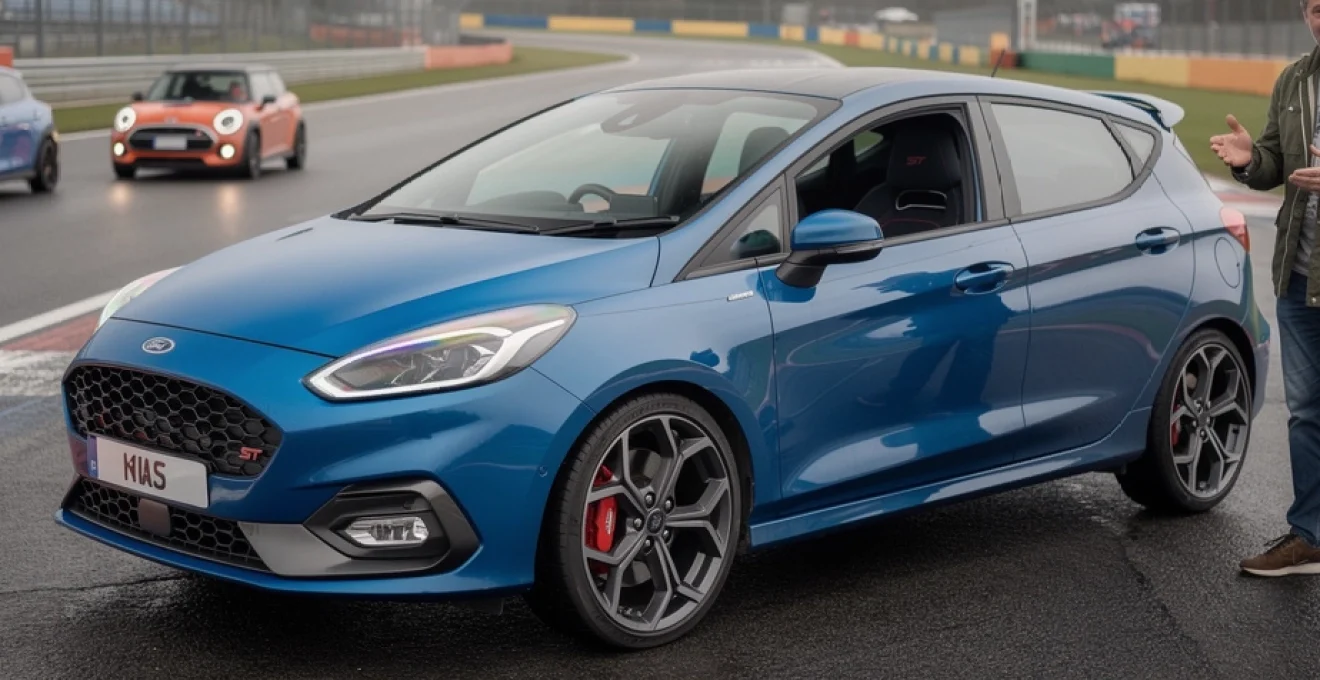
The Ford Fiesta ST Mk8 arrived into a market already dominated by its own predecessor and then somehow managed to reset the benchmark again. In a UK landscape where small hot hatches are rapidly disappearing, this compact turbocharged supermini combines serious pace with real-world usability and running costs that still make sense. Motorway slog, muddy B-road or the occasional track day, the Fiesta ST has become a go-to choice for drivers who want engagement every time they turn the key. Even now that new production has ended, the Mk8 ST remains one of the most compelling ways to enjoy performance motoring without supercar bills or super-sized dimensions.
Ford fiesta ST mk8 overview: hot hatch positioning, rivals and UK market context
When the Fiesta ST Mk8 launched in 2018, it slotted straight into the heart of the affordable performance sector. Power climbed to around 197bhp, but the real story was chassis sophistication and everyday polish. At the time, rivals included the Peugeot 208 GTi by Peugeot Sport, MINI Cooper S, VW Polo GTI and, later, the Hyundai i20 N and Toyota GR Yaris. The Peugeot and Renaultsport Clio soon bowed out, leaving the Fiesta ST and i20 N as the last of the traditional small hot hatches on sale in the UK.
By the time production stopped in 2023, UK list prices had crept to roughly £26,500–£27,000 for a fully loaded ST‑3, reflecting rising manufacturing costs and tighter margins on compact performance cars. That increase partly explains why Ford ended both Fiesta and Fiesta ST lines in favour of more profitable crossovers and EVs. Yet on the used market, the Mk8 ST undercuts many larger hot hatches while still delivering a level of involvement that some newer, heavier cars struggle to match. For drivers who prioritise steering feel, compact dimensions and analogue interaction, the Fiesta ST Mk8 occupies a sweet spot that is increasingly rare.
1.5‑litre EcoBoost engine: turbocharging, three‑cylinder characteristics and real‑world performance
Powertrain architecture: 1.5 EcoBoost inline‑three, cylinder deactivation and emissions strategy
Under the bonnet sits Ford’s 1.5‑litre EcoBoost inline‑three, an all‑aluminium engine that replaced the Mk7 ST’s 1.6‑litre four‑cylinder. On paper that sounded like a downgrade; in practice, it transformed the car’s character. The triple uses high‑pressure direct injection, variable valve timing and an integrated exhaust manifold to keep the turbocharger spinning efficiently. Peak power is quoted at 197bhp, with torque at 214lb ft on early cars and up to 236lb ft on post‑facelift models.
A notable innovation is cylinder deactivation, a world first for a three‑cylinder when it launched. Under light loads, the engine can shut down one cylinder and effectively run as a two‑cylinder unit, reactivating the third pot in just 14 milliseconds. That strategy, combined with the engine’s compact mass and low internal friction, helps deliver WLTP CO₂ figures in the 136–150g/km region depending on wheel size and trim. For you, it means hot‑hatch performance without the fuel bills of a larger four‑cylinder, especially on long, steady runs.
Turbocharger behaviour: boost threshold, mid‑range torque delivery and overtaking performance
The turbocharging strategy defines how the Fiesta ST Mk8 feels on the road. Boost builds from about 1,800rpm, with a fat torque plateau stretching to around 4,000rpm. The engine then pulls strongly to 6,000rpm, where maximum power is delivered just before the red line. There is some initial delay below 1,500rpm, but once through that boost threshold, the car surges forward with a deep, characterful growl that sounds far more interesting than many rival four‑cylinder units.
For overtakes on typical UK A‑roads, third and fourth gears are the sweet spots. Rolling from 40–70mph in third happens briskly enough to expose gaps that slower traffic cannot use, and the compact ratios in the six‑speed MT82-family gearbox keep the engine right in its torque band. For everyday use, you can short‑shift and rely on torque, but when pushing on, the three‑cylinder responds best to being worked towards the upper mid-range, where it feels eager and alive without becoming frenetic.
Acceleration metrics: 0–62 mph, in‑gear times and roll‑on performance versus fiesta ST mk7 and GR yaris
Officially, the Fiesta ST Mk8 covers 0–62mph in 6.5 seconds and runs on to about 143–144mph. Independent tests frequently reproduce or even slightly better that figure, particularly when launch control is used on grippy tarmac. The flat‑shift function, which allows you to keep your right foot planted while dipping the clutch, also trims tenths off full‑bore runs for those who are mechanically sympathetic enough to use it sparingly.
Compared with the Fiesta ST Mk7, the Mk8 is roughly half a second quicker to 62mph and feels noticeably stronger in mid‑range roll‑on tests thanks to the broader torque curve. Against a Toyota GR Yaris, the Fiesta’s outright acceleration is slightly behind—the GR’s turbocharged 1.6 and all‑wheel drive launch harder—but in rolling 30–70mph bursts the difference is less dramatic than headlines suggest, especially if you are in the right gear. For daily overtakes on single‑carriageway roads, the Fiesta ST’s in‑gear urgency is more than sufficient.
Fuel economy and WLTP CO₂: motorway cruising, mixed driving and long‑term owner reports
Real‑world fuel economy is one of the Fiesta ST Mk8’s understated strengths. Long‑term tests from several UK magazines have reported averages between 38 and 43mpg over 6,000–9,000 miles, mixing commuting, B‑road blasts and motorway hauls. One well‑documented ST‑3 long‑termer averaged 38.1mpg, slightly below the WLTP combined figure but impressive given regular performance testing.
At 70mph in sixth gear, the engine hums at modest revs, often returning 45mpg or more on a steady cruise if you resist the temptation to downshift. Around town and on short trips, you should expect mid‑30s, particularly if using Sport mode. CO₂ emissions around 136g/km on smaller wheels keep road tax and Benefit‑in‑Kind more reasonable than many more powerful hot hatches, which works in your favour if you want performance without heavy ongoing taxation.
Reliability trends: known engine issues, carbon build‑up and service intervals for the fiesta ST mk8
The 1.5‑litre EcoBoost engine has generally proven robust, but some patterns have emerged. A small number of early cars suffered from cam cover oil leaks, sometimes severe enough to justify an engine replacement under warranty. When viewing a used Fiesta ST, it is sensible to lift the plastic engine cover and inspect carefully around the head and cam cover for any fresh oil misting or residue.
Unlike smaller EcoBoost units, the ST’s engine uses a timing chain, so there is no scheduled belt replacement, although oil quality is critical to chain longevity. Direct injection creates some potential for intake valve carbon build‑up over high mileages, but widespread issues have not been reported yet. Official services are required every 12 months or 12,500 miles, and sticking to that interval—or shorter if you do frequent track days—helps prevent sludging and keeps internals in good health.
Chassis, suspension and handling: track‑tuned set‑up on b‑roads and circuits
St‑specific suspension hardware: stiffer springs, anti‑roll bars and force‑vectoring springs
The Fiesta ST Mk8’s handling is its defining trait. Ford did not simply bolt on stiffer springs; the car gets a comprehensive ST‑specific chassis tune. At the front sit MacPherson struts with twin‑tube dampers, at the rear a torsion beam axle with directionally wound force‑vectoring springs. Those cleverly wound springs are designed to add lateral location without the weight and complexity of a Watt’s linkage, saving about 10kg according to Ford.
Spring and damper rates are significantly firmer than the standard Fiesta, and the torsion beam itself is extremely stiff, requiring around 1,400Nm of torque to twist a single degree. The result is a rear axle that feels planted and predictable, allowing the front to do the bulk of the work while the back follows faithfully—until you choose to provoke a little rotation. On smoother surfaces, that translates to a well‑controlled, tied‑down feel. On broken urban tarmac, the ride can be busy but rarely truly crashy if the suspension is healthy and the tyres are properly inflated.
Steering calibration: EPAS tuning, rack ratio and feedback on UK b‑roads
Steering is via an electrically assisted rack with an impressively quick 12:1 ratio, about 14% faster than the Mk7 ST’s setup. That means small inputs translate quickly to front‑wheel angle, so you rarely need more than a quarter turn for typical bends. Some drivers find the rack almost too fast at first, especially coming from softer mainstream hatchbacks, but acclimatisation comes quickly and the payoff is agility that suits Britain’s narrow, sight‑limited lanes.
In Normal mode, weight is relatively light but consistent. Sport adds extra heft, which many owners prefer for spirited driving, while Track scales back stability control interference rather than altering steering tune radically. Pure steering “feel” is more muted than older hydraulic systems, but as you load the front tyres through a fast corner, the Fiesta ST still communicates grip levels and slip angles clearly enough for precise, confident placement.
Track performance: behaviour at brands hatch, donington park and bedford autodrome
Take a Fiesta ST Mk8 to circuits such as Brands Hatch Indy, Donington Park National or Bedford Autodrome and the balance that works so well on B‑roads scales up convincingly. Turn‑in is keen, body roll minimal and, importantly, the car remains exploitable rather than intimidating at the limit. Trail braking into medium‑speed corners often reveals a playful rear axle that can be nudged into mild rotation, particularly if you are willing to carry brake pressure a fraction longer than usual.
On longer sessions, standard dampers cope surprisingly well, though repeated high‑speed compressions can expose their road‑biased tune. The limited‑run Performance Edition and ST Edition introduced Ford Performance coilover kits from the factory, dropping the ride height by 10–15mm and adding multiple stages of rebound and compression adjustment. Those cars feel calmer and more composed on track, with slightly improved bump absorption and more consistent tyre contact over kerbs.
Tyre choice and grip: michelin pilot sport 4, ford performance pack options and wet‑weather traction
From the factory, most Mk8 Fiesta STs arrived on Michelin Pilot Super Sport or later Michelin Pilot Sport 4 tyres. Grip levels from these UHP tyres are high in both dry and wet conditions, but the car’s chassis tuning means it still feels mobile and interactive rather than locked‑down and inert. Owners who replace worn Michelins with cheaper rubber often notice a significant drop in steering precision and wet‑weather confidence, so tyre brand and model deserve close attention.
For UK conditions, sticking with a premium performance tyre such as the Pilot Sport 4 or Goodyear Eagle F1 Asymmetric 6 is highly recommended. Mixed tyre brands front‑to‑rear, as occasionally seen on used examples, can exaggerate the car’s natural rotation and create odd breakaway characteristics, especially in the wet. If you plan regular track work, a second set of wheels with more track‑orientated rubber can preserve your road tyres and allow heat cycles to be managed properly.
Brake system performance: fade resistance, pad life and upgrade paths for fast‑road use
The standard braking package uses 278mm ventilated front discs and 253mm solid rear discs. For fast‑road driving and occasional track days, stopping power is more than adequate. Even under repeated heavy stops from motorway speeds, pedal feel remains firm and confidence‑inspiring. Several track tests have noted minor grumbling noises from the brakes before any meaningful fade appears, suggesting the system operates close to its limits but rarely beyond.
On circuit, especially with sticky tyres and an aggressive driving style, you may notice some fade after several hot laps, along with accelerated pad wear. For you as an enthusiast, upgrading to higher‑friction pads, braided lines and high‑temperature fluid can significantly increase fade resistance without sacrificing road usability. Full big‑brake kits are available but generally unnecessary unless you are chasing serious lap times or fitting power‑enhancing modifications.
Differential, drive modes and traction: ford performance pack and front‑axle dynamics
Quaife mechanical limited‑slip differential: torque distribution and corner‑exit traction
Many Fiesta ST Mk8s are fitted with the Ford Performance Pack, which adds a Quaife mechanical limited‑slip differential (LSD), launch control and a shift‑light function. The Quaife unit is a helical‑gear type diff that continuously distributes torque to the front wheel with more grip, rather than simply allowing the inside wheel to spin away precious traction. During hard corner exits, you can feel the car “dig in” and pull itself towards the apex, reducing understeer and improving exit speed.
On typical B‑roads, that translates to the ability to get back on the throttle earlier and more assertively without simply spinning up the inside tyre. The LSD works in harmony with Ford’s brake‑based torque vectoring, although sharp, binary throttle applications can occasionally confuse the interplay between mechanical and electronic systems, leading to a brief tug at the wheel before everything settles. With smooth inputs, the diff feels like a natural extension of the chassis.
Electronic aids: ESC, traction control and launch control calibration in normal, sport and track modes
The Fiesta ST Mk8 offers three main driving modes—Normal, Sport and Track—that alter throttle response, exhaust valve behaviour and stability‑control thresholds. In Normal, ESC is fairly conservative, gently trimming power and braking individual wheels to keep the car tidy. Sport loosens the reins, allowing more slip and rotation before intervening, which suits enthusiastic road driving without pushing into outright hooligan territory.
Track mode takes things further, disabling traction control and moving ESC into a looser “sport” threshold, leaving more responsibility with the driver. Launch control, available with the Performance Pack, holds revs at about 3,000rpm when you floor the throttle with the clutch depressed, optimising boost and traction for consistent 0–62mph efforts. For most owners, launch control is a party trick rather than an everyday tool, but it showcases how comprehensively Ford calibrated the electronic side of the car to support, not smother, the mechanical package.
Torque steer and wheel hop: front‑wheel drive characteristics under hard acceleration
With almost 200bhp going through the front wheels, some degree of torque steer is inevitable, particularly on poor surfaces or in low gears. The Fiesta ST Mk8 does occasionally tug at the wheel under full‑throttle acceleration, especially if the road surface is cambered or damp. However, the effect is usually minor and easily corrected once you are expecting it.
Wheel hop—where the driven wheels skip rapidly under hard launches—can occur if you sidestep the clutch or attempt aggressive drag‑style starts on uneven surfaces. Launch control mitigates this by managing torque delivery more progressively, but mechanical sympathy remains important. Using a smoother clutch release and allowing the tyres a moment to bite keeps the drivetrain happier and still delivers brisk, drama‑free getaways.
Performance pack value analysis: lap time gains and daily drive compromises
Is the Performance Pack worth it for you? For most drivers, yes. Independent testing has shown meaningful lap‑time improvements with the Quaife LSD, particularly on tighter circuits where traction out of slower corners dominates the stopwatch. On the road, the diff sharpens responses and makes the car feel more like a purpose‑built driver’s car than a warmed‑over supermini.
In daily use, compromises are limited. At parking speeds, there is a slight increase in steering effort and some additional scrub on full lock, but it is subtle. Tyre wear on the driven axle can be a touch higher if you regularly exploit the diff’s capabilities, yet that is a fair trade for the extra corner‑exit traction. Given that many later ST‑3 cars included the Performance Pack as standard, and earlier cars with it command only a modest premium used, targeting an LSD‑equipped car is sensible.
Interior, recaro seats and ergonomics: daily usability in a performance supermini
Driving position and pedal layout: heel‑and‑toe downshifts and long‑journey comfort
One of the Fiesta ST Mk8’s biggest improvements over previous generations lies in the cabin. The driving position drops lower than in many rivals, allowing a more natural, “in” the car rather than “on” the car feel. Steering wheel reach and rake adjustment is generous, and the pedals are well spaced for those who enjoy heel‑and‑toe downshifts. The brake pedal sits slightly higher than the throttle, but with practice, rev‑matching becomes intuitive.
Over long distances, the combination of adjustable seat height, steering reach and supportive cushioning makes the ST surprisingly comfortable, particularly once the suspension has settled into its smoother high‑speed rhythm. Noise levels are respectable for a small hatchback: wind noise is present but not intrusive, tyre roar is contained if you stick to premium rubber, and the engine fades into the background when cruising in sixth.
Recaro sports seats: lateral support, adjustability and impact on taller drivers
Pre‑facelift Fiesta STs feature chunky Recaro bucket seats, while later cars receive Ford’s own integrated‑headrest sports seats. Both designs provide strong lateral support, with pronounced bolsters that hold you firmly in place through fast bends. For enthusiastic driving, that support is excellent; you avoid bracing yourself on the steering wheel, which improves input precision and reduces fatigue.
For taller drivers, the high bolsters and relatively thick backrests can eat into rear legroom, especially in three‑door cars, and some find the Recaros slightly narrow in the shoulders. The facelifted Ford‑branded seats offer a bit more adjustability, including variable base length that benefits shorter drivers and those with longer thighs alike. If you are well over six feet, testing seat comfort and headroom carefully is wise before committing to a specific trim.
Cabin quality and materials: touchpoints, wear patterns and facelift (ST edition) updates
Material quality takes a clear step up from the Mk7 ST. Soft‑touch plastics cover key areas, switchgear has a solid click and the steering wheel, gearknob and major touchpoints feel robust. It is still a supermini at heart, so hard plastics appear lower down, but overall ambience is more mature than many expect at this price point.
Typical wear points on used examples include slight shine on the steering wheel leather, bolster wear on Recaro outer edges and occasional creaks from dashboard or pillar trims over rough roads. The facelift brought a 12.3‑inch digital instrument cluster to higher trims and minor trim revisions, while limited‑run ST Edition models added blue stitching, carbon‑effect trim and high‑gloss black exterior accents. None of these changes affect fundamental ergonomics, but they do lift perceived quality.
Practicality: rear space, 3‑door vs 5‑door fiesta ST mk8 and boot usability
As a small hot hatch, the Fiesta ST must juggle performance with everyday usefulness. Rear space is adequate rather than generous; adults fit for shorter journeys, but knee and headroom are tight for taller passengers. Children and teenagers manage fine, which suits the car’s role as a daily driver for many owners.
Early in the model’s life, both three‑door and five‑door body styles were offered, though UK sales of the three‑door were relatively low and later production focused on the five‑door ST‑3. Three‑door cars look slightly sleeker and may appeal to purists, while five‑door models offer much easier access to the rear seats. Boot space remains on par with the standard Fiesta, ample for weekly shopping or a couple of suitcases. For track days, the boot happily swallows a set of spare wheels, tools and basic gear if you pack sensibly.
Infotainment, connectivity and driver‑assistance tech in the fiesta ST mk8
SYNC 3 touchscreen system: navigation, apple CarPlay, android auto and audio quality
The Fiesta ST Mk8 uses Ford’s SYNC 3 infotainment system with an 8‑inch touchscreen on most trims. While not the most graphically advanced interface on the market, it is responsive enough and reasonably intuitive once you learn the menu structure. Physical shortcut buttons and separate climate controls mean you are not forced to dive into sub‑menus for basic functions, which is invaluable when hustling along a favourite B‑road.
Apple CarPlay and Android Auto come as standard, allowing you to mirror navigation apps and streaming services. An optional Bang & Olufsen sound system—standard on some ST‑2 and ST‑3 specs—adds a subwoofer and upgraded speakers. For a compact hatch, audio quality is impressively rich and detailed, making longer motorway journeys more pleasant and masking some of the car’s natural road noise.
Driver‑assistance features: adaptive cruise, lane‑keeping assist and parking aids
Safety and convenience tech on the Fiesta ST Mk8 reflects its dual personality as both performance car and everyday runabout. Depending on trim and options, you may find adaptive cruise control, lane‑keeping assist, traffic sign recognition and automatic high beams. These systems are generally well calibrated, with lane‑keeping intervention gentle enough not to feel intrusive if you prefer to be in full control.
Front and rear parking sensors, plus a reversing camera on higher trims, make threading the car into tight urban spaces straightforward despite the relatively thick C‑pillars. Auto emergency braking and multiple airbags are standard, and Euro NCAP awarded the wider Fiesta range strong safety scores, which matters if you plan to use the ST as a family car as well as a weekend toy.
Instrumentation: digital displays, performance shift lights and customisable screens
Pre‑facelift cars feature clear analogue dials with a central trip computer, which many enthusiasts appreciate for their simplicity. The Performance Pack adds a subtle shift‑light that illuminates near the red line, encouraging timely upshifts when pushing hard. Visibility is good even in bright sunlight, and the lack of gimmickry keeps information focused on what you need to drive quickly and safely.
Post‑facelift models adopt a 12.3‑inch digital instrument cluster with a choice of display themes tied to the driving modes. While not as configurable as some rival systems, it provides crisp graphics and clear readouts for speed, engine speed and driver‑assistance status. Some drivers note a slight latency when switching modes, but once set, the display becomes unobtrusive and easy to live with day to day.
Ownership costs, reliability and used‑market buying guide for the fiesta ST mk8
Depreciation and residual values: fiesta ST vs hyundai i20 N and MINI cooper S
Depreciation for the Fiesta ST Mk8 has been gentler than for many mainstream superminis, thanks to strong enthusiast demand and the model’s abrupt discontinuation. Early high‑mileage ST‑2 and ST‑3 cars can now be found from around £9,000, while late, low‑mileage facelifted ST‑3s and special editions still command £18,000–£20,000 or more. Limited‑run Performance Edition and ST Edition models, with their coilovers and lightweight wheels, hold value particularly well.
Compared with the Hyundai i20 N, the Fiesta ST tends to be slightly cheaper like‑for‑like, largely because the Hyundai is newer and rarer on UK roads. Against the MINI Cooper S, the Fiesta generally offers stronger performance per pound and, in many enthusiasts’ eyes, a more engaging driving experience. If you value residual strength alongside involvement, the Fiesta ST sits in a favourable position among small hot hatches, especially now that no direct new equivalent exists in Ford showrooms.
Insurance groups, road tax and typical running costs in the UK
The Fiesta ST Mk8 usually falls into insurance groups in the mid‑20s (UK scale), making premiums manageable compared with full‑fat hot hatches such as Civic Type R or Focus ST. For a 30‑ or 40‑something driver with a clean record, annual premiums are often similar to or only marginally higher than those for a well‑specified standard Fiesta or Focus, particularly if mileage is limited.
Road tax aligns with its CO₂ band and vehicle age, putting it in a moderate bracket that does not penalise you as heavily as larger‑capacity rivals. Servicing at main dealers every 12 months or 12,500 miles is typical, with prices kept reasonable thanks to shared Fiesta componentry. Consumables such as tyres and brake pads will naturally wear faster if you drive enthusiastically, but the car’s relatively low kerb weight helps keep running costs in check compared with heavier, more powerful hot hatches.
Common faults, recalls and warranty claims reported by fiesta ST mk8 owners
Beyond the earlier mentioned cam cover oil leaks, a few other issues have cropped up in owner reports. Some cars suffer from rattles around the dash and door cards, particularly on poor surfaces; while annoying, these are rarely structural and can often be resolved with careful refitting or additional padding. Water ingress through door or window seals has been noted on a minority of cars, so lifting carpets and checking for damp footwells is important during any inspection.
The exposed front‑mounted intercooler, visible through the lower grille, looks purposeful but can be delicate. High‑pressure jet‑washing or sizeable debris impacts may deform the cooling fins, reducing efficiency over time. When viewing a used example, a quick visual check of the intercooler core can save you from an unexpected replacement cost. As with any performance model, warranty claims are more likely if the car has been modified or tracked extensively, so documentation and history matter.
Pre‑purchase checks: service history, modified examples and track‑used cars
When hunting for a used Fiesta ST Mk8, a few targeted checks can help you find a strong example. A full service history—ideally with main dealer stamps or a reputable specialist—is essential, especially given the engine’s reliance on high‑quality oil and timely changes. High mileage alone is not a red flag if maintenance has been meticulous; some of the best‑driving cars are those used regularly on motorways rather than short‑hopped in cities.
Inspect tyres for matching premium brands and even wear; budget tyres or mismatched sets suggest corners have been cut. Look for aftermarket remaps, air intakes or exhausts, and ask for proof of professional installation and any supporting modifications. A well‑tuned car from a respected firm can be enjoyable, but tuning without proper documentation adds risk. Finally, ask directly whether the car has seen track use. Occasional track days are not necessarily a problem if fluids and consumables have been changed more frequently; heavy, undisclosed use combined with weak history is a reason to walk away and continue the search for a Fiesta ST Mk8 that delivers its full potential without hidden compromises.