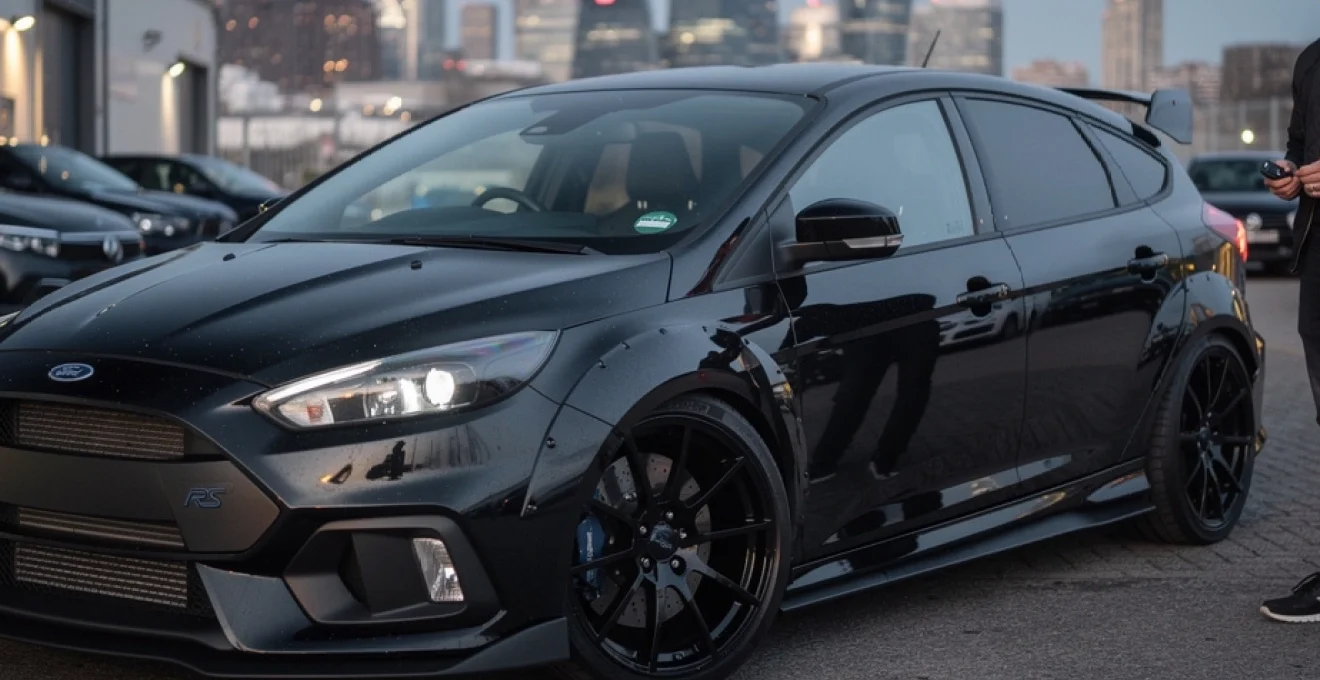
A black Ford Focus RS has a presence that even bright Nitrous Blue cars struggle to match. The wide arches, rally-inspired aero and aggressive stance all take on a different character when finished in a deep, dark shade. For many enthusiasts, a black Focus RS is the closest thing to a modern homologation special that can blend into traffic during the week and attack a B-road or trackday at the weekend. If you want a hot hatch that feels special every time you walk up to it yet still flies under the radar, a black RS hits a very particular sweet spot.
Beyond the drama, choosing black has practical implications for paint care, resale desirability and modification potential. It affects how the body kit reads in different light, how the LED lights and black trim pop, and even how stealthy those big Brembo brakes appear behind dark alloys. Understanding what makes a black Focus RS unique helps you buy, protect and enjoy one of the most coveted modern fast Fords.
Factory black paint options on the ford focus RS: shadow black vs absolute black and special-order finishes
Shadow black metallic paint code, clearcoat system and scratch resistance on the focus RS mk3
On the Mk3 Focus RS, the mainstream UK factory black paint option is Shadow Black, a metallic finish with fine metallic flake that softens the lines slightly in bright sun. Ford typically lists Shadow Black under paint code G1 or UA depending on market, paired with a modern water-based basecoat and two-stage clearcoat system. In practice, that means good UV resistance and a consistent gloss when properly maintained, but also the usual challenge: black shows everything.
Compared with solid whites or greys, Shadow Black is more prone to visible swirl marks and fine scratches. Industry data from detailing specialists suggests that dark metallic clears show up to 30% more visible wash marring than lighter colours under direct LED light. If you like your paint to look “glass smooth”, you will need a correct wash routine, perhaps a machine polish every 18–24 months, and ideally some form of additional protection such as a quality ceramic coating or film.
Older generations of Focus RS, such as the Mk2, could also be found in Panther Black or special matte-style finishes like the RS500’s factory-applied matt black foil-wrap. Those cars behave differently in terms of scratch resistance: the RS500’s film, for instance, cannot be machine polished like a clearcoat and requires more specialised care, but it delivers that ultra-aggressive satin look many owners still try to replicate on the Mk3.
Contrasting black finishes: paint vs factory black plastic trim, gloss vs satin elements
A black Focus RS is rarely “just black”. The car combines painted bodywork with unpainted black plastic trims, gloss black inserts and, on certain editions, matt or satin foil elements. That mix is one of the key reasons a black RS can look so “factory special” even if you have not modified anything.
The Mk3 front bumper alone blends painted surfaces with textured black lower grilles and gloss black foglight surrounds. Around the windows you get satin or semi-gloss black B-pillars, and the rear diffuser is usually a tougher, slightly greyer plastic that can fade if not protected. On Edition and Heritage-style builds with a black roof and spoiler, these elements tie together almost like a factory de-chrome pack from premium marques.
Detailers sometimes talk about “layered black” on these cars: the bodywork gives deep gloss, the plastics break up the mass, and well-maintained gloss trims highlight the performance intent. When you polish only the painted panels and ignore the trims, the car can look oddly tired, so treating the contrasting blacks as a complete system is essential if you want that show-car look on the road.
Black focus RS vs stealth grey, nitrous blue and frozen white in UK resale and desirability
Colour has a measurable effect on UK resale values for hot hatches, and the Focus RS is no exception. Trade data and specialist dealer adverts often show Nitrous Blue commanding a premium of £1,000–£2,000 over more conservative hues, especially on low-mileage, high-spec cars. However, black Focus RS examples have been gaining traction, particularly among buyers who already own a blue RS or other bright toy and want something more understated.
Stealth Grey typically appeals to buyers seeking a stealth-performance balance, while Frozen White tends to highlight the rally heritage and aero package. By comparison, a black Focus RS emphasises road presence and subtlety. Observations from UK RS specialists indicate that well-kept black RS models can sell as quickly as blue cars when mileage and specification align, especially when fitted with sought-after packs like the Quaife diff Option Pack or final-edition trims.
For buyers concerned about collectability, rarer hues such as Heritage Deep Orange or RS500 matte black wraps will always sit at the top. Yet a pristine black RS with full history and tasteful options remains an attractive long-term prospect, particularly as third-party wrap trends shift and more factory colours age into classic status.
Special-order and wrap alternatives: satin black, PPF, ceramic coatings and colour-change wraps
If you want the drama of a black Focus RS but also crave individuality or extra protection, modern wrap and protection options provide several routes. A high-quality, satin black colour-change wrap can echo the legendary RS500 look, softening reflections and making the wide arches appear even more muscular. Satin or matt finishes, however, demand careful cleaning, since polishing can create shiny patches that break the uniform sheen.
Paint protection film (PPF) is increasingly common on hot hatches. Full-front PPF can absorb stone chips and reduce the risk of deep scratches by up to 90% in high-impact areas according to several leading PPF brands. Combining PPF with a ceramic coating gives you a robust, multi-layer defence: the film takes the hits, while the coating adds slickness and easier washing.
Colour-change wraps also make sense if you are buying a black RS with tired paint but strong mechanical history. Instead of a costly respray, a professional wrap offers a reversible way to refresh the car and protect the original finish beneath. Just ensure any wrap or PPF installer is experienced with complex shapes; the RS front bumper and rear diffuser have tight curves that punish poor workmanship.
Exterior design cues enhanced by black: body kit, aero components and “stealth” styling
Black on black effects: gloss black 19-inch alloys, black mirror caps and rear spoiler integration
The Focus RS body kit is aggressive in any colour, but in black it takes on a cohesive, almost OEM-plus look, especially when combined with gloss black 19-inch wheels and matching mirror caps. On Edition-style specifications, the matt black roof and rear spoiler visually lower the roofline and emphasise the wide rear track. For many owners, that “black on black” effect is what turns the car from hot hatch into mini-supercar in everyday traffic.
Fitting black forged or cast 19s with blue Brembo calipers peeking through echoes Ford’s own limited runs that combined dark wheels with coloured calipers. This detail matters more than you might think: surveys of used RS buyers in the UK often show upgraded or special-edition wheels ranking among the top three visual features that influence purchase decisions, alongside paint colour and interior spec.
If you are upgrading alloys, aim for OEM widths and offsets or work closely with a specialist to maintain correct scrub radius and steering feel. Too much poke on a black RS can spoil that factory “integrated” aesthetic and introduce unwanted tramlining, especially on poor British roads.
Visual mass reduction: how black paint alters the perception of the RS wide-body arches and bumpers
One of the most fascinating aspects of a black Focus RS is how it hides and reveals the bodywork depending on light. The flared arches and deep bumpers that dominate in Frozen White or Nitrous Blue become subtler in black, especially in low light or wet conditions. For some, that is the appeal: you get genuine rally-car hardware without shouting about it at every petrol station.
Designers often talk about “visual mass”. Dark colours recede; light colours advance. On the RS, that means the car can appear slightly smaller and more contained in black, even though the physical dimensions are unchanged. The wide-body kit becomes more of an Easter egg for those who know what they are looking at, rather than a constant, in-your-face statement.
From a photography or social media perspective, this trait can be both a blessing and a curse. A black RS may require careful lighting and angles to show off its curves, but when captured correctly, the reflections on the flanks and bonnet give a more sculptural, high-end feel than brighter colours that flatten under harsh light.
Headlight and taillight design on a black focus RS: LED signature, tinting and smoked lenses
The Focus RS lighting signature looks particularly sharp against black bodywork. The projector headlamps, with their DRL elements, stand out like jewellery against the dark paint. At the rear, the red lenses offer a strong contrast that frames the diffuser and exhaust tips. From a safety standpoint, there is also some benefit: studies show that high-contrast lamp clusters improve vehicle recognisability in low light conditions.
Many owners experiment with light tints or smoked lenses to push the stealth theme further. Light-smoke tints often work best, subtly muting the chrome inside the units without compromising output. Going too dark not only risks MOT and legal issues but can make the rear of the car look visually “dead”, especially at night.
If you are considering LED upgrades or dynamic indicators, choose parts from reputable suppliers and avoid cheap units that can throw up CANBUS errors or moisture issues. On a black RS, any condensation or LED failure is immediately obvious, so quality matters if you want to maintain that high-end appearance.
De-chroming and black badging: debadged tailgates, black RS emblems and grille treatments
Chromed or bright badges can look a little out of place against a stealth body kit. That is why many black Focus RS owners opt for black or colour-matched emblems, particularly on the front grille and tailgate. A black RS logo with a subtle blue outline, for example, ties nicely into the Brembo calipers and interior stitching without adding clutter.
Some go further and debadge the rear altogether, leaving only the blue oval or even replacing that with a black gel badge. This approach reinforces the “if you know, you know” character of a black RS and shifts focus toward the exhaust, diffuser and stance. It is similar to de-badged German performance saloons that hide their power behind anonymous plates.
Avoid overdoing the de-chrome, though. Completely blacking out the grille, badges, exhaust tips and lights risks making the front end look like a featureless void. Maintaining at least a couple of contrasting details gives the eye something to read and keeps the design honest to its rally-bred roots.
All-wheel-drive system and drift mode: why the focus RS powertrain feels different from standard black hot hatches
2.3 EcoBoost engine tuning: turbocharger, intercooler and ECU calibration unique to the RS
Under the bonnet, the 2.3-litre EcoBoost engine is what gives the black Focus RS its serious performance credentials. Shared in basic architecture with the Mustang EcoBoost, the RS version receives a more aggressive turbocharger, uprated intercooler, stronger pistons and unique ECU calibration. Factory output in the Mk3 RS sits around 345–350 PS (about 350 hp) and 440 Nm of torque, with overboost lifting that briefly under hard acceleration.
The result is a hot hatch that sprints from 0–62 mph in around 4.7 seconds in ideal conditions, putting it in the same league as many premium sports cars. Yet in a black RS, much of that performance remains hidden: to the untrained eye, it can look like a well-sorted diesel Focus until you unleash full throttle. That under-the-radar acceleration is a big part of the charm.
Tuning potential is significant. Dealer-approved upgrades from specialists such as Mountune have historically increased power to 370 bhp and beyond with supporting hardware, while still retaining OEM-like driveability. Data from tuners suggests that a well-mapped RS can produce mid-range torque figures approaching 500 Nm, transforming in-gear acceleration without sacrificing reliability when serviced correctly.
GKN twin-clutch rear drive unit: torque vectoring and rear-biased AWD characteristics
The Focus RS all-wheel-drive system is far from a simple “on-demand” setup. The GKN twin-clutch rear drive unit uses two independently controlled clutch packs to send power to either rear wheel, enabling real torque vectoring and a distinctly rear-biased feel in the right conditions. Unlike many front-led hot hatches, the RS can genuinely rotate from the rear under power.
On a damp UK B-road, that system gives a black RS an agility that belies its family-car roots. Instead of scrabbling for traction at the front like some rivals, the RS feels like it is pushing out of corners. Enthusiast tests have shown that lateral grip approaches that of larger, more expensive performance cars, with some magazine road tests recording over 1.0 g of cornering force on track tyres.
Visually, none of this is advertised. A black paint job, subtle badges and conservative wheels can easily mislead other drivers into underestimating the car. Then, when the AWD system hooks up out of a roundabout in Sport mode, the RS simply disappears up the road with a whoosh of turbo and a crackle from the exhaust.
Drive modes (normal, sport, track, drift): how chassis settings transform the “under the radar” black RS
The RS’s drive mode system is central to its character. Normal mode softens the damping, relaxes throttle response and tones down exhaust theatrics, which suits daily commuting or motorway runs in a discreet black car. Switch to Sport and you get firmer steering, more responsive throttle mapping and louder exhaust pops on overrun, adding a touch of theatre without making the car antisocial.
Track stiffens the dampers significantly and sharpens everything for circuit work. It is best saved for smooth surfaces, as UK backroads can feel too harsh in this setting. Then there is Drift mode, the headline-grabber: it shifts torque rearwards and relaxes stability systems to allow controlled, sustained oversteer if you have space and skill.
What stands out is how these modes let a black Focus RS behave like two cars in one. In low-profile guise, you can trundle through town quietly; with a couple of button presses, it becomes a tail-happy, track-ready weapon that feels worlds apart from a standard black hatchback.
Exhaust system character on a black focus RS: overrun pops, valve control and aftermarket options (milltek, mountune)
The factory exhaust on the Focus RS already offers a distinct soundtrack, especially in Sport and Track modes. A valve in the system opens to reduce back pressure and increase noise, particularly under load and on overrun, where those well-known pops and crackles appear. On a black RS, the dark bodywork frames the twin tips so that the sound becomes the main statement rather than chrome jewellery.
For many enthusiasts, aftermarket systems from brands like Milltek and Mountune bring the car to life. A resonated cat-back can refine the tone while remaining neighbour-friendly, whereas a non-resonated system ramps up volume and aggression for track or weekend use. Some setups can increase flow by around 10–15% and shave a few kilograms of weight, which is noticeable on spirited drives.
From a practical perspective, consider how much drama you really want from a black sleeper-style build. Too loud an exhaust may clash with the subtle styling and invite unwanted attention, whereas a carefully chosen system enhances the RS’s character without undermining the stealth philosophy.
Chassis, suspension and braking hardware on the ford focus RS mk3
The chassis engineering under a black Focus RS is one of the main reasons it stands out from regular performance hatchbacks. Up front, the car uses an adapted RevoKnuckle-type setup, essentially a modified MacPherson strut that reduces torque steer by separating steering and suspension forces more effectively. Combined with stiffer bushes and bespoke geometry, this allows the RS to deploy its power cleanly even on bumpy tarmac.
Two-mode dampers give you a choice between a compliant road setting and a firmer track-biased mode, with the firmer map reportedly about 40% stiffer. On British roads, the softer setting tends to work best, particularly on the often-underrated OEM 19-inch tyre sizes. Upgrading tyres to a modern UHP compound such as a Michelin Pilot Sport 4S can improve wet grip by roughly 10–15% compared with earlier-generation tyres according to independent tests, which is worth considering if you drive year-round.
Braking is handled by sizeable Brembo front calipers clamping 350 mm discs, providing strong, fade-resistant stopping power. In independent instrumented tests, a stock RS can stop from 62 mph in around 34–36 metres when on quality tyres. For trackdays, swapping to high-friction pads and fresh high-temperature brake fluid makes a noticeable difference and helps avoid soft pedal issues after repeated hard stops. If you are buying used, pay close attention to disc condition and any judder under braking; replacement costs are significant, but essential for a car of this performance level.
Interior specification in a black focus RS: contrast stitching, recaro seats and optional packs
Recaro shell seats vs standard sport seats: bolstering, driving position and upholstery choices
Inside a black Focus RS, the seats are one of the most obvious clues that you are not in a regular Focus. The optional Recaro shell seats bring deep bolstering, integrated headrests and a more focused driving position, ideal if you enjoy trackdays or fast road driving. They hold you firmly under lateral loads, which complements the car’s high cornering grip.
However, the shell seats sit higher than some expect and can feel tight for broader drivers. The standard RS sport seats, while less dramatic visually, often work better for daily use, offering more adjustability and easier access. Upholstery typically mixes leather and microfibre, with blue contrast stitching on regular RS models and red stitching on special editions like the RS500, creating a link to Ford’s rally heritage.
If you are shopping used, check for bolster wear and any creaks from the seat frames. Strong lateral grip plus repeated entry and exit can accelerate wear, especially on the driver’s outer bolster.
Interior ambience in a black RS: dark headlining, carbon-effect trim and ambient lighting
The cabin ambience of a black Focus RS leans towards purposeful rather than plush. A dark headlining, carbon-effect trim pieces and subtle ambient lighting give a cocooned, cockpit-like feel at night. In contrast to some rivals that rely heavily on bright colours or flamboyant accents, the RS interior feels closer to a rally car with some creature comforts layered on top.
On certain limited or Edition-spec cars, real or imitation carbon fibre appears on the door pulls, handbrake surround and auxiliary gauge cluster. These touches, though minor, contribute to the sense that you are driving something more special than a warmed-over family hatch. Combined with the short-throw gear lever and thick-rimmed steering wheel, the interior constantly reinforces that you are at the helm of a serious driver’s car.
Upgrading interior ambient lighting bulbs or adding discreet LED footwell illumination can modernise the cabin without straying from the stealth theme. As with exterior mods, moderation is key if you want to preserve long-term appeal and resale value.
SYNC 3 infotainment, digital gauges and performance telemetry functions
Ford’s SYNC 3 system, available on later Mk3 Focus RS models, brings a usable touchscreen interface with navigation, Bluetooth and smartphone integration. While not as slick as the very latest systems, it remains functional and easy to use on the move. Voice control helps when you want to keep hands on the wheel, particularly on twisting roads where the RS excels.
The RS also offers digital performance gauges and telemetry-style functions, allowing you to monitor boost pressure, oil temperature and other key metrics. For an enthusiast, these readouts are more than gimmicks: they help you warm the car properly before hard driving and keep an eye on critical temperatures during extended spirited runs.
If you are buying used, check for full functionality of SYNC features and confirm that any available software updates have been applied. Infotainment glitches are rarely deal-breakers, but clean operation reflects overall care and maintenance.
LUX pack, winter pack and other UK-market option packs frequently found on black RS models
UK-market black Focus RS models are often highly specced, as buyers drawn to more subtle colours tend to prioritise comfort and convenience for daily use. The LUX Pack typically adds features such as rear parking sensors or camera, keyless entry, power-fold mirrors and upgraded audio. These extras make a noticeable difference to day-to-day usability without diluting the car’s hardcore character.
The Winter Pack usually bundles heated front seats, a heated steering wheel and heated mirrors. Given the RS’s popularity as an all-weather performance car, these options are very desirable in the UK climate and can command a small premium on the used market. A black RS with both packs effectively becomes a year-round weapon that is just as happy on a frosty commute as it is on a summer trackday.
When inspecting a used example, verify option packs via the original build sheet or Ford dealer records. Mislisted cars are common in classifieds, and accurate spec confirmation helps you judge value fairly and avoid overpaying for a lightly equipped example dressed up with aftermarket trinkets.
Ford focus RS vs rival black performance cars: golf R, honda civic type R, audi RS3 and Mercedes-AMG A45
Against its main rivals, a black Ford Focus RS offers a distinct blend of drama and subtlety. A black Volkswagen Golf R is arguably the ultimate Q-car, with understated styling and very strong straight-line performance, but its more neutral chassis tune lacks the playful, rear-biased antics of the RS. The Honda Civic Type R, even in black, remains visually wild due to its aero overkill, which some drivers love and others find too conspicuous for daily use.
Premium rivals such as the Audi RS3 and Mercedes-AMG A45 bring sophisticated interiors and potent engines, especially in recent iterations where power outputs comfortably exceed 400 PS. However, they also command significantly higher purchase and running costs. Insurance groups, tyre sizes and service pricing all typically scale with the premium badge, making the Focus RS relatively accessible to run by comparison.
On a twisty road, a black RS often feels more interactive than its rivals. The all-wheel-drive system invites you to play with weight transfer and throttle steering in ways that more locked-down competitors may not. If you want the fastest way from A to B in all conditions, a black RS3 or A45 might edge ahead. If you want something that feels like a road-legal rally weapon while still blending into a supermarket car park, the black Focus RS remains hard to beat.
Buying a used ford focus RS in black in the UK: pricing, specification checks and common issues
Buying a used black Focus RS in the UK requires a bit of homework, but the reward is a car that combines everyday usability with serious performance. Prices as of recent market data often start in the low-to-mid £20,000s for higher-mileage examples and stretch beyond £35,000 for low-mileage, late cars with top specifications or limited-edition status. Black cars with rare option combinations or cherished histories, such as single-owner, full main dealer service records, can attract strong bids from dedicated enthusiasts and collectors.
When inspecting a black RS, begin with paint and bodywork. Black paint exposes poor repairs, mismatched panels and swirl-heavy repaints more than almost any other colour. View the car in both bright and soft light, running a hand gently over panels to detect overspray lines or texture differences. Look for stone chipping on the bonnet and bumper, and check whether PPF or ceramic coatings have been applied; documented protection work is a good sign of a fussy owner.
Mechanically, focus on engine health and the all-wheel-drive system. Ensure the car starts cleanly from cold, idles smoothly and pulls strongly without misfires or hesitation. Listen for unusual noises from the rear drive unit and check for any warning lights relating to traction or stability systems. A full service history, ideally with annual oil changes and timely fluid replacements, dramatically reduces risk, particularly on tuned examples where power and heat loads are higher.
Inside, inspect the seats, steering wheel and gear knob for excessive wear relative to mileage. A black RS with 20,000 miles should not have heavily collapsed bolsters or shiny, worn steering wheel leather. Verify option packs and original equipment, checking that aftermarket modifications have been carried out by reputable specialists. Quality suspension, brake and exhaust upgrades can be a plus if documented; cheap coilovers or unknown remaps are red flags.
Finally, factor in running costs realistically. Tyres, brakes and quality servicing are not cheap on a 350 hp all-wheel-drive hatchback, even if purchase price looks tempting. Setting aside a budget for preventative maintenance, paint correction and perhaps protective treatments like PPF or ceramic coating ensures your black Focus RS stays as special to look at as it feels to drive, whether you are carving your favourite B-road at dawn or quietly blending into the office car park.