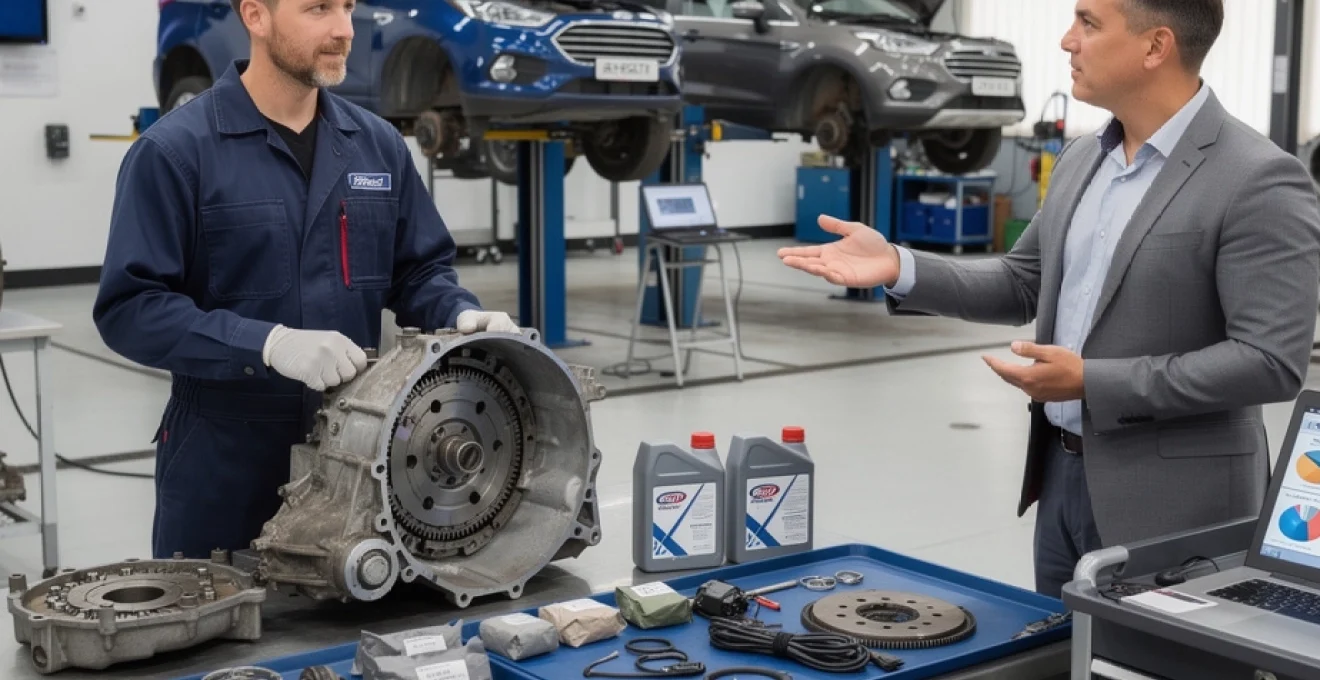
When a Ford Powershift gearbox starts slipping, shuddering or throwing transmission warnings, most drivers immediately wonder how much a replacement is going to cost. The Ford dual‑clutch transmission is sophisticated, but it is also well known in the UK market for premature clutch wear, mechatronic issues and control unit failures. Understanding typical Ford Powershift gearbox replacement cost ranges, what actually goes into a quote and where labour and parts margins sit puts you in a far stronger position when speaking to a dealer or specialist. Getting clear on the numbers also helps you decide whether a full replacement, a quality rebuild or a targeted clutch or mechatronic repair offers the best value for your situation.
Typical ford powershift gearbox replacement cost range in the UK market
Across the UK, the average Ford Powershift gearbox replacement cost for a complete unit supplied and fitted typically sits between £1,400 and £3,000 including VAT, depending on model, gearbox variant and who carries out the work. Independent gearbox rebuilders commonly advertise first‑generation reconditioned Powershift transmissions from around £1,995 + VAT for a full box, and second‑generation units from about £2,010 + VAT, with many Ford‑specific automatic specialists listing fitted prices for certain models near the £1,000–£1,300 mark. By contrast, a Ford main dealer replacement using a brand‑new OEM transmission can exceed £3,000–£4,000 once labour, fluids and software updates are included.
For smaller cars such as Fiesta and Focus fitted with the dry‑clutch 6DCT250, a typical independent specialist may quote £1,000–£1,400 for a reconditioned unit supplied and fitted, often including a two‑year or 24,000‑mile warranty on private vehicles. Larger models like the Mondeo, Kuga, Galaxy and S‑Max running the wet‑clutch 6DCT450 or MPS6 usually sit higher, in the £1,300–£2,000 region for a full recon box. Labour rates in London and the South‑East tend to push these figures up by 10–20% compared with some regional gearbox shops, especially for complex four‑wheel drive variants and hybrid applications where book times are longer.
It is also worth factoring in that most reputable transmission specialists now advise full fluid changes with OE‑spec DCT oil and often recommend replacing ancillary components such as the dual‑mass flywheel where contamination or excessive wear is evident. That can add £200–£600 to the overall automatic gearbox replacement cost, but in professional opinion it is usually preferable to doing the job twice. In recent years, rising prices of OEM clutch packs and mechatronics units have also nudged average UK replacement costs upwards by around 8–12%, a trend which is unlikely to reverse while parts remain tightly controlled by the main dealer network and a handful of specialist suppliers.
Key ford models and powershift variants affecting replacement price (fiesta, focus, mondeo, kuga, C‑Max, galaxy, S‑Max)
The model and specific Powershift variant fitted to your Ford have a direct impact on price because they determine parts cost, labour time and the level of demand for reconditioned units. Broadly, there are two main Ford dual‑clutch families: the dry‑clutch 6DCT250 used primarily in smaller engines, and the wet‑clutch 6DCT450 / MPS6 found in heavier, higher‑torque cars and SUVs. Each has its own common failure patterns, and those patterns shape how gearbox builders stock exchange units and price their work.
On the Fiesta and smaller‑engined Focus, the 6DCT250 is prevalent. It is notorious for clutch pack wear and input seal leaks, so there is a large aftermarket for clutch kits and recon boxes. That volume helps keep the typical Fiesta Powershift gearbox replacement cost at the lower end of the scale, even though some dry‑clutch units see multiple repairs over a car’s lifetime. The Focus straddles both types: lower‑output engines often use the dry clutch, while higher‑output or later models may have the wet‑clutch MPS6, which tends to be more robust but more expensive to rebuild when it finally does fail.
Mondeo, Kuga, Galaxy and S‑Max models were usually fitted with 6DCT450 / MPS6 wet‑clutch units, particularly on diesel engines and higher‑powered petrols. These gearboxes can handle more torque but require a larger oil quantity and more expensive clutch drums and mechatronic components, increasing the cost of a full replacement. C‑Max and S‑Max owners often see quotes in the mid‑range because these MPVs share many components with Focus and Mondeo, making exchange units widely available from UK gearbox rebuilders that specialise in Ford, Volvo and Land Rover transmissions. Four‑wheel drive variants, as found in some Kuga and Galaxy models, add extra complexity during removal and refit, pushing labour time and therefore cost higher.
Itemised powershift gearbox replacement quote: parts, labour, VAT and surcharges
When comparing quotes, it helps to understand how a typical Ford Powershift gearbox replacement cost is built up. A thorough written estimate should separate the transmission unit itself from labour, fluids and any surcharges, so that you can see where the major spend lies and what flexibility you have to save money without sacrificing reliability. For a standard front‑wheel drive Focus, for example, the gearbox may represent 60–70% of the total bill, with the rest split between workshop time, lubricants, filters, seals and VAT.
OEM vs remanufactured vs used powershift gearbox unit pricing (6DCT250, 6DCT450, MPS6)
At the top of the price spectrum sits a brand‑new OEM Ford Powershift unit ordered via the main dealer network. These can easily exceed £2,500–£3,000 before fitting, and for some late or rare variants the price is higher still. In the middle, remanufactured or reconditioned gearboxes from specialist rebuilders are usually the sweet spot, particularly for 6DCT250 and 6DCT450 units where known weak points are addressed during the rebuild. As a rule of thumb, expect around £1,995 + VAT for a first‑generation Powershift recon box and roughly £2,010 + VAT for a second‑generation equivalent supplied on an exchange basis.
Used or “breaker’s yard” transmissions sit at the lowest advertised price point but carry the highest risk. A cheap used Powershift from a crashed car might look appealing at £500–£800, yet there is typically no way to verify its internal condition or mileage, and consumer statistics show that a significant proportion of used dual‑clutch boxes develop faults within 12 months. Choosing a fully remanufactured exchange unit from a dedicated Ford automatic gearbox specialist often strikes the best balance between cost and peace of mind, particularly when backed by a written warranty and clear service history requirements.
Dual-clutch kit, mechatronic unit and TCM costs within a full gearbox replacement
Within a complete transmission replacement, the clutch pack, mechatronic valve body and transmission control module (TCM) account for most of the material cost. For the dry‑clutch 6DCT250, an OEM or high‑quality aftermarket dual‑clutch kit can range from £350 to £700 depending on specification, while wet‑clutch 6DCT450 kits typically sit in the £500–£900 band because they include more complex multi‑plate assemblies and seals. Mechatronic units on Powershift gearboxes, which house solenoids and hydraulic control channels, are frequently £600–£1,200 as individual components, and in many cases are replaced or fully rebuilt during a comprehensive remanufacture.
The TCM is either integrated into the mechatronic unit or bolted onto the box, and failures can lead to sudden loss of drive or harsh shifting. New control modules often cost £400–£800, not including programming. Some specialists offer TCM repair or data cloning services for less, often between £200 and £400, which can significantly reduce overall Powershift repair costs compared with replacing the entire gearbox. When reviewing a quote, it is worth checking whether these high‑value items are being renewed, refurbished or reused, because that makes a substantial difference to both cost and long‑term reliability.
Labour time estimates in hours for powershift swap at ford main dealer vs independent specialist
Swapping a Ford Powershift gearbox is labour‑intensive, with book times typically between 7 and 12 hours depending on model, drivetrain layout and access. A small front‑wheel drive Fiesta or Focus may be scheduled at roughly 7–8 hours, whereas a Mondeo estate or four‑wheel drive Kuga can easily reach 10–11 hours once subframes, driveshafts and exhaust sections are accounted for. Ford main dealers usually charge higher hourly rates – frequently £120–£180 per hour in and around major UK cities – while independent gearbox specialists tend to sit in the £70–£110 bracket, so the same job may differ by several hundred pounds on labour alone.
Interestingly, many dedicated automatic transmission rebuilders are more efficient than general garages because they repeat similar jobs daily and invest in purpose‑made lifting and alignment tools. That can reduce the effective labour time below the standard book estimate, even when charging by the hour. Some specialists instead quote fixed prices for a full supply‑and‑fit Powershift replacement, bundling labour into a single headline figure; this makes it easier for you to budget but can conceal how many hours are actually being spent on the vehicle. Asking for the estimated labour time as well as the hourly rate gives better visibility.
Ancillary parts and fluids: DSG/DCT oil, filter, seals, flywheel and software update costs
Beyond the gearbox and clutch pack, a thorough Powershift replacement always involves fresh dual‑clutch transmission fluid, new filters and replacement seals. Ford‑approved DCT oil is not cheap, typically £15–£25 per litre, and a full fill on a wet‑clutch unit can require 6–8 litres, so fluid alone often appears on the invoice as £120–£200. Add in sump gaskets, output shaft seals and small hardware items and you commonly see another £50–£120 in consumables. Many specialists also recommend inspecting or replacing the dual‑mass flywheel, especially when the original box has suffered significant clutch slip or overheating.
A new flywheel may add £300–£600 to the job, but skipping it risks noise, vibration and premature wear on the fresh gearbox. Modern Powershift installations also rely on software calibrations within the TCM; after fitting, most workshops carry out parameter resets and clutch adaptations using Ford IDS, Forscan or equivalent, and some models require paid software updates from Ford servers. These programming and calibration steps may be itemised as a separate £50–£150 charge on a detailed invoice, yet they are essential to smooth operation and long component life. Treat them as part of the true Ford Powershift gearbox replacement cost, not as optional extras.
Ford dealer vs independent transmission specialist vs gearbox rebuilder: cost and warranty comparison
Choosing where to have a Powershift gearbox replaced is almost as important as deciding whether to replace it at all. Ford main dealers, independent automatic transmission specialists and dedicated gearbox rebuilders each have different pricing models and warranty approaches. Understanding those differences helps you decide whether paying dealer rates is justified by convenience and brand alignment, or whether a respected specialist provides better value and often more tailored technical expertise on Powershift, 6DCT250 and 6DCT450 units.
Main dealer replacement pricing structures at ford UK (parts markup, fixed-price repairs)
Ford dealerships in the UK generally follow manufacturer labour guides and apply a set parts markup on OEM components. That means a brand‑new Powershift gearbox supplied and fitted at a main dealer often reaches £3,000–£4,000 or more, particularly on later models or hybrid variants. Some dealers promote fixed‑price automatic gearbox repairs for certain age bands, but these packages can still be significantly higher than independent quotes, largely because of the use of new genuine parts and higher workshop overheads. For company cars under warranty or vehicles with extended dealer service plans, this route may still be the most straightforward.
The main advantage of dealer replacement is that the work appears in the official Ford digital service record, and any subsequent software updates or recalls will automatically consider the new gearbox. However, dealer warranties on replacement transmissions are not always longer than those from independent specialists; one or two years are common, and mileage limits may apply. It is worth scrutinising the small print around what is covered – for example, whether consequential engine damage from a gearbox failure would be honoured – and whether servicing must continue at the dealer to keep the warranty valid.
Specialist transmission rebuild shops (e.g. automatic man, midland transmission) pricing models
Independent automatic gearbox specialists and transmission rebuild shops typically focus on a narrower set of driveline components, investing in specialist tooling and staff training. As a result, their pricing models often centre on reconditioned or remanufactured units supplied on an exchange basis, with a clear labour allowance for removal and refit. Many such businesses offer Powershift replacement packages in the £1,000–£2,000 range depending on model, undercutting dealer prices while still including high‑quality parts, new clutches and reconditioned mechatronic units.
A professional observation from the field is that these specialists usually have a deeper day‑to‑day familiarity with Powershift failure modes than a generalist main dealer workshop. That can translate into more accurate diagnostics – distinguishing between a failing clutch pack, a defective mechatronic valve body and a TCM software issue – and therefore more precise repair recommendations. Some also provide nationwide collection and delivery or mobile removal/refit services coordinated with a central rebuild facility, which can reduce downtime if you rely on the vehicle for work.
Reconditioned powershift gearbox suppliers and exchange unit charges in the UK
Reconditioned Powershift gearbox suppliers in the UK commonly operate on an exchange basis: a fully rebuilt 6DCT250 or 6DCT450 is supplied, and your old unit is collected and returned as the “core” for the next rebuild. To ensure the old gearbox is returned, most suppliers charge a core surcharge or deposit, often £300–£500, which is refunded once the original transmission arrives in serviceable condition. This system helps maintain stock of popular Ford units such as those for Fiesta, Focus, Mondeo, Kuga, Galaxy and S‑Max.
Prices for these reconditioned exchange units, without fitting, typically start from approximately £1,400 and rise toward £2,000 + VAT depending on generation and specification. Many gearbox rebuilders can deliver next‑day anywhere in mainland UK, and even into Europe, via specialist logistics partners who are familiar with handling heavy transmissions. For garages and mechanically capable owners, buying a recon box direct can be cost‑effective, with a local workshop carrying out the removal and refit. However, using a single supplier to both provide and install the unit often simplifies warranty claims if any issues arise.
Warranty length, mileage limits and exclusions on replacement powershift units
Warranty is a key factor when evaluating the real value of any Ford Powershift gearbox replacement cost. Many independent specialists offer two‑year or 24,000‑mile warranties on Powershift gearboxes they have supplied and fitted to private cars, with commercial vehicles sometimes limited to one year but with no mileage cap. These terms can actually exceed some main dealer offerings, particularly for vehicles beyond the manufacturer’s original warranty period. The most important aspect is that both parts and labour are covered, not just the transmission unit itself.
There are, however, common exclusions: neglecting regular fluid changes, using incorrect oil, tuning the engine beyond specified torque limits or continuing to drive with obvious gearbox faults can all invalidate coverage. Some warranties require that any future gearbox servicing is performed at the same specialist or to a documented standard elsewhere. Reading and understanding these conditions before authorising work is essential. A slightly higher initial price from a rebuilder with robust, clearly written warranty terms may prove far cheaper than a bargain gearbox with weak or ambiguous protection.
Diagnostic process before committing to full powershift gearbox replacement
A full Powershift gearbox replacement is one of the most expensive repairs most Ford owners will ever face, so a disciplined diagnostic process pays for itself. Proper use of specialist scan tools, careful interpretation of fault codes and a structured road test can often distinguish between a gearbox that truly needs replacing and one that simply requires a clutch pack, TCM or mechatronic repair. In many cases, the early symptoms – jerky shifts, delayed engagement or the dreaded “Transmission Malfunction – Service Now” message – can be caused by relatively localised faults that do not demand a complete gearbox swap.
Forscan, IDS and other diagnostic tools used to differentiate mechatronic vs gearbox failure
The most effective diagnostics on Ford Powershift units rely on manufacturer‑level tools such as Ford IDS or well‑equipped aftermarket software like Forscan. These platforms can access live data streams and module‑specific tests that basic OBD readers cannot. By monitoring clutch temperatures, solenoid current draw, gear engagement times and hydraulic pressures, a skilled technician can identify whether the problem lies in the mechatronic valve body, the TCM software or the mechanical geartrain itself. That level of insight is crucial before approving a four‑figure Ford automatic gearbox repair bill.
Advanced diagnostic routines also include adaptation resets and relearn procedures. If a Powershift gearbox has had recent work, or if the clutch packs have worn gradually, the control module may simply need its learned values resetting and a fresh adaptation drive cycle completing. Sometimes a harsh or jerky shift disappears once these software calibrations are performed correctly. Of course, if adaptations repeatedly fail or key pressure parameters cannot be achieved, that data becomes evidence supporting the case for a more substantial repair or replacement.
Interpreting common powershift DTC fault codes (P07A2, P2832, P0868, etc.) and cost implications
Certain diagnostic trouble codes (DTCs) appear frequently on failing Ford Powershift transmissions and have fairly predictable cost implications. For example, a code such as P07A2 (clutch A stuck engaged) often points to a worn or contaminated clutch pack or a hydraulic issue within the mechatronic unit controlling that clutch. Likewise, P2832 (shift fork “D” position circuit range/performance) can indicate a problem with the gear selector actuators or internal forks. In both cases, a full gearbox replacement may not be strictly necessary if the fault is confined to the clutch assembly or mechatronic.
On the other hand, a code such as P0868 (transmission fluid pressure low) together with metal debris in the oil and widespread gear ratio errors suggests more extensive internal damage. At that point, the economics often favour a complete remanufactured exchange unit rather than trying to patch multiple components. Understanding what these codes really mean helps you have an informed conversation with the workshop and challenge any “replace the whole gearbox” recommendations that do not seem fully justified by the evidence.
Road test procedures and clutch adaptation checks to avoid unnecessary full replacement
Road testing remains an essential part of diagnosing a suspect Powershift gearbox. A controlled test drive that includes gentle take‑offs, moderate acceleration, steady cruising and light braking allows a technician to feel for shuddering, flare (engine revs rising without corresponding speed increase) and delayed engagement, particularly in first, second and reverse gears where many Powershift problems first appear. Combining that subjective feel with live data on clutch slip counts, gear command versus actual ratio and shift times can quickly reveal whether the unit is fundamentally healthy.
Clutch adaptation checks are especially useful following reset or repair. If, during an adaptation drive cycle, the gearbox struggles to complete its routines, continually times out or logs new DTCs, that is strong evidence of internal mechanical or hydraulic weakness. Conversely, if adaptations complete smoothly and shift quality improves, a full gearbox replacement may be avoidable for the time being. A careful road test can therefore save you many hundreds of pounds by confirming that a targeted clutch kit or mechatronic repair is sufficient.
When a clutch pack, TCM or valve body repair is cheaper than complete gearbox replacement
Not every Powershift problem justifies a new or reconditioned gearbox. If diagnostics show stable internal gear ratios but high slip across one clutch, a clutch pack replacement can be a much cheaper option, particularly on 6DCT250 units where clutch kits are relatively accessible and labour is lower. Similarly, where fault codes and pressure data point squarely at the mechatronic valve body, sending this assembly for specialist repair or installing a remanufactured unit may resolve the issue at a fraction of the full replacement cost.
TCM‑only faults, such as communication losses or corrupted software, can often be addressed via reprogramming, replacement of the control unit or even data cloning from the original module. These interventions typically sit in the £300–£900 range, versus £1,500–£3,000 for a full gearbox. That said, it is essential to consider mileage and overall condition: if the Powershift has already covered well over 100,000 miles with patchy maintenance, a partial repair might only defer the inevitable. Balancing short‑term savings against long‑term reliability is crucial, especially if you plan to keep the vehicle for several years.
Known powershift gearbox failure patterns and how they influence replacement decisions
Patterns of failure on Ford Powershift gearboxes are now well documented in the UK and worldwide, influencing both pricing and repair strategies. On the dry‑clutch 6DCT250 commonly found in Fiesta, Focus and smaller C‑Max models, premature clutch wear, leaking input shaft seals and TCM issues are the dominant problems, often appearing between 40,000 and 80,000 miles. Many cars experience jerky engagement in first and reverse, accompanied by the familiar “Transmission Malfunction – Service Now” message. Here, clutch replacements and seal upgrades are frequent, but if contamination has persisted for too long, bearing damage inside the transmission case can make a full replacement more sensible.
The wet‑clutch 6DCT450 / MPS6 used in Mondeo, Kuga, Galaxy and S‑Max tends to last longer but is vulnerable to clutch pack failure (often due to spring collapse), mechatronic hydraulic pressure loss and oil contamination. In many workshops, Powershift failures are seen clustering around 80,000–120,000 miles where fluid has not been changed at the recommended intervals. Once clutch material circulates through the oil system, it can block fine control passages, leading to harsh shifts and repeated limp‑home modes. At that point, investing in a full remanufactured gearbox – with upgraded clutches, fresh bearings and a reconditioned valve body – is usually more logical than attempting piecemeal internal repairs.
Real‑world claims data from independent transmission specialists suggest that well over half of the Ford Powershift units they see have suffered from overdue maintenance or incorrect fluids at some point, underlining how sensitive these gearboxes are to proper care. Industry‑wide, the past few years have also seen an increase in Powershift‑related complaints reaching consumer bodies, prompting several technical service bulletins and updated clutch designs. For you as an owner, this history means there is now a mature ecosystem of rebuilders and parts suppliers familiar with the common failure patterns, able to offer targeted improvements rather than simply reinstalling weak original components.
Cost-saving strategies for ford powershift gearbox replacement without compromising reliability
Facing a four‑figure Ford Powershift gearbox replacement cost can be daunting, but there are several strategies to control the bill while still achieving a durable result. One of the most effective is to seek out an established independent automatic transmission specialist rather than defaulting to a main dealer. Lower hourly labour rates, access to remanufactured exchange units and bulk purchasing of OEM‑quality parts all help reduce the final invoice. At the same time, these specialists are often better placed to advise whether a clutch‑only repair, mechatronic overhaul or TCM work will resolve your issue without replacing the entire gearbox.
Timing also matters. Addressing early warning signs – such as mild shudder, intermittent warning lights or slow engagement – nearly always leads to cheaper solutions than waiting for a complete loss of drive. Early intervention can often confine contamination to the clutch and mechatronic assembly, avoiding damage to the geartrain and bearing sets. It is similar to catching a roof leak before it saturates the joists; the cost difference between a patch and a full structural repair can be substantial. Budgeting for regular fluid changes using the correct DCT oil, typically every 3–4 years or 40,000–50,000 miles, is another proven way to lengthen gearbox life and delay major expenditure.
Finally, the way you use the vehicle plays a role. Powershift gearboxes are at their best with smooth, progressive inputs. Avoiding long periods of creeping in heavy traffic, minimising rapid “on‑off” throttle transitions and selecting neutral rather than holding the car on the brake for extended stops all help reduce heat and clutch wear. For drivers who tow regularly or operate in hilly areas, proactively discussing uprated cooling or more frequent servicing with a transmission specialist can prevent problems before they become expensive. These driving and maintenance habits cost little to adopt but can significantly influence the real‑world cost of owning a Ford fitted with a Powershift transmission.