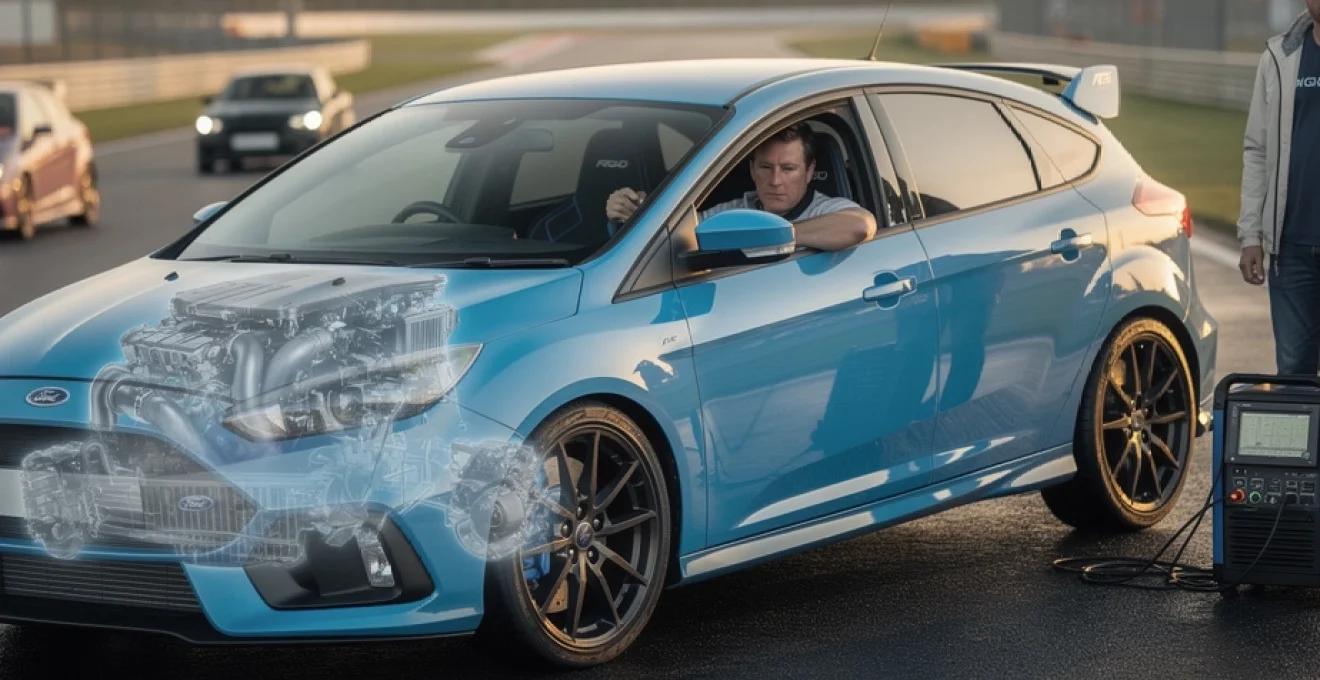
The Ford Focus RS Mk3 marked a turning point for fast Fords. After two generations of front‑wheel‑drive hooliganism, the Mk3 arrived with sophisticated torque‑vectoring all‑wheel drive, a high‑output EcoBoost engine and a chassis calibrated by Ford Performance for serious track work. For many drivers it became the first genuinely affordable hot hatch that could keep a modern super saloon honest on a wet B‑road, yet still carry a family and a weekly shop.
If you are looking at a Ford Focus RS Mk3 as a used buy, a weekend toy or even a daily driver, understanding the engineering underneath the bodywork pays dividends. This is not just a Focus with a big turbo. It is a carefully integrated package where engine, AWD system, suspension and electronics have been tuned to work together. Get familiar with how the car makes its power, how the twin‑clutch rear drive unit behaves, and what the head gasket recall really means, and you will be in a much better position to judge whether a particular RS suits your driving style and usage.
Ford focus RS mk3 overview: production years, trim levels and UK market positioning
The Mk3 Ford Focus RS went on sale in the UK in 2016 and remained in production until 2018. Built in Saarlouis and engineered by Ford Performance, it sat at the very top of the Focus range, above the Focus ST. All UK cars used the five‑door shell; a three‑door RS was never offered, a decision driven by Ford’s global platform strategy and the cost of re‑engineering the side structure for limited volumes.
Power came from a 2.3‑litre `EcoBoost` turbocharged four‑cylinder, officially rated at 345 bhp and 347 lb ft (470 Nm). Combined with the advanced all‑wheel‑drive system, that was good for a claimed 0–62 mph in 4.7 seconds and a top speed of 165–166 mph. When new, the Focus RS was priced noticeably below premium rivals such as the Mercedes‑AMG A45, Audi RS 3 and BMW M2, but slightly above the Volkswagen Golf R. That value proposition is a big reason why you still see the RS described as one of the great “mega hatch” bargains of the last decade.
UK buyers effectively had three flavours. The standard RS could be optioned with forged 19‑inch wheels, Recaro shell seats, a Luxury Pack and various paint colours, with Nitrous Blue being by far the most popular. In 2017 the RS Edition arrived, available only in Nitrous Blue with a matt black roof, mirrors and rear spoiler, plus a Quaife limited‑slip differential on the front axle and the Recaro shells as standard. Finally, the 2018 Heritage Edition was limited to just 50 UK cars in Tief Orange, each fitted from the factory with Ford‑approved Mountune FPM375 hardware and calibration, along with the Quaife diff and extra cabin trim. Values of those special editions have already started to diverge from regular Mk3 Focus RS prices, which is worth bearing in mind if you are cross‑shopping standard and Edition cars.
Ecoboost 2.3-litre engine specs: power output, torque curve and internal hardware
At the heart of the Focus RS Mk3 is the all‑aluminium 2.3‑litre `EcoBoost` four‑cylinder, a close relative of the unit found in the contemporary Mustang but significantly reworked. In RS guise it displaces 2,261 cc, uses a dual overhead cam 16‑valve head with variable valve timing and runs a relatively high 9.37:1 compression ratio for a turbo motor. Officially it delivers 345 bhp (257 kW) at 6,000 rpm and 346 lb ft (470 Nm) between roughly 2,000 and 4,500 rpm, with a transient overboost function allowing up to around 369 lb ft (500 Nm) for short bursts under full load.
To achieve 150 bhp per litre on pump fuel, Ford upgraded much of the internal and supporting hardware compared with the Mustang tune. The cylinder head uses an enhanced alloy for better heat resistance and sits on a more robust head gasket. The block is fitted with stronger cast‑iron liners and the cooling package is uprated with a higher‑capacity radiator and large‑bore plumbing. The intake and exhaust are far less restrictive than on the Mustang, with a large‑bore exhaust and an electronically controlled valve in the tailpipe to balance back‑pressure against noise. It is a highly stressed engine, but when fed good quality 99 RON fuel and serviced correctly it can be a durable unit even with regular track use.
Twin-scroll turbocharger design, boost pressure management and anti-lag strategy
The RS uses a larger twin‑scroll turbocharger than the Mustang. A twin‑scroll design essentially separates the exhaust pulses from paired cylinders as they enter the turbine housing, reducing pulse interference and helping the turbo spool harder and earlier. For you, that translates into much better low‑down response than a comparable single‑scroll setup at the same peak boost level.
Boost pressure is managed via the ECU, wastegate, electronic recirculation (dump) valve and careful ignition and fuelling control. There is no rally‑style anti‑lag system as such, but in the Sport and Track driving modes the engine calibration keeps the turbo spinning aggressively between gears, aided by very short ignition cut times when you execute fast upshifts. Overboost is time‑limited to protect the turbo and block from excessive thermal and mechanical stress. Abuse repeated launch control starts on a hot day and you are asking for trouble; use the system sparingly and the hardware tends to cope well.
Fuel injection system, compression ratio and knock control on 99 RON vs 95 RON petrol
The 2.3 EcoBoost uses high‑pressure direct injection with multi‑hole injectors and sophisticated spray targeting. Combined with the 9.37:1 compression ratio, the engine can run relatively lean and efficient in light load cruise, yet still accept substantial boost in the mid‑range without detonation. Advanced knock sensors monitor combustion in real time and the ECU dynamically trims ignition timing on each cylinder to stay just shy of knock even when fuel quality deteriorates.
On 99 RON super unleaded, the RS generally delivers its full quoted 345 bhp and strong, repeatable in‑gear performance. Run it on 95 RON and the knock control strategy will pull timing under high load, especially in hot weather. You will feel that as a softer top‑end and slightly lazier torque curve, and you may also see fuel economy worsen as the ECU fattens the mixture to keep things safe. For an engine of this specific output, treating 99 RON as mandatory rather than optional is a smart policy if you value both performance and long‑term health.
Cooling package: intercooler efficiency, oil cooling and thermal management in track use
High power density brings with it a serious heat management challenge. The Focus RS tackles this with a larger front‑mounted intercooler, a higher‑capacity main radiator, and an additional oil cooling circuit. The intercooler does a good job of keeping charge temperatures under control for brisk road use, although repeated maximum‑boost runs on a hot track day will still see intake temperatures climb and the ECU gently trim power to protect the engine.
Oil temperature and pressure are monitored continuously, and the ECU will adjust both boost and ignition timing if the oil gets too hot. For sustained track work, regular oil changes with high‑quality synthetic and more frequent coolant and brake fluid flushes are recommended. Many owners who track the car regularly also move to a slightly more aggressive oil grade for added protection under prolonged high‑temperature, high‑shear conditions, a bit like fitting stronger running shoes before attempting a marathon rather than a quick jog.
Real-world performance figures: 0–60 mph, in-gear acceleration and top speed vs focus ST and golf R
On paper the Focus RS Mk3’s performance is impressive; in the real world it feels even stronger thanks to the traction advantage of all‑wheel drive. Independent testing has repeatedly recorded 0–60 mph times of around 4.7–5.0 seconds depending on surface and conditions, with the standing quarter mile dispatched in roughly 13.3–13.5 seconds at just over 100 mph. In‑gear acceleration is equally telling: factory data suggests 30–50 mph in 4th takes about 3.5 seconds, and 50–70 mph in 5th around 4.3 seconds.
Compared with a Focus ST, the RS is comfortably over a second quicker to 60 mph and feels vastly more composed when launching hard or pulling out of a damp junction. Against a Mk7.5 Golf R DSG, the numbers are close – the VW’s launch control and slick dual‑clutch gearbox give it a marginal edge off the line in some tests – but once rolling the RS’s extra power and shorter gearing often tell. Top speed is electronically capped around 165–166 mph, more than enough for UK and most European circuits where handling balance and braking matter far more than the last 5 mph of v‑max.
AWD and chassis engineering: ford performance all-wheel drive, suspension and brakes
The Focus RS Mk3’s chassis is where the car truly distinguishes itself from most hot hatches. Instead of the more common Haldex‑style system that behaves like a front‑drive car until slip is detected, the Ford Performance all‑wheel‑drive setup was engineered from the outset to aid rotation and agility. At its core sits a GKN twin‑clutch rear drive unit (RDU) coupled to a power transfer unit (PTU) at the front of the gearbox. This hardware can send up to 70% of available torque to the rear axle, and then up to 100% of that rear torque to either individual rear wheel via independently controlled clutch packs.
Superimposed on that mechanical layout are adaptive dampers, a re‑worked EPAS steering system, stiffened suspension pick‑up points and serious Brembo brakes. The result is a car that can be driven neatly and neutrally, yet also happily indulge in power oversteer if you deliberately provoke it in the right mode. As several industry ride and handling engineers remarked when the RS launched, this was the first mainstream hot hatch that genuinely felt like a “mini GT‑R” in the way it could pull itself around a bend under power.
GKN twin-clutch rear drive unit: torque-vectoring logic, drift mode and PTU operation
The GKN `Twinster` rear drive unit is effectively the magic box that gives the RS its character. Rather than relying on brake‑based torque vectoring, which heats up the brakes and wastes energy, the system actively over‑speeds the outside rear wheel by up to around 2% relative to the front axle. The PTU on the gearbox sends a continuous drive to the rear prop shaft; the RDU then decides, in milliseconds, how much of that torque each rear wheel should receive based on steering angle, throttle position, yaw rate, wheel speeds and selected drive mode.
Normal and Sport modes bias torque forwards for stability, but will still send meaningful drive to the rear under load, subtly helping the car rotate. Track mode allows greater rear bias and more slip before the stability control intervenes. Drift mode goes a step further, explicitly calibrating the torque vectoring to encourage controlled oversteer. It is worth stressing that the electronics are still watching you closely; the car is not a rear‑drive drift missile and will step in smartly if you go too far. Used with mechanical sympathy and plenty of space, however, it adds a layer of adjustability that few rivals can match.
Suspension geometry: MacPherson struts, multi-link rear, spring rates and adaptive dampers
Up front the Mk3 Focus RS uses a MacPherson strut setup, while the rear features a sophisticated multi‑link independent arrangement derived from the standard Focus’s much‑praised “Control Blade” layout. Spring rates are significantly stiffer than on a Focus ST, and the car sits lower, reducing roll and sharpening responses. Crucially, Ford fitted two‑stage adaptive dampers that can be toggled between Normal and Sport/Track settings from a button on the stalk or via drive modes.
In Normal damper mode, the RS retains just enough compliance for daily driving, although the low‑speed ride is still firm and you will feel poor surfaces more than in, say, a Golf R. Switch to the stiffer setting and the car becomes noticeably tauter; on smooth circuits this added body control is superb, but on typical UK tarmac it can feel too aggressive, causing the body to fidget rather than flow. If you plan to use the car primarily on B‑roads, leaving the dampers in Normal while still enjoying the sharper throttle and AWD calibration of Sport mode is often the sweet spot.
Steering calibration and EPS mapping: rack ratio, feedback and selectable drive modes
Instead of the variable‑ratio rack used on the Focus ST, the RS gets a fixed‑ratio electric power‑assisted steering (EPAS) system with a quick, linear rack. The goal was predictable responses and better feedback at and beyond the limit. Assistance level varies with speed and with the selected drive mode: Normal offers the lightest feel, Sport weighs things up, and Track/Drift applies an even meatier calibration.
Compared with many contemporary hot hatches, the RS’s steering feels usefully communicative. You can sense the front tyres load up and start to slide rather than being surprised by sudden understeer. Lock is not particularly generous, which you notice in tight car parks or hairpins, and big 19‑inch tyres do generate some tramlining on poor surfaces. However, the combination of rack ratio, EPAS tuning and front axle geometry gives the Focus RS a confident front end that encourages you to lean on the grip without constantly second‑guessing what the electronics might do next.
Braking system: brembo front calipers, disc dimensions, pad compounds and fade resistance
Stopping power is handled by serious hardware. Up front sit 350 mm ventilated discs clamped by four‑piston Brembo calipers; at the rear you will find 302 mm solid discs with single‑piston calipers. Bosch ABS and brake force distribution integrate with the torque vectoring and ESC systems, yet pedal feel remains admirably natural rather than “by‑wire”. The standard pads strike a sensible compromise between cold bite, dust and noise for fast‑road use.
On track, the factory setup copes well for a few hard laps but will eventually show signs of fade if you are heavy on the brakes. That is more a function of car weight (around 1,569 kg kerb) than component quality. Enthusiastic owners who track the car regularly often move to a more temperature‑resistant pad compound and higher‑boiling‑point fluid; think of it as putting stickier trainers on the same strong legs. Front pad life of 15,000–20,000 miles is common with mixed driving, and replacement discs and pads are not extortionate by high‑performance standards.
Tyres and wheels: 19-inch alloys, pilot super sport vs cup 2, impact on grip and tramlining
All Mk3 Focus RS models left the factory on 19‑inch wheels with 235/35 R19 tyres. Standard cars used a cast ten‑spoke gunmetal design; optional lightweight forged five‑spoke alloys saved almost 1 kg of unsprung mass at each corner, which subtly benefits both ride and response. Michelin Pilot Super Sport (PSS) tyres were the default fitment, with the even stickier Michelin Pilot Sport Cup 2 available for those who prioritised dry grip over wet performance and wear.
On UK roads the PSS remains the best all‑rounder, offering strong traction in mixed conditions and a progressive breakaway. Cup 2s transform dry‑track lateral grip and braking but are much less happy in standing water and cold temperatures, and tend to follow cambers more aggressively. Either way, budgeting for high‑quality tyres is essential. This is a car where cheap rubber will not only blunt performance but actively undermine the sophisticated torque‑vectoring strategies baked into the AWD software.
Transmission and driveline: getrag 6-speed manual, clutch assembly and gearing
The Focus RS Mk3 is resolutely old‑school in at least one respect: it is manual‑only. The six‑speed Getrag gearbox uses strengthened internals compared with lesser Focus models and is paired with an uprated clutch assembly to cope with the 470–500 Nm torque loads. The shift itself has a short, mechanical throw and a satisfying weight, with a positive gate that encourages deliberate inputs rather than wrist‑flicking laziness. Many enthusiasts still rate it above the Golf R’s manual and broadly on par with the BMW M140i’s, even if it falls just short of the Honda Civic Type R for sheer slickness.
Gearing is fairly short, with 6th chosen as a usable motorway ratio rather than an ultra‑tall overdrive. At 70 mph the engine sits in the low‑to‑mid 2,000 rpm band, which is enough to pull cleanly without a downshift while keeping noise tolerable. There is no factory auto rev‑matching; heel‑and‑toe downshifts are entirely up to you, which many drivers enjoy. The gearbox also incorporates an anti‑stall function: if you do stall pulling away, a quick stab of the clutch will re‑start the engine. The only caveat is clutch life; repeated launch control starts and ham‑fisted standing‑start antics can eat into the clutch’s margin of safety, and a replacement kit including labour is comfortably into four figures.
Interior and technology package: recaro seats, sync infotainment and driver assistance systems
Step inside a Focus RS Mk3 and you are greeted by a cabin that is recognisably Mk3 Focus, but with a handful of key upgrades. Deeply bolstered Recaro sports seats come as standard, trimmed in half‑leather with blue stitching and, on Nitrous Blue cars, colour‑matched bolsters. They offer good lateral support without the excessive compromise of some aftermarket buckets. The optional Recaro shell seats look and feel more motorsport‑inspired and save some weight, but sit higher and delete height adjustment; if you are tall, trying a shell‑equipped car before buying is essential. Many owners ultimately prefer the standard seats for mixed use.
The dashboard is dominated by an 8‑inch touchscreen running Ford’s `SYNC 2` or later `SYNC 3` software, depending on build year and updates. Navigation, Bluetooth and DAB are common, and Apple CarPlay/Android Auto are available on SYNC 3 systems. Auxiliary analogue gauges on top of the dash display oil temperature, oil pressure and turbo boost, a welcome nod to older RS and Cosworth models. Materials quality is decent rather than premium – plenty of soft‑touch plastics on the upper surfaces, harder finishes lower down – but the switchgear feels robust and the overall design has aged better than some period rivals.
Driver assistance features include automatic headlights and wipers, rear parking sensors, a rear‑view camera where specified, and Ford’s MyKey system, which allows you to programme a secondary key with speed or audio limits. Autonomous emergency braking was optional rather than standard. Cabin space remains perfectly adequate for a family, with decent rear legroom thanks to the five‑door shell, though the boot shrinks to about 260 litres because of the rear AWD hardware packaging. Fold the rear seats and you still have over 1,000 litres of usable space, so using the RS as a daily driver is entirely realistic if you accept the firmer ride and slightly higher road noise.
On-road and track review: handling balance, understeer mitigation and comparison with rivals
How does the Focus RS Mk3 actually feel on the road? In short, exceptionally capable, often entertaining, and occasionally a bit uncompromising. The front end bites keenly, the rear axle is constantly helping to rotate the car rather than just following along, and the AWD system does an excellent job of shuffling torque without drawing attention to itself. Against key contemporaries such as the Honda Civic Type R FK2/FK8, VW Golf R Mk7 and Subaru WRX STI, the RS sits towards the more playful, less polished end of the spectrum – which, depending on your taste, may be its biggest asset.
On a dry, flowing B‑road you can lean hard on the outer front tyre, feel the rear begin to push the car around the corner, and then use the throttle almost as a steering tool. Compared with the ultra‑precise but FWD‑biased Civic Type R, the Ford trades a fraction of ultimate turn‑in sharpness for far better traction out of slower bends and a more adjustable attitude mid‑corner. Versus a Golf R, the Focus feels more alive, less insulated and more willing to slide a few degrees when you really commit. Think of the RS as sitting somewhere between a traditional hot hatch and a modern AWD rally rep in character.
Cornering behaviour and lift-off oversteer on UK b-roads and circuits like brands hatch
On typical UK B‑roads, the Focus RS Mk3 encourages precise, committed driving. Turn‑in is quick and accurate, helped by the fixed‑ratio rack and stiff front end. If you carry too much speed into a corner, the car will still push wide like any nose‑heavy hatchback, but the torque‑vectoring rear axle and ESC calibration do an impressive job of trimming that initial understeer as soon as you ease off the throttle or feed in drive mid‑corner. On a steady, balanced throttle you can feel the car settle into a neutral stance with all four tyres working.
Lift‑off oversteer is available but not vicious. Backing out of the throttle sharply while loaded up will rotate the rear enough to help you tighten your line, especially in Track mode where ESC thresholds are relaxed, but it is progressive rather than snappy. On circuits such as Brands Hatch Indy, the RS can be driven very hard with confidence, braking deep, turning in late and using the strong traction to fire out of tight corners. Compared with, say, a Subaru WRX STI, the Ford feels less nose‑heavy and more willing to rotate on throttle, yet remains easier to catch than a rear‑drive coupe without electronic aids.
Launch control, traction out of slow bends and stability control intervention thresholds
The RS’s launch control is accessed via the instrument cluster menus. Once armed, you simply floor the throttle in 1st with the clutch in, then sidestep the pedal quickly; the system holds revs, manages wheelspin and optimises torque distribution to deliver consistent sub‑5‑second 0–60 mph runs on a decent surface. For occasional use it is impressively effective. However, repeated launches are tough on clutch, PTU and RDU temperatures, so using it as a party trick at every set of lights is asking for accelerated wear.
Out of slow bends, the Ford’s combination of short gearing, strong mid‑range torque and torque‑vectoring rear drive gives it a notable advantage over front‑drive rivals. Where a Civic Type R may flash its traction light and scrabble in 2nd on a damp exit, the RS simply hooks up and goes, with only a brief chirp from the tyres. ESC thresholds vary with drive mode: Normal is conservative, Sport allows a sensible amount of slip and yaw, and Track/Drift give you far more rope before intervening. For fast road use, Sport tends to be the best compromise between safety net and enjoyment.
Noise, vibration and harshness (NVH): exhaust note, cabin refinement and motorway comfort
Fast Fords have never been about whisper‑quiet refinement, and the Mk3 RS continues that tradition. At idle there is a purposeful thrum from the 2.3 EcoBoost, rising to a hard‑edged growl as revs build. The exhaust’s active valve opens wider in Sport and Track modes, adding more volume plus a theatrical barrage of pops and crackles on the overrun. For many owners this soundtrack is a key part of the car’s appeal; for neighbours on cold‑start winter mornings, perhaps less so.
Cabin noise levels are higher than in a Golf R or Audi S3. Wide 235‑section tyres generate noticeable roar on coarse motorway surfaces, and the firm suspension transmits more thumps from potholes and expansion joints than more comfort‑oriented hatches. At a steady 70 mph the car is by no means unbearable – you can comfortably cover long distances – but you are always aware this is a focused performance car rather than a quietly anonymous commuter. If you prefer near‑luxury motorway refinement, a Mercedes‑AMG A35 or A45 will suit you better; if you are willing to trade some serenity for feedback and character, the RS is deeply satisfying.
Benchmarking against honda civic type R FK2/FK8, VW golf R mk7 and subaru WRX STI
Against the FK2/FK8 Honda Civic Type R, the Focus RS Mk3 concedes a little in absolute steering precision and gearbox feel. The Honda remains the reference point for front‑drive track pace. However, the Ford claws back points in poor weather, on broken surfaces and out of slow corners thanks to its AWD hardware. Compared with a Mk7 Golf R, especially in DSG form, the RS is less refined and lacks the VW’s dual‑personality ability to be a quiet cruiser one moment and a point‑to‑point weapon the next. Yet from a pure driver engagement point of view, the Ford feels more special, more “RS” in character.
The Subaru WRX STI, meanwhile, appeals to a similar rally‑bred niche but is hampered in Europe by an older powertrain with poorer fuel economy and CO₂ figures. The RS offers more modern infotainment, better everyday usability and, frankly, a more desirable badge in the current market. When viewed alongside premium mega‑hatches like the A45 or RS 3, the Focus undercuts them significantly on running costs and purchase price while matching or exceeding them for driver involvement, even if the interiors and badges of the German cars feel more upmarket.
Reliability, known issues and maintenance: head gasket failures, head cracking and recall history
From a reliability perspective, the Mk3 Focus RS is broadly robust but not without well‑documented issues. The most notorious concerns head gaskets on early cars. Due to a production mix‑up, some 2016–early 2017 RS models left the factory with a head gasket intended for the Mustang’s version of the 2.3 EcoBoost, which uses a different cylinder head design. This mismatch could allow coolant to leak into the combustion chambers, leading to white exhaust smoke, gradual coolant loss, misfires and, if ignored, cracked cylinder liners or even head damage.
Ford acknowledged the problem and launched a field service action to inspect affected engines, replace the gasket with the correct part and, where necessary, fit a new head. When assessing a used RS, looking for paperwork referencing the official campaign (often noted as FSA17832 on dealer records) is crucial. A properly documented gasket and head replacement, carried out by Ford, need not be a deal‑breaker; if anything it can be a positive sign that the engine has effectively had a major refresh. What should raise eyebrows is an early car with no evidence of the check or work, especially if there are signs of coolant staining or unexplained top‑ups.
Beyond the gasket issue, there have been sporadic reports of turbo failures (most often on heavily tuned or poorly serviced cars), worn clutches on vehicles subjected to repeated launch control starts, and occasional rear differential whine where fluid changes have been neglected. Suspension bushes and adaptive dampers can wear more quickly on cars used hard on track, and some owners have experienced steering sensor glitches that trigger warning lights. These are not endemic flaws so much as the typical wear points of a high‑performance car that invites enthusiastic driving.
From a maintenance standpoint, treating the RS as a serious performance machine rather than a regular hatchback pays off. Oil changes every 6,000–10,000 miles with quality synthetic, rear diff fluid every 30,000 miles, and brake fluid at least every two years help keep the drivetrain and braking system healthy. Running on 99 RON fuel, allowing the engine and turbo to warm through gently before hard use, and cooling the car down with a few minutes of light driving after a track session are simple habits that significantly reduce stress on components. Taken together, those practices allow the Focus RS Mk3 to deliver its blend of pace, practicality and driver engagement for many years without the kind of horror stories sometimes associated with older rally‑bred machinery.