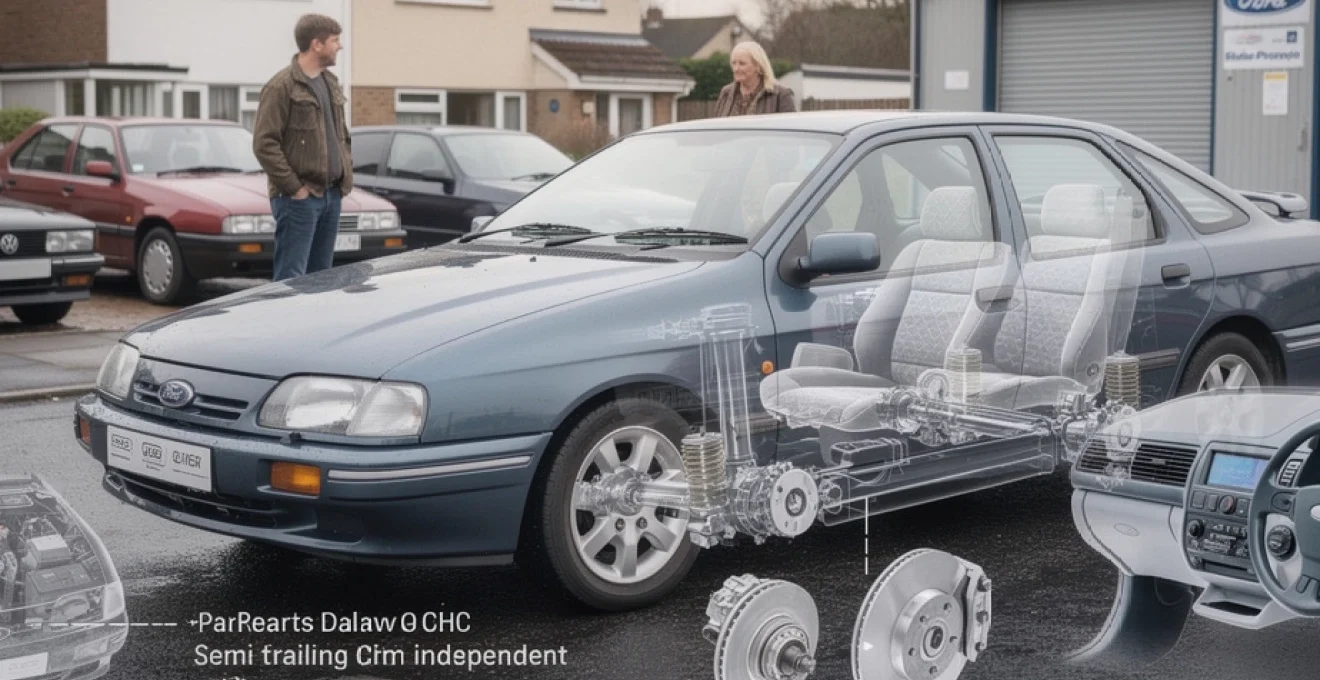
The 1990 Ford Sierra hatchback sits at a fascinating crossroads in family car history. It combines a revolutionary early‑1980s aerodynamic body with late‑1980s engine technology and early‑1990s equipment expectations. If you grew up around UK company car parks full of “jellymould” Fords, the 1990 Sierra is probably exactly what you picture: a five‑door hatchback in LX or GL trim, 2.0 injection under the bonnet, pounding up and down the motorway as a fleet workhorse. Today, that same mix of rear‑wheel drive, simple engineering and distinctive styling gives the Sierra hatchback growing appeal as an affordable modern classic and a usable everyday classic car for enthusiasts who value character over complexity.
Ford sierra hatchback 1990 in context: late-80s d-segment design, market rivals and UK positioning
UK and european d-segment landscape in 1990: comparing ford sierra to vauxhall cavalier mk3 and VW passat B3
By 1990 the Ford Sierra hatchback competed in a fiercely contested D‑segment against the front‑wheel‑drive Vauxhall Cavalier Mk3, Volkswagen Passat B3, Peugeot 405 and Rover 400/600 predecessors. The market was shifting quickly towards more efficient, lighter, transverse‑engined saloons and hatchbacks, yet Ford maintained a loyal following for the rear‑drive Sierra, especially in the UK company car sector. A 1990 Sierra hatchback measured around 442 cm in length and weighed from roughly 1100 to 1350 kg depending on engine and trim, putting it slightly longer than a Honda Civic hatchback but shorter than an Opel Vectra. That made it a true mid‑size family car rather than a compact.
Price remained one of the Sierra’s strongest weapons. In markets like Latvia, a 1990–1993 Sierra hatchback can still be found between 1300 and 2100 €, and period‑correct comparisons suggest that even when new the Sierra undercut many rivals. Contemporary reliability data from inspection reports show a defect rate of about 30.1% on 13‑year‑old examples versus a 26.9% class average, so quality sat slightly below par but running costs were low. For fleet managers chasing whole‑life cost rather than outright innovation, that equation often tipped the scales in Ford’s favour despite the more modern engineering of the Cavalier and Passat.
Design language and aerodynamics: from uwe bahnsen’s 1982 “jellymould” to the facelifted 1990 sierra hatchback
When the original Sierra appeared in 1982, its flowing “aeroback” shape shocked Cortina buyers used to ruler‑drawn saloons. The design, led by Uwe Bahnsen, borrowed ideas from concept cars like the Probe III and achieved a drag coefficient around 0.34, exceptionally low for a mass‑market family car. Early cars were dubbed the “jellymould” and faced slow sales, but time has been kind to the styling. By 1990 the silhouette looked contemporary rather than radical, especially alongside the equally wind‑tunnel‑sculpted VW Passat B3.
The 1987 facelift softened the nose with a new front end, integrated bumpers and a more conventional grille on the three‑box Sapphire. The 1990 hatchback benefited from these revisions plus a cleaner tail treatment and better sealing, which improved motorway refinement and crosswind stability over the earliest cars that had suffered stability issues at speed. The result in 1990 was a body that still cut cleanly through the air, helping the 2.0 injection versions to combine 120 bhp performance with realistic combined fuel consumption in the high‑30s mpg range when driven gently.
Body styles and trim hierarchies: 5-door hatchback versus saloon sapphire and estate in the 1990 line-up
In the 1990 model year the Sierra family offered three main body styles: the five‑door hatchback, the notchback saloon branded Sapphire, and the spacious estate. The hatchback remained the volume seller in the UK, particularly with 1.6 and 2.0 engines in LX, GL and Ghia trims, while the Sapphire appealed to more conservative drivers and fleet buyers who still preferred a boot. Estates targeted families and trades needing maximum load capacity, often specified with the 1.8 TD diesel for long‑distance economy.
Trim hierarchies were clear and familiar to anyone who has looked at period Ford brochures. Base models were sparsely equipped but cheap, LX added essential comforts, GL and GLX brought plusher décor and more electric features, while Ghia topped the regular range with velour or plush cloth, alloy wheels and extra instrumentation. The XR4x4 hatchback and 2.9‑litre variants sat above these as performance‑leaning halo models, taking advantage of the Sierra’s rear‑drive chassis and, in some cases, permanent four‑wheel drive.
Production locations, build years and chassis codes: genk, dagenham and the final sierra model years
Production of the Ford Sierra for Europe centred mainly on the Genk plant in Belgium and the historic Dagenham facility in the UK, with additional output from other European factories depending on year and specification. The platform itself dates back to the 1982 launch and remained in production until 1993, when the last Sierras left showrooms to make way for the front‑wheel‑drive Mondeo. By 1990 the chassis and bodyshell were well understood both in the factory and in the dealer network, which helped to keep warranty issues under control and ensured that parts availability remained excellent.
Ford invested heavily in tooling for the Sierra platform, so the 1987 facelift and 1989–1990 technical refresh focused on incremental improvements rather than all‑new architectures. Chassis codes and engine codes evolved as Pinto OHC units gave way to the newer 2.0 DOHC `i4` engines and the 1.8 Endura‑D diesel came on stream. For you as an owner or restorer, that means a 1990 Sierra hatchback combines the most mature iteration of the body and suspension with some of the most complex – and occasionally troublesome – engines of the range.
Engine range and drivetrain specifications of the 1990 ford sierra hatchback
Pinto OHC petrol engines: 1.6 and 2.0-litre carburetted and injection variants with power and torque data
The backbone of the early Sierra range was the venerable Ford `Pinto` overhead‑cam engine family, carried over from the Cortina. By 1990 the Pinto was in its twilight years but still available in certain markets and trims. The 1.6‑litre versions typically produced around 71–75 bhp depending on tune (`1.6` carburetted or `1.6i` injection), enough for relaxed cruising rather than rapid performance. Torque delivery was usefully chunky at low to mid revs, making the 1.6 Sierra easy to drive in traffic despite modest headline figures.
The 2.0‑litre Pinto in carburetted form delivered roughly 100–105 bhp and around 120–125 lb ft of torque. Injected `2.0i` versions pushed this to about 115–120 bhp, trimming the 0–60 mph time into the low 10‑second bracket and giving a top speed just shy of 120 mph. Owners and mechanics often praise the Pinto for being simple to service: a basic tools‑and‑ramps job for the home enthusiast. The main long‑term weakness is top‑end lubrication; clogged oil spray bars can accelerate camshaft wear if the wrong oil is used or oil changes are stretched.
DOHC “I4” 2.0-litre injection units: EFI fuelling, compression ratios and performance figures on ghia and XR4x4
To keep pace with rivals, Ford introduced the 2.0‑litre DOHC `i4` engine in the late 1980s, and by the 1990 model year this twin‑cam unit powered many Sierra 2.0i hatchbacks in Ghia, GLX and XR4x4 form. Using an alloy cylinder head with chain‑driven double overhead camshafts and eight valves, the engine produced around 120–123 bhp and roughly 130 lb ft of torque, backed by Bosch electronic fuel injection (`EFI`) and a compression ratio close to 9:1. Performance in a 1990 Sierra hatchback 2.0i typically meant 0–60 mph in roughly 9.5–10.0 seconds and a top speed of around 120 mph.
On paper the `i4` brought the Sierra up to contemporary standards in efficiency and emissions. In practice, it developed a reputation for stretched or snapping timing chains, cooling system furring, and occasional cracked heads if neglected. For you as a buyer or restorer, careful maintenance history is vital. Regular coolant changes, the correct oil, and attention to any rattles from the front of the engine are essential preventative measures if you want the 2.0 DOHC to be dependable rather than fragile.
Ford 1.8 TD Endura-D diesel: turbocharging, indirect injection and real-world fuel consumption
Diesel buyers in 1990 could opt for the Ford 1.8 TD `Endura-D` engine in the Sierra hatchback. This turbocharged indirect‑injection four‑cylinder replaced the earlier, rough‑running 2.3‑litre Peugeot‑sourced diesel and represented a major step forward in refinement and economy. Factory figures quote average combined consumption around 6.4 l/100 km, which equates to roughly 44 mpg, with owners typically reporting real‑world figures 5–10% higher in steady motorway use.
The 1.8 TD produced approximately 75 bhp, but more importantly delivered a useful torque plateau at low to mid revs, making the car feel stronger than the power figure suggests. For long‑distance commuting, a 1990 Sierra 1.8 TD offered fuel costs far lower than equivalent petrol models, with ownership cost analyses suggesting fuel accounted for roughly 49% of annual running costs on typical usage. As with many early turbo diesels, regular oil changes and proper turbo cool‑down behaviour (allowing the engine to idle briefly after hard runs) vastly improve longevity.
Transmission options: type 9 5-speed manual, MTX-75 and A4LD automatic gearbox ratios and reliability notes
Transmission choice in the 1990 Ford Sierra hatchback revolved around three core gearboxes. The earlier `Type 9` five‑speed manual – derived from the famed “rocket” box – is loved for its light, short throw and strong durability, especially when mated to Pinto engines. As the range evolved, Ford introduced the `MTX-75` alloy‑cased five‑speed manual for the 2.0 twin‑cam models. This newer unit added features like synchromesh on reverse but was criticised for a rubbery shift feel and for shorter service life in hard fleet use.
Automatic buyers found the four‑speed `A4LD` unit coupled mainly to the 2.0i and 2.9i petrol engines. The 2.0i automatic Sierra combined 120 bhp with official fuel consumption of around 7.8 l/100 km in mixed driving – still competitive for an automatic D‑segment hatchback at the time. Whichever gearbox you prefer, checking service records for regular fluid changes and listening for whining, crunching or hesitation on shifts will give you a good indication of health. In enthusiast circles, the earlier Type 9 is often preferred for performance builds thanks to its mechanical feel and rebuildability.
Drivetrain layouts: rear-wheel drive versus permanent four-wheel drive XR4x4 hatchback configuration
One of the 1990 Sierra’s defining traits is its traditional rear‑wheel‑drive (`FR`) layout on most versions. This gives the hatchback a natural handling balance that enthusiasts still enjoy, especially compared with contemporary front‑wheel‑drive rivals. Power is sent via a conventional propshaft to a rear differential, with semi‑trailing arm independent suspension allowing each rear wheel to move separately for better grip and ride comfort. The layout also makes certain maintenance tasks – like gearbox removal – relatively straightforward for the home mechanic.
Above the standard rear‑drive range sat the `XR4x4` variants, which used a permanent four‑wheel‑drive system derived from the Cosworth models. These 2.0i and 2.9i 4×4 hatchbacks featured a centre differential and additional front driveshafts, giving excellent traction in poor weather and on loose surfaces. The 2.9i 4×4, with 146 bhp, offered the most rapid official 0–100 km/h time in the 1990 Sierra hatch range at around 9.2 seconds and a 203 km/h top speed. When considering a used XR4x4, careful inspection of the transfer case and front driveshafts is vital, as these components can suffer in hard use.
Chassis engineering, suspension, steering and braking systems
Semi-trailing arm independent rear suspension and MacPherson strut front arrangement: geometry and ride characteristics
Under the distinctive bodywork, the 1990 Ford Sierra hatchback employs a chassis layout that was advanced for its 1982 launch and still respectable by 1990 standards. At the front, simple `MacPherson strut` suspension with coil springs and an anti‑roll bar provides predictable responses and low production cost. At the rear, independent semi‑trailing arms support each wheel, with the differential carried in a subframe. This was a major step forward from the Cortina’s live axle and contributed to the Sierra’s reputation for stable high‑speed cruising and comfortable motorway ride.
Geometry tuning over the years gradually sharpened the handling. Later cars, including the 1990 hatch, gained slightly firmer bushes and, in some trims, a marginally lowered ride height to reduce float and improve turn‑in. If you drive a tired example today, worn front reaction arm bushes can make the steering feel vague and the car wander; refreshing these components transforms the behaviour. Think of the chassis as a strong but ageing athlete: given fresh joints and decent “trainers” (quality tyres), it still performs well despite its years.
Steering systems: manual rack-and-pinion versus power-assisted steering (PAS) on higher-spec 1990 models
The Sierra uses a straightforward `rack-and-pinion` steering system, with many 1990 hatchbacks benefitting from optional or standard power‑assisted steering (`PAS`) depending on engine and trim. Manual racks are rare on later UK‑market cars and produce heavier steering, especially at parking speeds, but they give a pleasantly direct feel once moving. PAS versions trade a touch of raw feedback for low‑speed ease, which mattered greatly for drivers spending hours in congested urban traffic.
Higher‑spec models such as Ghia and XR4x4 often combined PAS with slightly quicker steering ratios, improving responsiveness on twisty roads. From a maintenance perspective, leaks from PAS racks and aging hoses are the main issues to watch for. For you as an enthusiast, upgrading a tired rack with a refurbished PAS unit can transform how the car feels without sacrificing the essential rear‑drive character that sets the Sierra apart from many period rivals.
Braking hardware: front ventilated discs, rear drums, ABS availability and stopping distance benchmarks
Braking on the 1990 Sierra hatchback follows a typical late‑1980s pattern: front disc brakes and rear drums on most variants, with higher‑performance models gaining ventilated discs and, in some cases, rear discs. For example, 2.0i and 2.9i models usually featured ventilated front discs, and certain XR4x4s adopted rear discs to cope with the additional performance and mass. Anti‑lock braking systems (`ABS`) were not widely fitted and remained unavailable or rare on many 1990 hatchbacks, though higher trims and special editions sometimes offered Teves electronic ABS derived from the Scorpio.
Contemporary tests placed the Sierra’s stopping distances in the middle of the class – neither outstanding nor worrying. Today, brake feel and performance depend heavily on maintenance. Fresh discs and pads, properly bled fluid, and unseized rear wheel cylinders or calipers make a huge difference. If you intend to use a 1990 Sierra hatchback for spirited road driving or occasional track days, upgrading to modern friction materials and ensuring cooling to the front discs will provide a worthwhile safety margin.
Wheel and tyre specifications: OEM 13-inch and 14-inch steel and alloy wheel fitments on LX, GL and ghia
Factory wheel fitments for the 1990 Ford Sierra hatchback ranged from simple 13‑inch steel wheels with plastic trims on base and LX models to 14‑inch steels and alloys on GL, GLX and Ghia versions. Performance‑oriented variants like the XR4x4 typically received distinctive alloy designs that helped visually separate them from standard fleet cars. Tyre sizes were chosen to balance ride comfort, cost and grip, with relatively tall sidewalls by modern standards.
Those tall sidewalls contribute to the Sierra’s supple ride and forgiving nature on poor UK roads. If you are considering aftermarket wheels, it is sensible to avoid oversized rims and ultra‑low‑profile tyres that could spoil the chassis balance and increase unsprung weight. A quality 14‑ or modest 15‑inch setup with modern tyres can sharpen response while preserving the period feel, much like fitting modern trainers to a classic road‑going athlete.
Interior design, equipment levels and driver ergonomics in the 1990 sierra hatchback
Dashboard architecture and switchgear: evolution from early sierra to late-model 1990 fascia
The Sierra cabin underwent a subtle but important evolution during its life. Early cars featured a distinctive two‑tier dashboard design with a wrap‑around instrument pod and, on higher trims, a separate cassette storage system and joystick fader controls. By 1990, cost rationalisation and customer feedback had pushed Ford towards a simpler one‑piece moulding that still angled key controls towards the driver but reduced component count and squeaks.
For you as a driver, the late‑model 1990 fascia typically feels more solid and ergonomic than the original. The main dials are large and clear, minor switches follow a logical layout, and column stalks have a light, positive action. Some rattles and creaks are inevitable in a car now three decades old, but much of the Sierra’s appeal lies in the straightforward, unfussy cockpit that places function ahead of flair.
Trim levels and option packs: base, LX, GL, ghia and XR4x4 hatchback standard and optional equipment
Trim structure on the 1990 Sierra hatchback gives you a wide spread of equipment levels to choose from. Base cars remain genuinely sparse: often manual windows, basic cloth, and minimal instrumentation. LX adds niceties such as better seat fabrics and often a tilt/slide sunroof, while GL and GLX step up with more brightwork, rev counters, improved sound systems and sometimes front fog lamps.
Ghia models occupy the top rung of regular trims with plusher upholstery, wood‑effect dash inserts, alloy wheels and additional electrical features such as electric windows and mirrors. The XR4x4 hatchback overlay takes performance‑leaning equipment – sports seats, unique alloys, additional gauges – and combines it with the mechanical upgrades of four‑wheel drive and more powerful engines. Choosing between trims largely comes down to whether you prioritise simplicity, luxury, or performance‑oriented character in your everyday classic.
Seating, upholstery and cabin practicality: rear folding bench, boot capacity and load-lugging capability
Despite its aerodynamic styling, the Sierra hatchback provides generous interior space by late‑1980s standards. Five doors and a wide tailgate give easy access, while the rear bench folds to create a long, flat load area. That flexibility helped the Sierra to function as a family car, business tool and weekend load‑lugger – one reason it became a default choice for so many UK households and fleets.
Upholstery options ranged from hard‑wearing basic cloth to softer velour in Ghia models. Front seats on 1990 cars are often praised for their support on long journeys, especially compared to some rivals with flatter cushions and limited lumbar adjustment. If you intend to use a Sierra hatchback daily, checking for worn bolsters, sagging foam and collapsed seat frames is worthwhile; refreshing these elements restores the long‑distance comfort that reviewers admired when the car was new.
In-car technology: factory-fit ford radio/cassette, optional trip computer and central locking systems
By modern standards, in‑car technology in the 1990 Sierra hatchback is refreshingly simple. Factory‑fit Ford radio/cassette units, sometimes with four speakers and fader controls, provided entertainment. Higher trims and option packs could add features like a basic trip computer, outside temperature display and warning panels for fluid levels or bulb failures, borrowing ideas from more expensive executive cars.
Central locking and, on some Ghia and XR4x4 models, electric windows became increasingly common by 1990. From an ownership perspective, this relative simplicity is a blessing: most electrical faults trace back to corroded connectors, tired relays or worn door looms, all fixable by a patient enthusiast with a multimeter. Upgrading discreetly to a modern head unit while keeping the original unit stored safely is a popular approach if you want Bluetooth convenience without losing originality.
Performance data, fuel economy and real-world driving characteristics
Acceleration, top speed and in-gear performance of 1.6, 2.0 and 2.0 DOHC injection hatchback variants
Performance in the 1990 Ford Sierra hatchback varies widely depending on engine choice. The 1.6‑litre petrol models, with around 71–80 bhp, typically record 0–60 mph times in the mid‑ to high‑13‑second bracket and top speeds close to 100 mph. These versions suit gentle driving and excel as relaxed daily classics rather than rapid cross‑country tools.
Step up to the 2.0 Pinto or 2.0 DOHC injection engines and the character changes markedly. With around 105–120 bhp and more torque, 2.0‑litre Sierras reach 60 mph in roughly 9.5–10.5 seconds and push on to 118–120 mph. In‑gear performance is strong enough to overtake confidently without frantic downshifts, especially in the 120 bhp injection cars. The flagship 2.9i 4×4 hatchback raises the bar with 146 bhp, achieving 0–100 km/h in about 9.2 seconds and a maximum speed of approximately 203 km/h, though at the cost of much higher fuel consumption.
Official fuel consumption figures versus owner-reported MPG in mixed UK driving conditions
Official fuel economy claims for the 1990 Sierra hatchback reflect the era’s test procedures. Petrol engines span combined figures from about 7.5 to 11.6 l/100 km (roughly 25–38 mpg), with the 2.0i manual noted as one of the most efficient petrol options at around 7.5–7.8 l/100 km. The 1.8 TD diesel returns an official 6.4 l/100 km or about 44 mpg combined. These laboratory‑style numbers often proved optimistic in real‑world UK use.
User‑reported data suggests actual fuel use runs around 8–10% higher for petrol engines and around 6% higher for diesels. That means you might realistically see 32–35 mpg from a well‑maintained 2.0i in mixed driving and closer to 40–42 mpg from the 1.8 TD. Ownership cost analyses for this generation quote average annual costs around 1500 € and roughly 0.27 € per kilometre, with fuel expenses accounting for nearly half of the total – a useful benchmark if you are budgeting for classic daily use.
Handling behaviour: rear-wheel-drive balance, body roll, understeer/oversteer tendencies and crosswind stability
The 1990 Sierra hatchback offers handling that feels different from most modern front‑wheel‑drive cars. The rear‑wheel‑drive layout gives a neutral base that can shade towards gentle understeer at sensible road speeds and, if provoked in the wet or on track, mild, easily catchable oversteer. Body roll is noticeable compared with more modern sports saloons but contributes to a progressive feel as grip builds and then gently bleeds away.
Early Sierras gained a reputation for nervousness in crosswinds due to their aerodynamic shape and relatively light rear ends. By 1990, suspension tweaks and improved tyres had largely tamed this trait, though a hatchback on worn dampers and ancient tyres can still feel fidgety in strong gusts. Treat the Sierra as a well‑mannered, rear‑drive touring car rather than a razor‑sharp sports saloon and you will likely enjoy its relaxed, confidence‑inspiring behaviour.
Noise, vibration and harshness (NVH) levels compared to contemporary rivals like the rover 400 and peugeot 405
Noise, vibration and harshness (`NVH`) levels in the 1990 Sierra hatchback sit around the middle of the late‑1980s pack. The aerodynamically efficient body reduces wind roar at motorway speeds compared with boxier predecessors, while independent rear suspension helps control road noise better than a live axle. However, rivals such as the Peugeot 405 and later Rover 400/600 derivatives often edged ahead in ultimate refinement thanks to more modern engine mounts and better sound insulation.
Within the Sierra range, DOHC petrol engines and especially the 1.8 TD diesel transmit more mechanical noise into the cabin than the smoother 2.3 and 2.9 V6 units. Age also plays a role; perished door seals, tired engine mounts and worn suspension bushes all increase NVH. Renewing these components and adding discreet extra insulation under carpets can make a tangible difference, bringing long‑distance refinement closer to that of younger, more complex cars while keeping the honest mechanical character intact.
Production history, facelifts and model-year changes leading to the 1990 ford sierra hatchback
Launch of the original 1982 sierra and early public reaction to the aerodynamic “jellymould” design
When the Sierra launched in 1982 as the replacement for the Cortina/Taunus, reaction was mixed bordering on hostile. Ford’s marketing presented the car as “man and machine in perfect harmony”, yet many traditional buyers struggled with the radical, wind‑tunnel‑driven shape and hatchback tail. Early motorway stability issues and the presence of discounted, familiar Cortinas in showrooms further hampered uptake. Behind the scenes, the project’s bold design direction led to internal ructions and reshaped careers within Ford’s European design hierarchy.
Technically, the 1982 Sierra was conservative underneath its futuristic body: rear‑wheel drive, Pinto OHC engines, and a mixture of front discs and rear drums. The true advancements were its aerodynamics and fully independent suspension, particularly at the rear. Over time, as rival manufacturers adopted their own smooth shapes, public opinion softened. The “jellymould” nickname persisted but gradually turned from an insult into a badge of character, paving the way for the Sierra’s later success and eventual acceptance as an everyday part of the 1980s streetscape.
1987 facelift and technical revisions: front-end redesign, interior updates and engine range reshuffle
The 1987 facelift marked a turning point for the Sierra. Externally, Ford revised the front end with smoother bumpers, a reprofiled bonnet and, on the new Sapphire saloon, a more traditional grille. Over 1200 new parts, including 77 new or altered panels, went into the refresh. Roof gutters were integrated, improving both appearance and aerodynamics, and the cabin gained a more cohesive dashboard along with upgrades to security and electrical systems.
Under the bonnet, the engine range began to shift. While Pinto units still featured heavily, Ford introduced the 1.8 CVH `R2A` engine to replace the weak‑performing 1.8 Pinto, aiming for better economy and lower servicing costs. Diesel buyers still had to put up with the older 2.3‑litre unit at this point, but the groundwork was being laid for the 1.8 Endura‑D and later DOHC petrol engines that would define late‑model cars like the 1990 hatchback.
Detail updates for 1989–1990 model years: injection proliferation, safety upgrades and trim rationalisation
Model‑year changes for 1989 and 1990 took the Sierra into its final, mature phase. Carburettors steadily gave way to fuel injection across much of the range, improving cold starts, emissions and real‑world fuel economy. The new 2.0 DOHC `i4` engine replaced the old 2.0 Pinto in many markets, offering more power and cleaner running at the cost of some durability concerns. The 1.8 Endura‑D turbo diesel arrived to address criticism of the old 2.3 diesel’s noise and thirst.
Safety and security upgrades included better locks, optional or standardised ABS on certain trims, and incremental improvements to crash protection. Trim lines were rationalised to simplify ordering and production, with popular fleet‑focused specifications like LX and GLX refined based on customer feedback. The 1990 Sierra hatchback therefore represents the sweet spot where the platform and body were fully debugged, and the equipment list matched period expectations, even if newer rivals were snapping at its heels.
Transition from sierra to ford mondeo mk1: platform shift from rear-wheel drive to front-wheel drive CDW27
The Sierra’s story ends with the arrival of the Mondeo Mk1 in 1993, built on the new front‑wheel‑drive `CDW27` platform. This shift mirrored wider industry trends towards transverse engines and space‑efficient packaging, prioritising cabin room and safety structures over rear‑drive dynamics. For Ford, the Mondeo reset the brand’s image in the D‑segment and became an instant hit, consigning the Sierra to a supporting role in used‑car classifieds within a few years.
From today’s perspective, that transition only enhances the Sierra’s appeal. If you value straightforward mechanical layouts and the feel of a front‑engine, rear‑drive car, the 1990 Sierra hatchback offers something the Mondeo and its descendants simply do not. It stands as the last mainstream Ford family car with this classic configuration before front‑wheel drive became the default.
Motorsport heritage and enthusiast culture surrounding the sierra platform
From sierra XR4i to RS cosworth: touring car and group A racing pedigree influencing the 1990 range
The Sierra platform has a motorsport pedigree that far exceeds its humble fleet origins. Early on, the XR4i coupe introduced a sportier image with a 2.8‑litre V6 and distinctive bi‑plane rear spoiler. The real legend arrived with the Sierra RS Cosworth and its later 4×4 derivatives, which dominated Group A touring car racing and became icons in road‑going form. Although the 1990 Sierra hatchback range sits several steps below those heroes, the engineering lessons filtered down in areas like suspension tuning and four‑wheel‑drive hardware.
For you as an enthusiast, that shared DNA matters. It means the basic bodyshell and suspension respond well to uprated springs, dampers and bushings, and that drivetrain swaps using Cosworth or later Ford engines have an established aftermarket path. Even a modest 2.0i hatchback can channel a little of that touring‑car spirit on a twisty B‑road with the right setup, while still functioning as a practical daily or weekend family car.
Grassroots motorsport and track use: 1990 sierra hatchback in club racing, rallying and track-day builds
Affordability and rear‑drive layout made the Sierra a staple of grassroots motorsport long after production ended. The 1990 hatchback, with its mature shell and engine options, has been used in club racing, clubman rallying and track‑day builds where budgets dictate creativity. The strong shell, long wheelbase and independent rear suspension provide a stable platform, while the ready supply of donor parts from scrapped cars keeps costs in check.
If you are considering a Sierra hatchback as a project, practical tips include starting with a structurally sound bodyshell, refreshing all suspension bushes with quality rubber or polyurethane, upgrading brake pads and fluid, and ensuring proper cooling for both engine and brakes. Think of it as building a reliable tool before chasing power figures; the platform rewards a balanced approach more than headline dyno numbers.
Modern classic status in the UK: collectability of late-model 1990 sierra hatchbacks and XR4x4 variants
In the current UK classic car scene, attention has understandably focused on Sierra RS Cosworths and rare XR4 derivatives, whose values have climbed sharply. However, late‑model 1990–1993 Sierra hatchbacks are steadily gaining recognition as usable modern classics. Their prices – often quoted in the 1300–2100 € range in parts of Europe – remain far below those of equivalent age hot hatches or sports saloons, yet they offer distinctive styling, rear‑wheel‑drive dynamics and simple mechanicals.
XR4x4 variants, especially with the 2.9 V6, occupy a middle ground between mainstream hatchbacks and full‑fat Cosworths in terms of collectability. For you as a prospective owner, prioritising rust‑free shells, complete interiors and strong service histories is key, since mechanical parts are generally easier to source than good body panels or trim. As numbers on the road continue to dwindle, the 1990 Ford Sierra hatchback stands out more clearly as a tangible link to an era when “man and machine in perfect harmony” meant a simple, honest family car doing exactly what it promised, day after day.