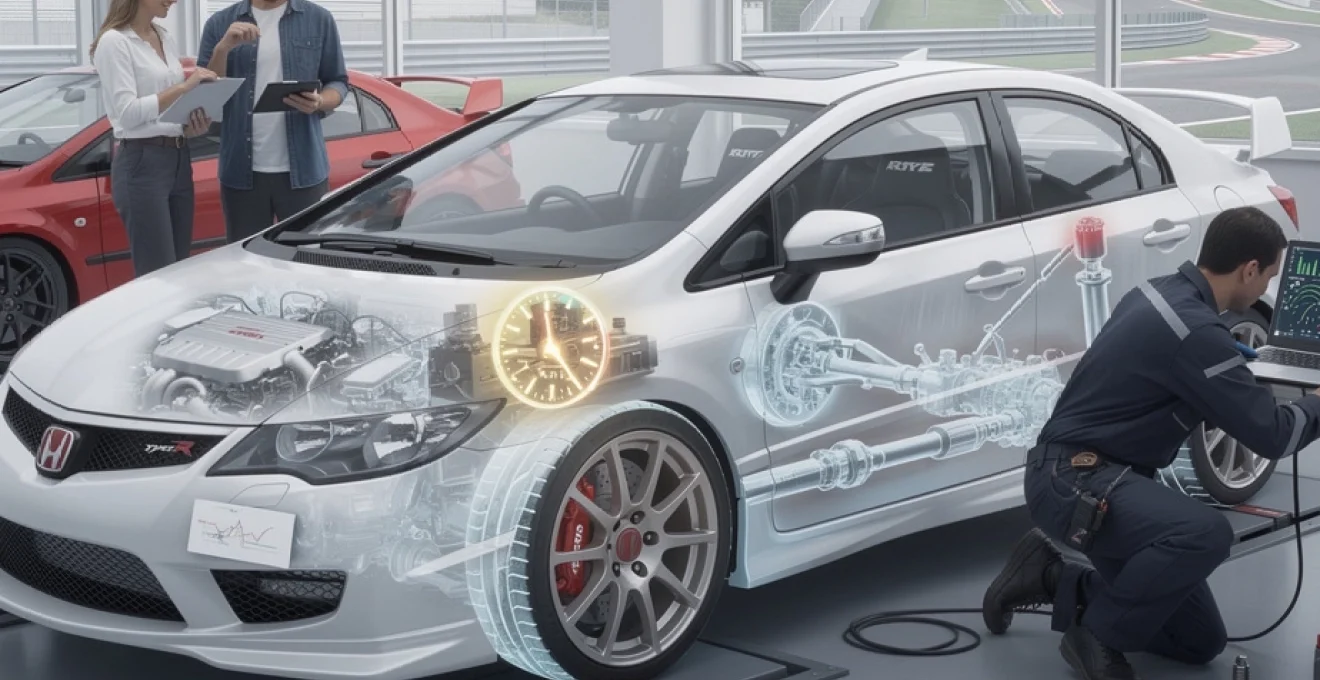
The 2010 Honda Civic Type R FD2 sedan is one of those rare cars that feels genuinely special the moment you drive it. Sharp, naturally aspirated response, a screaming redline and a chassis tuned on Japanese circuits give it an intensity few modern turbo hot hatches can match. For drivers who want a four-door that feels more like a touring car than a commuter saloon, it is an incredibly tempting used buy. Yet these cars are now 14–15 years old, usually imported, and often driven hard. If you are considering one, you need to know exactly what you are getting into, what to check, and how the FD2 stacks up against the better-known FN2 hatchback.
Market overview: 2010 honda civic type R sedan (FD2) vs FN2 hatchback and regional variants
The 2010 Honda Civic Type R sedan, chassis code FD2, was built primarily for the Japanese domestic market. At the same time, Europe received the spaceship-like Civic Type R FN2 hatchback, and some Asian markets got locally assembled versions with slightly different specs. If you are shopping in the UK or Europe, almost every FD2 you find will be a grey import, whereas the FN2 is a native model with full dealer support and a large pool of cars and parts.
On paper, the FD2 looks like the enthusiast’s choice. Power is around 220–225 PS (varies slightly by market), compared with roughly 200–201 PS for the FN2 and EP3. The FD2 also gains a stiffer body shell, double-wishbone rear suspension instead of the FN2’s torsion beam, and more aggressive geometry. It feels closer in spirit to a road-legal Super Taikyu car than a warmed-over family hatch, which is precisely why demand for clean FD2s has risen in the last five years while many turbo hot hatches have depreciated heavily.
In the UK, FN2 values for tidy cars often start around £4,500–£5,000, while FD2 sedans typically sit higher due to rarity and import costs. A straight, rust-free, 2010 FD2 with reasonable mileage can easily command £14,000–£20,000 depending on condition and modifications, especially if it retains factory paint and OEM wheels. When you compare this to prices of later FK2 and FK8 Type Rs, the FD2 still looks competitive as a last-of-the-line, naturally aspirated, high-rev VTEC icon.
Among Honda enthusiasts, the 2010 FD2 sedan has quietly shifted from “quirky grey import” to “modern classic” status, especially as naturally aspirated performance cars disappear from new showrooms.
Engine and performance specs of the 2010 civic type R sedan K20A VTEC
K20A 2.0 i-VTEC technical data: compression ratio, redline and power band
The 2010 Civic Type R FD2 sedan uses the legendary K20A 2.0-litre i-VTEC engine in a high-output tune. In FD2 form, the K20A typically runs a compression ratio around 11.7:1, significantly higher than the 9.8–11.0:1 figures seen on many contemporary 2.0-litre engines. Peak power is quoted at approximately 220–225 PS at around 8,000 rpm, with maximum torque of roughly 215 Nm at about 6,100–6,200 rpm.
Redline sits around 8,400–8,600 rpm depending on ECU calibration, with the rev limiter only slightly above that. The usable power band is wide for such a high-specific-output engine: it starts to wake up from 4,000 rpm, pulls harder as the high-lift i-VTEC cam lobes engage, and then charges ferociously to the limiter. Compared to the European FN2 and EP3, torque delivery is more linear, with fewer flat spots but a more intense top-end rush.
| Engine code | Displacement | Power (PS @ rpm) | Torque (Nm @ rpm) | Redline |
|---|---|---|---|---|
| K20A (FD2) | 1998 cc | 220–225 @ ~8000 | ~215 @ ~6100 | ~8600 rpm |
| K20Z4 (FN2) | 1998 cc | 200–201 @ 7800 | 193 @ 5600 | 8000 rpm |
If you are stepping out of a modern turbo hot hatch, the FD2’s naturally aspirated delivery will feel different. There is less shove at 2,000–3,000 rpm, but once you learn to work the gearbox and keep the engine singing above 5,000 rpm, the car feels alive in a way boosted cars rarely match.
Real-world performance: 0–60 mph, quarter mile and in-gear acceleration figures
Independent tests of stock FD2 sedans typically show 0–60 mph times in the 6.0–6.3 second range and 0–100 km/h in around 6.4 seconds. The quarter mile tends to fall in the mid 14-second bracket at roughly 95–99 mph, depending on surface, driver, and tyre choice. These numbers sit very close to a healthy EP3 and ahead of a standard FN2, largely thanks to shorter gearing, the mechanical limited-slip differential and the extra power.
In-gear, the FD2 feels stronger than its figures suggest. Fourth-gear acceleration from 40–80 mph is brisk, making real-world overtakes easier than the stats imply. Shorter gear ratios keep the engine in its sweet spot, so if you are used to short-shifting a torquey turbo car, you may be surprised at how often the FD2 wants another downshift for maximum punch.
Track capability: suzuka, tsukuba and nürburgring lap comparisons with FN2 and EP3
The FD2 was tuned with circuit work very much in mind. Period Japanese tests at Suzuka and Tsukuba frequently showed the FD2 Type R lapping quicker than the EP3 and FN2 despite carrying similar power. On Tsukuba’s tight layout, the FD2’s stiffer shell and double-wishbone rear end help it rotate more cleanly than the torsion-beam FN2, with lap times commonly 1–2 seconds quicker in like-for-like conditions.
Factory Nürburgring times for the FD2 are less widely publicised than for later FK2/FK8 models, but independent builds and tuner cars often matched or beat contemporary European hot hatches with similar power. The balance suits fast, medium-speed corners; think Silverstone’s National layout rather than a bumpy back road. If you plan regular track days, an FD2 with healthy brakes and tyres will comfortably run all day, provided you monitor oil temperature and use high-quality fluids.
ECU mapping, cam profiles and i-VTEC engagement characteristics on the FD2
The FD2’s ECU mapping is more aggressive than the European FN2 tune. Cam profiles on the K20A are designed to maximise flow at high rpm, and the i-VTEC switchover point (where the engine jumps from low to high cam) is typically set around 5,400–5,800 rpm in stock calibration. The changeover is smoother than early B-series VTEC engines but still very noticeable if you are accelerating hard in second or third gear.
Fuel and ignition maps are lean but safe on 100 RON Japanese fuel, so many imported cars will have been remapped for 97–99 RON UK petrol. If you are test-driving a 2010 Civic Type R sedan and notice an unusually soft top-end or hesitation at switchover, factor in a professional health check and possibly an ECU retune. Poorly adjusted maps can rob 10–15 PS and ruin the crisp response that defines the FD2.
Aftermarket tuning potential: hondata, spoon sports and mugen engine upgrades
The FD2 sedan responds very well to quality, light-touch tuning. Most owners start with a freer-flowing intake, a performance exhaust manifold and cat-back system, combined with a programmable ECU such as Hondata. Gains of 15–25 PS at the wheels with a smoother, broader power band are realistic when mapped by a reputable Honda specialist.
Spoon Sports, Mugen and other Japanese tuners offer upgraded cams, higher-compression pistons, baffled sumps and full exhaust systems. It is not unusual to see naturally aspirated FD2 builds approaching 250–260 PS with stock displacement. Turbocharging and supercharging are possible but transform the character of the car; for many enthusiasts, the whole point of the FD2 is that razor-sharp, high-revving naturally aspirated feel. When viewing a modified car, look for documented parts, dyno graphs and supporting mods like upgraded cooling and fuelling rather than a random collection of bolt-ons.
For longevity and enjoyment, aim for a well-mapped, mildly tuned FD2 rather than chasing headline dyno numbers at the expense of reliability and driveability.
Chassis, suspension and braking: FD2 sedan hardware vs standard civic and FN2
Suspension layout: front MacPherson, rear double wishbone and factory spring rates
Unlike the FN2 hatchback, which uses a rear torsion beam, the FD2 Type R sedan features MacPherson struts at the front and a proper double-wishbone rear suspension layout. This alone gives it a serious advantage in terms of camber control, stability over bumps and adjustability for track use. Spring rates and damper valving are significantly stiffer than the standard Civic sedan, resulting in a very firm ride on poor surfaces but outstanding control on smoother tarmac.
Factory ride height is low, and the chassis runs relatively aggressive alignment out of the box. For fast-road use on UK surfaces, many specialists recommend slightly softer coilovers or progressive-rate lowering springs, combined with a small reduction in front camber and toe-out. If you test-drive an FD2 that crashes over every imperfection, set expectations accordingly: some of the firmness is standard, but blown dampers or budget coilovers can make things far worse.
Limited-slip differential (LSD) behaviour and handling balance in wet and dry conditions
The FD2 sedan is fitted with a helical mechanical limited-slip differential from the factory. On dry roads, this allows you to get on the power very early out of tighter corners, pulling the nose into the apex rather than washing wide in understeer. It is a defining part of the car’s character: the steering stays alive with feedback, and you can literally feel the front axle clawing for grip.
In the wet, the LSD still helps traction but demands respect. If you pin the throttle at low speed on cold tyres, the diff can cause the car to pull more strongly to one side, especially if the road surface is uneven. When you are evaluating a used FD2, check for smooth, predictable engagement of the diff; clunks, groans or inconsistent behaviour can point to worn fluid, abuse on track, or in rare cases internal damage.
Brembo braking system, disc sizes, pad compounds and common upgrade paths
The 2010 Civic Type R FD2 comes equipped with serious braking hardware straight from the factory. Up front, four-piston Brembo callipers clamp sizeable ventilated discs (typically around 320 mm), with solid or ventilated discs at the rear depending on market spec. Brake feel is firm and reassuring, with good bite and decent fade resistance for road use.
For repeated hard stops on track days, stock pads and fluid are the limiting factors. Common upgrades include high-friction pads (Ferodo DS2500, Project Mu, Endless, etc.), braided stainless lines and high-temperature racing brake fluid. As long as discs are not cracked or excessively lipped, this combination is usually enough for enthusiast use. If you find a car with a big brake kit fitted, check whether the rest of the setup—master cylinder, rear bias, ABS behaviour—has been considered, not just aesthetics.
Wheel and tyre setup: OEM 18-inch enkei alloys, recommended tyre sizes and compounds
Most FD2 sedans left the factory on 18-inch Enkei alloys, usually 7.5J or 8J wide, wrapped in 225/40 R18 tyres. These wheels are relatively light and strong, and many owners try hard to keep them, as replacing damaged OEM Enkeis can be expensive. When inspecting a car, look for kerb rash, cracks or previous repairs; buckled wheels can cause vibration and uneven tyre wear.
Tyre choice dramatically affects how the FD2 feels. High-performance road-legal tyres such as Michelin Pilot Sport 4S, Bridgestone Potenza S001/S007 or Yokohama Advan AD08R suit the chassis very well. If you are balancing daily driving with occasional circuits, a 225/40 R18 tyre in an ultra-high-performance compound offers the best mix of grip, steering feel and comfort. For track-only cars, some owners drop to 17-inch wheels with 215/45 R17 semi-slicks to reduce costs and improve sidewall compliance.
Body rigidity, seam welding and chassis bracing unique to the FD2 type R sedan
One of the FD2 sedan’s biggest advantages over the FN2 hatch and standard Civics is its massively reinforced body shell. Honda added extra spot welds, additional bracing, thicker steel in key areas and a rear bulkhead behind the seats to stiffen the chassis. Torsional rigidity numbers were significantly higher than the base sedan, contributing to the precise, almost kart-like responses that enthusiasts rave about.
This stiffness does place more stress on suspension pick-up points and subframes, so buying a car with a clean, rust-free underside is essential. Check for corrosion on rear beams, front subframes and jacking points—especially on imported cars that have already lived through several salty UK winters. A straight, tight-feeling FD2 with no creaks or clunks still feels incredibly modern even today; a tired, loose one can feel harsh and rattly, so condition is everything.
Think of the FD2’s shell as a roll cage in disguise: it lets the suspension do the work, but punishes any neglect underneath with noise and vibration.
Known reliability issues and high-mileage checks for a used 2010 civic type R sedan
The FD2 shares many strengths and weaknesses with other K-series Type Rs. The K20A engine itself is robust if serviced correctly, but there are several age- and mileage-related issues you need to check. High oil consumption is common on hard-driven engines; a litre every 1,000–1,500 miles is not unusual. If you are viewing a car, ask the owner how often they top up and what oil grade they use. Low oil plus repeated high-rpm driving is the quickest way to damage an FD2’s engine.
Timing chains can stretch over time, especially on engines that have seen lots of limiter use. There is often no obvious warning until it is too late, so for cars approaching or exceeding 100,000 km, many specialists recommend a preventative chain and tensioner replacement. Budget around £600–£800 with quality parts and labour. Tappet noise (a light ticking from the top end) on cold start can point to valve clearances due rather than serious issues, but persistent loud tapping even when warm deserves investigation.
Gearbox synchro wear, particularly in second and third, can cause crunching or a notchy shift. This is more likely on cars used for frequent track days or drag runs. A healthy FD2 gearbox should feel slick and precise; any resistance or grinding under quick but not brutal shifts is a warning sign. Also listen for whining at constant speeds, which can indicate bearing wear. Clutches last well if driven sensibly, but heavy pedals, judder or slipping under VTEC load suggest a replacement is near.
Elsewhere, age-related issues include soft paint that chips easily on the nose, lacquer peel on exposed panels, cloudy headlights and occasional interior rattles from the headlining or dashboard. Rust around the roof edges, door seals and rear arches is less severe on JDM cars than some UK models, but imported FD2s can still suffer once exposed to British weather. Always inspect the boot floor and under-carpet areas for signs of water ingress, especially if rear light seals or aerial grommets have been disturbed.
Service history, maintenance intervals and OEM part numbers to verify
Scheduled servicing: oil change intervals, valve clearance checks and timing chain inspection
For a 2010 Civic Type R sedan, a watertight service history is almost more important than mileage. In Japan, many FD2s were serviced at 10,000 km intervals or annually, but for UK use and frequent spirited driving, 5,000–6,000 miles (8,000–10,000 km) oil changes with high-quality fully synthetic 5W-40 or 5W-30 are a safer bet. If an owner has stretched oil changes to 15,000 miles, approach with caution.
Valve clearance checks are typically recommended every 25,000–30,000 miles. Documentation of at least one valve clearance adjustment on a higher-mileage FD2 shows the car has been looked after. As mentioned earlier, timing chains do not have a fixed replacement interval, but if the car is over 100,000 km and the chain has never been touched, factor that job into your budget. Whenever you see invoices, look for genuine Honda part codes or quality aftermarket equivalents rather than unknown brands.
Fluids and consumables: honda MTF-3 gearbox oil, brake fluid specs and coolant type
Fluids make a big difference to how the FD2 drives. Gearbox oil should be genuine Honda MTF‑3, changed roughly every 40,000–50,000 miles or more often for track use. If a seller cannot confirm when the gearbox oil was last changed, plan to do it immediately after purchase. Fresh MTF-3 often transforms a slightly notchy shift into something much crisper.
Brake fluid should meet at least DOT 4 specifications; many owners opt for high-temperature DOT 4 or DOT 5.1 fluids if they attend track days. A two-year interval is a good baseline. Coolant should be Honda Type 2 long-life, usually blue in colour, with change intervals of around five years or as recommended by your specialist. Evidence of regular fluid changes shows that previous owners have treated the FD2 as a precision tool rather than just transport.
OEM vs aftermarket parts: clutch kits, engine mounts and suspension bushes
Genuine Honda parts are not always cheap, but for critical items—clutch kits, engine mounts, key sensors—they tend to last and fit correctly. Many FD2s on the market feature some aftermarket upgrades, so you will need to judge whether those parts are high-quality improvements or cost-cutting measures. Branded uprated engine mounts (for example, Spoon or Hardrace) can sharpen response but also increase vibration; budget brands may simply fail early.
Suspension bushes are another area to scrutinise. Polyurethane bushes can transform steering precision and feel fantastic on track, but they also add noise and harshness, which you may find tiring on longer drives. For a road-focused car, fresh OEM rubber bushes with quality dampers are usually the best compromise. When you go through the paperwork, look for part numbers or clear descriptions rather than vague lines like “suspension work”. Detailed invoices are a green flag.
Recalls, TSBs and common dealer updates affecting 2010 type R sedans
Because the FD2 is a JDM model, recall and technical service bulletin (TSB) information is not always as visible through European dealer networks. Nonetheless, many of the global Honda campaigns still apply—airbag inflator recalls, for example, affected a wide range of Civics built around this period. When you check a potential purchase, ask if any recall work has been done and, if possible, verify the chassis number with a Honda dealer or specialist familiar with imports.
Technical updates on similar K-series models have included improved clutch release bearings, revised ECU software to smooth idle and occasional replacement of faulty sensors. While there are no notorious, FD2-specific factory disasters to worry about, a car that has seen a main dealer or reputable specialist regularly is more likely to have had minor updates and campaigns addressed, even if the paperwork is partly in Japanese.
Interior, equipment levels and JDM-specific features on the 2010 type R sedan
The FD2’s cabin feels distinctly more conservative than the futuristic FN2, but it still has plenty of Type R flavour. Deeply bolstered front seats with red fabric inserts, red carpets, alloy gear knob and drilled pedals set the tone. The driving position is lower and more “saloon-like” than the high-perched FN2, which taller drivers often prefer on longer journeys. If you value a serious driving environment over gadgetry, you will likely feel at home here.
Equipment levels vary by sub-trim, but typical 2010 FD2s feature automatic climate control, keyless entry, HID headlights, and a basic infotainment unit that feels dated now. Many imported cars will have had the original Japanese-market head unit replaced with a modern double-DIN unit offering Apple CarPlay or Android Auto. Provided the wiring has been done neatly, this is generally a plus rather than a negative.
There are a few JDM quirks to be aware of. Speedometers may be in km/h, sometimes with an overlay for mph, and odometer readings will almost always be in kilometres. Some cars retain Japanese-language instrument cluster messages and navigation menus. You also gain typical Type R touches such as the numbered build plaque, red start button and unique trim. When checking a car, inspect seat bolsters for wear or splits, listen for roof-lining rattles on rough roads, and test all window switches, mirror controls and climate functions carefully.
Importing a honda civic type R FD2 into the UK: legal, tax and SVA considerations
If you are thinking of importing a 2010 Civic Type R sedan yourself rather than buying one already registered, the process needs careful planning. First, you will need to budget for auction fees, shipping, UK duty and VAT, which can add 30–40% to the hammer price depending on exchange rates and services used. A typical FD2 may cost £8,000–£10,000 at auction in Japan but land at closer to £14,000–£16,000 once all costs are included.
Once the car arrives, it must go through IVA or Single Vehicle Approval (or their current equivalents), receive an MOT, have its lights and speedometer adapted for UK use, and then be registered with the DVLA. Headlight beam patterns, rear fog light functionality and odometer readings are the key areas inspectors look at. Using an experienced import specialist can streamline this process; for a fee, they will handle paperwork, testing and registration, allowing you to focus on choosing the right car.
Insurance for imported FD2s can be slightly higher than for a UK FN2, especially for younger drivers, because insurers treat them as higher-risk performance imports. It is worth obtaining quotes for “2010 Honda Civic Type R FD2” before committing. Road tax is based on engine size and emissions band at the time of registration; the 2.0-litre capacity and performance focus mean it will not fall into the cheapest bracket. If you prefer a simpler life, buying a car that is already correctly registered and taxed in the UK often makes more sense than importing from scratch, even if the headline purchase price seems higher.
Pricing guide, mileage bands and negotiation tips for 2010 civic type R sedan buyers
The FD2 market has firmed up in recent years as enthusiasts recognise the car’s significance as one of the last high-revving, naturally aspirated Type Rs. Broadly speaking, you will encounter four price/mileage bands for 2010 Civic Type R sedans, although exact values fluctuate with exchange rates and demand:
- High-mileage drivers (120,000+ km / 75,000+ miles): usually £11,000–£14,000 if straight and rust-free.
- Mid-mileage cars (80,000–120,000 km): typically £14,000–£18,000 depending on history and modifications.
- Low-mileage examples (under 80,000 km): often £18,000–£22,000, sometimes more for pristine, lightly modified cars.
- Collector-grade or heavily tuned builds with premium parts: £22,000+ is not unusual.
When negotiating, focus less on shaving the sticker price and more on the value of any remedial work required. For example, if timing chain replacement, clutch, tyres and a major service are all due soon, you could be looking at £2,000–£3,000 in immediate maintenance. Use clear, specific points—documented oil intervals, evidence of valve clearance checks, condition of brakes and tyres—to justify a lower offer. Sellers who understand these cars will also understand why those items matter.
Be wary of cars that appear cheap for the year and mileage but lack documentation. A genuinely cared-for FD2 usually comes with a folder of Japanese auction sheets, import paperwork and a growing stack of UK invoices from known Honda specialists. Conversely, a car with patchy history, mismatched tyres, obvious paintwork and a tired interior is unlikely to be a hidden gem. If you are not fully confident in assessing mechanical condition yourself, paying for a pre-purchase inspection by a Honda performance specialist is money very well spent. It is much cheaper than rebuilding a K20A or replacing a gearbox, and it gives you leverage during negotiation if any issues are found.