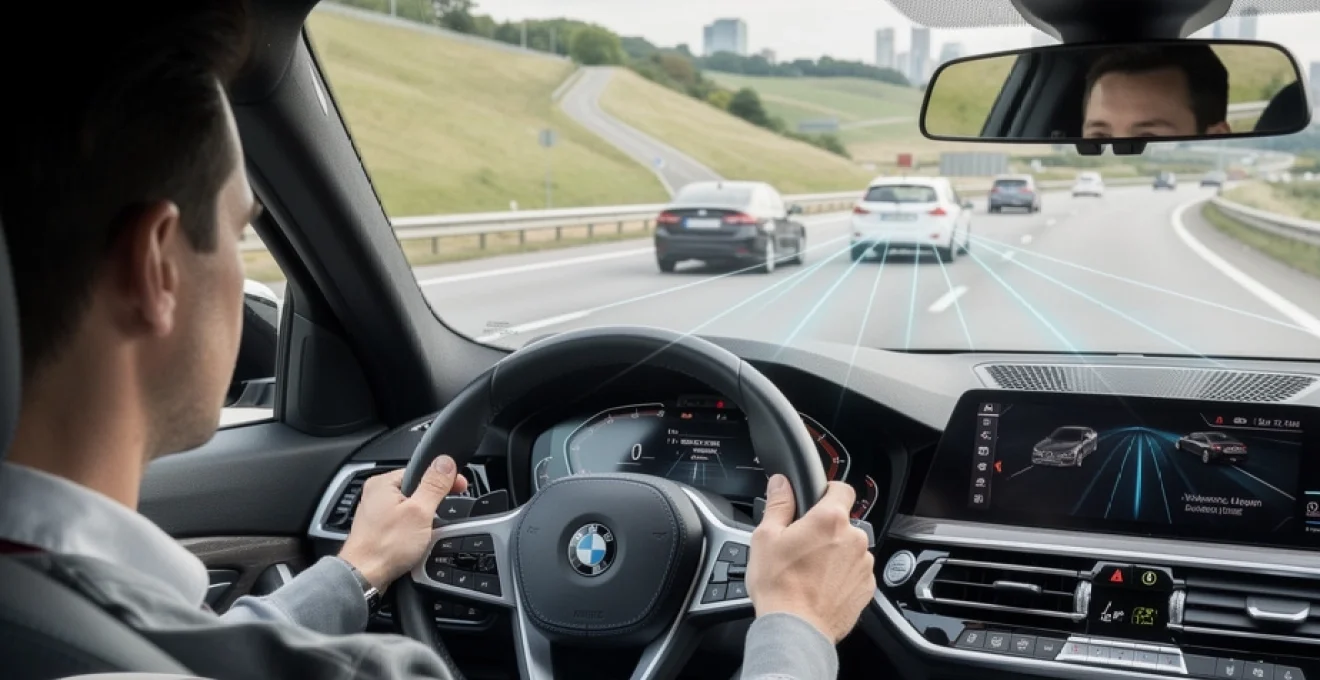
Modern BMW cruise control with brake function changes the way you manage speed on long journeys, busy motorways and steep descents. Instead of simply holding the throttle open like older systems, it blends precise engine management with controlled braking to keep your car close to the speed you have selected. If you have ever felt your BMW subtly apply the brakes while going downhill, or ease off smoothly when traffic slows, you have already experienced this technology at work. Understanding how it operates helps you use it with more confidence, avoid surprises in tricky conditions and get the most comfort and safety from your car on every trip.
Core principles of BMW cruise control with brake function in modern BMW models
Closed-loop speed regulation: electronic throttle, engine torque control and integrated braking
At the heart of BMW cruise control with brake function lies a closed-loop control strategy. The system constantly compares the actual vehicle speed from the wheel-speed sensors with the target set speed stored in the control unit. Any difference between the two becomes an error signal that the system tries to reduce to zero. Instead of using a cable, the electronic throttle body and the engine management computer (`DME` for petrol, `DDE` for diesel) precisely adjust engine torque. When torque reduction alone is not enough – for example on a steep downhill gradient – the cruise system commands the DSC/ABS unit to apply the brakes gently on your behalf.
This integrated engine-and-brake approach allows the car to maintain a stable speed even in demanding conditions. For you as the driver, the experience feels like a smooth, intelligent co-driver managing speed in the background. The system keeps within defined comfort limits for acceleration and deceleration, so automatic brake applications are subtle rather than abrupt. In many recent BMWs, especially those on the CLAR platform, this logic is harmonised with other assistance features such as lane keeping, so that speed control feels consistent across the driver assistance suite.
From conventional cruise control to active cruise control with Stop&Go and braking intervention
Traditional cruise control in older cars only adjusted throttle input. Set 70 mph on a gentle motorway and the system simply opened or closed the throttle to keep the car close to that speed. As long as the road stayed fairly flat, it worked adequately. However, during long downhill sections or when suddenly lifting off before a lower speed limit, engine braking often was not enough to prevent the car from creeping over the set speed, especially in heavier vehicles like the BMW X5 or 5 Series Touring.
To solve that, BMW introduced Dynamic Cruise Control and later cruise control with brake function. These variants extend conventional cruise by allowing the system to call upon the service brakes. Active Cruise Control (`ACC`) with Stop&Go adds a further layer: radar and camera sensors allow the car to adapt its speed to traffic, slowing and accelerating automatically within the chosen speed and distance range. From a driver’s point of view, the jump from basic cruise to ACC feels like moving from a basic thermostat to a smart climate-control system that also responds to people walking in and out of the room.
Key hardware components: steering wheel buttons, DSC/ABS unit, wheel-speed sensors and brake actuators
Although BMW cruise control with brake function feels software-driven, it depends on a robust set of physical components. On the steering wheel, dedicated control buttons allow you to set, resume and adjust the speed in small increments. A rocker switch typically lets you nudge speed up or down in 1 mph or 1 km/h steps, and a separate button can store your current speed as the new target. Some models include a `LIM` function to cap maximum speed without full cruise engagement, useful for variable speed-limit zones.
In the drivetrain, the DSC (Dynamic Stability Control) / ABS hydraulic modulator sits at the centre of the brake function. It controls brake pressure at each wheel, based on commands from the cruise and stability algorithms. Four wheel-speed sensors feed back detailed rotation data so the system can detect any difference in axle speeds, calculate slip and adjust braking as needed. The brake booster, often with an electromechanical component in newer models, helps provide fast, finely metered brake pressure even without heavy pedal input from you.
CAN bus and FlexRay data exchange between DME, DSC and ACC radar modules
Communication between all these modules flows through the vehicle data networks, primarily the `CAN` bus and, in higher-end models, the high-speed `FlexRay` network. The engine control unit (`DME`/`DDE`), the DSC module, the instrument cluster and the ACC radar sensor share information such as current speed, yaw rate, distance to the vehicle in front and driver inputs. The cruise control logic sits across several of these nodes, rather than in a single black box.
Why does this matter to you? Because the system can react in milliseconds to changes in the environment. If the ACC radar detects a slower vehicle, it sends a deceleration request over the network. The DSC interprets this request and converts it into hydraulic brake pressure, while the engine control unit reduces torque simultaneously. This distributed, redundant architecture is one reason modern BMW cruise systems are both smooth and reliable, even when driving for hours on the motorway.
Sensors and control units enabling BMW cruise control with brake function
Wheel-speed and yaw-rate sensing via DSC/ABS for precise deceleration calculation
Wheel-speed sensors are the primary data source for accurate speed and distance calculations. Each wheel carries a toothed ring or magnetic encoder; as it rotates, the sensor generates a signal proportional to speed. The DSC control unit uses this data not only to determine the vehicle’s actual speed but also to detect differences between individual wheels that could indicate slip or cornering forces. Yaw-rate sensors and lateral acceleration sensors further describe how the vehicle is rotating and leaning in a bend.
When cruise control with brake function asks for deceleration, DSC uses this detailed picture to decide how much brake pressure is safe. For example, on a wet motorway, the system may use more engine braking and less hydraulic braking to avoid activating ABS. This careful modulation is a major reason automatic braking in cruise mode typically feels gentle and well-judged instead of nervous or jerky, even when you are descending a long hill with a full car.
Engine control unit (DME/DDE) coordination with DSC for torque cut and overrun fuel shut-off
The engine control unit has two key jobs during cruise control: providing enough torque to reach and hold the target speed, and reducing torque quickly when the car risks exceeding it. In everyday driving with cruise engaged on level ground, most corrections happen via tiny adjustments to throttle opening, variable valve timing and boost pressure in turbocharged engines. The control software is tuned to maintain speed with minimal oscillation, targeting both comfort and fuel efficiency.
During downhill control, the engine management switches to an overrun strategy. It closes the throttle, cuts fuel injection in overrun and may command downshifts in automatic transmissions to increase engine braking. Only once this engine-based deceleration is no longer sufficient does the system start using the brakes. From a technical perspective, this staging protects brake wear and reduces heat build-up, especially important during long Alpine-style descents where sustained braking might otherwise lead to fade.
Radar and camera integration in active cruise control (e.g. BMW 3 series G20, 5 series G30)
Active Cruise Control with Stop&Go builds on the base cruise system by adding radar and, in newer generations, a forward-facing camera. In models like the BMW 3 Series G20 or 5 Series G30, the radar sensor sits behind the front kidney grille or lower air intake and continuously scans the lane ahead. It estimates the distance, relative speed and angle of other vehicles, often up to 150–200 metres in front, even in poor visibility.
The camera adds an extra layer of object recognition and lane detection, helping the system distinguish between stationary objects, vehicles in adjacent lanes and genuine obstacles in your path. Together, radar and camera feed a fusion algorithm that decides whether to maintain speed, reduce it or prepare for possible emergency braking. When ACC with brake function is active, the system can automatically follow a vehicle down to low speeds and back up again, as long as you remain ready to intervene.
Brake system electronics: hydraulic modulator, brake booster and electric parking brake interaction
The brake function of BMW cruise control relies on the same hardware that underpins ABS and stability control. The hydraulic modulator houses solenoid valves and a pump that can build or release brake pressure independently at each wheel. When the cruise system requests 0.2 g of deceleration, the DSC module calculates the exact pressure needed and applies it gradually, often below the threshold at which you would feel a distinct pedal movement.
In many modern BMWs, the brake booster has an electromechanical component that allows rapid pressure build-up without requiring a strong pedal push from you. In stop-and-go traffic with ACC, the system can even bring the car to a near standstill and hold it momentarily, coordinating with the electric parking brake when necessary. The interaction between service brakes and parking brake is carefully calibrated so that handbrake engagement cancels normal cruise but does not interfere with safety-critical automatic braking interventions.
Step-by-step sequence: how BMW cruise control with brake function manages speed on the road
Set speed acquisition, storage and live adjustment using steering wheel multifunction controls
From the driver’s seat, using BMW cruise control with brake function starts with the steering wheel buttons. Once you activate the cruise system, you typically press a “SET” or “RES” button to store your current speed as the target. The control unit then holds this set speed in memory until you either adjust it or switch the system off. If you tap the rocker switch up or down, speed changes in small increments; holding the switch often adjusts in larger steps, for example 5 mph at a time.
Some BMWs also support a form of speed limit takeover, where the system can adopt a limit detected by the road-sign recognition camera as the new set speed. This is particularly helpful if you use cruise control frequently to comply with urban speed limits. If you disengage cruise using the brake pedal, the stored set speed remains available for quick resumption, which can reduce fatigue on routes with frequent changes between 50 mph and 30 mph zones.
Speed maintenance on level roads via throttle modulation and minimal brake use
On an even motorway or dual carriageway, BMW cruise control behaves mostly like a highly refined throttle controller. The engine management unit manages torque in small increments to compensate for wind, rolling resistance and gentle gradients. Once speed stabilises, the system aims to minimise interventions to avoid that slightly “surging” feeling common in older cruise systems. In practice, if you glance at the tachometer, you will often see only small movements as the car responds to these subtle adjustments.
In this scenario, the brake function remains on standby. As long as the system can hold the target speed using normal engine control and occasional downshifts, it will not call upon the DSC hydraulic modulator. This strategy contributes to lower brake wear and helps maintain fuel economy, especially over long distances where unnecessary brake drag would otherwise waste energy and increase emissions.
Automatic downhill speed control with gradient detection and controlled brake pressure
When the car encounters a downhill gradient, gravity starts to push it beyond the set speed. The cruise control software detects the onset of acceleration by monitoring wheel speed and comparing it with expected models of engine drag and road load. First, it commands maximum safe engine braking, including closing the throttle, cutting fuel and potentially downshifting the automatic transmission. In many BMW xDrive and rear-wheel-drive models, this alone can hold the car close to the target on moderate slopes.
Once engine braking and drivetrain drag are no longer sufficient, cruise control with brake function asks the DSC module for help. Brake pressure builds gradually to maintain the vehicle at or slightly below the set speed, with typical deceleration levels in the comfortable 0.1–0.25 g range for routine control. Brake lights illuminate when deceleration exceeds a defined threshold, making following drivers aware that your BMW is slowing even if you are not visibly pressing the pedal. Maintaining this balance between controlled speed and comfort is a key part of the system’s calibration.
Adaptive deceleration in traffic using ACC with brake function and distance presets
With Active Cruise Control engaged, the system adjusts not only to your chosen speed but also to vehicles ahead. You select one of several distance presets, usually represented by bars in the instrument cluster. The car then monitors the traffic in your lane, gently lifting off and braking as required to maintain the chosen time gap. If the vehicle ahead speeds up or changes lane, ACC accelerates your BMW back towards the set speed, subject to legal and comfort constraints.
In practice, this means you can drive along a busy motorway with significantly less need for constant small brake and throttle inputs. If traffic slows unexpectedly, the system can decelerate swiftly using both engine braking and the service brakes. However, it always expects you to remain attentive, hands on the wheel, ready to intervene. In many jurisdictions, the system’s behaviour is tuned to comply with limits on automated following distance and maximum deceleration for comfort and safety.
Deactivation logic: clutch use, brake pedal input, DSC interventions and driver overrides
BMW cruise control with brake function includes multiple pathways for deactivation, all prioritising your authority as the driver. Pressing the brake pedal is the most common: the system immediately suspends speed control and hands full braking control back to you. In manual-transmission models, pressing the clutch beyond a certain threshold also cancels cruise to avoid over-revving the engine during a downshift.
DSC interventions provide another safety-based deactivation route. If the stability control system detects significant wheel slip, heavy yaw or other conditions that require maximum braking or torque reduction, it can override cruise control commands. In this state, cruise remains off until you explicitly resume it. This layered logic ensures that automatic speed maintenance never conflicts with higher-priority stability and traction functions, especially on wet roads or in sudden emergency manoeuvres.
Braking strategies in different driving scenarios: downhill, traffic, motorway and urban use
Long downhill descents and engine braking coordination in BMW xdrive and rear-wheel-drive models
On extended downhill stretches, such as mountain passes, cruise control with brake function becomes particularly valuable. Studies from European mountain regions show that sustained braking can easily raise disc temperatures above 500°C, increasing the risk of fade. By combining engine braking with measured brake interventions, BMW systems aim to keep brake temperatures within a safe band. In xDrive models, torque distribution strategies can also help manage traction while decelerating on uneven or partially slippery surfaces.
From a driver’s perspective, one practical tip is to choose a slightly lower set speed than you might use on level ground. This gives the system more margin before reaching legal limits and reduces the need for heavy brake use. It also leaves headroom if you decide to cancel cruise and control the descent manually using lower gears. Although the technology is capable, responsibility for choosing a safe speed on challenging downhill sections still rests with you.
Stop-and-go congestion handling with ACC and brake function in BMW X5 G05 and 5 series touring
In dense traffic, the Stop&Go extension of Active Cruise Control can transform the driving experience. In vehicles such as the BMW X5 G05 or the latest 5 Series Touring, ACC can follow a leading vehicle down to very low speeds, sometimes to a full temporary stop depending on market calibration. If traffic moves again within a short window, the car will set off automatically; beyond that, a light tap of the accelerator or a button press from you is usually required.
Industry observations suggest that drivers using such systems report reduced fatigue in heavy traffic by up to 30–40%. From a technical angle, the brake function must operate extremely smoothly here, applying and releasing pressure dozens or hundreds of times in a single commute. The system always leaves a buffer so that if the vehicle in front brakes sharply or a pedestrian steps out, full emergency braking remains immediately available under your command or via autonomous safety systems.
Motorway cruising: distance control, gentle brake applications and lane-change considerations
On the motorway, BMW cruise control with brake function seeks to maintain a calm, flowing rhythm. Distance control uses low levels of deceleration where possible, minimising disturbance to traffic behind you. If the car ahead slows gradually, your BMW mirrors this pattern. If it brakes harder, the system can step up deceleration quickly, but still within legal limits for comfort-oriented driver assistance. Statistics from European NCAP testing show that such systems can reduce rear-end collision risk significantly when used correctly.
One key consideration when overtaking is how the system behaves during lane changes. If you indicate and pull out while ACC is following a slower vehicle, the radar may temporarily see open road ahead and start to accelerate. Experienced drivers often anticipate this by adjusting the set speed slightly before pulling out, ensuring the acceleration matches the available gap. As ever, it remains your task to judge lane changes; the cruise system only handles longitudinal control, not lateral decision-making.
Urban speed limit compliance using cruise control with brake function and speed limit info
In towns and cities, cruise control with brake function can help maintain compliance with low speed limits, particularly on gently sloping main roads where cars tend to creep above 30 mph. When combined with Speed Limit Info from the camera and navigation data, some BMWs can suggest an appropriate set speed or apply a soft limiter so that you need to make a conscious decision to exceed the posted limit. Used correctly, this can reduce the risk of minor speeding infringements in camera-controlled zones.
However, urban environments pose special challenges: pedestrians, cyclists, parked cars pulling out and frequent junctions require constant vigilance. For that reason, BMW advises against using cruise in very congested or complex city streets. A useful rule of thumb is to limit use to relatively straight, predictable urban stretches, such as ring roads or multi-lane avenues, where you still benefit from stable speed control without compromising situational awareness.
Safety, redundancy and legal aspects of BMW cruise control with brake function
Fail-safe design, diagnostic monitoring and fallback modes in the DSC and DME
Because cruise control with brake function can apply the brakes without direct pedal input, BMW designs the system with multiple fail-safes. Both the DSC and DME continuously monitor sensor plausibility: if a wheel-speed signal drops out, if brake pressure readings do not match command values, or if communication on the CAN bus becomes unreliable, the system deactivates automatic speed control. In many cases, a check-control message appears, and only base functionality remains until the fault is cleared.
Modern diagnostics log fault codes with time stamps and environmental data, enabling technicians to trace intermittent issues. A conservative design philosophy means that when in doubt, the system reverts to a simpler, driver-only mode. This approach aligns with industry best practice and with UNECE requirements for assisted driving systems, which demand predictable failure behaviour rather than attempting to “soldier on” in a degraded but opaque state.
Brake light activation, ABS/ASC/DSC interaction and stability priorities during automatic braking
Automatic braking during cruise control must also communicate clearly to other road users. To achieve that, BMW calibrates brake light activation based on deceleration rate rather than pedal position. If the system applies enough braking to exceed a set deceleration threshold, the brake lights come on, regardless of whether your foot is moving. In emergency-level deceleration, hazard lights may also flash automatically, as defined by local regulations.
During such events, ABS, ASC (Automatic Stability Control) and DSC take priority over comfort-oriented cruise interventions. If a wheel begins to lock or slip, ABS and DSC immediately override cruise commands to stabilise the car. Once stability is restored, cruise may remain disengaged until you actively resume it. This hierarchy ensures that no automatic speed-holding function compromises grip or steering control, particularly on wet, icy or gravel roads.
European regulatory framework (UNECE R79, R152) and BMW system calibration limits
European regulations such as UNECE R79 (steering equipment) and R152 (Advanced Emergency Braking Systems) shape how BMW calibrates cruise and ACC functions. While these rules primarily target steering and autonomous braking, they also influence acceptable levels of automated longitudinal control. For example, maximum permitted deceleration for comfort-oriented ACC is typically limited to around 3–4 m/s², with higher values reserved for emergency braking systems only.
As a result, BMW cruise control with brake function is tuned to operate well within these boundaries. The system is a driver-assistance feature, not an autonomous driving function, so your responsibility to monitor the environment and obey speed limits remains unchanged. In practical terms, the calibration aims for a natural, human-like driving style that regulators, insurers and other road users can predict and trust.
Limitations in adverse conditions: wet roads, ice, steep gradients and sensor contamination
No matter how sophisticated, BMW cruise control with brake function faces important limitations in adverse conditions. On wet or icy roads, available friction between tyre and surface drops significantly; studies show stopping distances can more than double on ice compared with dry asphalt. In such scenarios, the system may reduce its intervention level or deactivate if it detects inconsistent wheel behaviour, as stability control takes precedence over precise speed holding.
Steep gradients and heavily laden vehicles present another challenge: even with engine braking and careful ABS modulation, brake temperatures can rise quickly. Practical advice for drivers includes downshifting earlier in manual mode on long descents, lowering the set speed, and occasionally allowing the brakes to cool. Sensor contamination – such as snow, mud or dense insects covering the radar – can degrade ACC performance. Regular cleaning of the radar area and windscreen camera zone helps maintain reliability, and any warning messages about sensor blockage should prompt you to revert to manual control until visibility is restored.
Model-specific implementations and evolution of BMW cruise control with brake function
BMW has gradually rolled out cruise control with brake function across the model range, from compact 1 Series hatchbacks to large X7 SUVs. Early implementations focused on downhill speed control in traditional cruise, using the brakes only when absolutely necessary. With each generation, integration with stability systems, navigation data and driver-assistance packages has deepened. In recent years, updates over model cycles have improved Stop&Go smoothness, extended operating speed ranges and refined the way the system handles cut-in vehicles from adjacent lanes.
For you as a BMW driver or prospective owner, understanding which version of the system your car has – basic Dynamic Cruise Control, cruise with brake function, or full Active Cruise Control with Stop&Go – allows better use day-to-day. Checking the owner’s manual for specific capabilities and limitations by model year remains essential, particularly as software updates and market-specific regulations mean that two cars with similar badges can behave slightly differently. Used with informed judgement, BMW cruise control with brake function offers a powerful tool to reduce fatigue, enhance comfort and maintain safe, consistent speeds across a wide variety of driving situations.