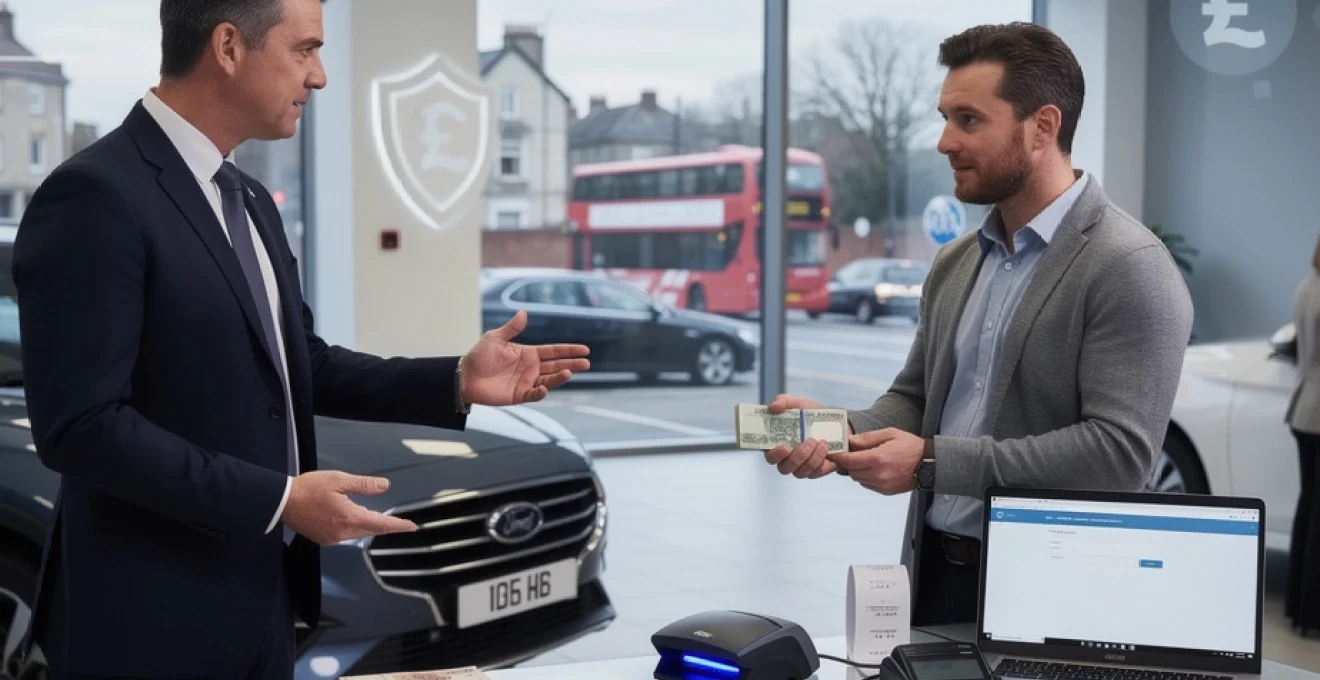
Turning up at a showroom with a bag of notes might sound old‑fashioned, but it still happens more often than you might think. Cars are high‑value, highly mobile assets, so cash payments sit right at the intersection of convenience, security and anti‑money laundering law. If you plan to pay cash for a car in the UK, or run a dealership handling customer notes and coins, understanding the limits and rules is essential. Misjudging it can lead to refused sales at best and regulatory trouble at worst, especially as cash usage continues to decline and compliance expectations rise.
The key question is not just whether you can pay for a car in cash, but how much a UK dealer is willing or allowed to accept, and what checks sit behind the scenes. The legal framework under the Money Laundering Regulations 2017, Proceeds of Crime Act 2002 and HMRC guidance is quite clear, yet everyday practice on the showroom floor is often more conservative. Knowing the difference helps you decide how to structure your payment sensibly and protect yourself from unnecessary risk or delay.
UK cash payment limits for car dealers: FCA, money laundering regulations 2017 and HMRC guidance
Defining “large cash transaction” for vehicle sales under UK money laundering regulations 2017
Under the UK’s Money Laundering, Terrorist Financing and Transfer of Funds (Information on the Payer) Regulations 2017 – usually shortened to the Money Laundering Regulations 2017 – a “large cash transaction” for dealers is pegged to a €10,000 threshold. In practice, HMRC translates this to around £8,700, but many compliance teams simply treat £10,000 as the operational trigger to keep things simple. If a business accepts or makes cash payments of €10,000 or more for goods, it is classed as a high value dealer and must register with HMRC for money laundering supervision before handling such payments.
For car dealers, “cash” here means physical notes and coins, or travellers’ cheques paid directly or via a third party. Importantly, several smaller payments can count as one high‑value transaction. If a customer pays three instalments of £3,500 in notes for the same vehicle, that still falls within the high‑value cash definition. This is designed to stop “structuring” or “smurfing”, where criminals deliberately break down large amounts to avoid detection. If you are a buyer planning to make repeated cash payments for one car, expect the dealer to treat the total as a single transaction.
Current UK legal position on cash ceilings for purchasing cars from dealers
There is currently no absolute UK‑wide legal ban on buying a car with large amounts of cash. Unlike some EU countries that impose strict statutory cash ceilings for high‑value purchases, the UK instead uses a regulatory approach focused on registration, due diligence and suspicious activity reporting. That means, in theory, you could pay £50,000 or £100,000 in notes for a prestige car without directly breaching a set cash cap, provided the dealership is properly supervised and compliant.
However, that does not mean a dealer must accept your cash. Legal tender rules only require notes to be accepted for the settlement of an existing debt, not for initiating a new sale. A car purchase is a voluntary transaction, so dealers are entirely within their rights to refuse physical cash or to set any internal ceiling they choose. What you will see in practice is a blend of money laundering regulation, bank charges, insurance conditions and security risk all pushing showrooms towards modest cash thresholds and a preference for electronic payments.
FCA supervision vs HMRC supervision for cash-heavy motor dealers
Many franchised and independent dealers fall into dual‑regulated territory: the Financial Conduct Authority (FCA) for consumer credit and insurance activities, and HMRC for money laundering supervision where high‑value cash is involved. The roles are different. The FCA focuses on conduct of business, affordability checks and treating customers fairly under finance agreements. HMRC, by contrast, is concerned with how cash is handled, whether suspicious funds are detected and reported, and whether internal controls are robust.
This split supervision can be confusing if you are new to the trade. The FCA does not set specific cash ceilings for vehicle purchases, but its expectations around systems and controls overlap with AML practice. HMRC guidance on high value dealers is explicit: businesses must not accept a high‑value cash payment until registered, and must keep detailed records and risk assessments. From a buyer’s point of view, this backdrop explains why a showroom that is slick and modern for finance may be unexpectedly wary about taking more than £1,000 in notes.
Distinguishing consumer cash payments from business-to-business (B2B) cash deals
Consumer transactions and B2B vehicle deals sit under the same AML umbrella, but the risk profile is different. A private individual buying a £3,000 runabout with £500 cash and the balance by bank transfer is generally low risk, provided basic checks are done. By contrast, a motor trader regularly paying £15,000 in cash for stock cars raises more obvious red flags. HMRC specifically targets sectors where criminals might try to “clean” funds by flipping high‑value goods such as cars, jewellery or art.
If you operate as a trader or limited company, expect a higher level of scrutiny when attempting large cash payments to another dealer. Proof of business activities, evidence of legitimate cash generation and additional verification questions are normal. Some franchised groups now have a blanket policy that B2B stock purchases must go through electronic methods only, even though smaller consumer cash payments remain technically possible on site.
Anti-money laundering (AML) rules car dealers must follow when accepting cash
Customer due diligence (CDD) and identity verification for high-value cash buyers
Whenever you pay a noticeable amount in cash, a compliant dealer should apply customer due diligence. In practical terms, that means taking and retaining evidence of your identity, and often your address, before accepting the money. Photographic ID such as a passport or photocard driving licence, plus a recent utility bill or bank statement, is standard. For very high‑value purchases, dealers may also ask about the source of funds, particularly if you are not a long‑standing customer.
This is not a sign of mistrust; it is a legal defence. If a dealership receives significant cash and cannot show it knew who the customer really was, it risks breaching the Money Laundering Regulations. For buyers, the key is to view CDD as part of the normal car‑buying process, like a credit check for finance. If you plan to pay a large lump sum in notes, bringing ID and being ready to explain how the funds were generated will usually make the experience smoother.
Enhanced due diligence (EDD) for politically exposed persons (PEPs) and high‑risk jurisdictions
Where a dealer identifies a politically exposed person (PEP) or a buyer linked to a high‑risk country, enhanced due diligence (EDD) is required. A PEP could be a senior politician, judge, military officer or someone closely associated with such individuals. High‑risk jurisdictions are defined by the UK government and international bodies such as the FATF, and are updated regularly in light of sanctions and global events.
EDD goes beyond basic ID checks. It might involve more detailed questions about occupation and income, additional documentary evidence for the source of funds and senior management approval before the transaction can go ahead. If you are on a PEP list or buying on behalf of someone in a high‑risk country, be prepared for slower processing and more detailed questioning, especially if you intend to use substantial cash. This is standard risk management rather than personal suspicion.
Suspicious activity reports (SARs) to the UK financial intelligence unit (UKFIU) at the NCA
Dealers have a legal duty to report suspicious activity where there is knowledge or suspicion that money laundering may be taking place. Suspicion is a low threshold – it can be triggered by unusual behaviour, inconsistent explanations for the source of funds, or payment patterns that appear designed to avoid the €10,000 threshold. In such cases, the nominated officer in the business must consider submitting a Suspicious Activity Report (SAR) to the UK Financial Intelligence Unit (UKFIU) at the National Crime Agency.
From a customer’s perspective, this is largely invisible. If a SAR is filed, the dealer may delay the transaction while the NCA considers whether to grant “appropriate consent” under the Proceeds of Crime Act. Most SARs do not result in direct action against the customer, but they are a crucial part of the UK’s defence against money laundering. If you are ever told that a payment is “on hold pending checks”, there may be a behind‑the‑scenes SAR process underway.
Proceeds of crime act 2002 (POCA) and criminal liability for accepting illicit cash
The Proceeds of Crime Act 2002 underpins the risk for dealers who accept tainted money. Under POCA, it is an offence to enter into or become concerned in an arrangement that facilitates the acquisition, retention, use or control of criminal property, if you know or suspect that it is criminal. A car bought with the proceeds of drug trafficking, tax evasion or fraud is a classic example of such property.
For dealership staff and management, the consequences of getting it wrong can be severe: unlimited fines, prison sentences and confiscation orders. Recent enforcement cases involving car traders have highlighted that “turning a blind eye” to dubious cash is not a defence. That is why a cautious dealer might decline your £20,000 in notes even if you are entirely legitimate. The risk of accepting illicit cash simply outweighs the marginal benefit of an additional sale.
Risk-based AML policies and in‑house procedures for franchised and independent dealers
Both franchised and independent dealers are expected to adopt a risk‑based approach to AML. Instead of treating every transaction identically, they should assess the risk factors – transaction size, customer profile, vehicle type, payment method – and adjust controls accordingly. Internal policies will usually cover acceptance thresholds for cash, staff training, verification steps, record‑keeping standards and escalation routes for suspicious cases.
In practice, a large PLC dealer group may have a central compliance team, dedicated training platforms and automated flags in the dealer management system (DMS) to pick up risky patterns. Smaller independents rely more on written procedures and the judgement of experienced staff. For you as a buyer, asking to see a dealer’s cash policy or AML notice can be reassuring, particularly if you intend to use mixed methods such as part‑exchange plus a sizeable cash contribution.
How much cash UK franchised dealers typically accept in practice (arnold clark, evans halshaw, lookers)
Common cash caps per transaction (£1,000–£3,000) in main dealer groups and online retailers
Although the law allows much larger amounts, most franchised dealers set their own internal cash limits considerably lower than the €10,000 HMRC threshold. Typical caps range between £1,000 and £3,000 per transaction. Some groups only accept cash for small deposits, others refuse notes entirely and require everything above a token amount to be paid by debit card or bank transfer. This is driven more by practicality, bank fees and security than by black‑letter law.
The trend has accelerated since the pandemic, with UK Finance data showing the proportion of cash payments falling from around 45% in 2015 to under 20% by 2023. In automotive retail, that share is even smaller for transactions above £5,000. Many online‑first retailers simply do not accept physical cash at all, and will direct you to faster payments or finance instead. If you are planning a cash‑heavy deal, contacting the dealership in advance to confirm its policy avoids a wasted journey.
Case examples: cash payment policies at arnold clark, evans halshaw and motorpoint
Larger dealer groups publish parts of their cash policies or at least communicate them clearly in showrooms. For example, some national groups state that they can accept up to £9,000 in cash in total across deposit and balance, aligning with the pre‑registration limit for high‑value dealers. Others adopt a stricter ceiling of around £1,000–£2,000 for consumer sales and request that remaining amounts are paid via bank transfer prior to collection.
Used‑car supermarkets and remarketing specialists such as Motorpoint and similar operators typically mirror this stance, combining low cash caps with strong encouragement to use digital payment. Anecdotally, staff at prestige franchises often treat substantial cash offers with suspicion rather than delight, because they trigger more admin, more checks and higher banking charges. From a negotiation point of view, a large pile of notes is no longer the lever it was 20 years ago; a straightforward finance deal can be more attractive to a franchise on commission and volume targets.
Balancing cash limits with card surcharges, bank transfer security and finance commission
Dealers sit at the junction of several competing pressures. Card providers charge merchant fees, especially on credit cards; banks charge for bulk cash deposits and may flag unusual cash activity; finance commissions and manufacturer bonuses are often linked to penetration rates. The result is an ecosystem where modest debit‑card payments and bank transfers are favoured, while large cash and high‑value card payments are quietly discouraged.
Some showrooms used to levy explicit surcharges on credit cards, but card scheme rules and consumer law have tightened significantly. Instead, limits on card usage or refusal of certain card types for balances above, say, £5,000 are more common. If you want to minimise hassle, combining a modest cash amount with a bank transfer remains the most efficient route. For very high‑value cars, especially in the £80,000‑plus bracket, using finance or leasing alongside a bank transfer deposit often aligns better with the dealer’s risk appetite.
Operational risks: theft, counterfeit notes and internal fraud in high‑cash dealerships
Beyond regulation, hard operational risk shapes cash limits. Holding large volumes of notes on site increases exposure to burglary, robbery and internal theft. Insurance premiums, safe requirements and cash‑in‑transit services all add cost. There is also the risk of counterfeit notes slipping through, particularly on busy Saturdays when staff are juggling test drives, valuations and phone enquiries.
Dealers that previously took £20,000 or more in cash for performance cars have increasingly moved away from that model after experiencing note forgeries or unexplained till discrepancies. A single counterfeit bundle or internal fraud incident can wipe out the margin on several cars. Requiring high‑value buyers to move their money through the banking system transfers the authentication and security burden to professionals, and leaves the dealership with an auditable electronic trail.
Practical payment structuring: deposits, part‑exchange and mixed cash/card methods
Taking cash for initial holding deposits vs final settlement of vehicle invoices
One sensible way dealers balance customer convenience with AML and security is to separate small holding deposits from final settlement. It is common to allow a £200–£500 cash deposit to take a car off sale, especially in used‑car operations where speed matters. The final invoice, however, is usually settled by Faster Payments, debit card or finance pay‑out on or before the day of collection.
If you prefer to use some cash, discussing this structure at the outset helps. A dealer might agree to take £300 in notes to secure the car and then require the remaining £9,700 electronically. This approach keeps the on‑site cash float within internal limits, while still giving you some flexibility over how you make your initial commitment. It also aligns much better with AML expectations because bank transfers are easier to trace than anonymous bundles of notes.
Using faster payments, CHAPS and bank drafts instead of large cash handovers
Modern electronic payment systems have largely removed the need for old‑style banker’s drafts and large cash handovers. UK Faster Payments allow near‑instant transfers up to limits set by your bank – often £25,000–£50,000 per day for personal customers, and higher for business accounts. For more expensive cars, dealers and customers may use CHAPS, which is a same‑day, guaranteed payment system usually carrying a fee of around £20–£30.
Bank drafts still exist but are less favoured because they can be forged and must clear before the car is released, which might take several days. If you plan to pay a dealer electronically, it is worth speaking to your bank in advance to ensure your transfer limits are temporarily raised if required. That way, the full balance can be sent while you sit in the showroom or shortly before collection, avoiding the practical and legal difficulties associated with carrying large sums of physical cash.
Documenting part‑exchange valuations when combined with cash contributions
Many used‑car transactions involve a combination of part‑exchange value, cash and finance. From a compliance and VAT perspective, documenting each element clearly matters. The invoice should show the gross price of the vehicle, the allowance for the part‑exchange, any cash paid, and any finance settlement or advance. This creates an audit trail that HMRC and internal auditors can follow if questions arise later.
For buyers, clarity helps protect consumer rights. If your part‑exchange is later found to have undisclosed issues and the allowance is adjusted, the paperwork should make it obvious how that affects the cash element and any outstanding finance. Keeping copies of the order form, valuation sheet and final invoice is particularly important where cash forms part of the consideration, because there is no bank statement entry to fall back on as definitive evidence of the amount handed over.
Handling cash when selling high‑value used cars, classic cars and prestige marques
The classic and prestige sectors have historically seen more cash than mainstream new‑car dealerships, partly because of international buyers and partly because high‑net‑worth individuals sometimes hold significant liquidity outside the banking system. However, these are exactly the types of transactions that attract AML scrutiny: large sums, sometimes cross‑border, changing hands for assets that can be moved or resold quickly.
Specialist dealers in classic and supercars increasingly use escrow arrangements or insist on full electronic settlement to manage these risks. Where cash is accepted at all, it is typically limited to small deposits, with the balance paid via CHAPS or international wire. If you are buying a high‑value classic or prestige car and intend to use substantial cash, you should expect more rigorous ID checks, possible delays while funds are cleared, and firm limits on how much of the price can be settled in notes.
Record‑keeping, VAT, and HMRC scrutiny of cash‑heavy car dealerships
Mandatory records for cash receipts, invoices and till systems under VAT notice 700
HMRC’s VAT Notice 700 sets out the core record‑keeping duties for VAT‑registered businesses, including motor dealers. All supplies must be backed by proper invoices showing the consideration received, whether in cash, bank transfer or other form. For cash receipts, businesses must maintain detailed till records, daily summaries and, where relevant, cash‑up sheets that reconcile physical notes and coins with recorded sales.
In a dealership context, that means every cash deposit or balance payment for a vehicle must be logged against a stock number or invoice. Petty cash for fuel, valeting or sundries should be ring‑fenced from customer receipts. Poor segregation or missing cash logs are red flags during HMRC visits. If you are a buyer, asking for a proper VAT invoice – even where you pay partly in cash – ensures the transaction is captured inside this framework and reduces the risk of disputes later.
HMRC compliance visits, cash discrepancy checks and undeclared takings
HMRC regularly carries out compliance checks on motor traders, particularly where VAT returns or accounts suggest high cash turnover or unusual margin patterns. During a visit, officers may review Z‑readings from tills, cash‑up records, bankings and sales invoices, looking for gaps or inconsistencies. A common technique is to compare recorded cash takings with what would be expected based on vehicle sales, service work and accessories over a sample period.
Where discrepancies are found – for example, repeated under‑banking of cash or unexplained shortfalls – HMRC may conclude that undeclared takings exist and assess additional tax, sometimes going back several years. Civil penalties and, in serious cases, criminal investigation can follow. For dealers, robust cash controls are not just about AML; they are also about protecting the business from tax risk. For buyers, dealing with a showroom that visibly takes documentation and receipting seriously is usually a safer choice.
Linking cash controls to VAT margin scheme for second‑hand cars
Many used‑car dealers operate under the VAT margin scheme, which taxes the dealer’s margin rather than the full selling price, provided the vehicle meets certain eligibility conditions. Under this scheme, accurate records of purchase price and selling price are crucial, as is clarity about any refurbishment costs. Cash payments, whether incoming from customers or outgoing to purchase stock, must be carefully tracked.
If a dealer buys a car for £7,000 in cash and sells it for £9,000, also taking part of that sale in cash, the paperwork must show both ends of the transaction clearly. HMRC margin scheme inspections often focus on whether cash purchases and sales have been properly captured in stock books and margin calculations. Businesses that treat cash casually risk both VAT errors and the appearance of money laundering vulnerability, even if the underlying funds are legitimate.
Internal audit trails, CCTV and bank reconciliation for large cash deposits
Good internal control over cash‑heavy operations usually combines process and technology. Many showrooms use CCTV coverage of payment points, dual‑control counting procedures and locked drop safes to reduce theft and prove what actually happened if a dispute arises. Regular, preferably daily, bank reconciliations ensure that recorded cash takings match the amounts physically banked after noting bank charges and any change floats retained on site.
This has a direct impact on how much cash a dealer is willing to accept. The more stringent the internal process, the more expensive it is to handle notes and coins. At some point, the cost and risk outweigh the perceived benefit of accommodating large cash buyers. From a consumer’s standpoint, this internal machinery explains why a perfectly solvent dealer might cap cash at £1,000 while insisting that anything more goes through the banking system where reconciliations and audit trails are automatic.
Best practice policies for UK car buyers and dealers when large cash is involved
Verifying banknotes: bank of england security features and counterfeit detection devices
If cash is part of the deal, both parties should take note verification seriously. Modern polymer Bank of England notes have advanced security features – clear windows, holograms, raised print and micro‑lettering – that can be checked quickly by hand. Dealers handling any meaningful volume of notes should also use counterfeit detection devices, such as ultraviolet lamps or automatic note readers integrated into safe systems.
As a buyer, you are entitled to see notes checked in front of you. If a dealer proposes to take a very large sum without basic verification, that is a red flag. Think of it like an identity check: a few extra minutes at the start can prevent far greater headaches later if counterfeit money is discovered at the bank. The same applies when buying privately; meeting at a bank branch and paying directly into the seller’s account allows professional staff and systems to validate the cash immediately.
Agreeing payment terms in writing on the vehicle order form and sales invoice
Clear written payment terms protect both sides and reduce the scope for misunderstanding. The vehicle order form should state the total price, deposit amount, balance due, and the method by which each element will be paid – cash, debit card, bank transfer, finance pay‑out or a combination. Any internal cash limit agreed with the sales executive should be reflected there, so you are not confronted with a different stance on collection day.
The final invoice should mirror those terms and show that the agreed payments were actually made in the specified way. If any change occurs – for example, a last‑minute decision to pay the full balance through Faster Payments instead of in part cash – updated documentation should be issued. In the absence of a bank statement entry for a cash payment, this paperwork may be the only formal evidence that you handed over a specific sum for the car.
Using independent escrow and secure showroom banking procedures for high‑value vehicles
For very high‑value or sensitive transactions, independent escrow services can offer extra comfort. An FCA‑authorised escrow provider can hold funds in a client account until both buyer and seller confirm that agreed conditions have been met, such as inspection results or delivery milestones. Although escrow is more common in classic and supercar trades, it can also be used where an overseas buyer wishes to settle in sterling but prefers not to rely entirely on a dealer’s internal processes.
On the dealer side, secure showroom banking procedures – such as same‑day banking of large cash receipts, limited staff access to safes and regular reconciliations – reduce risk and reassure customers that their payments are handled professionally. Even if you never see the detail, simple indicators like separate counting areas, visible compliance notices and staff who can explain the cash policy confidently are signs that controls exist beyond mere custom.
Consumer rights, refunds and chargebacks when cash forms part of the consideration
Consumer protection law – including the Consumer Rights Act 2015 for vehicles bought from dealers – applies regardless of payment method. If a car is mis‑described, not of satisfactory quality or not fit for purpose, you may be entitled to a repair, replacement or refund within specified timeframes. However, when cash has been used, the mechanics of any refund become more complex. Dealers may insist on refunding to the original means of payment, but where that was anonymous notes, a bank transfer or cheque is usually substituted.
Unlike card payments, physical cash offers no chargeback route through your card issuer. If a dispute arises and the dealer is uncooperative, enforcement options are limited to formal complaint channels, ADR schemes or court action. For that reason alone, many buyers prefer to ensure that at least a substantial part of the transaction goes through a traceable channel, even if some cash is used. Treat cash as one component of a carefully documented deal rather than the entire payment, and your position under consumer law becomes much easier to evidence if anything goes wrong later.