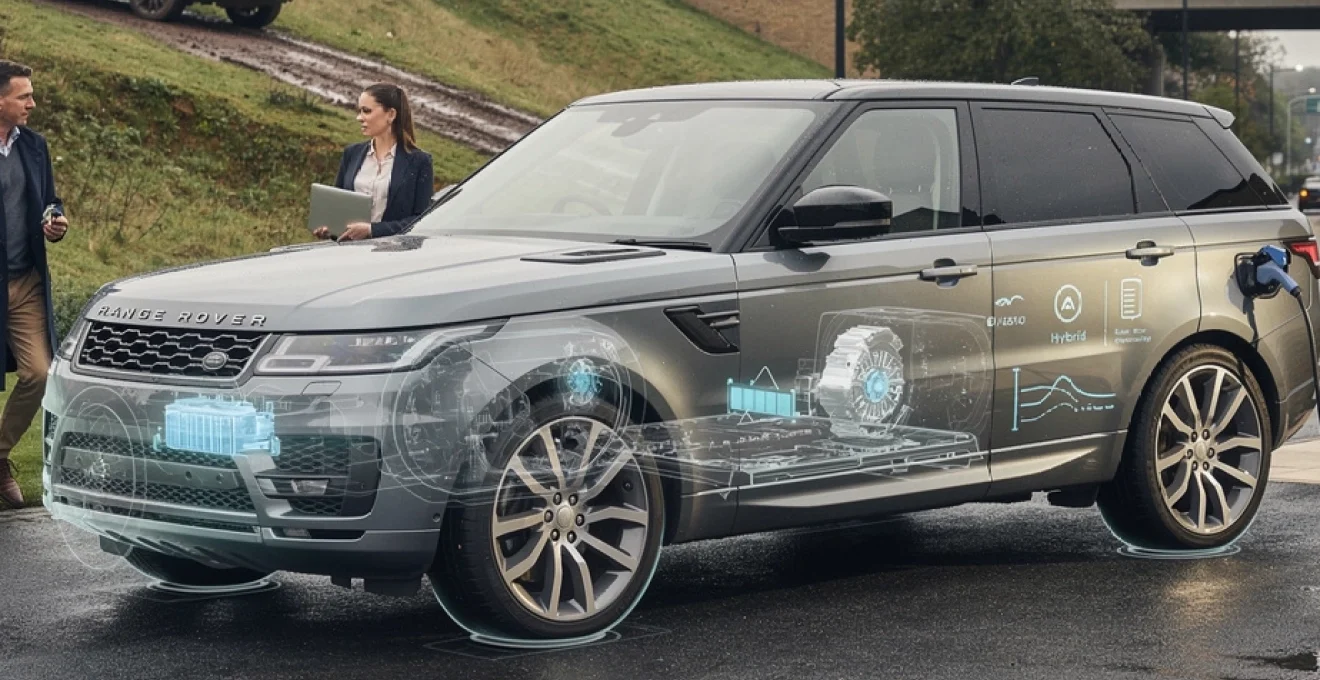
The Hybrid Range Rover Sport sits in a rare sweet spot: a luxury SUV that can cruise silently through town on electric power, tow a heavy caravan to the Lake District, and still feel at home parked outside a five‑star hotel. For drivers who want refinement and presence without committing fully to a pure EV, the plug‑in hybrid Range Rover Sport offers a compelling middle ground. Yet it is also a complex piece of engineering, mixing high‑voltage battery tech, powerful petrol engines and advanced chassis systems in a 2.5‑tonne body.
Understanding how the hybrid systems work, what real‑world electric range you can expect, and how charging fits into daily life is crucial before signing on the dotted line. There are also questions around off‑road ability, towing performance and long‑term ownership costs compared with diesel or mild‑hybrid petrol models. If you are considering a Hybrid Range Rover Sport as a company car, family SUV or fleet vehicle, a clear view of these trade‑offs will help you choose the right powertrain and specification.
Hybrid range rover sport powertrains: p400e vs p440e vs p510e plug‑in hybrid systems
Ingenium 2.0 and 3.0 petrol engines: displacement, turbocharging and performance figures
Across recent generations, the Hybrid Range Rover Sport has been offered with several plug‑in hybrid (PHEV) badges: P400e, P440e, P460e and P510e/P550e. Earlier models used a 2.0‑litre four‑cylinder Ingenium petrol engine, while current cars pair a 3.0‑litre straight‑six with an electric motor.
The older 2.0 P400e combined a turbocharged 1,997cc engine with around 296 bhp and an electric motor for a total output close to 398 bhp. Performance was strong on paper but, in practice, the four‑cylinder could feel strained when the battery was low, especially in a heavy SUV.
Newer P440e and P510e/P550e variants use a 3.0‑litre, six‑cylinder Ingenium petrol. This larger engine is smoother, quieter and better suited to a luxury SUV. Power outputs typically sit around 440–460 PS (about 454 bhp) for the P440e/P460e and 510–550 PS (around 543–550 bhp) for the P510e/P550e, with torque figures up to 800 Nm quoted in some specs. That puts the hybrid Range Rover Sport firmly in high‑performance territory while retaining impressive efficiency for the class.
Electric motor integration within ZF 8-speed automatic gearbox
Instead of a separate e‑axle, the Hybrid Range Rover Sport integrates its electric motor into the familiar ZF 8HP eight‑speed automatic gearbox. The motor sits between the engine and transmission, allowing both power sources to drive all four wheels via the standard permanent all‑wheel‑drive system.
This layout brings several benefits. Packaging is neat, so ground clearance and off‑road geometry remain close to diesel and mild‑hybrid petrol models. It also means the car can run purely on electric power without the engine turning, or blend engine and motor output seamlessly when maximum acceleration is requested. Gearshifts in EV mode are generally very smooth; some drivers barely notice the transmission changing ratios when cruising around town.
Because the motor is upstream of the transfer case, full electric all‑wheel drive is available at low and medium loads. That is particularly useful on wet grass, gravel or snow, where instant e‑torque to both axles makes the big SUV feel sure‑footed from the first few metres.
High‑voltage battery specifications: usable kwh, cell chemistry and cooling strategy
Battery capacity has increased significantly over time. Earlier P400e models used a pack of around 13–17 kWh gross, limiting real‑world EV range to roughly 20–25 miles. Current P440e and P510e/P550e versions step up to batteries with roughly 31.8–38.2 kWh usable capacity, depending on market and model year, enabling WLTP electric‑only ranges of 53–76 miles.
The battery uses modern lithium‑ion cell chemistry with liquid cooling, mounted under the boot floor and central tunnel area to keep the centre of gravity low. Active thermal management is vital in a heavy PHEV: by maintaining the pack in its ideal temperature window, the system preserves performance during repeated fast‑charge sessions and helps slow long‑term degradation.
From an ownership perspective, a cooled battery is also reassuring. High‑temperature operation is one of the main drivers of capacity loss over time, so active cooling gives the hybrid Range Rover Sport a better chance of retaining usable range after many years of use.
Combined system output, torque curve and 0–62 mph times across hybrid variants
What does all of this deliver in terms of real performance? Combined system outputs for the main hybrid Range Rover Sport versions broadly look like this:
| Variant | Approx. power | Approx. torque | 0–62 mph (claimed) |
|---|---|---|---|
| P400e (2.0 PHEV) | ~398 bhp | ~640 Nm | ~6.4–6.7 seconds |
| P440e / P460e | ~440–460 PS (454 bhp) | ~660–680 Nm | ~5.3–5.5 seconds |
| P510e / P550e | ~510–550 PS | Up to 800 Nm | ~4.7 seconds |
The key advantage is the torque curve. Electric motors deliver maximum torque from near zero rpm, so off‑the‑line response is instant compared with a diesel that needs time to spool its turbo. Once moving, the straight‑six engine takes over with a broad torque plateau, giving the PHEVs a relaxed, elastic feel when overtaking.
Independent tests often show the P460e getting to 60 mph in around 4.8–5.3 seconds, and the more powerful P550e hovering in the mid‑4s. Those figures encroach on performance SUV territory, yet the car can also glide through city traffic in near silence when in EV mode.
WLTP CO₂ emissions and fuel consumption comparison with diesel and mild‑hybrid petrol models
On paper, the Hybrid Range Rover Sport offers dramatic CO₂ and fuel‑consumption advantages over its purely combustion‑engined siblings. WLTP figures for the latest PHEVs quote combined CO₂ emissions as low as 18–20 g/km, with laboratory fuel economy in the region of 300–400 mpg when the battery is regularly charged.
By comparison, a D300 or D350 mild‑hybrid diesel sits around 200–210 g/km and 36–40 mpg on the WLTP cycle, while a P400 or P530 mild‑hybrid petrol is typically in the mid‑20s mpg and 230–260 g/km bracket. Real‑world data from UK drivers suggests that a P460e can average more than 100 mpg on short commutes if charged daily, but drop into the mid‑20s mpg on a long motorway run with a depleted battery.
For drivers who plug in consistently, the hybrid Range Rover Sport can slash fuel use compared with an equivalent petrol, while still undercutting company car tax liabilities versus a diesel SUV.
This swing in economy is why charging habits matter more for a PHEV than raw WLTP numbers. If you treat the car like a conventional petrol and never plug in, expect fuel bills to be similar to the six‑cylinder petrol models, because the extra weight of the battery has to be carried everywhere.
Electric driving capability in the range rover sport PHEV: EV range, modes and real‑world usage
EV, hybrid and save modes: how land rover’s hybrid control software prioritises energy flow
The hybrid Range Rover Sport typically offers three main drive modes related to powertrain behaviour: EV, Hybrid (or Auto) and Save (sometimes called Charge or Preserve). Understanding how these work helps you extract the best economy.
In EV mode, the car prioritises electric drive and will stay engine‑off as long as there is sufficient battery charge and power demand remains moderate. You can usually reach motorway speeds on electric power alone, useful for zero‑emission sections in towns or clean‑air zones.
Hybrid mode lets the software blend engine and motor as it sees fit. Navigation data, gradient and traffic conditions can all influence how aggressively battery energy is used. This is typically the best mode for mixed driving if you do not want to micromanage the drivetrain.
Save mode preserves a set level of battery charge for later in the journey. For example, you might drive up the motorway on the petrol engine and then use the stored charge to run silently through a city centre. Some versions even allow the engine to top the battery back up, though this is less efficient overall than charging from the grid.
Official WLTP electric‑only range vs real‑world range in UK urban, a‑road and motorway driving
Recent PHEV versions of the Range Rover Sport quote official WLTP electric‑only ranges of between 53 and 76 miles, depending on model and wheel size. Independent tests in the UK have recorded real‑world EV ranges of about 48 miles on a mixed route, which is a strong result relative to the official figure.
Expect the following rough real‑world electric ranges if driving thoughtfully:
- Urban driving (London or Manchester traffic): 45–60 miles EV range
- Mixed A‑road and dual carriageway: 40–50 miles EV range
- Motorway at 70 mph: 30–40 miles EV range
Temperature has a big influence. In mild spring or autumn weather, the car can hit the upper end of those ranges, while in a cold January with the heater working hard, range can drop by 20–30%. For many UK commuters, that still covers a return trip on a single overnight charge, which is why plug‑in hybrid SUVs appeal so strongly as daily family cars.
Regenerative braking calibration, one‑pedal feel and brake‑by‑wire system behaviour
Like most modern PHEVs, the hybrid Range Rover Sport uses a brake‑by‑wire system that blends regenerative braking from the electric motor with friction braking at the discs. Calibration has improved markedly over generations; current cars offer a consistent pedal feel that makes smooth stops easy to achieve.
Some early P400e owners reported a slight delay when releasing the foot brake as the regenerative system disengaged. Later software updates have largely smoothed this out. The driving experience is not quite “one‑pedal” in the way some EVs are, but you will notice strong regeneration the moment you lift off the accelerator, particularly in driving modes that favour energy recovery.
Think of regenerative braking as a way of pouring momentum back into the battery rather than wasting it as heat; in stop‑start city traffic, that effect is especially noticeable on the trip computer.
For drivers new to electrified vehicles, the brake pedal can initially feel slightly artificial because the system decides how much regen versus friction to use. After a few days’ acclimatisation, most owners report that it fades into the background and simply feels like a powerful, reassuring brake setup.
Impact of wheel size, climate control and driving style on electric‑only efficiency
Achieving the best electric‑only efficiency in a hybrid Range Rover Sport depends on spec choices and driving technique. Larger 22‑ or 23‑inch wheels look superb but add weight and rolling resistance, costing several miles of EV range compared with 20‑inch wheels. Air suspension does help by optimising ride height, yet physics still applies.
Climate control usage is another big factor. Using heated seats and steering wheel instead of cranking up cabin heat can save several per cent of battery energy on a cold morning. Similarly, preconditioning the car while plugged in warms the cabin using mains electricity rather than depleting the high‑voltage pack.
Driving style matters more than many expect. Gentle acceleration, early lifting and using the car’s coasting abilities can easily add 5–10 miles to a full‑charge range. Think of the battery as a finite budget; every hard launch or extended high‑speed burst is a big withdrawal from that account.
Charging the hybrid range rover sport: AC home charging, public networks and workplace setups
On‑board charger power (7.2 kw/11 kw) and compatible home wallbox options in the UK
The hybrid Range Rover Sport typically features an on‑board AC charger rated at around 7.2 kW, matching the common 32 A single‑phase wallboxes fitted to UK homes. Some markets offer 11 kW three‑phase capability, but for most UK buyers the limiting factor will be the domestic supply rather than the car itself.
At 7 kW, expect a 0–100% charge in roughly five hours on newer 31.8–38.2 kWh battery packs. Earlier, smaller packs will recharge in around two to three hours at the same rate. A dedicated home wallbox is strongly recommended for convenience and safety; charging from a 3‑pin domestic socket is possible but slow (up to 15 hours) and best treated as a backup option.
Smart wallboxes that integrate with time‑of‑use tariffs are particularly helpful. They allow the car to automatically charge overnight during off‑peak hours, significantly reducing running costs per mile compared with petrol or diesel.
AC vs DC charging: maximum kw intake, charge curve and 10–80% time benchmarks
One of the unusual strengths of the Range Rover Sport PHEV compared with many rivals is DC rapid‑charging capability. Where some plug‑in SUVs are limited to 7.4 kW AC only, the Range Rover Sport supports up to around 50 kW DC charging.
On a suitably powerful DC charger, a 10–80% top‑up can take about 30–40 minutes, while a 0–80% session usually completes in under an hour. That makes it feasible to restore most of the electric range during a supermarket stop or lunch break on a motorway journey.
However, the charge curve is not flat. As with a full EV, peak power is only available when the battery is in the middle of its state‑of‑charge window and at an optimum temperature. The last 10–20% of charge tapers significantly to protect the cells, so chasing 100% on a DC charger wastes time. For most journeys, targeting 80–90% gives the best balance between range and dwell time.
Connecting to UK networks such as BP pulse, pod point, InstaVolt and gridserve
Public charging infrastructure in the UK has grown rapidly, and a hybrid Range Rover Sport fits well into that ecosystem. For AC destination charging at shopping centres, hotels and public car parks, networks such as Pod Point and BP Pulse are widely available. Many of these locations offer 7–22 kW posts, ideal for a few hours’ top‑up while the car is parked.
For faster DC sessions, rapid and ultra‑rapid chargers from Gridserve, InstaVolt, Osprey and others are now common on motorway services and major A‑roads. With a PHEV, you do not need to queue for the highest‑powered 150–350 kW units; any 50 kW charger will allow the Range Rover Sport to charge at close to its maximum DC rate.
If using public charge points regularly, registering with a handful of major networks and installing their apps simplifies payment and helps you locate compatible chargers. Contactless payment is becoming the norm on newer rapid units, but some older points still require RFID cards or app authentication.
Home charging installation, load management and smart tariff optimisation (octopus, OVO, british gas)
For most hybrid Range Rover Sport owners, home charging will cover the majority of energy needs. A typical installation involves a 7.4 kW wallbox connected to a dedicated circuit, with an earth rod and built‑in safety features such as PEN‑fault protection. An electrician will also assess main fuse capacity and household load to ensure the supply can safely support car charging alongside other appliances.
Load‑management features are particularly useful in older properties. These systems monitor current draw and can temporarily reduce charge rate or pause charging if demand approaches the household limit. Once demand falls, the wallbox automatically resumes at the full rate.
Smart tariffs from suppliers such as Octopus, OVO and British Gas offer cheap overnight electricity, often between 00:30 and 04:30 or similar windows. By scheduling charging during these slots, you can reduce cost per electric mile dramatically. In many cases, driving a Range Rover Sport PHEV on off‑peak electrons works out cheaper per mile than running a typical family diesel hatchback on pump fuel.
Off‑road and towing performance of the hybrid range rover sport compared with diesel and mild‑hybrid
Terrain response 2 and electric torque delivery on mud, sand and low‑traction surfaces
Land Rover’s reputation is built on off‑road capability, so the hybrid Range Rover Sport must do more than just cruise silently through Chelsea. Fortunately, Terrain Response 2 and electric torque delivery make it extremely competent away from tarmac.
In low‑traction conditions such as mud, wet grass or sand, the instant response from the electric motor gives the driver fine control when feathering the throttle. Combined with intelligent traction aids, this allows the car to pull away where a conventional automatic diesel might bog down or hesitate.
Off‑road drive modes adjust throttle mapping, gearbox behaviour and the traction and stability systems to suit the surface. For example, the Mud and Ruts setting allows more wheel slip to build a “wedge” of material in front of the tyre, while Sand mode sharpens throttle response and holds gears to maintain momentum. The hybrid models retain these characteristics largely unchanged.
Wade depth, ground clearance and approach/departure angles with hybrid battery packaging
A common concern with any electrified off‑roader is whether battery packaging compromises ground clearance or wading ability. The hybrid Range Rover Sport is designed so that its high‑voltage components are sealed and mounted safely within the body structure, rather than slung low beneath it.
Official wade depth for recent models is quoted at up to 850–900 mm, identical to or very close to combustion‑only variants. Ground clearance can reach around 273–281 mm in the highest off‑road air‑suspension setting, and approach, break‑over and departure angles remain generous for a large luxury SUV.
Off‑road, this means you do not have to drive the hybrid any more gingerly than a diesel or V8. Battery cooling and sealing are designed to cope with slow wading, though, as with any 4×4, extended immersion beyond rated limits is not advisable.
Braked towing capacity, nose weight limits and caravan towing with the PHEV system
Many Hybrid Range Rover Sport buyers tow horseboxes, large caravans or car trailers. Braked towing capacity for PHEV models is typically around 3,000 kg, slightly below the 3,500 kg allowed on some non‑plug‑in versions but still ample for most leisure use. Maximum nose weight usually sits in the 100–150 kg band, but it is important to check the specific handbook for your model year and tow‑bar type.
Electric assistance is particularly welcome when towing. The extra torque helps the car pull cleanly from junctions and roundabouts, and the smooth power delivery makes it easier to modulate speed on inclines. However, towing heavily at motorway speeds will deplete the battery quickly, effectively turning the car into a powerful petrol SUV for the rest of the journey.
For long, heavily loaded trips where charging is not practical, a diesel Range Rover Sport may still be the most economical choice. For mixed use—weekday electric commuting and occasional towing at weekends—the PHEV strikes a very appealing balance.
Hill descent control, low‑speed off‑road EV creep and control in technical terrain
In technical off‑road sections, Hill Descent Control and low‑speed torque management become more important than outright power. The hybrid Range Rover Sport offers very precise “creep” performance thanks to the electric motor’s fine control at low rpm. This makes manoeuvring over rocks, ruts or roots easier than in some traditional automatics.
Hill Descent Control works in conjunction with the ABS and drivetrain to maintain a set speed on steep declines, freeing you to focus on steering and line choice. The hybrid system can even recoup energy during descents via regeneration, although the priority is always stability and safety rather than maximum energy recovery.
In many scenarios, off‑road progress in EV mode is almost eerie, with just tyre and gravel noise. For countryside estates or early‑morning access to events, that low‑noise operation can be a genuine advantage.
Ownership costs and reliability considerations for a hybrid range rover sport in the UK
Battery and hybrid component warranty coverage, degradation expectations and JLR guarantees
In the UK, hybrid Range Rover Sport models usually come with an eight‑year or 100,000‑mile warranty on high‑voltage battery and electric drivetrain components, alongside a four‑year or 50,000‑mile vehicle and powertrain warranty. That aligns with many premium rivals and gives reassurance over early‑life defects.
Battery degradation is always a concern for PHEV buyers. In practice, liquid‑cooled packs driven and charged sensibly tend to retain the bulk of their usable capacity over the first 8–10 years. Losing 10–20% of range over that period would be typical rather than exceptional. Because the car starts from a relatively generous electric range, even a modest capacity loss still leaves a usable EV distance for commuting.
Maintaining a sensible charging routine—avoiding repeated DC fast charging on hot days and not leaving the battery at 0% or 100% for long periods—can further extend pack life. The onboard management system already builds in safety buffers around the extremes of charge to help in this respect.
Scheduled servicing intervals, dealer labour rates and typical hybrid‑specific maintenance
Service intervals for the Hybrid Range Rover Sport are broadly similar to combustion models, often around every 12 months or 16,000 miles, depending on usage. Official main‑dealer labour rates in the UK are at the premium end of the market, reflecting the brand and complexity of the vehicle.
Hybrid‑specific maintenance is relatively light. The high‑voltage system is largely sealed, with periodic checks and software updates. Brake wear can be lower than on equivalent petrol versions thanks to regenerative braking, although the car’s substantial weight means discs and pads are still consumables on a 2–3‑year timescale for many drivers.
Coolant for the battery and power electronics may have different service intervals to the engine coolant, but this is largely invisible to the owner and handled as part of scheduled maintenance. From a practical standpoint, you are unlikely to notice a large difference in day‑to‑day servicing compared with a mild‑hybrid diesel.
Company car tax (BiK), VED, london congestion charge and ULEZ compliance for PHEV models
For UK company car drivers, the hybrid Range Rover Sport can be significantly cheaper to run than a comparable diesel. Thanks to official CO₂ emissions of around 18–20 g/km and electric ranges over 40 miles, recent PHEV models qualify for low Benefit‑in‑Kind (BiK) bands relative to their size and luxury level. Specific BiK rates change each tax year, but a P440e often sits several bands below a D300 diesel in HMRC tables.
Vehicle Excise Duty (VED) is also lower in the first year due to reduced CO₂, although the expensive‑car supplement still applies in years two to six because the list price exceeds £40,000. In terms of urban access, hybrid Range Rover Sports with sufficient electric range are typically exempt from London ULEZ charges as they meet or exceed Euro 6 standards.
Eligibility for Congestion Charge discounts has tightened in recent years; PHEVs now need a minimum electric range and specific CO₂ thresholds, and may still require a paid registration. Checking the latest TfL rules is essential if central London driving is a major part of your use case.
Common owner‑reported issues, software updates and recalls on p400e and p440e
No modern Land Rover discussion is complete without touching on reliability. Historic surveys have placed the brand towards the lower end of the rankings, although the latest Range Rover Sport platform has shown some improvements. For hybrid models specifically, owner‑reported issues tend to cluster around software, charging and ancillary systems rather than catastrophic drivetrain failures.
Examples include occasional infotainment glitches, sporadic “charging fault” messages linked to public chargers, and the earlier‑mentioned lag between brake release and regen hand‑off on some P400e cars. Many of these problems have been mitigated through over‑the‑air or dealer‑applied software updates, and JLR has issued recalls where safety is concerned, particularly around charging hardware and HV cabling in early production runs.
From a professional standpoint, a hybrid Range Rover Sport still requires a degree of tolerance for occasional trips to the dealer compared with, say, a Lexus RX. For buyers prioritising absolute bulletproof reliability, an alternative brand may appeal more. For those who value the driving experience and off‑road capability, the trade‑off is often considered acceptable.
Choosing the right hybrid range rover sport spec: trims, options and use‑case scenarios
Dynamic SE, autobiography and p510e first edition: equipment differences relevant to hybrid use
Choosing the right trim level is as important as picking the right powertrain. For hybrid Range Rover Sport models, Dynamic SE often represents a strong starting point. It usually brings 20‑ or 21‑inch wheels, air suspension, high‑quality leather, heated seats and the full Pivi Pro infotainment system as standard, which already suits daily hybrid use very well.
Autobiography trim layers on more luxury—22‑way massage seats, upgraded Meridian audio, digital LED headlights, extended leather, a sliding panoramic roof and more advanced driver‑assistance systems. For drivers spending long hours on the motorway or using the car as an executive shuttle, those features meaningfully enhance comfort.
Limited‑run First Edition or P510e‑specific models typically bundle performance‑oriented styling packs, larger wheels, and the higher‑output hybrid system. These versions suit buyers who want near‑SV levels of performance with the tax benefits of a PHEV. The trade‑off, of course, is price and sometimes a slight reduction in electric range due to wheel and tyre choices.
Air suspension, adaptive dynamics and active anti‑roll systems with hybrid weight distribution
The hybrid battery pack adds weight but also lowers the centre of gravity. Air suspension with adaptive damping is therefore a key enabler for both comfort and control. By actively adjusting spring rates and ride height, the system counters the extra mass, delivering a ride that is cosseting yet disciplined over undulations.
On higher‑spec cars, active anti‑roll systems and the so‑called Stormer Handling Pack further sharpen dynamics. These technologies use electronically controlled anti‑roll bars and torque‑vectoring to resist body lean in corners and boost agility. The result is a large SUV that, while not as razor‑edged as a Porsche Cayenne, feels remarkably composed on a twisty B‑road.
If regular fast driving is part of your life—perhaps on frequent cross‑country trips—investing in these chassis options is worthwhile. For mainly urban and motorway use, the standard air suspension already provides excellent comfort, and smaller wheels can enhance both ride quality and efficiency.
Optimising options for fleet users vs private buyers: charging, driver aids and interior tech
Fleet managers and company car drivers will typically focus on running costs, safety and connectivity. For this group, key options include integrated navigation with live traffic (to make the most of predictive hybrid control), advanced driver‑assistance systems such as adaptive cruise with steering assist, and practical interior features like durable upholstery and rear‑seat USB‑C ports.
For private buyers using the car as a family SUV, priorities often shift slightly towards comfort and entertainment. Rear‑seat entertainment screens, heated rear seats, configurable ambient lighting and upgraded audio systems can transform long journeys for passengers. A refrigerated centre console, while indulgent, is a genuinely useful feature for family road trips.
Across both groups, a properly installed home wallbox and, where possible, access to workplace charging have more impact on real‑world economics than many interior options. If you can charge at home overnight and top up at work, the hybrid Range Rover Sport effectively behaves like an EV for the majority of your mileage, with the petrol engine reserved for long trips or towing duties.
Resale value trends for PHEV range rover sport vs diesel and fully electric luxury SUVs
Used‑market trends for electrified luxury SUVs are still evolving, but early data suggests that Range Rover Sport PHEVs hold value well compared with some rivals. Strong demand from urban and suburban buyers who value ULEZ compliance and low BiK has supported residuals, while the badge carries considerable weight in the UK market.
Diesel values remain robust for now, especially for buyers in rural areas or those who tow frequently. However, tightening emissions legislation and shifting public sentiment are gradually reducing demand for pure diesel in some segments. Fully electric large SUVs, meanwhile, can suffer from rapid tech turnover, with older models looking dated in range and charging specs after only a few years.
A well‑specified hybrid Range Rover Sport, particularly with the larger‑capacity battery and long electric range, offers a balanced proposition. It sidesteps some range anxiety associated with full EVs, benefits from favourable tax treatment today, and remains attractive to second and third owners who may not have access to rapid‑charging infrastructure but still want a luxurious, partially electrified SUV.