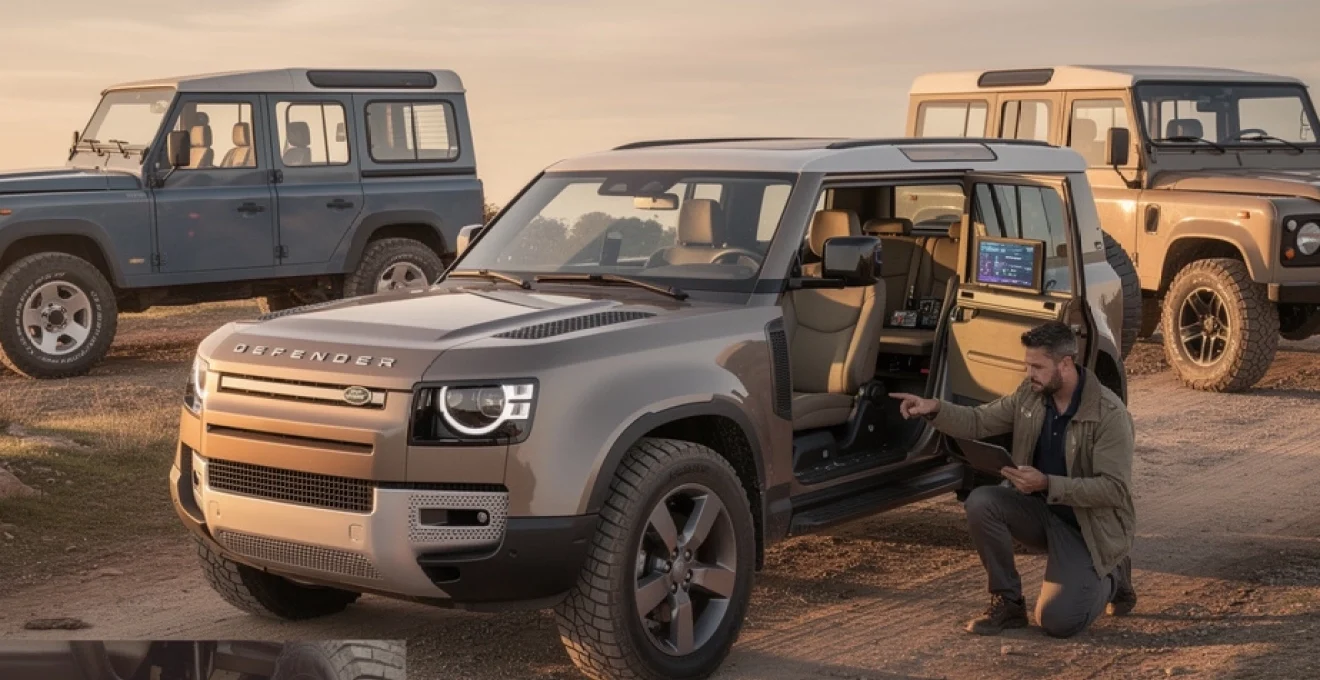
The Land Rover Defender L663 arrived in 2020 with the unenviable task of replacing one of the most recognisable 4x4s on the planet. For many enthusiasts, a Defender is more than a vehicle: it is a working tool, an expedition partner and, for some, a family heirloom. The new model had to satisfy that heritage while meeting stringent emissions rules, crash regulations and the expectations of SUV drivers used to refinement, connectivity and comfort.
If you are choosing between a classic Defender 90/110 and the latest L663, or simply trying to understand what has changed beneath the surface, the details matter. From the new aluminium D7x monocoque platform and advanced air suspension to Pivi Pro infotainment and plug‑in hybrid powertrains, the current Defender has been re-engineered as a thoroughly modern off‑road SUV that still targets class‑leading capability in mud, sand and rock.
Design evolution of the land rover defender L663 vs classic defender 90/110
Exterior architecture: aluminium monocoque d7x platform vs ladder-frame chassis
The most fundamental change in the Land Rover Defender L663 is hidden in plain sight: the move from a traditional ladder-frame chassis to an aluminium monocoque structure. Classic Defender 90 and 110 models used a separate frame with bodywork bolted on top, brilliant for bolting on accessories but compromised for crash performance and refinement. The L663 uses the dedicated D7x platform – the stiffest body structure Land Rover has ever produced – engineered around extreme off‑road loads and modern safety demands.
This aluminium architecture is claimed to be up to three times stiffer than a conventional body-on-frame design from the same segment. Higher torsional rigidity brings several benefits you will notice every day: fewer squeaks and rattles, more precise steering, and a calmer ride both on rough tracks and motorways. At the same time, the D7x platform is designed from the outset to accept electrified powertrains, including mild‑hybrid systems and a plug‑in hybrid, without compromising structural integrity.
Despite the engineering shift, the silhouette remains instantly recognisable. The upright stance, near-vertical tail, slab sides and exposed spare wheel all echo the original Defender. The design brief was to create a utilitarian, functional object rather than a fashion SUV, and the exposed fasteners, visible door hinges and robust bumpers underline that intention in day-to-day use.
Proportions, overhangs and approach angles on defender 90, 110 and 130
Dimensionally, the Land Rover Defender L663 is larger than its predecessor, but the engineering team has worked hard to keep overhangs short and geometry tight for serious off‑road driving. The three body styles – Defender 90, Defender 110 and Defender 130 – each target a slightly different use case, from compact off‑roader to family adventure wagon and multi‑row SUV.
The Defender 90 measures around 4,583mm including the rear‑mounted spare wheel, making it only a little longer than many family hatchbacks. That compact length, combined with short overhangs, translates into excellent approach and departure angles for steep inclines and sharp departure points. The 110 stretches to about 5,018mm with the spare wheel, accommodating up to seven seats, while the 130 pushes further again, focusing on three rows and long‑haul touring with passengers and luggage.
Off‑road enthusiasts looking for the best possible breakover angle typically gravitate towards the 90, due to its shorter wheelbase and nimble footprint. The 110 offers a good balance of interior space and off‑road geometry, while the 130 trades some breakover performance for carrying capacity and a vast load bay. The choice between them depends largely on how often you need to seat six or seven people versus tackling tight, technical trails.
Lighting, glazing and body detailing: signature DRLs, alpine lights and contrast roof
Lighting and glazing play a surprisingly important role in the Defender L663’s character. The classic round headlamps have evolved into square LED clusters with circular signature daytime running lights, giving a modern yet instantly familiar face. Full LED headlights are standard across most of the range, with matrix LED units on higher trims improving night‑time visibility by intelligently masking out oncoming traffic while maintaining high‑beam coverage elsewhere.
Traditional Defender cues such as the so‑called “alpine lights” in the roof above the rear seats have been reinterpreted with modern glazing and sealing technology. These upward‑facing windows improve the sense of space for passengers and give a nod to safari heritage. A contrast roof, sometimes paired with a black bonnet panel or protective film, adds further visual separation and hints at the vehicle’s off‑road purpose. Functional details like the side‑hinged tailgate, external spare wheel and robust, squared‑off wheel arches reinforce the idea that this SUV is designed to work hard in hostile environments.
Interior ergonomics: exposed magnesium cross‑car beam, wash‑out flooring and modular storage
Open the door and the Defender L663 immediately feels different to most premium SUVs. The horizontal dashboard is anchored by an exposed magnesium cross‑car beam, both a structural component and a design statement. It provides robust mounting points for grab handles, storage shelves and accessories. Rather than hiding every fixing under trim, the design celebrates visible screws and open shelves, conveying a sense of honest engineering and utilitarian intent.
The interior balance between ruggedness and comfort is one of the L663’s biggest strengths. Materials are chosen for durability – rubberised flooring, wipe‑clean surfaces and hard‑wearing fabrics – yet the overall ambience is modern, with digital instrumentation and a central touchscreen. In certain specifications, the floor can be washed down after a muddy off‑road session, especially useful if you carry dogs, surfboards or farm kit. The optional front jump seat, creating a three‑across arrangement, is a direct link to early Land Rovers and allows the Defender 90 and 110 to carry six occupants without moving to a much larger vehicle.
Chassis, suspension and off‑road hardware of the defender L663
D7x aluminium monocoque structure, rigidity figures and crash performance
The Defender’s D7x platform has been engineered to exceed not only the structural demands of serious off‑roading but also modern crash standards across multiple markets. According to Land Rover, the body structure can withstand up to 6.5 tonnes of vertical load through the suspension mounting points and over 7 tonnes of winching load. These figures matter if you are planning recovery operations, heavy towing or expedition preparation with roof tents and equipment.
From a safety perspective, the monocoque allows more controlled deformation in accidents than a separate chassis. Crash structures can be integrated into the body, improving energy absorption and passenger protection. In independent tests, the Defender L663 has achieved strong safety ratings with comprehensive airbag coverage and advanced driver assistance systems supporting the physical structure. For anyone using a Defender as a family vehicle, this represents a significant step forward over older generation models.
Independent suspension: double wishbone front, integral link rear and air vs coil springs
Another major transformation is the move to fully independent suspension. The front uses a double wishbone layout, while the rear features an integral link design. This combination delivers a blend of wheel articulation, ride comfort and precise control that older solid‑axle Defenders simply could not match on tarmac. For drivers who split time between long motorway journeys and rough tracks, the difference in refinement is substantial.
Most Defender 110 and 130 models are equipped with air suspension as standard, while the 90 can be specified with either traditional coil springs or height‑adjustable air springs. Coil springs offer simplicity and slightly lower weight, appealing for some off‑road purists, but air suspension brings superior adaptability. Height can be varied for entry, loading, motorway cruising and deep off‑road work, giving you more flexibility in a single vehicle.
Driveline layout: permanent AWD, twin‑speed transfer box and active rear locking differential
The Defender L663 uses permanent all‑wheel drive with a twin‑speed transfer case, providing both high and low ranges for different driving conditions. Low range is essential for slow‑speed control over obstacles, steep descents and heavy towing manoeuvres. The system constantly varies torque between the front and rear axles to maintain traction, aided by a sophisticated traction control system.
An active rear locking differential is available on many versions and strongly recommended for frequent off‑road use. By locking the rear axle, the vehicle can continue moving even when a wheel is off the ground or spinning freely. Combined with brake‑based torque vectoring – which can subtly brake individual wheels to send power where it is most useful – the driveline allows the Defender to tackle terrain that would halt less specialised SUVs on the first muddy ascent.
Geometry and capability metrics: ground clearance, wading depth, articulation and towing
Off‑road capability can be measured objectively through geometry and key metrics. Air‑suspended Defenders offer up to around 291mm of ground clearance in their highest off‑road setting, far exceeding most road‑biased crossovers. Approach, breakover and departure angles are highly competitive, especially on the Defender 90, allowing confident climbing and descending without constant fear of bumper damage.
The published maximum wading depth of the Defender L663 is an impressive 900mm when correctly set up, reinforcing the vehicle’s suitability for river crossings, flood‑prone tracks and remote expeditions. Suspension articulation of up to 500mm helps maintain four‑wheel contact over uneven ground. Towing capacity is also robust, with up to 3,500kg braked towing permitted, making the Defender a compelling choice if you regularly haul trailers, boats or caravans.
Tyre and wheel packages: 18–22 inch options, all‑terrain specs and spare wheel mounting
Wheel and tyre choice plays a critical role in real‑world ability. The Defender L663 is available with wheels from 18 inches up to 22 inches in diameter. For serious off‑road work and overlanding, many specialists advocate 18‑ or 19‑inch wheels with higher‑profile all‑terrain tyres, which better absorb sharp impacts, provide more sidewall flex and are easier to air down on sand or rocks.
Larger 20‑ to 22‑inch wheels, often shod with road‑biased tyres, deliver sharper steering and a more stylish appearance in urban environments, but inevitably sacrifice some off‑road compliance. The side‑hinged tailgate carries a full‑size spare wheel as standard, a key advantage for remote travel. Having a matching spare with the same tyre spec is essential if you encounter a puncture many miles from the nearest tyre centre, especially when using specialist off‑road rubber.
Engine range, powertrains and transmissions in the land rover defender L663
Ingenium 4‑cylinder and 6‑cylinder petrol engines: P300, P400 MHEV specifications
The early Defender L663 engine line‑up centred on JLR’s Ingenium family of modular petrol and diesel engines. On the petrol side, the P300 uses a 2.0‑litre, four‑cylinder turbocharged engine delivering around 296bhp. Performance is strong enough for brisk everyday driving, with 0–62mph times in the region of 8 seconds for the Defender 90 and just over for the 110, depending on specification.
Above that sits the P400, a 3.0‑litre, six‑cylinder mild‑hybrid petrol engine producing roughly 394bhp. Thanks to its integrated starter‑generator and 48‑volt electrical system, the P400 can harvest energy during deceleration, provide torque fill during acceleration and support smoother stop‑start operation. Official figures quote 0–62mph in about 6.3 seconds for the Defender 90 and 6.4 seconds for the 110, making this one of the quickest production Defenders ever while maintaining respectable fuel efficiency for a large off‑road SUV.
Ingenium diesel line‑up: D200, D250 and D300 mild‑hybrid torque and efficiency data
For many buyers, especially those planning long‑distance touring or regular towing, the diesel Defender remains the default choice. Early models offered D200 and D240 versions of the 2.0‑litre Ingenium diesel, both with mild‑hybrid assistance. The D200 produced around 197bhp with 0–62mph times of just over 10 seconds in the 90 and 110, while the D240 increased power to approximately 236bhp and trimmed the sprint to about 9 seconds.
Later in the lifecycle, revised 3.0‑litre six‑cylinder diesel units badged D200, D250 and D300 arrived in some markets, combining stronger torque outputs with improved refinement and lower real‑world fuel consumption. Official economy figures in the high 30s mpg for the lighter 90 and low‑to‑mid 30s for the heavier 110 show how modern diesels can still deliver compelling efficiency in a large, permanent‑4×4 vehicle, particularly when covering high annual mileages.
P400e plug‑in hybrid powertrain: electric range, battery capacity and charging hardware
The Defender P400e plug‑in hybrid adds another layer of versatility for mixed‑use owners. Combining a petrol engine (typically a 2.0‑litre Ingenium unit) with an electric motor and a substantial battery pack, the P400e offers silent, emissions‑free running for shorter journeys and full system power for demanding conditions. Depending on market and configuration, official WLTP electric‑only range is generally around 25–30 miles, enough to complete many commutes or school runs without using fuel.
Battery capacity sits in the mid‑teens to low‑20kWh range, supported by AC and DC charging. Public rapid charging can bring the battery from low to 80% in under an hour in favourable conditions, while a home wallbox overnight charge prepares the vehicle for daily use. For drivers who split usage between local errands and weekend off‑road escapes, the P400e can significantly reduce running costs and tailpipe emissions during everyday driving while still retaining authentic Defender capability.
High‑performance V8 variants: 5.0‑litre supercharged outputs and dynamic calibration
At the top of the range, high‑performance V8 Defender variants cater to enthusiasts who want classic off‑road ability with serious on‑road pace and soundtrack. These models use a 5.0‑litre supercharged V8 petrol engine producing in the region of 525bhp, sending power through all four wheels via the 8‑speed automatic gearbox. Acceleration is dramatic for such a boxy vehicle, with 0–62mph times dipping well below 6 seconds.
Chassis tuning on V8 Defenders is recalibrated for more dynamic driving, with bespoke damper settings, larger brakes and unique stability control tuning. While few owners will ever explore the full performance envelope on a green lane, the extra power does make overtaking with a trailer or climbing long motorway gradients effortless. The V8’s characterful exhaust note also adds an emotional dimension that is difficult to quantify but highly valued by many long‑time Land Rover fans.
ZF 8‑speed automatic gearbox mapping, low‑range ratios and driveline durability
All Defender L663 models use a ZF 8‑speed automatic transmission, chosen for its blend of durability, smoothness and flexibility. Gear ratios are closely spaced for responsive acceleration in high range, while low range multiplies torque for crawling over obstacles. In practice, the gearbox is almost always in the right gear, helped by intelligent mapping that considers throttle input, gradient and driving mode.
In off‑road settings, the transmission holds gears longer to avoid unwanted shifts mid‑obstacle, and in deep sand or mud, the calibration works with Terrain Response 2 to minimise wheelspin. From a longevity standpoint, the gearbox has a strong track record in other JLR products and luxury SUVs, provided servicing schedules are followed and towing limits respected. For most owners, the combination of 8‑speed auto, twin‑speed transfer box and permanent AWD strikes an ideal balance between ease of use and hardcore capability.
Off‑road systems, terrain response 2 and All‑Terrain technologies
Terrain response 2 drive modes: mud & ruts, sand, rock crawl and configurable settings
The Defender L663’s electronic brain is every bit as important as its mechanical hardware. Terrain Response 2 is the central control system, offering dedicated modes such as Grass/Gravel/Snow, Mud & Ruts, Sand and Rock Crawl. Each mode tailors throttle response, traction control, differential strategy and gearbox behaviour to match the surface under the tyres.
Configurable Terrain Response goes further, allowing experienced drivers to fine‑tune individual parameters to personal preference. For instance, you can select a softer throttle map for precise low‑speed rock crawling while keeping the differential more aggressively locked. This level of adjustability effectively turns the Defender into multiple vehicles in one, optimising performance whether you are tackling a wet field, a rutted track or a steep, rocky ascent.
Electronic aids: hill descent control, All‑Terrain progress control and brake‑based torque vectoring
Modern off‑road electronics can feel intimidating at first, but many features quickly become indispensable. Hill Descent Control automatically modulates the brakes to maintain a steady speed on steep descents, letting you focus on steering rather than juggling pedals. It is particularly useful when the surface is slippery or visibility is limited.
All‑Terrain Progress Control (ATPC) functions a little like low‑speed cruise control for rough ground. You set a target speed – often walking pace – and the system handles throttle and braking, allowing full attention on wheel placement. Brake‑based torque vectoring supports these systems by gently braking spinning wheels, directing power to those with grip. In combination, they make the Defender more forgiving for less experienced off‑road drivers while still offering advanced control for experts.
Clearsight ground view and off‑road camera suite for technical obstacle navigation
The Defender L663’s camera technology transforms how you see the terrain around the vehicle. The ClearSight Ground View system uses forward‑facing cameras and clever image processing to create a virtual view of the area directly in front of and beneath the front wheels on the central screen. On steep crests or when manoeuvring around rocks, this effectively lets you “see through” the bonnet, reducing guesswork.
Additional cameras provide 190‑degree wide‑angle coverage and a 3D surround view, helping with tight trails, parking in confined spaces and aligning with trailers. For anyone who has ever misjudged a rock step or hidden stump in an older 4×4, this technology can drastically reduce the risk of damage. It also makes the Defender more approachable for drivers new to off‑roading, easing the learning curve.
Wade mode, air suspension lift and calibration for deep‑water crossings
Water crossings are among the most dramatic off‑road scenarios, and the Defender’s 900mm wading depth is one of its headline figures. Wade mode prepares the vehicle for deep water by raising the air suspension, adjusting climate control to recirculate air, and optimising drivetrain settings to prevent stalling or loss of traction. Sensors and cameras help you judge depth and line before committing to the crossing.
It is still essential to follow sound technique – walking the route where safe, driving slowly to minimise bow waves, and avoiding sudden throttle inputs – but the vehicle’s hardware and software work together to provide an extra safety margin. For rural users navigating flooded fords or expedition drivers fording remote rivers, this capability can be more than a party trick; it can be a genuine enabler of safe travel.
On‑road dynamics, refinement and NVH in the defender L663
Although the Land Rover Defender L663 is engineered as a serious off‑road machine, its day‑to‑day life for many owners involves commuting, family trips and long motorway journeys. Here, the transition from ladder‑frame to stiff aluminium monocoque truly pays off. Body control is significantly tighter than older Defenders, with far less shimmy over broken surfaces and a more composed response to quick lane changes. The independent suspension, particularly in air‑suspended models, filters out high‑frequency bumps while still allowing long‑travel compliance over potholes and speed humps.
Noise, vibration and harshness (NVH) have been dramatically improved. Acoustic glass, extensive sound‑deadening and careful engine mounting reduce the characteristic clatter of earlier diesel Defenders to a distant murmur, especially at a steady cruise. Petrol and plug‑in hybrid versions are quieter still, and the P400e can run in near‑silence in electric mode around town. Steering is more direct and precise, giving you confidence on faster roads, and braking performance benefits from large discs and strong calipers shared with other premium JLR products. For many long‑time Land Rover drivers, the biggest surprise when stepping into a Defender L663 is not its off‑road prowess, but how civilised and car‑like it feels at 70mph on the motorway.
Interior technology, pivi pro infotainment and driver assistance systems
Pivi pro and pivi pro 2: 11.4‑inch touchscreen, snapdragon hardware and OTA updates
The Defender L663 introduced a new generation of Land Rover infotainment called Pivi Pro, later joined by updated Pivi Pro 2 hardware in some model years. Early vehicles used a 10‑inch touchscreen, while later versions feature an 11.4‑inch curved display with faster processing courtesy of Snapdragon automotive hardware. The emphasis is on rapid startup – essential in a world where a driver expects maps and media to be ready almost immediately after pressing the start button.
Over‑the‑air (OTA) software updates help keep the system current without constant dealer visits, whether improving navigation algorithms, adding new connected services or refining user interface details. For you as an owner, that means the digital experience can subtly improve over time rather than feeling outdated after a few years. The layout is deliberately simple, with large tiles for key functions and context‑sensitive menus designed for gloved hands and bumpy tracks.
Digital instrumentation: interactive driver display, HUD and off‑road data visualisation
Behind the steering wheel, many Defender L663 specifications include a 12.3‑inch interactive driver display, replacing traditional analogue dials. This digital cluster can show classic round instruments, a full‑screen map, or a mix of vehicle information depending on preference. For technical off‑roading, the display can highlight suspension height, steering angle, driveline lock status and pitch/roll, giving immediate feedback on the vehicle’s attitude.
An optional head‑up display (HUD) projects key data such as speed, navigation prompts and safety alerts onto the windscreen. In demanding terrain, this helps you keep eyes up and focused on the environment, rather than constantly glancing down at screens. Think of it as a co‑driver quietly feeding you the essentials while you concentrate on placing tyres and reading the surface ahead.
ADAS suite: adaptive cruise control, pilot assist, lane keep assist and 3D surround camera
Advanced driver assistance systems (ADAS) have become a core part of any modern SUV, and the Defender is no exception. Adaptive Cruise Control maintains a set distance from the vehicle ahead, easing long drives on congested motorways. Lane Keep Assist gently steers the car back between lane markings if you begin to drift, reducing the risk of unintended lane departures due to distraction or fatigue.
The 3D Surround Camera system complements these aids with a real‑time, rotatable view of the Defender from above and around, invaluable in tight city streets, multi‑storey car parks and on narrow trails with rock walls or trees. Blind Spot Monitoring, Rear Cross Traffic Alert and traffic sign recognition further enhance situational awareness. For anyone considering a Defender as a daily driver in dense urban traffic, these systems significantly reduce stress and help protect both occupants and vulnerable road users.
Connectivity: apple CarPlay, android auto, eSIM, Wi‑Fi hotspot and remote app functions
Connectivity is now a baseline expectation rather than a luxury, and the Defender L663 delivers a broad suite of options. Apple CarPlay and Android Auto integration allow you to mirror smartphone apps for music, navigation and messaging onto the central screen, maintaining a familiar interface. Built‑in eSIM functionality supports connected services and can provide a Wi‑Fi hotspot for passengers, useful on long trips or as a mobile office.
Remote app functions enable you to monitor fuel or battery level, lock or unlock the vehicle and, in some cases, pre‑condition the cabin temperature before setting off. This can be particularly helpful in extreme climates, whether warming the interior on a frosty morning or cooling it before driving away from a hot campsite. Taken together, these features make the Defender feel as up‑to‑date in digital terms as it is in mechanical engineering.
Trim levels, body styles and defender L663 special editions
Defender 90, 110 and 130 body configurations, seating layouts and load volumes
The Defender L663 range is built around three primary body styles: 90, 110 and 130. The compact Defender 90 offers three doors and a shorter wheelbase, making it particularly agile off‑road and easier to manoeuvre in tight urban streets. It can seat up to six people with the optional front jump seat, although rear access is naturally more constrained than in the longer versions.
The Defender 110 adds rear doors and a longer wheelbase, opening up more legroom and a generous boot. In five‑ or six‑seat configurations, load space ranges from around 646 litres with the rear seats in place up to over 2,300 litres with them folded, depending on exact layout. The optional 5+2 arrangement adds a third row suitable mainly for children or occasional adult use on shorter journeys. The 130 takes this concept further, prioritising three rows of seating and substantial luggage capacity for large families or group expeditions. Boot volume figures of up to 2,380 litres with seats folded highlight just how versatile these longer models can be for overlanding, camping or commercial tasks.
Core grades: S, SE, HSE, X‑Dynamic and X specification breakdown
Trim levels for the Defender L663 are structured to reflect different equipment and styling preferences. The core grades typically progress from a well‑equipped base specification through S, SE and HSE variants, each adding layers of comfort, technology and visual differentiation. S models often introduce upgraded wheels and additional convenience features, while SE and HSE bring higher‑grade upholstery, more advanced LED headlights and enhanced driver assistance systems.
X‑Dynamic trims add more rugged visual elements – such as contrast lower cladding, unique wheel designs and interior accents – aimed at those who want a tougher aesthetic without stepping up to the fully loaded X models. At the top, Defender X grades combine near‑flagship luxury equipment with distinctive exterior detailing, black contrast roofs and, in some cases, exclusive paint colours. When choosing a specification, it is wise to prioritise functional upgrades – such as air suspension or the off‑road pack – before purely cosmetic options, especially if regular use in challenging terrain is planned.
Special editions: defender V8 carpathian edition, 75th limited edition and expedition builds
Special editions have become an important part of the Defender story, offering factory‑curated combinations of options and styling cues. The Defender V8 Carpathian Edition, for example, pairs the 5.0‑litre supercharged engine with unique Carpathian Grey paint, contrasting black roof and bonnet, and specific trim inside and out. It targets buyers seeking the most exclusive and performance‑oriented Defender available from the showroom.
Anniversary models such as the 75th Limited Edition celebrate Land Rover’s heritage with heritage‑inspired colours, badging and curated equipment lists. Expedition‑oriented builds, whether from the factory or approved partners, may incorporate roof racks, raised air intakes, underbody protection, on‑board air compressors and integrated storage systems. For you as a buyer, these editions can represent good value if the included extras match planned usage, but a bespoke build from a more basic trim can be equally compelling for focused tasks like overlanding or field work.
Commercial variants: defender hard top configurations for utility and fleet use
Beyond lifestyle and family roles, the Defender L663 also serves as a serious commercial vehicle through its Hard Top variants. These models replace the rear passenger area with a load space separated by a robust bulkhead, effectively turning the Defender 90 or 110 into a van with exceptional off‑road ability. The load bay is fitted with tie‑down points, durable flooring and, in some specifications, configurable storage solutions for tools and equipment.
For fleets and small businesses operating in rural, construction or utility environments, the Defender Hard Top offers a rare blend of payload capacity, towing strength and go‑anywhere traction. While comfort and technology remain at a high level compared with many traditional vans, the emphasis shifts towards durability and practicality. If day‑to‑day work involves unmade roads, farms, remote installations or severe winter conditions, a Defender Hard Top can provide a dependable platform that still feels refined and comfortable during long hours behind the wheel.