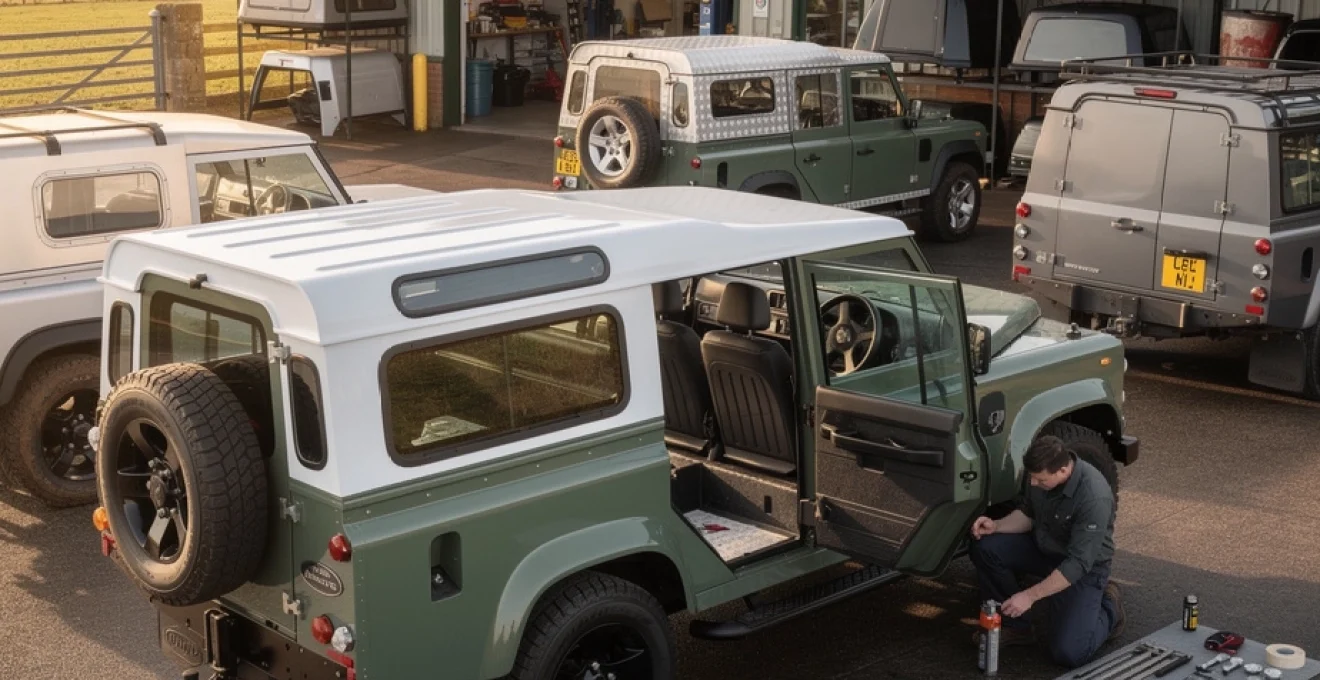
Choosing the right Land Rover hard top is about far more than keeping the rain out. The roof and side panels you fit define how the vehicle works as a tool, how it is taxed and insured, and how easily it can be sold on. Whether you run a Defender 90 Hard Top as a compact urban van, a Defender 110 utility for rural work, or an older Series or Discovery commercial for specialist duties, the right configuration transforms day‑to‑day usability. With modern hard tops offering integrated storage, insulation, electronics and security, you have more choice than ever – but that choice can be confusing if you are juggling commercial use, weekend adventure and future resale.
Recent launches of the latest Defender 90 and 110 Hard Top models, along with the continuing demand for classic Defender and Series conversions, show just how strong the UK appetite is for Land Rover vans, commercial 4x4s and expedition builds. Understanding configurations, construction, fitment and regulations makes it easier for you to specify a hard top that suits both work and leisure, while staying on the right side of DVLA, MOT testers and insurers.
Land rover hard top configurations by model: defender 90/110/130, discovery 1–3 and series II–III
Factory hard top variants for land rover defender 90, 110 and 130 (van, utility, station wagon conversions)
The modern factory Defender Hard Top range shows how diverse Land Rover hard top configurations can be. The current Defender 90 Hard Top offers around 1.4m³ of load volume and a payload of roughly 670kg, while the long‑wheelbase Defender 110 Hard Top delivers about 2.1m³ and 800kg payload, with towing capacity up to 3,500kg. In both cases, the rear seats are removed and the side glass is replaced by solid panels, creating a flat, rubber‑lined loadspace with integrated lashing points and underfloor storage. For many users, that layout is far more practical than a traditional pick‑up with a canopy because tools and cargo are secure, dry and easily heated.
Earlier Defender 90, 110 and 130 models offered multiple factory hard top and utility variants. Typical patterns were the basic van‑back (panel sides, no rear seats), utility Station Wagon (glazed sides with removable rear seats) and the familiar pick‑up with optional canopy. Some owners ask if a modern Defender Hard Top can be run as both hard top and soft top for summer by removing roof and sides. Technically it is possible on classic Defenders that share common mounting points, but it involves re‑routing seat belt anchorages, fitting a hoop set and ensuring type‑approval safety standards are not compromised. For business users focused on residual value, a well‑specified fixed hard top usually proves more saleable than a multi‑configuration hybrid.
Legacy hard top styles for land rover series II, series IIA and series III (SWB vs LWB fitment constraints)
Series II, IIA and III hard tops follow a simpler pattern: short‑wheelbase (SWB, 88in) and long‑wheelbase (LWB, 109in) roofs and side panels, usually in aluminium with steel rear doors. Fitment constraints are critical; an 88in roof will not simply bolt onto a 109in without major fabrication, and side panels are specific to wheelbase and body style. Many Series vehicles left the factory as soft tops or truck cabs, then received aftermarket or dealer‑supplied hard tops later in life. Conversions were easy because the body tub mounting points for the cappings, rear body and windscreen frame are common across soft and hard top variants.
If you plan to swap between a Series hard top and canvas, the main structural difference lies in the seat belt anchorage. A hard top tends to use body‑side or roof‑mounted upper anchors, while a soft top relies on a tubular roll‑over hoop or transverse bar behind the seats. Regardless of age, that anchorage must meet modern MOT expectations for strength, positioning and corrosion resistance. Anyone buying a second‑hand Series hard top should inspect the gutter rails, rear door frame and steel/aluminium joint lines, as these are the areas most exposed to water ingress and electrolytic corrosion.
Hard top compatibility on discovery and freelander commercial derivatives in the UK market
Discovery and Freelander commercial derivatives blur the line between hard top and car‑derived van. Discovery 1 and 2 commercial conversions typically used steel body shells with blanked‑out rear windows, rear seats removed and a full‑height bulkhead installed. Later Discovery 3 and 4 commercials were developed more like the modern Defender Hard Top, with professionally engineered loadspaces, integrated storage wells and rubber‑lined floors. Because these vehicles are built as closed bodies from the start, there is no removable “canopy” in the traditional sense; instead, you are dealing with interior panels, bulkheads and linings.
Freelander commercial models in the UK market were also based on passenger shells with rear seating removed and side glass blanked or filmed. Hard top compatibility here usually refers to interior trade racking, dog guards, mesh partitions and external roof rack systems rather than detachable tops. If you are used to the modularity of a Defender hard top, Discovery and Freelander commercial conversions feel more fixed, but they offer excellent refinement, security and crash performance for light commercial vehicle (LCV) use.
Panel van versus glazed hard top layouts for utility, agricultural and fleet applications
Choosing between a panel van‑style hard top and a glazed hard top layout is one of the most important decisions for a working Land Rover. Panel van sides maximise security and privacy for valuable tools, plant or surveying equipment, and typically offer more interior surface area for racking, shelving and branding. Agricultural users often favour solid sides because they resist damage from livestock and vegetation and make it easier to clean down with pressure washers and disinfectant.
Glazed hard tops, as seen on many utility Station Wagons and newer Defender Hard Top derivatives with optional glass panels, allow better visibility and a more car‑like feel for mixed passenger and cargo use. Fleet operators sometimes specify partial glazing, for example rear quarter windows combined with blanked middle panels, to balance outward vision and security. For dual‑purpose Land Rovers that double as family transport, a glazed hard top with a removable or fold‑away bulkhead provides welcome daylight and reduces the “white van” feel without giving up load volume entirely.
OEM and aftermarket land rover hard top options: genuine LR, safety devices, truckman, ifor williams
Genuine land rover hard tops and roofs: part numbers, build codes and VIN-based identification
Genuine Land Rover hard tops and roofs remain the benchmark for fit and finish, especially on late‑model Defender and Discovery-based commercials. Factory parts are identified by Land Rover part numbers and build codes stored in the vehicle’s VIN record, which helps you confirm whether a vehicle left the factory as a hard top, Station Wagon or pick‑up. That distinction matters for both resale value and compliance, particularly where the V5C already lists the body type as “Light 4×4 Utility” or “Panel Van”.
When sourcing OEM Defender roofs and side panels, it makes sense to match build codes as closely as possible to the original configuration. For example, converting a factory Defender 90 Hard Top into a glazed utility by adding genuine windows and trims will usually deliver better panel alignment, door sealing and noise levels than a generic aftermarket kit. Genuine rear doors, seals and hinges are also designed to work together, reducing the risk of leaks and wind noise that commonly plague poorly fitted older conversions.
Heavy‑duty commercial canopies from ifor williams, brownchurch and safety devices for defender pick‑ups
For Defender pick‑ups and older Series trucks, heavy‑duty commercial canopies from brands such as Ifor Williams, Brownchurch and Safety Devices effectively act as modular hard tops. These aluminium or steel framed units bolt to the loadbed cappings and usually offer a choice of solid or mesh sides, rear barn doors or drop‑downs, and options for internal racks. Farmers and plant operators favour Ifor Williams and Brownchurch for their proven durability and easy parts availability; a damaged mesh panel or roof sheet can often be replaced without discarding the entire canopy.
Safety Devices canopies occupy a more specialist niche, combining roll‑over protection structures with an enclosed top for expedition or hostile‑environment use. These are particularly attractive if you require a certified roll cage and an enclosed hard top in one integrated system. The trade‑off is weight and cost: these systems add significant mass over the rear axle and need careful attention to payload and suspension upgrades, especially on older 110 and 130 models already running at or near their gross vehicle weight.
Truckman and Alu‑Cab canopy systems with side access, roof rails and integrated ventilation
Truckman and Alu‑Cab canopy systems bridge the gap between pure commercial hard tops and lifestyle or expedition shells. A typical Truckman top for a Defender pick‑up offers lockable side access doors, optional roof rails and integrated ventilation grills, allowing you to store tools, dogs or sports equipment securely. Alu‑Cab products often go further with gull‑wing side doors, internal lighting provisions and pre‑engineered brackets for awnings and roof tents. For a mixed‑use vehicle that spends weekdays on site and weekends on trails, that combination of work access and leisure flexibility is extremely attractive.
From a professional perspective, side access is one of the most underrated features on a Land Rover hard top. Being able to open a gull‑wing door and reach tools at chest height without climbing into the back dramatically speeds up repetitive jobs. It also reduces strain injuries and damage to interior trim. When specifying a Truckman or Alu‑Cab canopy, pay attention to hinge and gas strut quality; these are the moving parts that work hardest, especially when a roof rack or spare wheel adds extra weight to the doors.
Modular expedition hard tops from front runner, patriot and nakatanenga for overland builds
Modular expedition hard tops from brands such as Front Runner, Patriot and Nakatanenga cater to a different audience: long‑distance travel, remote work and self‑sufficient overlanding. These systems often combine a reinforced roof, low‑profile rack and integrated mounting tracks for awnings, jerrycans, sand ladders and roof tents. The key idea is to turn the hard top into a structural component capable of supporting higher static roof loads for sleeping and heavy gear, while keeping dynamic loads within Land Rover’s rated limits.
A modern Defender 110 Hard Top, for example, might be rated for a dynamic roof load of 100kg but a static load of 300kg when parked. Expedition hard tops exploit that difference by distributing weight through multiple mounting points and stiffened panels. If your goal is a long‑range touring Defender 110 or 130, a modular expedition roof that accepts bolt‑on accessories without drilling can save countless hours and reduce leak risk. It also helps retain value, because a future owner can re‑configure the same shell for different roles without cutting new holes.
Second‑hand MOD wolf and tithonus military hard tops: sourcing, de‑militarisation and road use
Ex‑MOD Wolf and Tithonus hard tops remain popular among enthusiasts looking for rugged, affordable options. These military roofs and sides are built to a heavier spec than most civilian equivalents, with reinforcing ribs, additional tie‑down points and thicker gauge aluminium or steel elements. They were designed for harsh environments and, in many cases, have survived decades of service on 90 and 110 chassis with minimal structural damage. However, they do come with quirks such as rifle clips, aerial mounts and blackout fittings that need removal or repurposing for civilian use.
De‑militarisation typically involves removing surplus brackets, welding or blanking unwanted holes, and repainting in a civilian colour. For legal road use, ensure the rear lighting, reflectors and number plate mounts comply with current Construction and Use regulations. Insurance providers may treat ex‑military hard tops as modifications, especially where the roof incorporates a roll cage or unusual apertures, so full disclosure is essential. Properly tidied and painted, a Tithonus or Wolf roof can make a Defender 90 or 110 stand out, while adding to the vehicle’s “tough” image and resale appeal among enthusiasts.
Construction types and materials: steel, aluminium, GRP and composite land rover hard tops
Pressed steel and aluminium hard tops on classic defenders and series models: corrosion and galvanic interaction
Traditional Land Rover hard tops combine pressed steel and aluminium panels, which brings advantages and challenges. Aluminium roof skins and side panels keep weight down and resist rust, while steel frames, gutter rails and doors provide strength and hinge mountings. The downside is galvanic interaction where bare aluminium and steel meet in the presence of moisture and salt. Over time, that mixed‑metal interface can blister, pit and eventually perforate, especially around rivets, gutters and rear door apertures.
Addressing this requires good preparation during fitment and refurbishment. Primer, seam sealer, proper gaskets and non‑conductive washers reduce galvanic corrosion risk dramatically. When inspecting a used Defender 90 Hard Top or Series roof, pay close attention to the inner gutter, rear corner joints and the steel strip under the windscreen seal. Replacing these sections before fitting the hard top to a restored chassis avoids the frustration of leaks and bubbling paint appearing within a couple of winters.
GRP (fibreglass) commercial tops: lay‑up methods, reinforcement ribs and long‑term fatigue behaviour
Glass reinforced plastic (GRP) – usually referred to as fibreglass – is common in aftermarket commercial tops because it is relatively cheap to mould, light and easy to repair. GRP hard tops for Defender and Series models typically use a hand‑lay‑up or vacuum‑infused shell with integrated ribs and thicker sections around hinges and latches. Done properly, this creates a strong, slightly flexible structure that shrugs off minor knocks without denting like steel or creasing like thin aluminium.
However, GRP has its own ageing pattern. Repeated flexing, UV exposure and thermal cycling can lead to micro‑cracks, crazing and local delamination, especially around drilled holes or unreinforced openings. If you are planning to cut new apertures for windows or vents in a fibreglass top, it is wise to add reinforcement rings or bond in alloy frames. Regular polishing or protective coatings help maintain UV resistance and reduce chalking, extending the life and appearance of the top significantly.
Aluminium and composite expedition roofs with integrated roof racks and load-bearing structures
Aluminium and composite expedition roofs take the idea of a hard top further by turning it into a true load‑bearing structure. Many modern systems use box‑section extrusions, bonded panels and internal frames to spread roof rack loads across multiple mounting points rather than concentrating everything at a few bolts. This is crucial when carrying roof tents, recovery gear and water or fuel, especially off‑road where dynamic loads spike with every bump and side‑slope.
Composite tops may combine aluminium skins with foam or honeycomb cores to improve stiffness and insulation while keeping weight down. The result is a roof that feels more like the monocoque shell of a modern SUV than the bolt‑on cap of an older Defender. If your build involves a heavy static roof load rating for sleeping, an integrated expedition roof offers far more safety margin than simply adding a rack to a standard hard top, particularly on earlier vehicles without factory roof‑rail reinforcements.
Thermal insulation, condensation control and acoustic damping in hard top panel design
Thermal insulation, condensation and noise control are often afterthoughts in Land Rover hard top projects, yet they have a huge effect on daily comfort. A bare aluminium or GRP hard top behaves like a cold box in winter and an oven in summer, encouraging condensation that drips onto tools, upholstery and electronics. Adding closed‑cell foam, foil‑backed insulation or specialist acoustic liners to the inside of roof and side panels makes a dramatic difference to temperature stability and cabin quietness.
A practical approach is to treat a Land Rover hard top like the shell of a campervan: insulate first, then add a vapour barrier and finally finish with a wipe‑clean lining. This three‑layer strategy reduces “drumming” at speed, deadens rain noise and helps keep condensation behind the lining instead of on visible surfaces. For commercial users transporting sensitive equipment or working long hours in‑vehicle, that comfort translates directly into productivity and perceived vehicle quality.
Fitment and installation procedure for land rover hard tops: preparation, mounting and sealing
Assessing body alignment and chassis condition before hard top installation on defender and series
Before fitting a hard top to any Defender or Series Land Rover, assessing body alignment and chassis condition is essential. A twisted chassis, sagging rear crossmember or bent tub cappings will translate into poor panel gaps, misaligned doors and chronic leaks, no matter how carefully the roof is bolted down. Measuring diagonals across the tub, checking door aperture squareness and verifying body mounts are intact prevents expensive rework later.
If the vehicle has recently undergone chassis replacement or major welding, it can be helpful to temporarily fit doors and the windscreen frame, then “dry‑offer” the hard top before final painting. This allows shimming and adjustment while fasteners are still accessible and surfaces are bare. Treat the hard top as a structural component tying the scuttle, tub and rear structure together rather than a cosmetic lid; if those reference points are true, the roof will seat and seal far more easily.
Removing soft tops, truck cabs and canopies: hoop set disassembly, header rail removal and trim preservation
Converting from soft top or truck cab to hard top on a Defender 90 or 110 involves more than unbolting a few panels. Start by photographing the existing hoop set, header rail and fixings, as this makes re‑assembly or resale easier later. Canvas or mohair tops should be carefully removed and stored clean and dry; good soft tops hold value, particularly genuine items or premium aftermarket brands that fit well and resist flapping at speed.
The steel header rail at the top of the windscreen frame must usually be swapped or removed to suit the hard top front seal profile. Hoop set feet and brackets on the tub cappings are unbolted, and any sealant or adhesive cleaned off. Interior trims around the B‑post and tub top are vulnerable to damage at this stage, so using trim tools and patience preserves clips and reduces rattles later. Think of it like dismantling a tent frame carefully rather than simply cutting guy lines.
Mounting a defender 90/110 hard top: fixing points, torque settings, brackets and spreader plates
Mounting a Defender 90 or 110 hard top follows a logical sequence. The roof and side panels are typically offered to the vehicle as a single assembly with helpers, then aligned to the windscreen frame and tub cappings. Factory fixing points include bolts along the gutter to the windscreen, bolts down through the cappings into the tub rails, and fixings at the rear corners into brackets or spreader plates. On some aftermarket tops, additional brackets are supplied to reinforce stress points.
Using correct torque settings and avoiding over‑tightening is critical. Crushing the cappings or deforming fibreglass flanges leads to leaks and stress cracks. A light initial torque to seat the seals, followed by even tightening after a day or two of settling, works well. Where the hard top incorporates heavy accessories such as roof racks, consider additional spreader plates or brackets to transfer load into the B‑posts and body sides, protecting both roof and tub over the long term.
Sealants, gaskets and weatherproofing: PU adhesive, butyl tape and OEM rubber profiles
Effective sealing transforms how a Land Rover hard top behaves in UK weather. OEM rubber profiles around the windscreen top, side panel joints and rear door aperture provide the primary defence, but careful use of supplementary sealants makes the difference between a dry, quiet interior and a damp, musty one. Polyurethane (PU) adhesive sealant is ideal for permanent joints where strength and flexibility are needed, such as gutter seams or overlapping panel flanges.
Butyl tape excels around removable joints and fasteners because it compresses without hardening and can be lifted cleanly if disassembly is required. A neat bead along the tub cappings under the hard top flange helps prevent capillary water ingress. However, over‑sealing can trap moisture and hide corrosion, especially on older Series and Defender tubs. A balanced approach, following Land Rover workshop manual guidance for key joints, maintains serviceability while ensuring long‑term weatherproofing.
Leak testing, panel gap inspection and post‑fitment adjustment under real-world load
Once a hard top is installed, leak testing and panel inspection under realistic conditions are essential. A hose test reveals obvious water entry points, but real‑world driving in heavy rain or crosswinds may expose different issues such as wind whistles or flex‑induced drips. Observing how the hard top behaves when the vehicle is fully loaded, hitched to a trailer or parked on uneven ground provides further clues about stresses and potential future cracks.
Minor adjustments of latch positions, hinge alignment and fastener torque usually rectify these problems. In some cases, adding small shims at the windscreen top or rear corners can even out panel gaps and improve seal compression. For vehicles that spend significant time off‑road, a periodic check of hard top fasteners and seals – perhaps at each service interval – keeps performance stable and catches developing issues before they become major water ingress or structural problems.
Regulatory and insurance considerations for land rover hard top conversions in the UK
DVLA body type updates, V5C amendments and MOT implications of van and hard top conversions
Hard top conversions on Land Rovers sit at the intersection of bodywork, taxation and legal definition. Changing a Defender from a Station Wagon to a van‑back hard top – or vice versa – may require a DVLA body type update and V5C amendment, especially where seat counts and window configurations change significantly. The DVLA bases decisions on evidence such as photographs, receipts and professional conversion invoices, so maintaining clear documentation of the work is wise.
MOT implications depend on how the vehicle is classified and used. A genuine commercial Hard Top used solely for business may be tested as a goods vehicle with different weight limits and brake balance expectations, whereas a dual‑purpose 4×4 might fall under passenger car rules. Removing or adding rear seats, cutting new windows or deleting existing glass can all influence how an MOT tester interprets the vehicle, so it is safer to align the hard top configuration, V5C details and intended use from the outset.
Light commercial vehicle (LCV) versus passenger classification: tax, ULEZ and congestion charge impacts
In the UK, whether a Land Rover hard top counts as an LCV or passenger vehicle affects tax, company car benefit‑in‑kind (BIK), ULEZ charging and even parking permits. A Defender 90 Hard Top registered as an LCV may qualify for flat commercial vehicle tax rates and lower BIK if used as a company van, while a glazed Station Wagon with multiple passenger seats is likely to be taxed as a car. Local Ultra Low Emission Zone (ULEZ) and congestion charge rules also distinguish between van and passenger classifications.
Switching from a hard top van layout to a more passenger‑oriented configuration by adding seats and windows could inadvertently move the vehicle into a less favourable tax and emissions bracket. Conversely, converting an older passenger Defender into a genuine commercial hard top might improve operating costs if the usage fits HMRC’s definition of a van. Professional advice is valuable here, as incorrect classification can lead to unexpected back‑tax or penalties.
Insurance disclosure for structural roof changes, window deletion and bulkhead modifications
From an insurer’s perspective, a hard top conversion is a structural modification that must be disclosed. Replacing a soft top with a steel or aluminium roof, deleting windows to create a panel van layout, or cutting new apertures all change the risk profile of the vehicle. Some insurers view enclosed hard tops as positive for security because tools and cargo are hidden, while others focus on increased repair costs or non‑standard parts availability.
Bulkhead modifications deserve particular attention. Removing or altering the factory bulkhead between cabin and loadspace, or installing a non‑OEM mesh or solid partition, can influence how a vehicle behaves in a collision and how loads are contained. Declaring these changes, along with the brand and specification of any hard top or canopy, avoids disputes in the event of a claim and may even open access to specialist 4×4 or commercial policies better suited to heavily modified Land Rovers.
Practical specification: payload, roof load, interior layout and aftermarket integrations
Static and dynamic roof load ratings for defender and discovery hard top configurations
Roof load ratings play a central role in specifying a Land Rover hard top, particularly on Defenders and Discovery commercials used for work at height or overlanding. Manufacturers distinguish between dynamic roof load – the maximum weight allowed while driving – and static roof load, which may be two or three times higher when parked. A typical modern Defender 110 Hard Top might be rated for 100kg dynamic and 300kg static, while older Defenders have lower official numbers and rely more on aftermarket reinforcement.
Exceeding these limits risks roof deformation, compromised handling and, in extreme cases, structural failure. When fitting racks, roof tents and gear boxes, add up the weight of the rack itself plus the load. A modular expedition hard top designed to share loads across multiple brackets makes it far easier to stay within safe limits. Regularly carrying ladders or long materials? A lighter GRP or aluminium rack may leave more payload for actual cargo, keeping the vehicle both compliant and safer to drive.
Bulkheads, load guards and racking systems for trade and utility land rovers
Inside a hard top Land Rover, bulkheads, load guards and racking determine how efficiently you can use the space. A full‑height bulkhead with a mesh window, as fitted to many Defender 90 and 110 Hard Top models, isolates the cabin from the load area and provides fixing points for hooks, shelving and tool boards. For some trades, a half‑height or removable bulkhead offers a useful compromise, allowing through‑loads when necessary while still providing restraint for most everyday cargo.
Racking systems specifically designed for Defenders, Discoverys and Series vehicles take into account the narrow body, wheel arch intrusions and rear underfloor storage wells. Mounting heavier items low and towards the bulkhead improves stability and reduces the risk of high‑mounted loads shifting under braking. Using the hard top’s internal ribs and frame members as anchor points, rather than thin roof skins or single‑skin GRP, preserves structural integrity and minimises drumming or squeaks once on the road.
Cutting apertures for side windows, gull-wing hatches and roof vents in GRP and aluminium tops
Customising a hard top with new side windows, gull‑wing hatches or roof vents can transform day‑to‑day usability, but careful planning is essential. Cutting into GRP or aluminium is relatively straightforward, yet each new aperture weakens the panel unless reinforced. For gull‑wing side doors on a Defender utility or pick‑up canopy, surrounding the cut‑out with a bonded frame or bracket set spreads hinge and latch loads and reduces stress cracking, especially on corrugated tracks and farm roads.
Roof vents require similar consideration. A small mushroom vent or low‑profile louvre can dramatically reduce condensation and smell build‑up in tool or dog‑carrying hard tops, but siting them away from structural ribs and seam joints avoids leaks. Additionally, allowing for cable runs and potential solar panel placement before cutting saves re‑work later. Treat the hard top like a body shell rather than a simple bolt‑on accessory; every cut should respect load paths and water‑shedding behaviour.
Wiring integration for interior lighting, rear work lamps, reversing cameras and heated screens
Modern hard tops increasingly integrate electrical features such as LED interior strips, rear work lamps, reversing cameras and heated rear screens. Running wiring neatly and safely through a Defender or Discovery hard top keeps systems reliable and reduces the chance of chafing or water ingress. Grommeted pass‑throughs, conduit and adhesive clips all help route cables along internal ribs rather than across bare panels where they can be snagged by cargo.
Where possible, integrating hard top electrics with existing vehicle looms using proper connectors and fused feeds maintains serviceability. For example, adding a heated rear screen to a Defender Hard Top is cleaner if using OEM switchgear and relays, especially on later models with CAN‑bus control. LEDs draw less current and generate less heat than incandescent lamps, making them ideal for enclosed hard top spaces that may already be thermally challenged in summer months.
Security hard tops: deadlocks, mesh guards and alarm sensor placement for tool and cargo protection
Security is often the primary reason for fitting a hard top to a Land Rover rather than sticking with a soft top or open pick‑up. Upgrading rear doors and side access panels with deadlocks, anti‑jemmy plates and reinforced hinges makes it significantly harder for opportunistic thieves to gain entry. Inside, steel mesh guards over windows and behind bulkhead apertures protect against smash‑and‑grab theft, particularly in urban areas or on unattended construction sites.
Alarm sensor placement deserves equal attention. A volumetric sensor that only covers the front cabin leaves the hard‑earned tools in the rear of a Defender 90 Hard Top vulnerable. Extending the alarm coverage to the loadspace, including tilt and motion sensors for roof‑mounted gear, creates a more complete security envelope. Ultimately, a well‑specified security hard top reduces downtime from theft, helps satisfy insurer requirements, and adds real value when the time comes to sell the vehicle on.