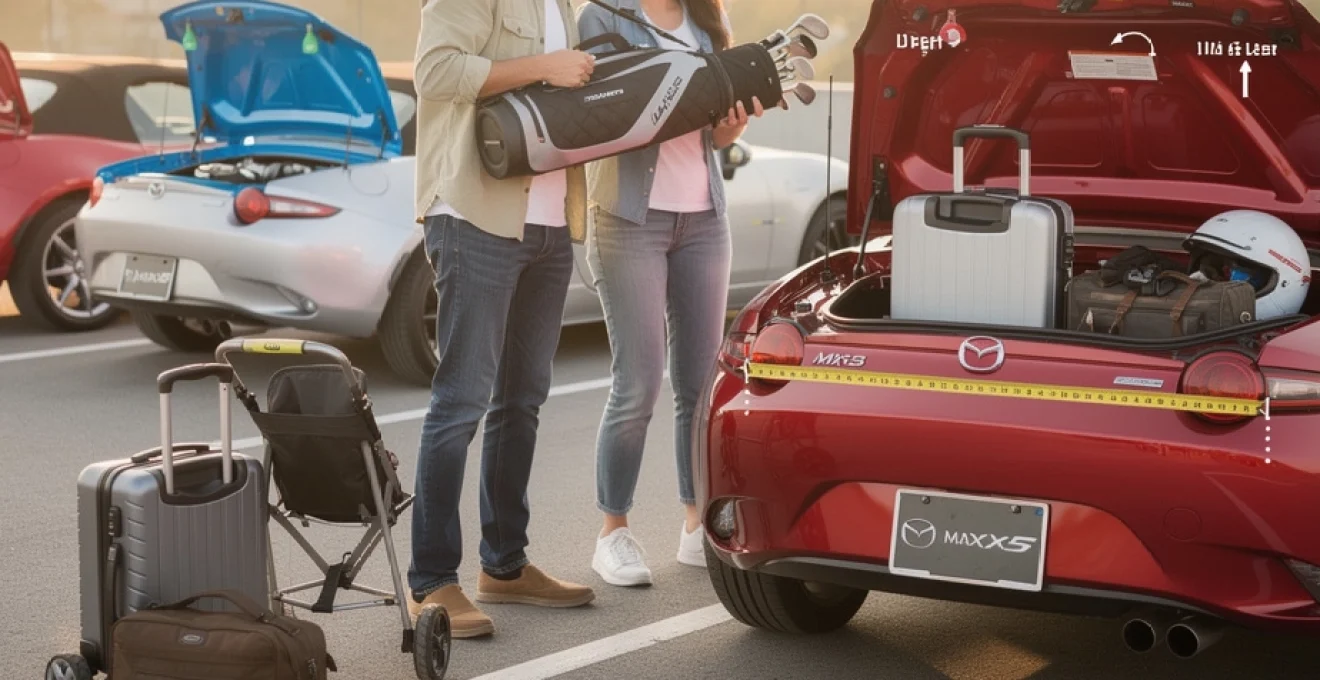
The Mazda MX‑5 has a reputation for light weight, precise handling and everyday usability, but for many buyers the real question is simple: how much actually fits in the boot? If you are planning weekends away, golf trips or a European tour, knowing the real Mazda MX‑5 boot dimensions matters just as much as power output or fuel economy. Sports cars are rarely luggage champions, yet clever packaging means the MX‑5 can be far more practical than its compact body suggests. Understanding the exact boot size, usable internal length, width and height – and how they vary by generation and roof type – helps you decide whether an NA, NB, NC or ND really fits your lifestyle.
Boot volume figures in litres tell only part of the story, especially in a car with a low, shallow load bay and a small boot opening. The shape of the space, how the fuel tank and suspension are packaged, and even where Mazda places tools and the tyre repair kit, all influence what you can pack. If you measure luggage in carry‑ons, hard cases or maybe camping gear, a detailed look at MX‑5 boot capacity across generations gives you a much clearer, real‑world picture.
Mazda MX‑5 boot capacity by generation: NA, NB, NC and ND compared
Official mazda MX‑5 boot volume figures in litres: NA (mk1), NB (mk2), NC (mk3), ND (mk4)
Across four generations, Mazda has kept the MX‑5 small and light, which naturally limits boot capacity. The official boot space figures provide a useful starting point before digging into internal dimensions.
| Generation | Chassis code | Approx. boot volume (litres) | Notes |
|---|---|---|---|
| NA (Mk1) | 1989–1997 | ~120 L | Original Miata/Roadster, simple boot layout |
| NB (Mk2) | 1998–2005 | ~144 L | Slightly improved packaging, similar architecture |
| NC (Mk3) | 2005–2015 | ~150–160 L | Largest and heaviest MX‑5, bigger exterior dimensions |
| ND (Mk4) | 2015–present | 130 L | Downsized body and focus on weight saving |
The current ND MX‑5 offers a quoted 130‑litre boot capacity, which is 81 litres less than a typical MINI hatchback but still adequate for two carry‑on suitcases and some soft bags. Interestingly, despite a smaller external footprint than the NC, owners routinely report that the ND’s boot is more useable in practice because of its regular shape and relatively low load sill. That is why many drivers manage multi‑week road trips carrying camping equipment, camera gear and clothing with surprising ease.
Generational changes in Mazda MX‑5 boot capacity reflect shifting priorities. The NC grew to meet crash regulations and comfort expectations, so its boot volume naturally increased. The ND reversed that trend with a lower kerb weight, tighter overhangs and a strong emphasis on 50:50 weight distribution, which costs litres on paper but delivers sharper handling. When you compare MX‑5 luggage space to other two‑seat convertibles launched since the 2010s, the numbers stack up well, especially considering the car’s compact rear overhang.
Dimensional differences between soft‑top and folding hardtop (PRHT/RF) MX‑5 boot designs
Roof design has a significant impact on boot space. The NC generation offered a Power Retractable Hard Top (PRHT), while the ND introduced the RF (Retractable Fastback). In both cases, the roof panels retract into a dedicated compartment above the boot rather than dropping into the luggage area.
That engineering decision is crucial: you do not lose boot volume when lowering the roof in an NC PRHT or ND RF. The quoted litres remain broadly the same, unlike some rivals where the folding mechanism steals most of the luggage space when open. However, the packaging of hinges, motors and roof cassette does slightly change usable height and the shape of the boot aperture.
On the NC, owners often describe the boot as “weirdly shaped”. Measurements shared by drivers show an opening around 36 x 16 inches (approximately 915 x 405 mm), with the largest internal plan dimension around 46 x 20 inches (about 1168 x 508 mm). Depth is roughly 12 inches (305 mm) to the higher floor sections, with an extra 3 inches (around 75 mm) in the central dip. Soft‑top and PRHT versions share the same basic footprint, but the PRHT gains more structure around the hinges and roof storage area, which can make loading bulky items slightly trickier.
Pre‑facelift vs facelift MX‑5 ND boot changes (2015–2018 vs 2019–present)
The ND facelift in 2018/2019 brought a more powerful 2.0‑litre engine, revised infotainment and extra safety features, but Mazda left the boot area essentially unchanged. Official luggage capacity remains 130 litres for both early and later ND cars, and there were no major changes to floor height, fuel tank placement or suspension layout that would affect internal measurements.
Minor differences do exist in trim and accessories. For example, some facelift cars gained slightly revised toolkit packaging, and optional audio upgrades in certain markets altered the shape of side panels marginally. From a practical perspective, though, you can treat all ND soft‑tops as having the same usable boot space. The same applies to RF models before and after the update.
This stability is useful when comparing a used 2016 MX‑5 ND with a newer 2021 car: if you test‑pack your luggage in one, you can expect it to fit in the other. When combined with the consistent two‑seat layout, this makes boot usability a predictable factor across ND model years, which is reassuring if you value luggage space as much as light weight and agility.
Uk‑spec vs EU/US‑spec MX‑5 boot space variations and spare wheel arrangements
Market‑specific regulations and customer expectations influence the way Mazda equips the MX‑5’s boot. Most modern ND and late‑NC cars in Europe and the UK use a tyre repair kit instead of a space‑saver spare wheel, freeing up under‑floor room and keeping the quoted 130‑litre figure intact. In North America, where road conditions and consumer preferences often favour spares, some versions have different under‑floor layouts that slightly alter recess depth.
The presence or absence of a spare wheel affects not just volume but also how flat the boot floor feels. A car with a compact spare or a large toolkit box will have less vertical room for tall items like camera backpacks or stacked soft bags. If you import an MX‑5 or buy in a different region, checking the exact spare wheel and repair kit arrangement is as important as comparing service history.
Electrical regulations, particularly for rear lighting and parking sensors, can add small control boxes behind boot trim panels. These do not change headline boot capacity, but they nibble away at side cubby space that you might otherwise use for tool rolls or shoe bags. For long‑distance touring, that side space is often as precious as the central floor area, so a quick inspection before purchase is worthwhile.
Internal boot dimensions: length, width and height in the mazda MX‑5 ND
Measuring usable load length from latch to bulkhead in an MX‑5 roadster
Official litre figures rarely tell you whether a particular suitcase or instrument case will physically fit. For that, the key measurement is usable load length: the distance from the boot latch to the rear bulkhead at floor level. In the ND MX‑5, this equates roughly to the longest item you can lay flat without angling it.
Owners who have measured the ND report a boot floor length of around 383 mm from the seat bulkhead to the rear end of the boot floor when measured along the centreline. That sounds short on paper, but remember that luggage rarely sits purely lengthwise; you use the full three‑dimensional space. In practice, two IATA‑sized cabin bags can be loaded nose‑to‑tail or diagonally with room for smaller items around them.
Thinking in terms of a “3D rectangle” rather than a flat slab helps. The bulkhead behind the seats is slightly curved, so the effective length at floor level is shorter than the diagonal length higher up. Tall but narrow bags can lean against that bulkhead, taking advantage of available height even where the floor tapers. For long, thin items like tripods or folded tents, angling them slightly towards one corner typically unlocks a few crucial centimetres of extra load length.
Wheelarch intrusion and minimum vs maximum boot width in the ND MX‑5
Width is the second key dimension for everyday usability. Like most compact rear‑drive cars, the MX‑5 has prominent wheelarches that intrude into the boot, so you have both a maximum and a minimum width to consider. The narrowest point, usually between the wheelarch liners, dictates which rigid cases and boxes can slide in without forcing.
In the ND, measurements indicate a minimum boot width of around 540 mm at the tightest section. Towards the rear of the boot and higher up, that width grows, so a bag that cannot sit flat may fit if rotated slightly and tucked into one side. This is where soft holdalls outperform hard cases: the flexible sides mould around the wheelarches and give you back some of the nominally “lost” capacity.
For planning purposes, consider the MX‑5 ND boot as a space where anything wider than about 52–53 cm might require compromise, while gear around 45–50 cm wide usually fits with margin. That helps when choosing camera cases, musical instruments or sports bags, especially if you do not want to be wrestling with the boot every time you load up for a trip.
Boot floor height, under‑floor recesses and load lip depth measurements
Vertical space and depth are also critical. The load opening height in an ND MX‑5 is around 475 mm, while the vertical distance from the boot sill down to the floor is about 390 mm. Those two figures define both how high an item can be and how far you need to lift things when loading and unloading.
The boot floor itself is not completely flat. Just as in the NC, where owners describe a dip of about 3 inches (75 mm) in the centre compared to the higher side sections, the ND uses under‑floor recesses for structural and packaging reasons. These recesses create a central “well” that can swallow denser items like toolkits, small cool bags or folded jackets, while leaving the outer floor level for suitcases.
Load lip depth matters for everyday comfort. Although the MX‑5’s sill is relatively high compared to a hatchback, the short overhang means you do not have to lean too far in, which is helpful in tight multi‑storey car parks or when loading heavy items. If you intend to carry fragile equipment, placing it in the slightly lower central section reduces the risk of it sliding into the boot lid during spirited driving.
Impact of boot trim, toolkit and tyre repair kit on usable cargo volume
Interior trim panels, sound‑deadening and tool storage take a portion of the MX‑5’s boot that is invisible in the bare volume figures. A typical ND boot contains a foam insert or tray with the tyre repair kit, jack (where supplied) and small tools. This insert raises part of the load floor and limits how deep you can stack items in that area.
Enthusiast owners who tour frequently sometimes re‑arrange these components, relocating emergency gear to soft pouches stowed in the cabin or behind the seats. Done sensibly, this can gain several litres of usable space without compromising safety. However, it is important that anything moved remains secure; a jack or wrench flying forward in a collision is a serious hazard.
Side trim panels also define whether there is enough space for slim items such as umbrellas, collapsible walking poles or rolled‑up picnic blankets. If your MX‑5 has aftermarket audio upgrades with amplifiers or subwoofers in the boot, expect a noticeable hit to usable volume. When viewing a used car, inspecting behind the boot carpet for such modifications is as important as checking service invoices.
MX‑5 RF vs soft‑top boot aperture and hinge placement constraints
Although ND RF and soft‑top models share similar boot volume, the way the boot lid hinges and the shape of the opening influence how easily you can load certain items. The RF’s more complex rear structure means hinge placement is slightly different, and the boot aperture feels a touch more constrained at the top corners.
This mainly affects tall, boxy objects that have to clear both the load lip and the upper edge of the opening in one smooth movement. Long but squashable luggage is far less impacted, as it can flex under the hinges. If you frequently carry rigid camera hard‑cases or flight cases, testing them in both RF and soft‑top cars is sensible before committing to a purchase.
Once items are inside, the floor area between RF and soft‑top ND models is effectively the same. For most owners, the difference in loading experience is minor compared with other factors such as wind noise, roof operation speed and styling preferences. From a pure boot‑practicality perspective, choosing between RF and soft‑top comes down more to ergonomics than absolute dimensions.
Real‑world luggage fitment: suitcases, golf bags and pushchairs in an MX‑5 boot
Cabin baggage and 55x40x20cm suitcase orientation tests in the MX‑5 ND
Airline cabin baggage is a useful reference for assessing practical boot space. A typical carry‑on suitcase measures around 55 x 40 x 20 cm. In the ND MX‑5, two such cabin bags will fit in the 130‑litre boot with some room left for smaller items such as shoe bags or a compact backpack.
Orientation is key. Placing one suitcase flat and the other on its side, slightly offset, usually works best. Some owners report that standing a 55 x 40 x 20 cm case on end near the bulkhead, then tucking a second case horizontally in front, uses the available length and height efficiently. Using soft packing cubes or compression bags inside those cases further boosts what you can take on a weekend away.
Compared with a small hatchback, you sacrifice the ability to stack multiple suitcases vertically, but for a two‑person trip the MX‑5’s boot is much more accommodating than its compact silhouette suggests. If you are used to motorbike touring, the space feels generous; if you come from an estate car, it requires a mental reset but remains entirely workable for minimalist travel.
Carrying a golf bag, trolleys and sports kit in NA, NB, NC and ND boots
Golf kit is often the acid test for sports‑car practicality. In earlier NA and NB MX‑5 generations, a full‑length golf bag with clubs usually needs the passenger seat to be folded, as the boot length is limited. The NC’s larger body gives the most flexibility: many owners manage a single stand bag in the boot by positioning it diagonally and removing the driver to reduce overall length.
In the ND, a compact stand bag without a full trolley is the most realistic option. Placing the clubs head‑first towards one rear corner and using the central floor dip to accommodate the club heads can work, but this heavily depends on bag length and headcover size. A separate folding trolley often has to ride in the passenger footwell or on a boot rack if fitted.
For other sports kit – such as helmets, motorcycle leathers or climbing gear – the MX‑5’s boot is surprisingly capable. One owner recounts completing a 5,000‑mile road trip in an NC with a tent, sleeping bags, pillows, two weeks’ clothing and two camera bags, all within the boot and cabin. The lesson is clear: choose flexible bags and pack strategically, and even quite bulky sports equipment can travel in an MX‑5.
Loading pushchairs, prams and baby gear in a mazda MX‑5 for family trips
Using an MX‑5 as occasional family transport is not impossible, but it demands realism. The car is a strict two‑seater, so if you are carrying a baby or toddler, one adult seat disappears immediately. The boot must then swallow a compact pushchair and associated baby gear such as changing bags and travel cots.
Ultra‑compact strollers that fold into a cabin‑size rectangle stand the best chance of fitting. Measurements of the ND boot suggest that a folded buggy under about 55 cm in length and 45 cm in width can slide in, often diagonally. Larger travel‑system prams are generally too big for the boot and would need a rear luggage rack or a different car.
For short family breaks, some owners use the space behind the seats (especially in NC and ND models) for nappy bags and soft items, keeping the boot for the folded pushchair and any hard‑sided containers. If you plan to combine parenthood with MX‑5 ownership, visiting a dealer with your existing buggy and doing a test fit can save a great deal of frustration later.
Weekend touring with soft bags, camera gear and helmets in the MX‑5
Where the MX‑5 boot really excels is weekend touring and lightweight road trips. Riders coming from motorcycle touring often describe the car as luxurious in terms of luggage space, and that experience shows how to make the most of every litre. Lightweight, compressible camping gear and modular packing systems transform the small boot into a surprisingly flexible cargo bay.
Examples from ND touring enthusiasts include carrying two high‑back camping chairs, a compact table, two ultralight camp beds, a single‑burner stove, cooking gear, four tent lights, cold‑weather sleeping bags and a cool bag, all packed into the boot alongside Roadster‑specific luggage. Additional items such as a 4‑person tent, extra sleeping bags, inflatable pillows and even a folding washing‑up bowl ride in a waterproof bag on a boot rack.
Camera gear and helmets fit best in the cabin rather than the boot, where you can keep them cushioned and quickly accessible. A laptop often slides neatly under the driver’s or passenger’s seat. With thoughtful packing, you can comfortably combine driving enjoyment with camping, photography or motorsport weekends without feeling overly compromised by the MX‑5’s compact footprint.
Boot engineering and packaging: fuel tank, rear subframe and soft‑top storage
Transverse fuel tank positioning and its effect on MX‑5 boot floor depth
The engineering that underpins the MX‑5 boot is as important as the raw measurements. Mazda positions the fuel tank transversely, just ahead of the rear axle line and beneath the boot floor. That location optimises weight distribution and crash safety but constrains how low the boot floor can sit.
Because the tank occupies vertical space directly under the load area, Mazda engineers must raise the boot floor by several centimetres compared with a front‑drive hatchback where the tank can live under the rear seats. The resulting shallow depth is one of the main reasons the MX‑5 cannot match small hatchbacks for outright volume, even if the plan area is similar.
On the plus side, placing fuel mass close to the car’s centre helps maintain consistent handling regardless of fuel level. That is critical for a lightweight sports car: a near‑empty or full tank should not dramatically change rear axle behaviour. For you as the driver, this translates into predictable balance on challenging roads, even if it means living with a slightly taller boot floor.
Rear suspension towers, subframe layout and wheelhouse packaging constraints
The rear suspension towers and subframe also dictate boot shape. The MX‑5 uses a compact multi‑link rear suspension layout attached to a rigid subframe. The upper suspension mounts project upwards into the body structure, which needs corresponding reinforcement in the boot sidewalls and floor.
This structural reinforcement is why the boot narrows between the wheelarches and why certain areas are off‑limits for large cut‑outs or storage wells. Removing too much material would compromise crash performance and torsional rigidity. The resulting “pinched” section is visible in any bare‑shell photo of an MX‑5 and explains why soft luggage packs more effectively than rigid boxes.
From a sports‑car perspective, this is a sensible compromise. The stiffer the rear structure, the more accurately the suspension can do its job and the better the car responds to steering inputs. If you value crisp turn‑in and stable high‑speed behaviour, the slight loss of boot width at the narrowest point becomes an acceptable trade‑off.
Soft‑top well vs PRHT/RF roof cassette: boot space trade‑offs by roof type
The way each MX‑5 generation stores its roof has a direct impact on boot engineering. NA and NB cars have relatively simple manual soft‑tops that fold into a well immediately behind the seats, largely clear of the boot. The boot therefore remains a separate, boxed‑in space with minimal intrusion from the roof mechanism.
The NC PRHT and ND RF introduce more complex, power‑operated roof mechanisms. Mazda’s engineers worked hard to ensure that the folding hardtop stores above and behind the cabin without sacrificing boot volume, using a compact roof cassette and shared structural elements. However, this adds weight and requires stronger hinge mounts, which slightly reshape the boot opening and the surrounding metal.
Soft‑top NDs avoid that extra hardware, so the rear deck and bootlid can be lighter and simpler. From a packaging point of view, both roof types offer similar cubic capacity, but the simpler soft‑top has marginally fewer constraints around the aperture and hinge arcs. That is why some owners who prioritise luggage space also favour the manual roof: fewer moving parts, slightly freer access, and a touch less complexity when loading awkward‑shaped gear.
Weight distribution targets and how they limit boot expansion potential
One recurring design goal across all MX‑5 generations is near‑perfect 50:50 front‑to‑rear weight balance. Achieving this in a small, front‑engined, rear‑drive car demands careful placement of heavy components such as the engine, gearbox, fuel tank and battery. The boot inevitably sits at the extreme rear of the car, where adding capacity risks shifting too much static weight rearwards.
To keep handling nimble, Mazda avoids long rear overhangs or deep, cantilevered boot wells. That is why you never see the MX‑5 with a large “trunk” like some small saloons. Any attempt to significantly extend the boot would either move the car’s centre of gravity backwards or require extensive re‑engineering of the cabin and fuel system.
From a dynamic standpoint, the MX‑5’s relatively small boot is therefore a deliberate choice rather than a failure of imagination. The car’s celebrated steering feel and agility depend on it. If you do need more luggage capacity, roof racks or rear boot racks add storage without altering the underlying balance of the chassis, which is a smarter approach than trying to build a fundamentally bigger tail into the bodyshell.
Practical packing strategies and accessories to maximise MX‑5 boot space
Using MX‑5‑specific luggage sets from mazda, RoadsterBags and MX5Parts
One of the easiest ways to make the most of the MX‑5’s small boot is to invest in luggage designed to match its contours. Several manufacturers offer MX‑5‑specific luggage sets shaped to sit snugly in the boot and the space behind the seats, often with cut‑outs for wheelarches and hinges.
These bespoke sets typically include one or two large, low‑profile bags for the boot floor and additional smaller bags for the shelf behind the seats. Because the designers know the exact internal dimensions, they can use almost every available centimetre without creating awkward dead zones. For regular touring, the convenience of a fitted luggage set is hard to beat, especially if you want to pack quickly and consistently before each trip.
If you prefer to use existing holdalls, measuring them carefully against the known ND dimensions (length about 383 mm, minimum width 540 mm, opening height around 475 mm) helps you select the most efficient combination. Bags that are too tall or wide waste space and complicate the loading process.
Fitting boot racks and rear luggage carriers from thule, Boot‑Bag and OEM
For longer trips or camping, a rear boot rack transforms the MX‑5’s carrying capacity. These racks clamp to or bolt through the bootlid and support an additional soft bag or hard case, usually up to around 20–30 kg depending on the design and local regulations.
Soft, waterproof “boot bags” that strap directly to the rack are particularly popular. A typical 75–95 litre boot‑bag can swallow a full‑size tent, sleeping bags, pillows and bulky jackets, leaving the internal boot for dense, smaller items. This approach keeps weight reasonably low and close to the rear axle, limiting any impact on handling.
When choosing a rack, pay attention to how it affects bootlid operation and rear visibility. Some designs allow the boot to open normally with the rack loaded, while others require partial unloading before you can access the internal boot. Proper strap routing and regular tension checks are essential to avoid paint damage or movement at speed.
Soft holdalls vs hard cases: optimising volume around the MX‑5 boot contours
The choice between soft holdalls and hard cases makes a dramatic difference in such a compact boot. Hard‑shell suitcases protect contents well but are unforgiving when the internal dimensions do not match perfectly. The MX‑5’s narrowing floor, wheelarch intrusions and shallow depth often leave odd gaps that a rigid case cannot exploit.
Soft bags, duffels and compression sacks behave more like water poured into a container: they flow into corners, dips and recesses. In the NC, owners routinely use the central 3‑inch floor dip to nestle a bag’s base and then stack another bag over the higher side sections. In the ND, similar tactics allow clothing and soft gear to occupy the full 130‑litre volume far more effectively than a single hard‑case would.
Combining one small hard case for fragile items with one or two soft holdalls often gives the best of both worlds. The hard case sits where the boot dimensions are known to accommodate it, while the soft bags fill the irregular spaces left over. Using packing cubes inside those bags keeps organisation high even when everything is tightly compressed.
Securing loads, using cargo nets and avoiding boot lid and hinge interference
Because the MX‑5 invites enthusiastic driving, properly securing luggage is more than just a convenience. Unrestrained bags sliding into the bootlid or hinges can cause damage or interfere with closing, particularly if items are stacked close to the opening. A simple cargo net or a pair of luggage straps anchored to existing tie‑points helps keep everything in place.
Before a long trip, a quick check for hinge clearance is wise. Close the boot slowly the first time with new luggage arrangements, listening and feeling for any resistance. If you sense contact, rearrange the load rather than forcing the lid; even slight repeated pressure can distort the thin outer skin over time.
For everyday use, keeping heavier items low and towards the bulkhead improves both handling and safety. Lightweight coats or sleeping bags can sit on top near the opening, while tools, liquids and dense gear belong in the central floor dip or tight against the rear bulkhead. This simple “heavy low, light high” rule mirrors best practice in motorsport and reduces the chance of unexpected movement during brisk cornering.
Buying checklist: assessing boot usability when choosing a used mazda MX‑5
When assessing a used Mazda MX‑5, boot practicality should sit alongside corrosion checks, service history and roof condition on the inspection list. Start by opening the boot and looking for signs of accident repair around the rear panel, bootlid and hinges. Uneven gaps, mismatched paint or non‑OEM seam sealer can indicate a previous rear‑end impact, which might affect both water tightness and structural integrity.
Next, examine the boot floor from inside, lifting the carpet to inspect the metal. Any ripples, fresh underseal or poorly aligned spare‑wheel wells suggest past damage. Because the boot floor also forms part of the rear crash structure, high‑quality repairs are crucial. Checking the toolkit, tyre repair kit and jack for completeness also reveals how carefully previous owners treated the car; missing or loose tools often correlate with more casual maintenance elsewhere.
Finally, perform a real‑world luggage test using the items you actually travel with. Bring a cabin‑sized suitcase, a soft holdall or even a compact pushchair if that reflects your lifestyle. See how easily they pass through the aperture, whether the boot lid closes cleanly and how much space remains for smaller items. If you plan frequent touring, envision how a boot rack and MX‑5‑specific luggage could expand your options. By approaching the boot with the same critical eye as the chassis and engine bay, you give yourself the best chance of choosing an MX‑5 that fits both your driving ambitions and your everyday practicality needs.