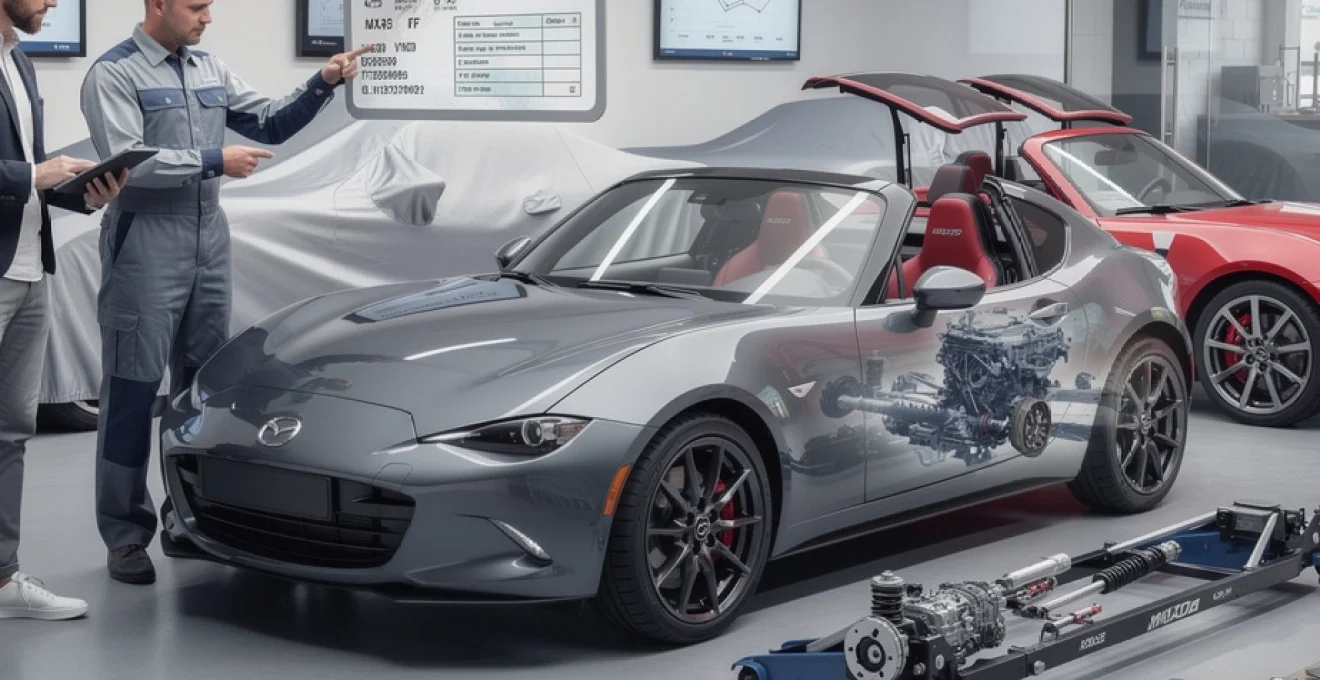
The Mazda MX‑5 RF Launch Edition sits in that rare space where everyday usability, engineering purity and genuine collectability intersect. Built in strictly limited numbers for the UK, US and key European markets, it combines the ND‑generation MX‑5’s light weight with an elegant retractable fastback roof and a carefully curated set of options. If you are considering buying one as an investment‑grade modern classic, or already own a car and want to protect its long‑term value, understanding what makes the Launch Edition distinct is essential. Values have stabilised and are now beginning to edge upwards, while interest in low‑mileage, original examples has grown noticeably since 2022. For an enthusiast who wants a car to enjoy yet preserve, the MX‑5 RF Launch Edition offers one of the most compelling entry points into limited‑run Japanese performance icons.
Mazda MX‑5 RF launch edition overview: production run, VIN ranges and market allocations
Global production numbers for the MX‑5 RF launch edition: limited to 500 units UK, 1,000 US and key EU markets
The MX‑5 RF Launch Edition was created to mark the introduction of the retractable fastback ND in 2017, and production was deliberately capped. In the UK, Mazda limited the run to just 500 cars, all based on the 2.0‑litre Sport Nav specification. In the United States, the Launch Edition (often referred to as the RF Launch Edition or RF LE) was restricted to 1,000 units, built for 2017 model year customers identified as Mazda loyalists. Continental Europe received a smaller allocation again, with several hundred cars split across major markets such as Germany, France and Spain. Taken together, total global RF Launch Edition production almost certainly sits well below 3,000 cars.
For a modern sports car, that is an exceptionally small figure. By comparison, mainstream ND RF production runs into the tens of thousands. This limited volume underpins the model’s appeal to collectors and means you see relatively few genuine Launch Edition cars at major events such as Japfest or the Goodwood Festival of Speed. Rarity alone does not guarantee future appreciation, but it does create a strong foundation when combined with desirable specification and a clear story, both of which the RF Launch Edition has in abundance.
VIN decoding and chassis identification: pinpointing genuine ND RF launch edition models
If you are assessing a potential purchase, verifying that the car is a genuine Launch Edition rather than a cosmetically upgraded standard RF is critical. Every ND MX‑5 carries a 17‑digit VIN that embeds the body style, engine and market. On RFs this VIN begins with the Mazda world manufacturer identifier and the ND chassis prefix, while a specific range of sequential numbers was associated with early RF Launch Edition builds at the Ujina plant in Hiroshima. Exact ranges vary by market, so the most robust approach is to cross‑check the VIN with an official Mazda dealer and request the build specification connected to that chassis.
Launch Edition cars should also show the correct equipment signatures at a glance: 17‑inch BBS alloys, piano black roof panels, specific paint and trim combinations, and interior Recaro seating on most markets. Any deviation from these key identifiers warrants deeper investigation. Some enthusiasts use specialist forums and historic dealer bulletins to match VINs against recorded Launch Edition lists, which can provide an extra level of reassurance when chasing a truly collector‑grade example.
Uk‑spec vs US‑spec MX‑5 RF launch edition: equipment, emissions and safety homologation differences
Although the UK and US cars share the Launch Edition theme, there are subtle yet important differences. UK examples are right‑hand drive, based on the 2.0 Sport Nav with the 160 PS Skyactiv‑G engine, manual gearbox, Bilstein dampers and a mechanical limited‑slip differential. Emissions calibration is designed to comply with Euro 6 regulations, and CO₂ figures sit around the mid‑160 g/km mark, depending on test cycle. US Launch Edition cars, by contrast, were offered with a choice of six‑speed manual or six‑speed automatic, based on the Grand Touring trim level and tuned to US emissions standards.
Safety equipment also varies. American cars typically include additional airbag labelling, slightly different seatbelt pre‑tensioner calibration and US‑specific lighting, including side markers. Headlamp beam patterns differ between left‑ and right‑hand drive markets, so importing a Launch Edition across regions often requires headlight changes for full compliance. From a collector point of view, matching the car to its original market specification tends to be preferred, especially where long‑term authenticity is a priority.
Launch colours and trim combinations: machine grey vs soul red with nappa leather interiors
The RF Launch Edition stands out most clearly in its paint and trim choices. In the UK, buyers could choose between Machine Grey and Soul Red metallic finishes, both paired with a piano black roof panel and matching mirror caps. Inside, the key differentiator is the high‑grade Nappa leather upholstery and Alcantara accents, combined with Recaro sports seats on many cars. This combination gives the cabin a far more upmarket feel than standard cloth or non‑Nappa leather variants and is immediately obvious as soon as you open the door.
In the US, the show car configuration combined Machine Gray Metallic with Auburn Nappa leather and a hand‑painted black roof panel, a specification that remained exclusive to the Launch Edition and was not repeated elsewhere in the MX‑5 RF range. For collectors, colour is not just an aesthetic choice; it has a measurable effect on residuals. Soul Red Launch Editions often attract slightly stronger bidding in the UK resale market due to the paint’s association with Mazda’s recent design language, while Machine Grey cars appeal to buyers who prefer a discreet, almost concept‑car look.
Technical specification of the MX‑5 RF launch edition: engine, chassis and drivetrain detail
2.0 Skyactiv‑G engine specification: output, compression ratio and ND1 vs ND2 differences
The RF Launch Edition uses Mazda’s naturally aspirated 2.0‑litre Skyactiv‑G petrol engine. In early ND1 guise, as found in 2017 cars, it produces around 160 PS (158 bhp) at 6,000 rpm and 200 Nm of torque at 4,600 rpm. A very high compression ratio of approximately 13.0:1 is central to its efficiency and response, allowing strong real‑world performance without resorting to turbocharging. This engine is deliberately free‑revving and rewards drivers who are prepared to work the upper half of the rev range on spirited drives.
Later ND2 cars (from late 2018 onwards) gained a power hike to around 184 PS, with a higher redline and revised internals. However, the RF Launch Edition is tied to the earlier ND1 specification and that is part of its appeal: it represents the purest, lightest version of the RF concept. Routine servicing is straightforward, and well‑maintained examples regularly cover more than 100,000 miles without major issues, making the engine a strong asset for anyone planning long‑term ownership.
Six‑speed manual and automatic gearboxes: ratios, known weak points and maintenance intervals
For UK buyers, the MX‑5 RF Launch Edition was effectively a six‑speed manual proposition. The close‑ratio Skyactiv‑MT gearbox is one of the car’s highlights, with a short, precise throw reminiscent of classic lightweight roadsters. Ratios are chosen to keep the engine in its power band, so you benefit from crisp response in second and third on B‑roads, while sixth remains tall enough for relaxed motorway cruising. Routine maintenance calls for gearbox oil changes roughly every 60,000 miles or sooner for hard‑driven cars, though proactive owners often shorten that interval.
In the US, Launch Edition buyers could choose a six‑speed automatic. While less appealing to some purists, the auto suits daily use and makes the RF a more versatile GT. Known issues across both transmissions are relatively rare. A small subset of early ND manuals experienced second‑gear notchiness or synchromesh wear, usually exacerbated by aggressive shifting on track. A thorough test drive should involve repeated shifts across all gears under load to check for any reluctance, noise or grinding, especially when the drivetrain is hot.
Bilstein dampers, limited‑slip differential and strut bracing on sport nav‑based launch editions
Chassis tuning is a key reason why the MX‑5 RF Launch Edition feels so composed. UK cars, based on the Sport Nav, gain factory‑fitted Bilstein dampers, a front strut brace and a mechanical limited‑slip differential at the rear axle. The Bilsteins control body movement more tightly than standard dampers yet retain the compliant ride that makes the ND fun at legal speeds. The LSD improves traction on corner exit, especially on greasy roads, and also adds a more adjustable balance when driven briskly.
The standard ND RF already benefits from a well‑judged front‑mid engine layout and low kerb weight of just over 1,100 kg in 2.0‑litre form. The Launch Edition package sharpens that baseline without resorting to harsh springing. Many owners who later move to coilovers or uprated anti‑roll bars report that the original Bilstein set‑up remains an excellent benchmark, particularly for road use. From a collector’s perspective, retaining the OEM dampers, strut brace and alignment settings is a wise move, even if a second, reversible set‑up is used for track days.
Brembo and standard braking systems: disc dimensions, pad compounds and fade resistance
Braking hardware on the RF Launch Edition corresponds closely to the 2.0 Sport Nav specification rather than the later Brembo/BBS packs offered on some ND models. Standard front discs measure around 280 mm in diameter, clamped by sliding calipers with performance‑oriented pad compounds that balance bite with low dust output. Rear discs are slightly smaller and primarily handle stability rather than primary stopping effort. For road driving, this set‑up is more than adequate and offers good modulation.
Some owners choose to retrofit Brembo calipers or complete big brake kits, particularly if track use is planned. From a collector’s angle, such upgrades are best kept reversible, with the original callipers, discs and pads stored carefully. Brake fluid should be replaced at least every two years to maintain pedal feel and minimise internal corrosion. When inspected properly and driven within legal limits, the factory system is resistant to fade and complements the MX‑5’s lightweight ethos.
Retractable fastback roof mechanism: electric motors, sealing, alignment and common failure modes
The RF’s party trick is its folding hardtop roof, which uses a series of electric motors, hinges and latches to store the front and middle roof panels beneath the rear buttresses. The mechanism adds weight compared with the soft‑top ND, but the trade‑off is improved refinement, better security and that distinctive fastback silhouette. Operation is controlled by a dedicated module that monitors latch positions, vehicle speed and roof panel angles, ensuring safe opening and closing at low speeds.
Common issues are far rarer than internet folklore suggests, but age and use can introduce minor niggles. Misalignment of the roof panels may lead to wind noise or slight water ingress, especially around the side seals. Motor failures are uncommon but can occur if the system has been forced or cycled repeatedly without proper lubrication. A careful inspection involves listening for any graunching or hesitations during a full open/close cycle and examining the seals for flattening or cracking. As with any complex mechanism, periodic cleaning and rubber conditioning helps keep the system healthy over the long term.
Launch edition‑specific equipment: cosmetic, interior and options pack identifiers
Recaro seats, nappa leather and bespoke stitching: distinguishing factory launch interiors
The interior of a genuine MX‑5 RF Launch Edition feels subtly more special than a regular ND cabin. High‑back Recaro sports seats, trimmed in Nappa leather with Alcantara inserts, provide excellent lateral support while remaining comfortable on long motorway runs. Unique contrast stitching, usually in a lighter tone, runs across the seats, dashboard and door cards, setting the Launch Edition apart visually. The Nappa hide itself has a finer grain and a softer touch than the standard leather used in other trims.
From a verification standpoint, seat tags and part numbers can be cross‑checked with Mazda documentation to confirm that the Recaros are original to the car. Replacement seat covers or aftermarket retrims, no matter how well executed, will usually reduce collector desirability. If you own a Launch Edition and want to keep it in top condition, using seat covers for daily use and conditioning the Nappa leather with suitable products every six to twelve months is a sensible strategy.
17‑inch BBS alloy wheels, finish codes and correct tyre specifications for RF launch edition
Wheel choice is another obvious identifier. The RF Launch Edition uses 17‑inch forged BBS alloys with a specific multi‑spoke design and a dark metallic finish. These wheels are lighter than standard cast items, shaving unsprung mass and subtly improving ride and steering response. Finish codes and casting marks inside the spokes can be checked against official parts catalogues to confirm authenticity, something that becomes more important as values rise.
Factory tyre specification for the 2.0‑litre ND typically centres around a 205/45 R17 size, which balances grip, feedback and ride comfort. Many owners choose premium tyres such as Michelin Pilot Sport 4, Goodyear Eagle F1 Asymmetric or similar ultra‑high‑performance options. For a collector car that still sees spirited use, maintaining the original tyre size and speed rating is advisable, even if brand choice changes with availability and personal preference.
Launch edition badging, plaques and documentation: what should be present on a collector‑grade car
Launch Edition cars usually include specific badging or plaques to denote their limited‑run status. In the cabin, this may take the form of a numbered plate on the dashboard or centre console, while exterior badging highlights the RF’s special status without overwhelming the clean design. These subtle identifiers are easy to overlook at first glance but play a major role in verifying that a car is genuine and unmolested.
A collector‑grade MX‑5 RF Launch Edition should ideally come with its original book pack, owner’s manual, stamped service booklet or digital service printout, and any period brochures or launch literature. Many first owners kept event invitations or certificates connected to preview nights and dealer handovers; such items add colour and provenance. Missing plaques, mismatched VINs on documentation, or badges that appear freshly applied are all signs that a more careful investigation is wise.
Bose audio, navigation and connectivity: factory infotainment vs later retrofit units
Technology is not the main reason enthusiasts seek out MX‑5s, yet the RF Launch Edition offers a well‑rounded infotainment package by ND standards. Most cars feature the Mazda MZD Connect system with navigation, a colour touchscreen and rotary controller, along with a factory Bose audio upgrade that includes additional speakers in the headrests. Bluetooth connectivity, DAB radio (in appropriate markets) and USB inputs cover most modern needs.
Over the car’s life, many owners have retrofitted upgrades such as Apple CarPlay/Android Auto kits or replaced the head unit entirely. While these changes can improve day‑to‑day usability, fully integrated aftermarket units may detract from originality. If long‑term collectability is the top priority, preserving the factory system or at least retaining it for refitting later is recommended. Firmware updates and occasional map refreshes help keep the standard navigation usable even as technology moves quickly elsewhere.
Market values and appreciation trends for the mazda MX‑5 RF launch edition
Historic price curves in the UK, EU and US: depreciation, plateau and appreciation phases
Like most modern sports cars, the MX‑5 RF Launch Edition followed a familiar pattern: initial depreciation, a period of stabilisation, and then early signs of appreciation. In the UK, list prices around the £27,000–£28,000 mark in 2017 typically fell to the high‑teens by 2020 for average‑mileage cars. Since 2022, however, asking prices for low‑mileage, well‑documented examples have firmed up, with some sub‑20,000‑mile Launch Editions advertised in the mid‑£20,000 range or higher.
In the US, Launch Edition values have tracked a similar curve in dollar terms, with manual cars in desirable colours now commanding a clear premium over standard Grand Touring RFs of the same year. Continental Europe, with its smaller supply, often sees even stronger pricing for pristine examples. Economic cycles, fuel prices and broader appetite for analogue sports cars all influence these trends, but the overall direction for limited‑run MX‑5s has been upward once they clear the steepest part of initial depreciation.
Mileage bands and condition grading: how usage patterns affect RF launch edition valuations
Mileage plays a significant role in Launch Edition valuation, though condition can sometimes outweigh raw odometer readings. Broadly speaking, UK cars fall into three bands: sub‑20,000 miles, 20,000–60,000 miles, and above 60,000 miles. The first category is already beginning to attract collectors who view the RF Launch Edition as a future modern classic. The middle band often provides the best balance between affordability and usability, especially if you plan to drive the car regularly.
Condition grading is equally important. A higher‑mileage car that has been garaged, maintained meticulously and kept away from harsh winter salt can look and feel fresher than a low‑mileage example used intensively on short trips. Detailed service records, paint‑depth readings and professional inspections all help to establish a car’s true state. Buyers who invest the time to check these factors carefully are usually rewarded with a better ownership experience and stronger residuals.
Impact of specification, colour and transmission choice on collector desirability
Not all MX‑5 RF Launch Editions are valued equally. As the car moves further into collector territory, specification nuances become more significant. In the UK, Soul Red examples with manual transmission and full dealer history tend to be the most sought‑after combination. Machine Grey cars are only slightly behind and often appeal to enthusiasts who favour a more understated look. Right‑hand drive configuration is vital for UK buyers, while left‑hand drive examples may find stronger demand in mainland Europe.
Transmission choice is an important differentiator in the US, where manual Launch Editions typically command a premium over their automatic counterparts. From a long‑term collector’s perspective, manuals are likely to remain the safer bet, reflecting broader trends in enthusiast markets. That said, an immaculate automatic car with single ownership and ultra‑low mileage could still be highly desirable, particularly if used as a comfortable GT rather than a track toy.
Comparative values: RF launch edition vs MX‑5 25th anniversary and ND sport recaro editions
Within the Mazda MX‑5 ecosystem, the RF Launch Edition sits alongside other limited‑run variants such as the NC‑generation 25th Anniversary Edition and the ND Sport Recaro. The 25th Anniversary cars, built in 2014 to mark a quarter‑century of MX‑5 production, remain strong performers on the used market and have already demonstrated that special‑edition MX‑5s can out‑perform regular models in value retention. The RF Launch Edition follows a similar formula but adds the novelty and engineering of the retractable fastback roof.
The ND Sport Recaro, another popular special, focuses more on chassis enhancements and aesthetic tweaks rather than a unique roof configuration. As a result, it often appeals to more track‑oriented buyers, while the RF Launch Edition attracts those who want a blend of refinement and rarity. Over the next decade, it is reasonable to expect the RF Launch Edition to track or slightly exceed the trajectories seen with these earlier limited‑run MX‑5s, especially for unmodified, low‑mileage cars.
Pre‑purchase inspection checklist for prospective RF launch edition collectors
Corrosion inspection points: subframes, suspension arms, sills and rear wheel arches
Although the ND MX‑5 is far more rust‑resistant than the earliest NA and NB generations, corrosion remains a concern as cars age, particularly in climates with heavy winter salting. When inspecting a Launch Edition, pay close attention to the front and rear subframes, suspension arms, and the inner lips of the rear wheel arches. Surface rust on exposed metal components is not unusual, but heavy flaking or structural corrosion should raise alarms. The undersides of the sills and jacking points deserve especially careful scrutiny.
A thorough inspection ideally involves a lift so that you can view the chassis from all angles. Look for previous undersealing work and assess whether it appears professional or hastily applied to mask existing problems. Given the RF Launch Edition’s potential as a collector car, corrosion repairs that cut into original panels may have a negative impact on future values, even if they are structurally sound.
Roof operation test protocol: cycle timing, latch integrity and water ingress diagnostics
Testing the retractable fastback roof correctly is essential. A simple protocol helps reveal any underlying issues:
- With the engine running and the car stationary, open the roof fully and listen for smooth motor operation.
- Once open, inspect the exposed hinges, seals and wiring looms for damage or aftermarket interference.
- Close the roof and check that the cycle completes without hesitation or warning messages on the dash.
After the mechanical test, examine the interior headlining, A‑pillar trims and rear deck for signs of water staining. During heavy rain, check for drips around the top of the windows or behind the seats. Minor squeaks can often be fixed with lubrication of rubber seals, but slow or inconsistent operation may indicate motor wear or incorrect alignment that will require specialist attention.
Chassis alignment and accident damage detection: geometry reports and panel gap analysis
The MX‑5’s light weight and rear‑drive chassis make it an entertaining drive, but also mean some cars have led hard lives on track days or spirited B‑road runs. To guard against previous accident damage, start with a visual check of panel gaps around the bonnet, boot, doors and roof panels. Uneven gaps, paint overspray or mismatched panel shades can all hint at prior repairs. Under the bonnet, look for ripples in the inner wings or front slam panel that suggest front‑end impacts.
A professional four‑wheel alignment report is one of the best tools for spotting underlying chassis issues. If a car struggles to achieve factory geometry settings within reasonable adjustment ranges, there may be hidden damage to suspension pick‑up points or subframes. Asking the seller for any historic geometry reports or bodyshop invoices can provide valuable context, especially if the car has participated in motorsport or regular track events.
Service history verification: oil change intervals, gearbox oil, differential oil and brake fluid
Service history tells a story not just of mileage but of mechanical sympathy. For an RF Launch Edition, look for oil changes at least annually or every 12,000 miles, whichever comes first, using Mazda‑approved 0W‑20 or similar Skyactiv‑compatible oils. Evidence of periodic gearbox and differential oil changes is a strong positive sign, particularly for cars used enthusiastically. Brake fluid replacement every two years is the minimum recommended interval; more frequent changes are ideal if track work is involved.
Modern Mazdas often rely on a digital service record (DSR) rather than a traditional stamped booklet. A main dealer can usually print this out, listing dates, mileages and operations carried out. When combined with invoices for supplementary work, this documentation gives a clear picture of how the car has been treated. Gaps of several years without servicing on a low‑mileage car are not ideal, as time‑based deterioration can be just as harmful as high mileage.
Authenticity verification: build sheets, dealer invoices and mazda digital service record (DSR)
Authenticity is at the heart of collecting. To verify a Launch Edition, start with the VIN and cross‑check it with Mazda or a trusted dealer for the exact build specification. Optional build sheets, if available, will confirm paint, trim, wheels and interior features, and provide strong evidence that the car left the factory as a Launch Edition rather than being converted later with cosmetic parts.
Dealer invoices from the original sale, along with documentation from any Mazda‑organised Launch Edition preview events, strengthen the provenance further. A complete Mazda DSR printout showing consistent dealer involvement over the years is an excellent sign. For the most fastidious collectors, commissioning an independent report that summarises all of this information into a single dossier can be a valuable investment, particularly if the car might later be sold at auction.
Long‑term ownership, maintenance and storage strategies for MX‑5 RF launch edition collectors
Preventive maintenance schedule beyond mazda’s service book for low‑mileage collector cars
Low mileage does not remove the need for maintenance; in some areas it increases it. Rubber components, seals and fluids all age over time regardless of use. For a Mazda MX‑5 RF Launch Edition kept as a collector car, a sensible preventive schedule includes annual engine oil changes even at very low mileage, brake fluid every two years, and gearbox and differential oils every four to five years. Coolant should be renewed according to Mazda’s guidance, with an eye on the actual age of the fluid rather than just the mileage.
Regular short drives are also important. Allowing the engine and drivetrain to reach full operating temperature helps evaporate condensation, keeps seals lubricated and prevents flat spots on tyres. Think of it as exercise for the car: just as a person cannot stay healthy by sitting still indefinitely, a sports car benefits from being used responsibly and consistently.
Recommended tyres, fluids and OEM part numbers to preserve originality and drivability
If the goal is to maintain both originality and enjoyable drivability, choosing the right consumables matters. Sticking to factory tyre sizes and load ratings keeps the chassis balance as Mazda intended, even if modern compounds offer more grip than the original fitment. High‑quality synthetic oils that meet Mazda’s Skyactiv specifications will support long engine life, while genuine or OEM‑equivalent filters reduce the risk of fitment issues.
Keeping a log of part numbers used, especially for items such as brake discs, pads, filters and belts, creates a useful reference for future owners and helps maintain a clear record of sympathetic maintenance. When in doubt, erring on the side of genuine Mazda parts for visible components, and carefully selected premium equivalents for hidden consumables, is a balanced approach for a collector‑driven car that still sees regular road use.
Climate‑controlled storage, battery conditioning and rustproofing for ND RF models
Storage conditions have a huge impact on how the RF Launch Edition ages. A dry, well‑ventilated garage is the baseline, but a climate‑controlled environment with stable temperature and humidity provides the ideal conditions. This reduces the risk of condensation inside the car and limits corrosion on exposed metal components. If the car will be parked for weeks at a time, a quality battery conditioner maintains charge and extends battery life, while still allowing the car to be started easily when the opportunity for a drive arises.
Additional rustproofing, such as applying wax‑based cavity protection to sills, chassis rails and suspension arms, can be a worthwhile investment even on a relatively young ND. The key is to use reputable products and ensure thorough preparation so that corrosion is not sealed in underneath. Careful underbody inspection every couple of years helps catch any emerging issues early, when they are easiest and cheapest to address.
Sympathetic upgrades: reversible modifications such as exhausts, wheel sets and suspension kits
Many MX‑5 RF Launch Edition owners are enthusiasts who enjoy personalising their cars. The challenge is to enhance enjoyment without compromising future collectability. Reversible upgrades such as a cat‑back exhaust, an alternative wheel set for track use, or height‑adjustable coilovers can all be excellent choices, provided the original parts are stored safely and can be refitted. This approach allows you to experience a sharper or more characterful car now, while future owners retain the option of returning it to standard.
When selecting modifications, focusing on quality brands with documented fitment and tuning for the ND platform helps preserve reliability and driving balance. Avoid cutting or drilling original bodywork where possible, and keep detailed records of all changes. From a collector’s perspective, a carefully modified Launch Edition with all original components present can be more attractive than a neglected, entirely stock example.
Insuring a mazda MX‑5 RF launch edition: agreed value policies and classic car cover options
Insurance is often overlooked when discussing long‑term ownership, yet it is vital for a limited‑run car such as the RF Launch Edition. Standard market‑value policies may not reflect the real replacement cost of a well‑kept Launch Edition, particularly as values begin to move upward. An agreed‑value policy, where you and the insurer jointly set the insured sum based on condition and documentation, provides clearer protection if the worst happens.
As the ND RF ages, more classic and specialist insurers will likely offer tailored policies that recognise its emerging status as a modern classic. Features such as limited‑mileage discounts, cover for spare parts, and protection for track‑day use (where permitted) can all be negotiated. Providing photographs, service records and valuation reports will strengthen your position and help secure terms that reflect the true worth of your Mazda MX‑5 RF Launch Edition.