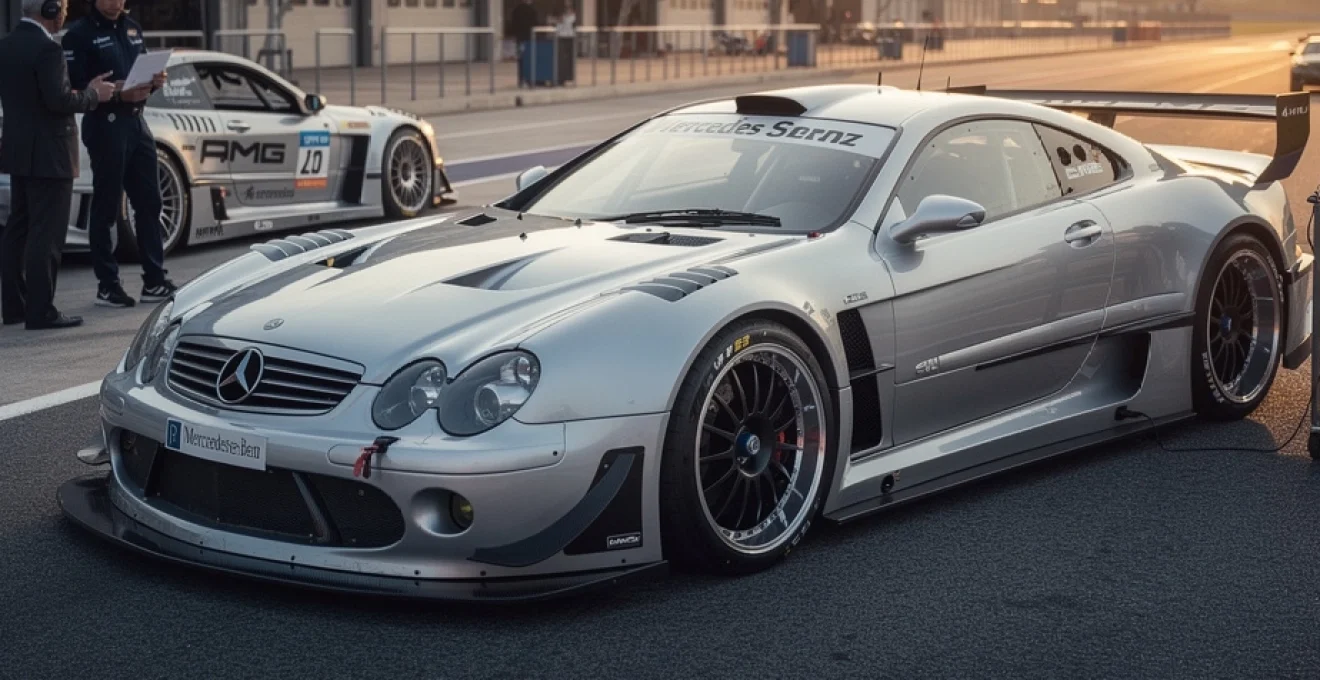
The Mercedes‑Benz CLK GTR sits at a crossroads between prototype racer and road‑going supercar, a machine created for the singular purpose of winning at the highest level of GT racing and then gently civilised for ultra‑wealthy clients. For anyone fascinated by homologation specials, the CLK GTR offers a textbook case of how far a manufacturer will stretch road‑car rules to dominate a championship. It mixed a carbon‑fibre monocoque, a huge naturally aspirated V12 and genuine Le Mans endurance technology with airbags, a CD player and number plates. Even more than two decades later, it remains a benchmark for extreme engineering and a key reference point whenever you hear talk of “race car for the road”.
Origins of the Mercedes‑Benz CLK GTR project and FIA GT homologation context
Amg’s response to McLaren F1 GTR and porsche 911 GT1 in the 1997 FIA GT championship
By the mid‑1990s, GT racing had exploded in popularity. The BPR Global GT Series, precursor to the FIA GT Championship, was packed with icons like the McLaren F1 GTR, Ferrari F40 LM and early Porsche 911 GT1 variants. McLaren had started with a road car and adapted it for racing; Porsche and later Mercedes‑Benz chose the opposite route, designing near‑prototypes and then reverse‑engineering them into road‑legal “Strassenversion” models. AMG’s mission was clear: build a GT1 car capable of beating the McLaren F1 GTR and 911 GT1 over long‑distance races, with reliability strong enough for 3‑hour sprints and 24‑hour marathons. The resulting CLK GTR was a brutal answer to both rivals, winning 17 of the 22 FIA GT races it contested in 1997–1998.
Development partnership between AMG, HWA and Mercedes‑Benz motorsport under norbert haug
Mercedes‑Benz Motorsport, under Norbert Haug, orchestrated a tightly integrated programme. AMG handled the powertrain and overall vehicle concept, while HWA—Hans‑Werner Aufrecht’s engineering company—managed day‑to‑day development, race preparation and later road‑car conversion. The W297 GT1 chassis was designed in Germany but utilised a carbon tub manufactured by Lola in the UK, a reminder of how international top‑tier racing had become. HWA’s role grew rapidly; the company ultimately became the technical backbone for both the FIA GT campaign and the CLK GTR Strassenversion production. This partnership structure foreshadowed the modern AMG‑HPP and AMG‑GT3 ecosystems that you see in current GT3 and GT4 customer racing.
Homologation requirements and transition from racing CLK GTR to road‑legal CLK GTR strassenversion
The FIA’s GT1 rules nominally required 25 road‑going examples for homologation, a measure intended to keep the category tied to production models. In practice, the FIA relaxed timing: manufacturers only needed one road car built initially, with the full batch allowed up to a year after the season. Mercedes‑Benz exploited this intelligently. The first road‑legal CLK GTR prototype was completed in 1997 to secure homologation; the main production run followed once the racing programme had already proved dominant. Converting a pure GT1 machine into the CLK GTR Strassenversion meant adding items such as ABS, traction control, higher ride height, softer damper settings and basic comfort features, while maintaining the race car’s core layout: mid‑mounted V12, rear‑drive, and the same fundamental carbon monocoque and suspension geometry.
Limited production run, chassis numbering and body style split (coupé vs roadster)
To satisfy homologation and a few select clients, Mercedes‑Benz and HWA produced a total of 26 CLK GTR Strassenversion cars: 20 coupés and 6 roadsters. Production cars were sequentially numbered 01/25 to 25/25, regardless of body style, with the earlier two road‑legal prototypes sitting outside this scheme. Coupés accounted for numbers 01/25 to 20/25, while Roadsters carried 21/25 to 25/25, plus an additional unnumbered open car. Variations were surprisingly rich for such a tiny production run: right‑hand drive was offered on two cars, a handful of special interior trims were created, and several chassis were later upgraded to “Super Sport” specification. For a collector, understanding this numbering and the coupé vs roadster split is essential when evaluating provenance and value.
Engine, drivetrain and performance specs of the Mercedes‑Benz CLK GTR
Amg‑tuned M120 6.9‑litre V12 architecture, displacement and internal components
At the heart of the CLK GTR Strassenversion sits an AMG‑tuned derivative of the M120 V12, known internally as GT 112. While the race cars were limited to 5,987 cc by GT1 rules, the road‑legal engines were stretched to 6,898 cc. Bore remained at 89 mm, but stroke increased from 80.2 to 92.4 mm, delivering the near‑7.0‑litre displacement that defines the car’s character. Internally, the engine shared almost nothing with the softer S‑Class and SL‑Class versions: forged pistons, titanium connecting rods, a lightweight flywheel, enlarged valves, high‑lift cams and a dry‑sump lubrication system all pointed to endurance racing. Magnesium cam covers and sump reduced weight, while Bosch HMS7.0 injection controlled fuelling with racing precision yet emissions compliance.
Power output, torque curve and rev characteristics compared with CLK 55 AMG and SL 73 AMG
The official output of the CLK GTR V12 is around 612 bhp at 6,800 rpm and 572 lb ft at 5,250 rpm, figures that placed it among the most powerful road cars of the late 1990s. For context, a period CLK 55 AMG produced roughly 342 bhp from its 5.4‑litre V8, while the SL 73 AMG’s 7.3‑litre M297 V12 delivered about 525–540 bhp. The CLK GTR’s torque plateau feels more like a race engine than a limousine powerplant: it pulls hard from mid revs but really detonates above 4,000 rpm, with a linear, relentless surge reminiscent of a naturally aspirated GT1 prototype. If you enjoy engines that combine big‑block muscle with high‑rev urgency, the CLK GTR’s power delivery remains uniquely appealing, even in an era of 1,000 bhp hybrids.
Sequential 6‑speed racing gearbox, paddle‑shift actuation and final drive ratios
Behind the V12 sits an X‑Trac 6‑speed sequential transaxle, carried over from the GT1 race car but adapted for road use. In place of the pure hand‑sequential race lever, HWA fitted a paddle‑shift actuation system and added a conventional foot clutch to improve drivability and extend service intervals. Ratios remained close, optimised for acceleration out of medium‑speed corners rather than relaxed motorway cruising. A multi‑plate carbon clutch and a Quaife limited‑slip differential managed the immense torque. For a driver stepping out of a standard Mercedes automatic, the CLK GTR’s gearbox feels like a direct motorsport transplant; shifts are fast, firm and mechanical, emphasising that this is not a grand tourer but a barely tamed GT1 car on the road.
Acceleration, top speed and braking figures benchmarked against McLaren F1 and ferrari F50
Mercedes quoted 0–62 mph in around 3.6–3.8 seconds for the coupé and a top speed of about 199 mph. Some later sources quote up to 208 mph for optimally geared examples, putting the CLK GTR firmly into hypercar territory by late‑1990s standards. For comparison, the McLaren F1 was capable of 0–60 mph in 3.2 seconds and a record 240.1 mph, while the Ferrari F50 delivered 0–62 mph in 3.7 seconds and a 202 mph top speed. On paper, the Mercedes sat between these benchmarks, but the real story lies in braking and circuit performance: massive carbon‑composite rotors and six‑piston calipers allowed repeated high‑speed deceleration more in line with a Le Mans prototype than with any road‑car rival, especially over long stints.
Fuel system, lubrication and cooling layouts derived from FIA GT endurance racing
The CLK GTR’s core fluid systems were adapted almost directly from FIA GT endurance racing. A 90‑litre fuel tank sat centrally to minimise balance shifts as fuel burned, down slightly from the 100‑litre tank used in pure race trim. The dry‑sump system used a separate carbon‑fibre oil tank and external scavenge pumps to ensure stable oil pressure under sustained high lateral loads, something you feel if you push the car hard on track. Cooling relied on multiple radiators and carefully positioned side and rear intakes, combined with an oversized roof scoop on the coupé. For the roadster, intake ducts were relocated to the flying buttresses behind the cockpit, maintaining airflow while compensating for the removed roof structure.
Chassis engineering, aerodynamics and materials used in the CLK GTR
Carbon‑fibre monocoque construction, aluminium subframes and torsional rigidity metrics
The core of the CLK GTR is a carbon‑fibre and aluminium honeycomb monocoque designed by AMG and manufactured by Lola. A steel roll‑cage with 40 mm tubing is integrated into the tub, giving the structure exceptional torsional rigidity compared with conventional steel unibodies of the time. While exact torsional numbers remain unpublished, contemporary engineers referenced stiffness levels comparable to Group C prototypes from the late 1980s. Front suspension components mount directly to the tub, while the gearbox casing serves as a stressed element at the rear, with an aluminium subframe supporting the V12. For you as a driver, that rigidity translates into immediate steering response and a suspension that can be set very precisely without the chassis itself flexing under load.
Push‑rod suspension geometry, double wishbones and adjustable race‑spec dampers
Both ends of the CLK GTR use double wishbones with inboard coil‑over units operated via push‑rods, a pure racing solution rarely seen on production cars even today. This layout allows optimised motion ratios, reduced unsprung mass and easier packaging for large brake assemblies and aerodynamic elements. Adjustable dampers enable fine tuning of compression, rebound and ride height, which was crucial for both FIA GT setup and the raised‑ride‑height road settings. Anti‑roll bars control lateral load transfer, giving the car a balance that can be trimmed from mild understeer to aggressive neutrality. If you are used to road‑car multi‑link systems, the CLK GTR’s suspension feels more like a DTM or GT3 racing car beneath you—hyper‑sensitive to setup and tyre choice.
Underbody aerodynamics, rear diffuser, fixed rear wing and high‑speed downforce levels
Aerodynamically, the CLK GTR occupies a fascinating middle ground between road car and prototype. The bodywork is dominated by a deep front splitter, flat underfloor and substantial rear diffuser, generating downforce without excessive drag. On the coupé, an integrated rear wing forms part of the tail, with an adjustable element providing up to an additional 35° of rake in high‑downforce mode. The overall package produced serious negative lift at racing speeds, contributing to the car’s crushing performance in the 1997 and 1998 FIA GT seasons. Crucially, unlike the later CLR LMGTP, the CLK GTR never suffered from the catastrophic pitch‑sensitivity that led to the infamous Le Mans flips, a distinction enthusiasts sometimes overlook.
Carbon‑ceramic braking system, calliper configuration and heat management
Period road tests and technical data highlight substantial brake hardware: front discs of around 355 mm with four‑piston calipers and rear discs of roughly 330 mm with six‑piston calipers. Although the race cars relied on full carbon race rotors, the Strassenversion used high‑performance composite or steel‑based systems tuned for better cold‑bite and road usability. Extensive ducting fed cooling air to the discs and calipers, while wheel designs aided heat evacuation. In hard circuit use, repeated stops from 180–190 mph were entirely realistic without fade, provided proper warm‑up and fluid maintenance. For any owner today, brake inspections and fluid changes are among the most critical maintenance tasks given the stress levels these components endure.
Wheelbase, track widths, kerb weight and weight distribution optimisation
The CLK GTR’s wheelbase is 2,670 mm, with a very broad track at both ends to maximise mechanical grip and stability. Production cars gained significant weight over the 1,005 kg race version, reaching approximately 1,470 kg for the coupé and about 1,575 kg for the roadster once safety and comfort equipment were added. Even with this extra mass, weight distribution remained close to ideal for a mid‑engined layout, with slightly more over the rear axle to aid traction. From a driving perspective, you experience a car that feels large but planted, combining the agility of a GT1 racer with a level of high‑speed stability closer to a modern GT3 machine than to a typical road‑going supercar.
Interior design, ergonomics and road‑legal adaptations of the CLK GTR strassenversion
Hybrid cockpit concept merging GT1 racing layout with Mercedes‑Benz luxury cues
Step into a CLK GTR and the first impression is of a racing cockpit softened at the edges by Mercedes‑Benz luxury cues. The basic driving position, with fixed bucket seats and an adjustable pedal box, comes straight from GT1 practice, optimising safety and control rather than day‑to‑day comfort. Yet the cabin is trimmed in leather and Alcantara, with carbon‑fibre inserts and tasteful stitching. You still get electric windows, central locking and a period audio system, reflecting the need to homologate the car as a genuine road vehicle. The effect is a hybrid cockpit: harsh, noisy and cramped compared with any standard CLK, but significantly more accommodating than a pure race car such as a Group C prototype.
Instrumentation, analogue gauges and switchgear borrowed from W202 and R129 models
To streamline development and ensure reliability, Mercedes raided its parts bins for much of the dash and switchgear. The main instrument cluster shares design language with W202 and R129 models, with analogue gauges for speed, revs, temperature and fuel. Switches for lights, wipers and climate functions are familiar if you have driven 1990s Mercedes models, which makes the car oddly intuitive despite its extreme character. Additional racing‑style controls manage functions like the pneumatic jacking system and traction control. Using production‑car components for routine functions also helped keep serviceability realistic; mechanics could source many interior parts from standard models rather than commissioning one‑off replacements.
Safety equipment, roll‑cage integration and FIA‑inspired seat design
Safety was a significant design driver, especially given the CLK GTR’s FIA GT origins. The integrated roll‑cage is tied directly into the carbon tub, and bucket seats mount to the rear bulkhead rather than to simple seat rails. Four‑point harnesses were standard, with airbags for both driver and passenger—remarkable for such a limited‑run homologation special. Side‑impact protection is substantial thanks to thick sill structures and the strong monocoque. In the roadster, rollover hoops behind each headrest provide additional protection. For you as a driver, the result is a cockpit that feels cocoon‑like and purposeful, more akin to a modern GT3 race car than to a roadster designed primarily for boulevard cruising.
Key racing achievements of the Mercedes‑Benz CLK GTR in FIA GT competition
1997 FIA GT season dominance with bernd schneider, klaus ludwig and mark webber
The CLK GTR’s competition debut in the 1997 FIA GT Championship marked Mercedes‑Benz’s return to top‑tier sportscar racing after the Group C era. Drivers such as Bernd Schneider, Klaus Ludwig and Mark Webber leveraged the car’s pace and reliability to devastating effect. Across the 11 rounds of the 1997 season, the CLK GTR won 6 races and secured both the Drivers’ and Manufacturers’ titles. Over the combined 1997–1998 campaigns, the CLK GTR and its evolution, the CLK LM, would win 17 of 22 races—an extraordinary strike rate of around 77%. For fans tracking dominant racing programmes, these seasons sit alongside the best stretches of Audi’s Le Mans era and Mercedes’ F1 hybrid dominance.
Race wins at hockenheim, nürburgring and suzuka and their impact on GT1 regulations
Victories at circuits like Hockenheim, the Nürburgring and Suzuka highlighted the CLK GTR’s versatility. Tight, technical layouts and fast, flowing tracks both suited its combination of mechanical grip and aerodynamic efficiency. This relentless winning streak, combined with rising costs and the increasingly prototype‑like nature of GT1 machinery, pushed organisers into a corner. The FIA and manufacturers realised that the gap between GT1 “homologation” specials and genuine road cars had become too wide. As a result, GT1 was effectively legislated out of existence after 1998, replaced by more production‑based categories. In a very real sense, the CLK GTR was so good that it helped kill the class it was built to dominate.
Evolution from CLK GTR to CLK LM for le mans 1998 and technical differences
For the 1998 Le Mans 24 Hours, Mercedes developed the CLK LM, a refined evolution of the CLK GTR aimed specifically at endurance on the Circuit de la Sarthe. The most significant change was the switch from the 6.0‑litre V12 to a 5.0‑litre M119 V8 derived from earlier Sauber‑Mercedes Group C cars. Engineers believed the V8 offered greater durability and better fuel efficiency under Le Mans conditions. The CLK LM’s bodywork also evolved, with cleaner aerodynamics and reduced drag. Despite securing pole position at Le Mans, both CLKs suffered engine failures early in the race—a rare reliability lapse in an otherwise dominant programme. This disappointment indirectly set the stage for the all‑new CLR LMGTP that followed in 1999.
Regulatory changes, GT1 class cancellation and end of the CLK GTR racing programme
By 1999, the GT1 landscape had changed dramatically. Manufacturer interest plummeted as costs spiralled and the cars drifted further from their supposed production roots. With Mercedes effectively the only committed GT1 manufacturer left, the class was cancelled from the FIA GT Championship. Le Mans organisers (ACO) introduced the LMGTP category, leading to the controversial CLR project and its notorious aerodynamic issues. Once the CLR programme collapsed after the terrifying airborne incidents in 1999, Mercedes withdrew from top‑level sportscar racing. The CLK GTR’s competitive career ended not due to obsolescence on track, but because the entire rule‑set that created it was swept away, leaving it frozen in time as the apex of GT1 evolution.
Variants, one‑offs and notable Mercedes‑Benz CLK GTR chassis in private collections
CLK GTR roadster production numbers, structural reinforcements and aerodynamic changes
The CLK GTR Roadster, produced in just 6 examples, represents one of the rarest open‑top hypercars ever built. Removing the fixed roof required structural reinforcements around the sills and rear bulkhead, as well as the addition of integrated rollover hoops behind each seat. Aerodynamically, the roadster traded the coupé’s roof scoop for side‑mounted intakes integrated into dramatic flying buttresses. The rear wing adopted a twin‑pylon design more reminiscent of the race car, while the front received a subtly revised grille featuring a prominent three‑pointed star. Kerb weight increased by roughly 105 kg over the coupé, but performance remained ferocious, with the same 612 bhp V12 and quoted top speeds north of 200 mph under ideal conditions.
CLK GTR super sport with AMG 7.3‑litre M297 V12 and revised performance specs
A handful of CLK GTRs were upgraded by HWA to “Super Sport” specification, featuring the 7,291 cc M297 V12 later seen in the AMG SL 73 and early Pagani Zonda models. Bore was increased to 91.5 mm while maintaining the 92.4 mm stroke, with compression reduced slightly to 10.0:1. Output climbed to around 655 bhp and 580 lb ft, edging the CLK GTR even closer to prototype‑level performance. Only five cars—one prototype and four production coupés—received this conversion, making them particularly coveted among collectors. For you as an enthusiast tracking ultra‑rare variants, the Super Sport represents the peak of CLK GTR road‑car performance and one of the most potent naturally aspirated Mercedes‑engined machines ever built.
High‑profile owners, auction sales at RM sotheby’s and gooding & company
Given production numbers in the low twenties for coupés and low single digits for many specific specifications, the CLK GTR has become a fixture at top‑tier auctions. Cars have appeared at houses such as RM Sotheby’s and Gooding & Company, with prices escalating significantly over the last decade. Early 2000s values around $1.5–2 million have grown to well over $8–10 million for especially rare examples, placing the CLK GTR firmly in the same financial stratosphere as the McLaren F1 and Porsche 911 GT1 Strassenversion. Several high‑profile collectors, including royal families and major private museums, hold multiple CLK GTRs. If you are researching a specific car, recent catalogues and specialist brokers often provide detailed histories, service records and period race documentation.
VIN decoding, colour combinations and provenance of historically significant chassis
For anyone considering a CLK GTR purchase or simply tracking individual cars, understanding VIN patterns and build details is crucial. Most chassis were finished in silver, echoing the “Silver Arrows” heritage, but a small number left the factory in red, dark blue or black. Interior trims ranged from dark grey leather to rare tartan patterns and even one magenta‑trimmed roadster. Two cars were built in right‑hand drive for a noted Southeast Asian collection, further differentiating them. VIN decoding allows identification of coupé vs roadster status, build sequence and, in some cases, later upgrades such as Super Sport conversions. Proper provenance often includes period photographs, homologation documents and HWA service records, all of which materially influence both value and historical significance.