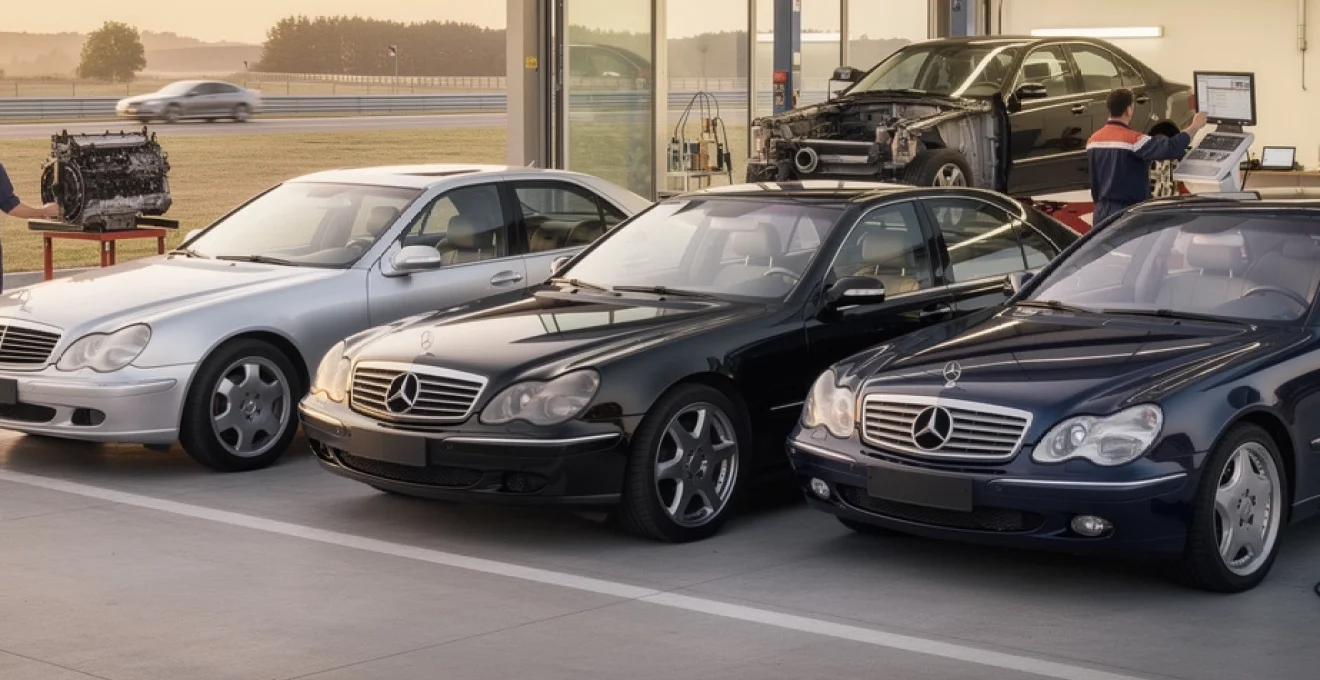
The 2000 Mercedes‑Benz S‑Class sits at a fascinating crossroads between traditional limousine luxury and the digital age. It blends deep‑cushioned comfort, restrained elegance and imposing presence with complex electronics, advanced air suspension and strong petrol and diesel engines. Two decades on, the W220‑series S‑Class has moved from high‑status executive saloon to attainable modern classic, attracting enthusiasts who value craftsmanship and long‑distance refinement more than touchscreens and gadget overload. If you are considering a used Mercedes S‑Class saloon from this era, understanding its engineering depth, strengths and known weaknesses is essential to enjoying dependable, affordable luxury over the long term.
W220 generation overview: positioning of the 2000 Mercedes‑Benz S‑Class in the luxury saloon segment
At launch, the W220 Mercedes‑Benz S‑Class was hailed as one of the finest executive saloons available at any price. Compared with the massive W140, it was shorter, narrower and around 300 kg lighter in some trims, yet more spacious inside and significantly more aerodynamic. The 2000 S‑Class competed directly with the BMW 7 Series (E38) and Audi A8 D2, but positioned itself as the most comfort‑oriented of the trio, with a quieter cabin, softer ride and a more opulent interior. Reviewers often described it as a “luxury barge”, but its light steering and sophisticated suspension meant it felt much smaller to drive than its dimensions suggest.
In the UK market, the S 320 CDI diesel and S 320 petrol quickly became the volume sellers, while the S 430 and S 500 targeted company directors and private buyers stepping up from an E‑Class. At the top of the range, the S 600 and early S 55 AMG delivered supercar‑level performance in a discreet limousine body. Depreciation was steep: some flagship models lost more than 50% of their value in the first three years, which today makes a well‑maintained 2000 Mercedes‑Benz S‑Class a surprisingly affordable route into high‑end motoring. This depreciation, however, makes it even more important for you to distinguish cherished examples from neglected ones.
Design and aerodynamics of the 2000 S‑Class: W220 body, drag coefficient and chassis architecture
Exterior styling analysis: proportions, LED rear lights and chrome detailing on S 320, S 430 and S 500
The W220 S‑Class moved away from the fortress‑like look of the W140 and adopted a more fluid, elegant shape. Its bonnet is lower and more curved, the glass area appears larger, and the body sides are smoother with subtle feature lines. On 2000 models, details differ slightly between S 320, S 430 and S 500, but all share chrome window surrounds, chrome grille slats and discreet badging. Wheel designs range from modest 16‑inch multi‑spokes on the S 320 to more assertive 17‑inch alloys on many S 500s.
One hallmark design feature is the use of early LED technology in the rear lamp clusters for certain lighting functions. These LED rear lights offer quicker illumination than traditional bulbs, adding a small but meaningful safety benefit when you are braking at motorway speeds. The overall effect is that the car still looks contemporary, especially when compared with the more angular W140 and some rivals from the same era. Many enthusiasts consider the 2000 S‑Class a sweet spot: modern enough not to feel dated, but classic enough to avoid excessive styling gimmicks.
Body structure and lightweight engineering: high‑strength steel, aluminium panels and torsional rigidity
Under the elegant bodywork, the W220 introduced a new focus on weight reduction for Mercedes luxury saloons. High‑strength steels are used strategically in the passenger cell, while bolt‑on panels such as the bonnet, boot lid and some suspension components are made from aluminium. This mixed‑material strategy cut mass by roughly 10–15% versus a comparable W140, improving fuel economy and agility without sacrificing safety. Torsional rigidity remained high, contributing to that characteristic S‑Class feeling of solidity over poor surfaces.
The lighter structure also allowed the 2000 S‑Class to make full use of its advanced suspension systems. Lower unsprung weight over each wheel helps the AIRMATIC and ABC systems react more quickly to bumps and body movements, smoothing out irregularities that would unsettle a heavier car. For you as a buyer of a modern classic S‑Class, this emphasis on lightweight engineering and rigidity means the car still feels composed and refined by today’s standards, provided the suspension is in good condition.
Aerodynamic optimisation: underbody panelling, mirror design and cd value versus W140 and BMW 7 series (E38)
The 2000 Mercedes‑Benz S‑Class was engineered with a strong emphasis on aerodynamics. The W220’s drag coefficient is as low as Cd 0.27 in some configurations, a notable improvement over the W140’s approximately 0.30 and competitive with the BMW 7 Series E38, which typically sits around 0.29. This reduction in drag is achieved through smooth underbody panelling, carefully profiled front and rear bumpers and a tapered boot line that reduces turbulence.
Mirror design plays a surprisingly important role. The door mirrors on the W220 were sculpted in the wind tunnel to minimise wind noise at motorway speeds, channelling air cleanly along the glasshouse. Combined with double‑glazed side windows on many models, this results in an exceptionally quiet cabin, even by current standards. If you spend long hours on motorways, the low aerodynamic drag and acoustic optimisation make the 2000 S‑Class feel like a rolling cocoon, isolating you from wind rush and tyre roar.
Wheelbase, track and suspension geometry: impact on ride comfort and high‑speed stability
The W220 was offered in standard and long‑wheelbase (LWB) variants, with the 2000 S‑Class LWB extending the wheelbase by around 120 mm. This extra length goes almost entirely to rear legroom, creating the feel of a rolling boardroom. A long wheelbase also calms the car’s reaction to bumps, reducing pitch and improving straight‑line stability. The front and rear tracks are relatively wide, giving the big Mercedes a planted stance and helping it resist crosswinds at speed.
Suspension geometry is tuned for comfort rather than razor‑sharp turn‑in, with relatively soft initial rates and clever use of anti‑roll bars. When paired with AIRMATIC or ABC, the S‑Class can simultaneously deliver a plush ride and secure handling. You will notice minimal body roll in fast sweepers, while the car still irons out broken road surfaces. For many owners, this blend of comfort and stability remains one of the main reasons to choose a 2000 S‑Class saloon over newer, firmer‑riding alternatives.
Paint systems, corrosion protection and rust‑prone areas on early W220 models
One of the key considerations when buying a 2000 Mercedes‑Benz S‑Class as a classic luxury car is corrosion. Early W220s used water‑based paint systems and thinner galvanisation than some previous generations, and several markets reported rust appearing earlier than expected. Common rust‑prone areas include wheel arches, the lower edges of doors, boot lids around the number plate recess and the front wings behind the wheel liners.
Underbody protection is generally good, but stone chips that break through the paint and underseal can develop into significant corrosion if left untreated. A thorough pre‑purchase inspection should include lifting the car to examine jacking points, subframe mounting areas and brake line routing points. Addressing small rust bubbles early with proper preparation and high‑quality paintwork is far cheaper than full panel replacement later. If you find a car that has been garaged and regularly washed, particularly in winter, it will almost always be a better long‑term bet than a neglected high‑mileage example.
Engine and drivetrain variants in the 2000 Mercedes‑Benz S‑Class: petrol, diesel and AMG powertrains
M112 and M113 petrol engines: S 320 V6, S 430 V8 and S 500 V8 performance and reliability
The 2000 S‑Class range is built around the robust M112 V6 and M113 V8 engines. The S 320 uses a 3.2‑litre V6 producing around 224 bhp, enough for 0–62 mph in roughly 8.5 seconds and a limited top speed of 155 mph. For many owners, this engine provides more than adequate performance with relatively modest fuel consumption for a large luxury saloon. The S 430 and S 500 use 4.3‑litre and 5.0‑litre V8s with 275–306 bhp, delivering stronger mid‑range acceleration and more relaxed high‑speed cruising.
Both engine families have earned a reputation for long‑term reliability if serviced properly. Typical issues include oil leaks from cam covers, occasional mass air‑flow sensor failures and ignition coil problems on high‑mileage cars. Regular oil changes with quality synthetic oil, plus timely replacement of auxiliary belts and tensioners, keeps the M112 and M113 running smoothly well beyond 200,000 miles. If you prefer a smooth, effortless drive and do relatively low annual mileage, a petrol S 430 or S 500 remains an excellent modern classic choice.
OM613 CDI diesel technology: S 320 CDI common‑rail injection, torque delivery and fuel economy
The S 320 CDI uses the 3.2‑litre inline‑six OM613 common‑rail diesel, which transformed the running costs of the S‑Class when new. With around 197 bhp but, more importantly, about 470 Nm of torque available from low revs, it delivers strong, relaxed acceleration that suits the car’s character. Owners typically report real‑world fuel economy of 35–40 mpg on longer runs, impressive for a large executive saloon weighing over 1.8 tonnes.
The common‑rail injection system allows multiple injections per cycle for quieter combustion, contributing to the S‑Class’s refined, almost petrol‑like diesel sound at cruising speeds. Known issues include injector sealing (black death), intake manifold clogging with soot and EGR‑related problems. However, with clean fuel, proper servicing and occasional intake cleaning, the OM613 is capable of very high mileages. If you plan to use your 2000 Mercedes‑Benz S‑Class as a high‑mileage daily driver, the S 320 CDI often represents the best blend of reliability, torque and economy.
S 600 V12 (M137) specification: twin‑spark ignition, refinement and known maintenance challenges
The S 600 in 2000 uses the 5.8‑litre M137 naturally aspirated V12, a technical showcase featuring twin‑spark ignition and advanced engine management. Power output is around 367 bhp with 530 Nm of torque, enabling near‑effortless acceleration in any gear. Refinement is the key attraction: at idle the V12 is almost silent, and under load it delivers a smooth, turbine‑like surge that even the best V8s cannot quite match.
However, owning a V12 S‑Class requires a realistic attitude to maintenance. There are twelve cylinders, twenty‑four spark plugs and more complex ancillary systems, all of which raise service costs. Common concerns include coil‑pack failures, oil leaks, and in some cases issues with cylinder deactivation systems on later updates. In 2000 guise, diligent maintenance and regular fluid changes are crucial. If you are tempted by the allure of a V12 modern classic, ensure the car comes with meticulous service history and be prepared for parts prices that reflect its flagship status.
Early AMG derivatives: S 55 AMG naturally aspirated V8 characteristics and tuning potential
The 2000 S 55 AMG sits just below the S 600 in prestige but offers a very different driving experience. Its tuned 5.4‑litre V8 produces around 354 bhp and a rich, muscular soundtrack that many enthusiasts find more engaging than the V12’s whisper. The S 55 AMG combines subtle styling tweaks—deeper bumpers, larger wheels, discreet badges—with firmer suspension and more direct steering, creating a surprisingly agile large saloon.
From a tuning perspective, the naturally aspirated AMG V8 responds well to intake and exhaust upgrades and remapping, although gains are modest without forced induction. For classic car insurance and collectability, an S 55 AMG in original condition usually holds value better than a heavily modified example. If you are drawn to the idea of a Q‑car luxury saloon with real performance cred, the early AMG derivative provides an intriguing alternative to the mainstream S 430 and S 500.
5g‑tronic automatic transmission (722.6): shift strategy, torque converter lock‑up and service intervals
All 2000 S‑Class models use the five‑speed 5G‑Tronic automatic transmission (internal code 722.6), a gearbox renowned for its durability when serviced correctly. It features adaptive shift logic that learns your driving style, holding gears longer under brisk acceleration and upshifting earlier for economy when driven gently. Torque converter lock‑up activates in several gears, improving fuel efficiency and reducing heat build‑up in the transmission fluid, especially at motorway speeds.
Although marketed as “sealed for life” in some markets, experienced specialists strongly recommend fluid and filter changes every 40,000–60,000 miles. Fresh ATF fluid maintains smooth shifts and extends the life of internal clutches and valve‑body components. Typical issues on neglected gearboxes include harsh shifting, delayed engagement into drive or reverse and conductor plate faults. If you test‑drive a 2000 Mercedes‑Benz S‑Class, pay close attention to the gearbox behaviour from cold and hot; a well‑maintained 5G‑Tronic should be almost imperceptible in normal use.
Advanced suspension and chassis systems: AIRMATIC, active body control and braking technology
AIRMATIC air suspension: air springs, adaptive damping system (ADS) and common failure points
AIRMATIC is one of the key reasons the 2000 S‑Class still feels like a true luxury car today. Instead of conventional steel springs, it uses air bellows at each corner, paired with electronically controlled dampers managed by the Adaptive Damping System (ADS). Ride height can be varied, and the system automatically adjusts damping rates in real time based on speed, load and road surface. The result is a limousine that glides over rough roads yet firms up when you push on, maintaining control and composure.
However, the trade‑off is complexity. Common AIRMATIC failure points include leaking air struts, tired air compressors, valve block issues and level sensor faults. Symptoms range from a drooping corner after parking overnight to persistent “AIRMATIC – Visit Workshop” warnings. When assessing a 2000 S‑Class, you should check that the car sits level, rises and lowers promptly and does not cycle the compressor excessively. Quality aftermarket parts and specialist knowledge now make AIRMATIC repair more manageable than when the cars were new, but it remains a key budget consideration.
Active body control (ABC) hydraulics: tandem pump, struts, pressure accumulators and diagnostic procedures
Higher‑end petrol models, especially the S 500 and S 600, could be specified with Active Body Control. ABC is a fully hydraulic suspension that uses high‑pressure struts, a tandem pump and pressure accumulators to counteract body roll and pitch almost completely. Sensors monitor body movement up to 100 times per second, and the system adjusts each strut’s pressure to keep the car level in corners, under braking and during acceleration. When functioning correctly, ABC gives the 2000 Mercedes‑Benz S‑Class an uncanny flatness through bends, almost like a maglev train gliding along a track.
ABC is also where many prospective buyers are understandably cautious. Key components include the tandem pump (which feeds both power steering and ABC), the valve blocks, accumulators (“spheres”) and the hydraulic lines running along the chassis. Over time, accumulators lose their gas charge, causing a harsh ride, while leaks can lead to low fluid levels and warning lights. A proper diagnostic session requires a capable scan tool, pressure checks and an understanding of Mercedes diagnostic codes specific to ABC. If you are not prepared for potentially four‑figure repair bills, choosing an AIRMATIC‑equipped rather than ABC‑equipped S‑Class may be the safer route.
Electronic stability program (ESP), ASR and brake assist integration with ABS on the W220
The W220 generation integrated several safety systems into a coordinated network. The Electronic Stability Program (ESP) works with ASR traction control and ABS to help keep the car stable during sudden manoeuvres or on slippery surfaces. Wheel‑speed sensors, a steering‑angle sensor and a yaw‑rate sensor feed data to the central control unit, which can brake individual wheels and reduce engine torque if it detects a loss of control.
Brake Assist monitors the speed and force with which you hit the brake pedal. If it recognises an emergency stop, it automatically increases braking pressure to shorten stopping distances. For a 2000 luxury saloon, these systems were state of the art and contributed to accident statistics showing significant injury‑reduction benefits from stability control in large cars. When shopping for a modern classic S‑Class, ensure that warning lights for ESP or ABS are not illuminated, as diagnosing intermittent sensor faults can take time even for experienced technicians.
Steering and front‑end components: rack‑and‑pinion, lower control arms and bushing wear patterns
Unlike the recirculating ball systems used in some earlier Mercedes flagships, the W220 uses rack‑and‑pinion steering, which gives clearer feedback and more precise control. The steering is still on the light side at low speeds, prioritising ease of parking over sharpness, but it weights up reassuringly on the motorway. Over time, play can develop in track‑rod ends and inner tie‑rods, leading to vague steering or uneven tyre wear.
The front suspension employs lower control arms with large rubber bushes, designed to isolate the cabin from road harshness. These bushes, along with anti‑roll bar links and top mounts, are all wear items. If you notice clunks over bumps, wandering at speed or rapid inner‑edge tyre wear, expect some front‑end refresh work. Fortunately, high‑quality aftermarket components are widely available, and once renewed, the front end of a 2000 S‑Class feels taut, stable and confidence‑inspiring again.
Wheel and tyre specifications: factory 16–18 inch setups, load ratings and recommended upgrades
Factory wheel sizes on the 2000 Mercedes‑Benz S‑Class range from 16 inches on many S 320s to 17 or 18 inches on V8, V12 and AMG variants. Tyres must carry appropriate load ratings, as the car’s kerb weight can exceed 1,900 kg depending on specification. For comfort‑focused use, many experienced owners recommend staying with 16‑ or 17‑inch wheels and quality touring tyres, which preserve the S‑Class’s signature ride quality and minimise road noise.
If you prefer a more contemporary look, upgrading to 18‑inch wheels is possible, but choose tyres with sufficient sidewall height and reinforced load ratings. Staggered setups on AMG‑style wheels can improve grip but may increase tramlining on poor road surfaces. Whatever configuration you choose, correct wheel alignment and regular tyre pressure checks are essential. A well‑aligned W220 tracks arrow‑straight on the motorway and feels secure even at very high speeds, which is part of the ongoing appeal of using an S‑Class as a long‑distance companion.
Electronic architecture and comfort technology: COMAND, fibre‑optic MOST bus and driver assistance
The 2000 S‑Class marks Mercedes’ shift towards a more integrated electronic architecture, built around early versions of the COMAND infotainment system and a fibre‑optic bus network known as MOST in later evolutions. COMAND integrates navigation, audio, telephone and vehicle settings into a single interface, controlled via buttons and a central rotary knob. For its time, this system was advanced, although by modern standards the graphics and route‑calculation speed feel dated. Retrofits such as discrete Bluetooth modules and updated navigation drives can help bridge the gap if you want modern connectivity in a classic luxury interior.
Electrical modules throughout the car communicate over CAN‑bus networks, reducing wiring complexity and allowing functions like automatic climate control, seat memory, massage seats and soft‑close doors to coordinate smoothly. Driver‑assistance technologies such as Parktronic parking sensors and early radar‑based cruise control (on some high‑spec cars) foreshadow today’s semi‑autonomous systems. When inspecting a car, it is wise to test every electrical function: seats, windows, mirrors, sunroof, central locking and all COMAND features. Seemingly minor faults can indicate water ingress, ageing control units or wiring issues that are best addressed early rather than allowed to cascade into multiple system failures.
Interior craftsmanship and materials: leather grades, wood veneers and long‑wheelbase (LWB) rear suites
Open the door of a well‑kept 2000 Mercedes‑Benz S‑Class and the first impression is one of understated opulence. Soft leather upholstery, genuine wood veneers and thick carpets combine to create a cabin that still feels premium compared with many contemporary cars. Different leather grades were offered, from standard hides to more supple and richly grained options on Designo or high‑spec models. Over time, bolsters on the driver’s seat can wear or crack, especially on lighter colours, but careful cleaning and conditioning restores much of the original appearance and suppleness.
The dashboard arcs gently around the driver, with clear analogue instruments and logically arranged climate and audio controls. Real wood trim—typically burr walnut or similar finishes—runs across the fascia and into the doors. Unlike some rivals that used lacquered plastic, the W220’s veneers can be carefully re‑polished if they develop minor scratches. Long‑wheelbase models elevate rear comfort further, offering extra legroom, individual rear seats with electric adjustment, optional rear climate control and, on some cars, folding tables and entertainment screens. If you intend to be chauffeured or regularly carry rear‑seat passengers, the LWB S‑Class arguably still sets the benchmark for classic limousine comfort in this price range.
Buying guide and maintenance checklist for a 2000 Mercedes‑Benz S‑Class as a modern classic
Approaching a 2000 Mercedes‑Benz S‑Class as a modern classic requires a blend of enthusiasm and pragmatism. The car delivers exceptional comfort, refinement and presence, but it is complex and demands careful maintenance. Service history is crucial: look for evidence of regular oil changes, gearbox fluid services, brake fluid replacement and documented suspension work. A thick folder of invoices from a reputable main dealer or independent specialist is often more valuable than low mileage alone. Cars that have been used gently but maintained poorly can generate higher bills than a higher‑mileage example that has been serviced on time with quality parts.
To structure your inspection, it helps to follow a simple process in person:
- Walk around the car checking for rust, paint mismatches and panel gaps that suggest accident repairs.
- Start the engine from cold, listening for rattles, warning lights or excessive smoke, then test drive to assess gearbox and suspension behaviour.
- Operate all electrical and comfort features, including AIRMATIC or ABC height adjustments, COMAND functions and seat controls.
- Review the service history in detail, confirming mileage, previous ownership and major component replacements.
Several specific challenges are worth budgeting for. AIRMATIC or ABC repairs can range from a few hundred pounds for a single component to several thousand for a full refresh. Electrical gremlins, especially in cars that have suffered water ingress through blocked drains, can take time to diagnose. Corrosion, if advanced, is often not economical to repair to a high standard. On the positive side, independent Mercedes specialists and a strong enthusiast community provide invaluable support, making it easier for you to keep a 2000 S‑Class in reliable, enjoyable condition over many years of classic ownership.