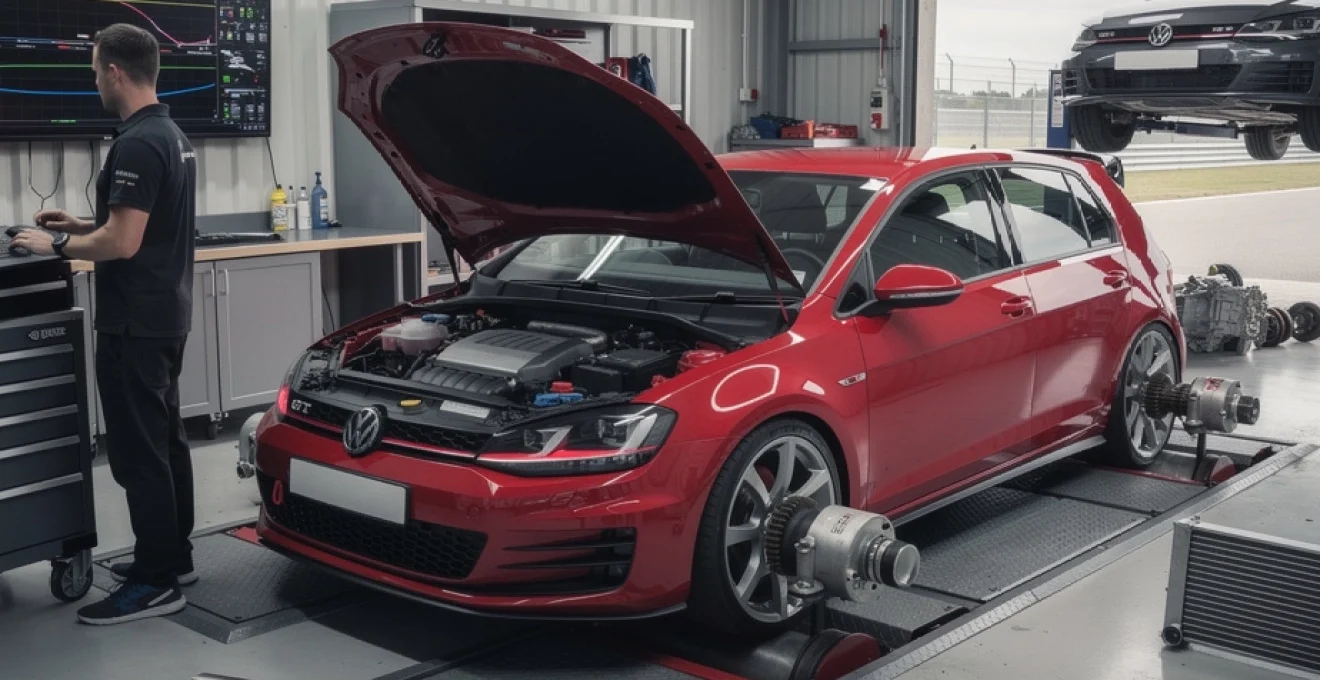
The Mk7 Golf GTI has become the default choice for anyone chasing strong real-world performance with daily-driver manners. Underneath the understated bodywork sits the EA888 Gen 3 engine, a powerplant that responds exceptionally well to careful tuning. With the right calibration and hardware, a stock hot hatch can be transformed into a genuinely quick road or track car, all while retaining reliability and refinement if you respect the platform’s limits.
If you own a Mk7 GTI or are considering buying one with tuning in mind, understanding how bhp figures are quoted, what the hardware can genuinely support, and which upgrade paths make sense is crucial. The difference between a safe 300 bhp build and a fragile 400+ bhp project often comes down to detail: fuel system strategy, intercooler choice, gearbox calibration and how the ECU manages heat and knock. Getting those details right lets you enjoy the extra power every single day.
Stock MK7 golf GTI BHP specs: EA888 gen 3 engine outputs by model year and market (UK, EU, US)
OEM power ratings: 220 PS vs 230 PS vs 245 PS performance pack and GTI performance
The standard Mk7 Golf GTI launched with the EA888 Gen 3 2.0 TSI in several output flavours, depending on model year and market. In early UK and EU cars, the base GTI is rated at 220 PS (about 217 bhp) at around 4,500–6,200 rpm. Later revisions and special trims, such as the GTI Performance or “GTI Performance Pack”, increased that to 230 PS (approximately 227 bhp). The mid-life facelift, commonly called Mk7.5, pushed things further for the GTI Performance to a quoted 245 PS (roughly 241 bhp).
US-market cars mirror this trend but with slightly different quoted bhp figures due to SAE measurement and fuel quality differences. In practice, most healthy GTIs dyno a little above book numbers: a “220 PS” car often records 235–245 bhp at the crank when back-calculated from hub or roller figures. This baseline is important because it means a seemingly modest Stage 1 remap to 300 bhp is not a 40% jump, but more like 25–30% over the engine’s true output.
Torque figures, boost pressure and factory ECU calibration across CHHA, CHHB, DKFA engine codes
Key EA888 Gen 3 engine codes in the Mk7 GTI family include CHHA, CHHB and later DKFA. Across these, factory torque is typically quoted at 350 Nm (258 lb ft) from as low as 1,500 rpm up to around 4,500 rpm for 220–230 PS models, with 245 PS versions edging closer to 370 Nm. Boost pressure on the stock IHI IS20 turbo is generally in the 0.9–1.1 bar region in sustained pulls, with short overboost peaks above that.
The factory MED17 ECU calibration is conservative, targeting rich air–fuel ratios under load and relatively gentle ignition advance, especially on lower-octane markets. Lambda values close to 0.78–0.80 at full throttle are common, which helps keep exhaust gas temperatures under control. This leaves noticeable headroom for tuners to lean mixtures slightly, increase boost and add timing while staying inside safe knock and temperature limits on 98/99 RON fuel.
Differences between standard GTI, GTI performance, GTI clubsport and clubsport S bhp maps
The standard GTI and GTI Performance share the IS20 turbocharger but differ in software and hardware such as the VAQ front diff and larger brakes. The Performance model’s ECU map runs a little more boost and torque but is fundamentally similar. The big jump comes with the GTI Clubsport and Clubsport S, rated at 265–310 PS depending on market and overboost strategy.
On these models, the ECU allows higher peak boost and more aggressive ignition timing in specific load and rpm zones, while also relying on improved intercooling and knock control. Torque is often quoted at 380–400 Nm, but short bursts in higher gears can see significantly more midrange thrust. For anyone chasing “Clubsport feel”, a well-developed Stage 1 map on a regular GTI will closely replicate, and often exceed, these factory special outputs.
Impact of WLTP vs NEDC emissions standards on quoted bhp for late mk7.5 GTI models
Late Mk7.5 GTI models were homologated under the newer WLTP and RDE test regimes rather than the older NEDC cycle. To meet particulate and NOx targets, calibration changes included slightly reduced high-load enrichment, modified cam phasing and, on some variants, gasoline particulate filters (OPF/GPF). As a result, quoted bhp numbers in brochures can look lower or more conservative, even though the hardware is largely unchanged.
On the dyno, WLTP-era cars often match or surpass earlier NEDC versions because manufacturers built in additional safety margins. For tuning, it simply means the base file is different, not necessarily weaker. Well-known UK tuners have already reverse-engineered these strategies, so a properly developed remap restores and exceeds any bhp “lost” to emissions compliance while retaining compliant cold-start and part-load behaviour where required.
EA888 gen 3 technical overview: hardware factors that define MK7 golf GTI BHP potential
Turbocharger specifications: IHI IS20 vs IS38 compressor maps, turbine sizing and spool characteristics
The Mk7 GTI’s stock turbocharger is the IHI IS20, a compact unit that balances rapid spool with enough flow for 320–340 bhp in the real world. On a modern dyno, a healthy IS20 car with a quality Stage 1 or Stage 2 map frequently records 290–330 bhp on pump fuel. Its small turbine and compressor wheels deliver near-instant response from 2,200 rpm, which is why tuned GTIs feel so flexible in daily driving.
By contrast, the Golf R and S3 8V use the larger IHI IS38. This turbo features a bigger compressor and turbine, allowing airflow into the mid-300s bhp on stock internals and into the 380–420 bhp range with ethanol blends and aggressive tuning. Spool is only slightly later, with meaningful boost from 2,800 rpm, making the well-known IS38 swap a popular route for GTI owners seeking R-level performance without sacrificing drivability.
High-pressure fuel system: injectors, HPFP limits and direct injection strategies at higher bhp
The EA888 Gen 3 runs a direct injection system with a mechanically driven high-pressure fuel pump (HPFP) and multi-hole injectors. Stock HPFP capacity is adequate for typical Stage 1 and moderate Stage 2 tunes on petrol, but it becomes a limiting factor as boost, rpm and ethanol content increase. Around the 360–380 bhp mark, especially on E30–E85 blends, commanded fuel pressure starts to drop if the pump and injectors are not upgraded.
Tuners respond with higher-lift HPFP internals or complete upgraded pumps to maintain 200+ bar of rail pressure under sustained high-load conditions. At the same time, injection strategies evolve: multi-pulse injection events, altered end-of-injection timing and careful lambda targets keep combustion efficient and reduce knock risk. For everyday 300 bhp setups, the stock system is more than capable when calibrated properly.
Intercooler efficiency, intake charge temperatures and knock control at stage 1 and stage 2 power levels
One of the EA888 Gen 3’s main constraints at higher bhp is the factory intercooler. In repeated pulls or on track, intake air temperatures can quickly exceed 50–60°C, forcing the ECU to pull timing and reduce boost to protect the engine. At Stage 1 (~300 bhp), this manifests as inconsistent performance on hot days; at Stage 2 (~330–360 bhp), it can significantly reduce repeatability and long-run pace.
Upgraded OEM-location or front-mount intercoolers often increase core volume by 100–140% while using more efficient fin designs. The result is intake temperatures closer to 10–15°C over ambient instead of 30–40°C, allowing the ECU to hold ignition advance and maintain estimated bhp across a full session. Effective intercooling is one of the most important “hidden” factors behind a Mk7 GTI that feels strong and consistent rather than fast only once.
Exhaust flow, catalytic converter cell density and backpressure constraints on bhp gains
The standard downpipe and catalyst on the Mk7 GTI are designed for emissions compliance and comfort rather than maximum flow. A relatively high cell-density cat and narrow tubing create backpressure once boost levels are increased, raising exhaust gas temperatures and choking off potential bhp gains. On a tuned car, that can mean the difference between 310 bhp and an easy 330+ bhp with cooler EGTs.
High-flow downpipes with 200-cell sports catalysts and smoother bends reduce backpressure dramatically. Combined with a less restrictive cat-back exhaust, the turbo works less hard to achieve target boost, which in turn reduces turbine inlet pressure and heat. For anyone targeting Stage 2 bhp levels, this is a core component both for outright power and for long-term turbocharger health.
Stage 1 remap on the MK7 GTI: safe bhp gains on stock hardware with popular UK tuners
Typical stage 1 power figures: 290–310 bhp and 420–460 nm on 98/99 RON pump fuel
A quality Stage 1 remap on a stock Mk7 GTI transforms the car more than any other single modification. On 98/99 RON fuel, realistic figures for a healthy EA888 Gen 3 are 290–310 bhp and 420–460 Nm of torque. Some dynos will show slightly higher peak numbers, especially Maha LPS or Dynojet machines, but the real story is the huge increase in midrange thrust.
Acceleration from 50–80 mph in-gear improves dramatically, often matching or exceeding stock Golf R or S3 times. Interestingly, many owners report no significant fuel economy penalty in gentle driving, because part-throttle efficiency can actually improve with more torque available at lower rpm. If you want to feel what the platform is capable of with minimal hardware changes, Stage 1 remains the most cost-effective route.
Comparison of ECU maps from revo, APR, RacingLine, MRC tuning and celtic tuning
UK and European owners are spoilt for choice when it comes to Stage 1 ECU tuning. Well-known options include Revo, APR, RacingLine, MRC Tuning and Celtic Tuning, each with slightly different philosophies on how hard to push the IS20. Some target very strong midrange torque with up to 460 Nm, while others favour a more progressive delivery that is kinder to the clutch and tyres.
More aggressive files may feel spectacular in-gear but can expose weaknesses in aging clutches or unserviced DQ250 units. Calibrations that balance 420–430 Nm with smooth boost control often prove better on wet roads and for front-axle traction. Checking dyno graphs and, more importantly, logs of boost, timing and knock before and after mapping gives a far more accurate picture than peak bhp claims alone.
DSG DQ250 TCU tuning requirements for handling stage 1 torque on GTI and GTI performance
The DQ250 6-speed DSG gearbox used in many Mk7 GTIs is strong, but its factory TCU software includes torque limiters that can interfere with a tuned engine file. At Stage 1 torque levels, some cars will experience “soft” upshifts or the gearbox cutting requested torque to protect itself, especially in higher gears. A dedicated TCU tune raises these limits and optimises clutch pressures and shift strategies.
For DSG cars running high-torque Stage 1 or any Stage 2 calibration, a TCU remap is highly recommended. Benefits include faster, more decisive shifts, higher shift points in Sport mode, improved launch control and better use of the engine’s boosted midrange. Manual owners can avoid TCU concerns but must monitor clutch health closely once torque rises above 400 Nm.
Ignition timing, AFR and boost targets on conservative vs aggressive stage 1 calibrations
Not all Stage 1 maps are created equal. Conservative calibrations typically target moderate boost (1.3–1.4 bar), modest ignition timing and slightly richer air–fuel ratios around lambda 0.80. Aggressive files may push 1.5–1.6 bar in the midrange, lean mixtures towards 0.82–0.84 and run several degrees more timing where knock resistance allows. On good 99 RON fuel, this can deliver an extra 10–15 bhp but at the cost of higher cylinder pressures and EGTs.
For a daily-driven car, especially in markets with variable fuel quality, a slightly softer map is often preferable. The real-world difference between 295 and 305 bhp is small, but the gap in knock sensitivity and drivetrain stress can be considerable. If you plan long Autobahn runs or track days, prioritising safe exhaust temperatures and repeatability over chasing a headline dyno number is a wise strategy.
Real-world dyno results from maha and dyno dynamics rollers for MK7 GTI stage 1 setups
On conservative, load-bearing dynos like Maha or Dyno Dynamics, a Stage 1 Mk7 GTI typically records 250–270 bhp at the wheels, equating to roughly 295–310 bhp at the crank once drivetrain losses are accounted for. Peak torque often appears as a broad plateau between 2,500 and 4,500 rpm, with 420–450 Nm available for most of that range. On more “generous” dynos, figures of 320+ bhp are possible for the same hardware and map.
What matters more than the number is the shape of the curve and how consistent runs are once the car is heat-soaked. A strong, flat torque delivery and repeatable power on the third and fourth pull show that the intercooler, ignition and fuelling strategies are working harmoniously. If you see power falling off sharply as intake temperatures climb, an intercooler upgrade should move near the top of your list.
Stage 2 and hardware upgrades: pushing the MK7 golf GTI beyond 350 bhp
High-flow downpipe, sports cat and cat-back exhaust selection for 330–360 bhp builds
Stage 2 tuning on a Mk7 GTI pairs a more aggressive ECU calibration with exhaust and intake hardware. A high-flow downpipe with a 200-cell sports cat is usually mandatory, freeing up exhaust flow and reducing backpressure. Cat-back systems add sound and minor flow gains, but the bulk of the performance step comes from the downpipe and catalyst combination, especially as boost pressure is raised.
On 98/99 RON, a well-matched Stage 2 setup can deliver 330–360 bhp and 470–500 Nm, depending on how hard the IS20 is pushed. At this level, turbocharger and exhaust gas temperatures become more critical, so a quality cat rather than a de-cat pipe is advisable for anyone who values long-term reliability and a civilised driving experience.
Front-mount and upgraded OEM-location intercoolers from wagner, airtec and forge motorsport
Intercooler upgrades move from “nice to have” to “essential” once Stage 2 power levels are in sight. Popular options include larger OEM-location cores and full front-mount systems from brands like Wagner, Airtec and Forge Motorsport. These units can increase frontal area and core volume significantly, sometimes by as much as 137%, while using more efficient internal fin structures.
The benefits are tangible: lower intake temperatures, reduced pressure drop and more stable bhp figures across repeated pulls. For track work or spirited driving in hot climates, an efficient intercooler can mean holding 340–350 bhp all session instead of watching the car gradually fall back to near-stock performance as heat soak takes over.
IS20 hybrid turbochargers vs IS38 swaps from the MK7 golf R and audi S3 8V
To go beyond the typical 340 bhp ceiling of a stock IS20, owners often choose between IS20 hybrid turbos and a straight IS38 swap from a Golf R or S3. Hybrids retain the original housing but use larger internals, delivering 360–380 bhp with the right supporting mods. They offer near-stock spool with noticeably stronger top-end, ideal for fast-road cars that value response.
An IS38 swap pushes potential further, into the 380–420 bhp range on pump fuel and even more with ethanol blends. Spool is slightly later, but still very usable for road and circuit use. At these outputs, fuelling, intercooling and gearbox strength all become major considerations; simply bolting on a bigger turbo without addressing the rest of the package is a quick route to problems.
Clutch and DSG upgrade options from sachs, RTS and TVS engineering for high torque outputs
Stage 2 torque levels and hybrid/IS38 setups expose the limits of both manual clutches and the DQ250 DSG. Manual cars commonly see clutch slip above ~420 Nm, especially on older units. Upgraded clutches from Sachs, RTS and similar suppliers offer higher torque capacity while aiming to retain acceptable pedal weight and drivability for daily use.
For DSG vehicles, software from specialists like TVS Engineering or other reputable TCU tuners increases clutch pressure, revises shift strategies and lifts torque limits. Some extreme builds may also require upgraded clutch packs or even DQ381/DQ500 swaps for sustained abuse. Factoring drivetrain upgrades into a power plan from the start saves money and downtime later.
Supporting mods: intake systems, turbo inlet pipes and turbo muffler deletes for improved flow
Beyond the headline parts, supporting hardware contributes to both bhp gains and engine health. High-flow intake systems with enlarged turbo inlet pipes reduce restriction on the compressor side, often freeing 10–15 bhp at higher boost and rpm. Turbo muffler deletes straighten and smooth the airflow path out of the compressor housing, improving response and turbo noise without affecting emissions.
On their own, these changes will not transform a GTI, but in combination with a Stage 1 or Stage 2 tune they help the turbo work in a more efficient region of its compressor map. Reduced pumping losses, lower shaft speeds for a given boost level and slightly cooler charge air all contribute to a more robust, repeatable setup, especially when used together with an upgraded intercooler and exhaust.
Big turbo and forged builds: 400–600+ bhp MK7 GTI tuning strategies
Garrett G25, G30 and BorgWarner EFR turbo kits for EA888 gen 3 high-power applications
For those chasing serious performance, big-turbo kits based on Garrett G25/G30 or BorgWarner EFR units open the door to 400–600+ bhp. These turbos feature larger compressor wheels, more efficient turbine designs and modern ball-bearing cores, allowing high boost levels with improved transient response. Paired with tubular or cast manifolds and external wastegates, they transform the character of the Mk7 GTI from quick hatchback to supercar-chasing missile.
With appropriate fuelling, intercooling and ECU strategies, G25-based setups often deliver 450–500 bhp, while G30 and larger EFR units can exceed 600 bhp on fully built engines. At this point, the car’s use case matters enormously: drag racing and roll-racing builds often accept later spool in exchange for huge peak power, whereas track-focused cars tend to favour slightly smaller, faster-spooling options for better corner-exit drive.
Forged internals: pistons, rods, head studs and compression ratios for sustained high boost
The stock EA888 Gen 3 bottom end is robust for its size, but sustained high boost and torque at 400+ bhp inevitably push it beyond intended limits. Forged connecting rods, often in H-beam or stronger I-beam designs, are the first line of defence against bending under high cylinder pressures. Matched forged pistons with improved ring packs and lower expansion alloys provide extra strength and better heat tolerance.
Head studs replace factory stretch bolts to maintain clamping force under extreme boost, reducing the risk of head gasket issues. Many builders also adjust compression ratio slightly, for example from around 9.6:1 to 9.0–9.2:1, to allow higher boost on pump fuel or ethanol while keeping knock at bay. The net effect is an engine that can withstand repeated hard pulls without the looming fear of catastrophic failure.
Upgraded low-pressure fuel pumps and multi-port injection (MPI) integration for E85 and race fuel
High-power Mk7 GTI builds increasingly rely on ethanol blends such as E85 to unlock knock resistance and cooling benefits. Ethanol contains more oxygen and has a higher octane rating, but also requires roughly 30% more fuel volume for the same lambda. The stock low-pressure fuel pump (LPFP) and lines become restrictive, which is why many kits include uprated LPFPs and enlarged lines to maintain flow and keep pump duty cycles within a safe range.
Some setups also integrate multi-port injection (MPI) to supplement the direct injectors at high load. MPI reduces the burden on the HPFP and DI injectors, improves fuel atomisation at very high mass flow rates and can help keep intake valves cleaner. Combined DI+MPI strategies, controlled either by advanced OEM ECU coding or piggyback controllers, offer a flexible and robust fuelling solution for 500+ bhp EA888 builds.
Standalone vs advanced OEM ECU tuning: syvecs, motec and advanced bosch MED17 strategies
At the extreme end of Mk7 GTI tuning, engine management becomes a crucial decision. Some builders choose advanced custom strategies on the stock MED17 ECU, retaining factory CAN integration, safety systems and diagnostics while adding complex features such as flex-fuel, boost-by-gear and advanced traction control. Skilled calibrators can extract extraordinary performance from the OEM unit, but it requires deep platform knowledge.
Standalone ECUs from brands such as Syvecs or Motec offer even more flexibility. These systems allow full control over fuel, ignition, boost and auxiliary outputs, making them ideal for fully custom turbo and fuelling setups or motorsport applications. The trade-off is additional complexity and, in some cases, reduced factory functionality such as OEM dash integration or drive assist features. Choosing between enhanced OEM control and full standalone depends entirely on power goals, budget and intended use.
Drag, roll-racing and track-focused GTI builds with 1/4 mile times and bhp benchmarks
Real-world performance benchmarks help frame what various bhp levels mean. A well-driven Stage 1 Mk7 GTI on decent tyres can run mid-13s in the quarter mile at around 105–108 mph. Moving to a strong Stage 2 or hybrid IS20 setup often drops times into the low-13s at roughly 112–115 mph. IS38 and moderate big-turbo cars in the 400–450 bhp range frequently see 11-second slips with trap speeds over 120 mph.
Track-focused cars tell a different story, where lap times depend more on consistency, cooling and chassis setup than peak bhp. A balanced 340–360 bhp GTI with good brakes, tyres and cooling can embarrass much more powerful but poorly prepared machinery. Deciding whether the goal is quarter mile times, roll-racing bragging rights or fast, sustainable laps is one of the most important early decisions in any serious build plan.
Reliability, cooling and drivetrain considerations at increased MK7 golf GTI BHP levels
Oil cooling, baffled sumps and PCV solutions to prevent oil starvation and blow-by
As Mk7 GTI bhp levels rise, oil temperature and control become critical for engine longevity. Hard-driven tuned cars commonly see oil temperatures of 120–130°C, especially in warm weather or on track. An upgraded oil cooler or auxiliary radiator helps stabilise temperatures, while a baffled sump reduces the risk of oil starvation under sustained lateral load, such as long right-handers on circuit.
The factory PCV system can also struggle with increased boost, leading to excess crankcase pressure and oil vapour entering the intake. Improved PCV solutions and catch can setups reduce blow-by, keep the charge air cleaner and help prevent detonation caused by oil contamination. For any GTI that sees regular spirited use, these are relatively low-cost upgrades that protect significant engine investment.
Heat management: radiators, auxiliary coolers and thermal management for track-driven GTIs
Thermal management goes beyond oil. Higher bhp figures generate more heat in the cooling system, gearbox and differential. Upgraded main radiators with higher fin density, auxiliary coolers for DSG units and, where fitted, additional heat exchangers for engine oil all contribute to keeping temperatures within safe limits. For track use, ducting and airflow management around intercoolers and radiators are just as important as core size.
Some owners also use heat shielding, turbo blankets and ceramic-coated exhaust components to reduce under-bonnet temperatures. Lower bay temperatures protect wiring, hoses and plastic components while also decreasing intake temperatures. Think of it as building a thermal ecosystem: each supporting upgrade helps the entire system work more efficiently under sustained load.
Drivetrain stress on DQ250 DSG, manual gearboxes, driveshafts and open vs VAQ diff setups
Extra bhp and torque inevitably place more stress on the Mk7 GTI’s drivetrain. The DQ250 DSG is generally happy at Stage 1 and moderate Stage 2 levels with a good TCU tune, but repeated drag launches and high-boost upshifts can accelerate clutch wear. Manual gearboxes are strong, but aggressive launches and clutch-dump starts can damage synchros and driveshafts, especially on grippier tyres.
Cars equipped with the VAQ electronically controlled front diff handle torque better out of corners than open-diff models, but even VAQ has limits once torque exceeds around 480–500 Nm. For serious track or drag builds, uprated driveshafts, stronger engine mounts and, in some cases, different gearbox options may be necessary. Managing wheelspin with sensible boost-by-gear strategies also goes a long way to protecting components.
Service intervals, spark plug heat ranges and oil specs for tuned EA888 engines
Finally, maintenance becomes more important as bhp levels rise. Tuned EA888 engines benefit from more frequent oil changes—every 5,000–7,000 miles instead of long-life intervals—using high-quality 5W-30 or 5W-40 oils that meet appropriate VW specifications. Shorter intervals help remove fuel dilution and contamination more regularly, which is especially important for cars that see frequent high-load use.
Spark plugs should be upgraded one heat range colder for Stage 2 and above, with replacement intervals reduced to around 10,000–15,000 miles depending on driving style. Monitoring for misfires, logging knock activity and occasionally inspecting plugs offers useful insight into combustion health. Regular DSG fluid and filter changes, brake fluid refreshes and careful inspection of boost hoses and vacuum lines round out a reliable, long-lived tuned Mk7 GTI setup that continues to deliver strong, repeatable bhp without nasty surprises.