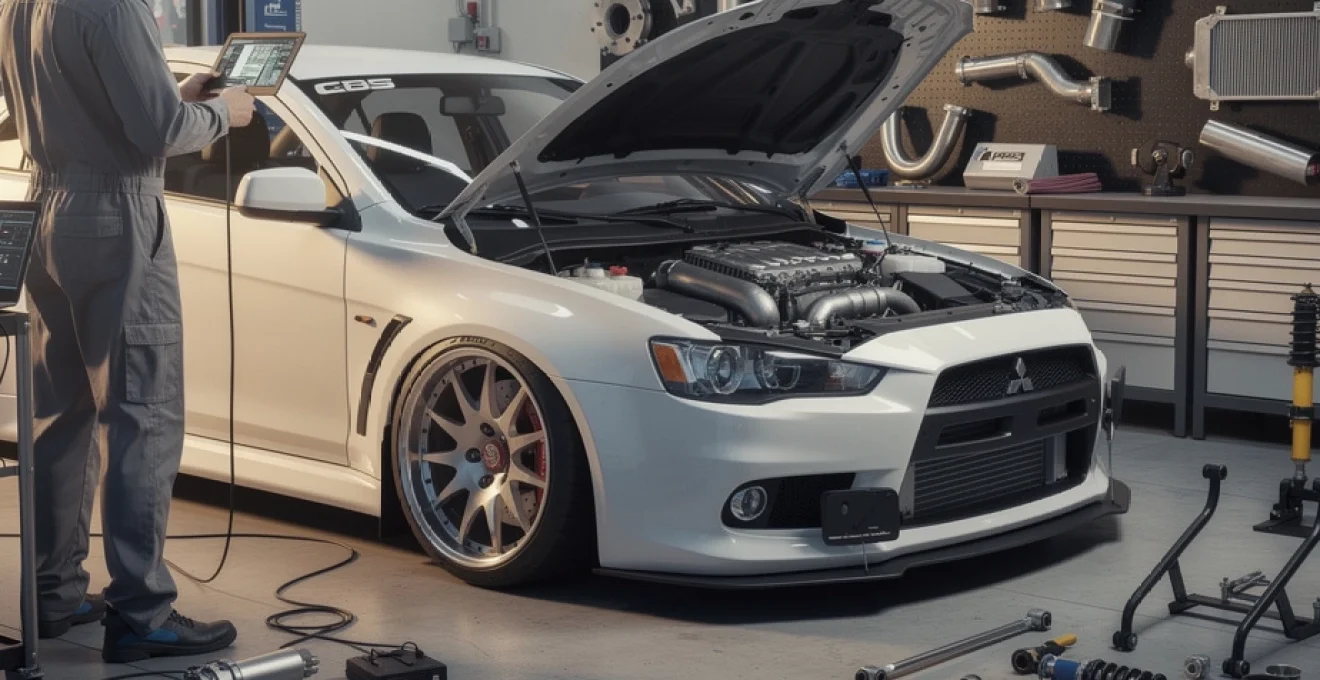
The MST MK2 Evo X blends classic Escort aggression with current rally technology, creating a platform that responds incredibly well to thoughtful tuning. With independent rear suspension derived from WRC development, lightweight carbonfibre bodywork and naturally aspirated engines delivering up to 370 hp, the car leaves the factory already primed for serious performance. Yet if you aim for focused road driving, fast-road touring or even full time-attack competition, the real magic comes from optimising how that power is delivered, managed and cooled.
Understanding where the MST MK2 Evo X package excels – and where its stock constraints begin to appear – helps you build a reliable, cohesive upgrade plan instead of simply chasing peak horsepower numbers. From ECU calibration and fuelling to coilovers, differential setup and endurance cooling, every change influences how the Evo X responds on real roads and circuits. The objective is not just raw speed, but a finely balanced, confidence-inspiring car you can drive hard and consistently.
MST MK2 evo X overview: chassis, drivetrain and stock performance constraints
The MST MK2 Evo X chassis starts from a heavily re-engineered Escort shell, strengthened with bodywork and chassis plates, braces and gussets to meet modern rally expectations. Underneath, the independent rear suspension echoes the iconic Colin McRae-developed RS2000 project, giving the Evo X a level of rear grip and adjustability that the original live-axle Escorts could never match. Combined with Reiger three-way adjustable dampers and alloy hubs, the stock setup already exceeds the capability of many classic-inspired builds.
From the drivetrain side, you can choose between a 2.5-litre Duratec and a 2.8/2.9-litre Millington Diamond engine, both naturally aspirated, with outputs around 275–279 hp for the Duratec and up to roughly 365–370 hp for the Millington. Power is channelled through either a Tractive six-speed sequential gearbox or a T5 H-pattern transmission to the rear wheels. Kerbweight has not been officially confirmed, but thanks to carbonfibre bodywork and lightweight components, the figure is expected to be highly competitive, especially compared with heavier modern performance cars exceeding 1400 kg.
Stock, the MST MK2 Evo X already offers a power-to-weight ratio approaching that of current super-hot-hatches. However, the limitation for many owners does not stem solely from engine output. Instead, constraints appear in long-session thermal management, brake fade during high-speed events, and how the suspension is aligned for specific uses such as hillclimbs or track days. Treat the Evo X as a tightly engineered base; with the right upgrades, you unlock a more durable, repeatable level of performance rather than simply inflating dyno figures.
Engine tuning paths for the MST MK2 evo X: ECU remaps, turbo upgrades and fuelling
Although the MST MK2 Evo X is supplied with naturally aspirated powerplants, the tuning logic shares a lot with turbocharged platforms such as the Mitsubishi Evo X 4B11T. You may not be targeting 600+ bhp turbo builds, but the same principles of careful ECU calibration, fuelling control and airflow management apply if you want a crisp throttle, strong torque across the rev range and safe engine temperatures. Think of the ECU as the conductor of an orchestra; the better the calibration, the more harmonious every mechanical component becomes.
Before diving into hardware modifications, a solid base map for your specific engine variant, fuel quality and driving style is essential. A carefully tuned ECU can often unlock 5–10% more usable performance on naturally aspirated engines through optimised ignition advance, variable cam timing and throttle mapping, even without aggressive changes. For more ambitious builds that might include high-compression pistons, aggressive cams or, in extreme cases, bespoke forced induction, the ECU strategy becomes mission-critical to avoid detonation and drivability issues.
ECU calibration strategies for evo X 4B11T: cobb accessport, EcuTek and open-source tuning
Many tuners take experience from the Mitsubishi `4B11T` Evo X world and apply similar strategies to engines in the MST MK2 Evo X. On the 4B11T, platforms like Cobb Accessport, EcuTek and open-source solutions such as `Tactrix` with ROM editing tools are common references for flexible ECU tuning workflows. While the MST engines typically run standalone or motorsport-grade ECUs, the mindset is similar: create a stable, known-good base map, then refine fuel, ignition and cam timing based on logged data.
For road-focused cars, a conservative ignition map with smooth throttle response generally delivers the best experience, especially on variable pump fuel. For track cars, timing and fuelling can be dialled in more aggressively around the mid-to-high rpm bands where the engine spends most of its time. Regular logging of knock activity, lambda values and intake air temperatures allows you to tailor the calibration to your exact MST MK2 Evo X setup over multiple sessions, rather than relying on a single dyno session snapshot.
Choosing turbo upgrades for MST MK2 evo X: stock frame, FP green, garrett GTX and BorgWarner EFR
Some MST MK2 Evo X builds move away from the naturally aspirated formula and adopt turbocharging, often drawing inspiration from popular Evo X turbo upgrade paths. Names such as FP Green, Garrett GTX and BorgWarner EFR are familiar to those pursuing high-boost, high-efficiency power. On a lightweight chassis like the MST, even a relatively modest turbo capable of 450–500 bhp can deliver devastating real-world pace, provided spool and response are carefully considered.
When choosing between stock-frame style turbos and full aftermarket housings, the key is intended use. For a fast-road Evo X recreation, smaller-frame turbos prioritising quick spool and mid-range torque often feel more exciting than giant units aimed at dyno glory. For time attack or drag racing, a GTX or EFR with advanced aerodynamics and modern bearing systems can hold high boost levels more efficiently at sustained high rpm. Matching turbine housing A/R to engine displacement and cam profile is crucial to avoid a peaky, difficult-to-drive setup.
Fuel system enhancements: high-flow injectors, walbro in-tank pumps and ethanol (E85) compatibility
Higher output, whether from a highly tuned naturally aspirated engine or a turbocharged conversion, demands a capable fuel system. High-flow injectors sized for at least 20–30% headroom beyond your target horsepower provide a safety margin for cold starts, transient enrichment and hot conditions. Modern in-tank pumps such as Walbro units can support significant power levels, but real-world data shows that fuel pressure can still sag at high duty cycles if the electrical supply or wiring is marginal.
If you aim to run ethanol blends like E85 for cooler combustion and knock resistance, planning for increased fuel volume is critical – E85 typically requires around 30% more fuel flow than standard petrol. This impacts injector size, pump flow capacity and fuel line diameter. With a centrally mounted fuel tank in the MST MK2 Evo X, careful consideration of pickup design and baffling also helps avoid fuel starvation during high lateral-G cornering on circuit days.
Boost control hardware: 3-port electronic boost control solenoids, wastegate actuators and MAP sensors
For MST MK2 Evo X owners adopting turbocharging, stable and precise boost control keeps the engine operating within its mechanical limits. A high-quality 3-port electronic boost control solenoid provides the ECU with fine-grained authority over boost levels, allowing gear-dependent or rpm-based boost strategies. Pairing this with an uprated wastegate actuator helps maintain consistent boost, especially under high exhaust backpressure or in hot conditions where weaker actuators may creep.
Upgraded MAP sensors with an extended pressure range (for example, stepping from a 2.5 bar to a 4 bar sensor) give the ECU accurate information about manifold pressure, enabling safer ignition and fuelling decisions. Combined with robust ECU strategies like boost cut, overboost protection and temperature-based derating, this hardware ensures that a tuned Evo X-style powertrain reacts predictably even when atmospheric conditions or load vary sharply.
Intake, intercooler and charge pipe optimisation for reliable power gains
Whether naturally aspirated or turbocharged, the MST MK2 Evo X thrives on efficient breathing. A well-designed intake with a smooth MAF or MAP housing, minimal turbulence and cool air feed can improve cylinder filling without introducing erratic airflow readings. For turbocharged applications, the intercooler and charge-pipe system become central; a core sized appropriately for the target horsepower and airflow allows for lower intake temperatures and reduced knock risk.
Charge pipes with gentle bends, bead-rolled ends and secure couplers help minimise pressure drop and avoid boost leaks, which are a common source of inconsistency in high-boost builds. Data from many track users shows that every 10°C drop in intake air temperature can reduce knock tendency by a noticeable margin, allowing more timing and, consequently, more reliable power on a tuned MST MK2 Evo X engine.
Exhaust, induction and airflow upgrades on the MST MK2 evo X platform
Airflow upgrades are central to unlocking the potential of the MST MK2 Evo X platform, especially when aiming for strong naturally aspirated performance. The car already benefits from a racing stainless-steel intake manifold, lightweight flywheel and dual clutch, but headwork, exhaust tuning and induction refinement still offer appreciable gains. Think of the engine as an air pump: the easier it breathes, the more efficient each combustion cycle becomes, improving power, throttle response and even fuel economy during light-throttle cruising.
The retro-futuristic headlights and carbonfibre body kit provide more than styling; careful ducting and venting can help feed cold air to the intake and extract hot air from under the bonnet. Small details – such as how the airbox seals to the bonnet, or the positioning of brake cooling ducts – have measurable effects when pushing on track or during extended mountain runs. An integrated approach to airflow, rather than bolt-on parts in isolation, delivers the most coherent and repeatable performance improvement.
Turbo-back exhaust systems: downpipes, high-flow cats and cat-back options from HKS, invidia and tomei
On turbo Evo X applications, brands like HKS, Invidia and Tomei are often referenced for well-engineered turbo-back systems. The same design philosophy applies to the MST platform: a free-flowing downpipe, a high-flow metallic catalyst and a carefully resonated cat-back system reduce backpressure while controlling drone. Lower backpressure helps the turbo or high-revving naturally aspirated engine clear exhaust gases more efficiently, allowing more aggressive cam overlap or ignition timing.
For road cars, a balance between noise control and flow is desirable; a 2.5–3.0 inch system with resonators often works well. For competition-specific MST MK2 Evo X builds, weight reduction and maximum flow may justify thinner wall tubing and fewer silencers. Data from typical performance exhaust tests often show 3–6% power gains on a well-tuned engine, with more significant improvements when replacing a heavily restrictive factory system.
Intake system choices: MST performance intake, cold air boxes and MAF housing considerations
The MST MK2 Evo X features performance-oriented induction hardware from the factory, but there is still room to refine intake path design. An enclosed cold air box drawing air from high-pressure zones at the front of the car helps feed cooler, denser air to the engine. For systems that retain a mass airflow sensor, MAF housing diameter and internal surface finish are critical to maintaining accurate readings; abrupt steps or sharp edges can cause turbulent flow and erratic fuelling.
Owners targeting fast-road or track-day use benefit from intake setups that prioritise consistency and filtration over outright noise. Oiled cotton filters or high-quality dry filters with adequate surface area ensure good flow while keeping fine dust out of the engine, which is particularly important if the Evo X replica spends time on gravel or rally-style stages. Regular inspection and cleaning according to mileage and environment further protect engine internals over the long term.
Front-mount intercooler cores and end-tank design for reduced charge temps
For turbocharged builds, a well-engineered front-mount intercooler is essential. Core size, fin density and end-tank design all play a role in charge air cooling and pressure drop. Vertical-flow cores can offer packaging advantages behind the Escort-style grille, while horizontal-flow designs may suit other bumper apertures better. The objective is to maintain low intake temperatures without introducing a restriction that forces the turbo to work harder.
End tanks with smooth internal transitions and correctly sized inlets/outlets help reduce turbulence; cast or fabricated aluminium options can both perform well if designed intelligently. Track data often shows that high-quality intercoolers can cut charge temperatures by 20–30°C versus undersized or generic units, dramatically improving knock resistance and power stability during back-to-back laps in hot weather.
Exhaust manifold and turbine housing flow improvements for faster spool
The exhaust manifold and turbine housing act as the gateway between exhaust flow and turbine energy. On turbocharged Evo X-style setups, upgrading from log-style manifolds to equal-length tubular designs can improve pulse energy delivery to the turbine, supporting quicker spool and stronger mid-range torque. However, equal-length systems sometimes occupy more space, which can be a packaging challenge in compact engine bays.
Choosing an appropriately sized turbine housing A/R ratio is another balancing act. Too small, and backpressure rises sharply at higher rpm, limiting power and increasing exhaust temperatures. Too large, and spool suffers, making the car feel lazy off-boost. For a lightweight MST MK2 Evo X, a slightly smaller housing often proves more engaging on the road, giving you strong response out of tight bends rather than focusing solely on top-end speed.
Suspension and handling upgrades: maximising MST MK2 evo X grip and chassis balance
The independent rear suspension and Reiger dampers already give the MST MK2 Evo X a chassis far removed from a 1970s Escort. Yet suspension tuning is where you can most dramatically tailor the car’s character to your intended use. Whether you prefer a compliant fast-road setup for B-roads or a more uncompromising time-attack alignment, spring rates, damping curves and geometry all combine to define how much confidence you feel when pushing near the limit.
The low kerbweight and compact wheelbase mean that even small suspension changes can have a big impact on balance. A beautifully tuned MST Evo X can feel like a precision tool, rotating neatly into corners and putting power down cleanly; a poorly tuned one may become nervous or unpredictable on rough tarmac. Investing in high-quality components and, crucially, expert setup time transforms the raw engineering of the chassis into on-road composure.
Coilover systems for road and track: ohlins road & track, tein mono sport and BC racing setups
Coilovers are the backbone of any serious suspension upgrade. For the MST MK2 Evo X, options inspired by platforms such as Ohlins Road & Track, Tein Mono Sport and BC Racing offer a range of damping technologies, spring rates and adjustability. For primarily road-driven cars, digressive damping profiles like those found on many `Ohlins` kits provide supple low-speed ride quality while maintaining control at higher shaft speeds over bumps and kerbs.
Track-focused users may lean towards stiffer spring rates and more linear damping curves, often combined with adjustable top mounts for camber tuning. The key is to avoid simply chasing stiffness; data from countless track setups confirms that a slightly softer, well-damped car can carry more speed over real-world surfaces than an overly stiff setup that skips and slides. Matching damper valving to spring choice and vehicle weight distribution is essential.
Anti-roll bars, strut braces and lower arm bars to tune understeer and body roll
Anti-roll bars (ARBs) allow you to fine-tune how the MST MK2 Evo X distributes lateral load between the front and rear axles. A stiffer front bar tends to increase understeer, while a stiffer rear bar encourages rotation. Combining adjustable ARBs with the car’s independent rear suspension provides a powerful toolset to dial in your preferred balance for tight hairpins, sweeping corners or mixed real-road use.
Strut tower braces and lower arm bars add rigidity to suspension mounting points, improving steering precision and consistency under heavy cornering loads. On a shell already reinforced with plates and gussets, these components complement the structural upgrades, reducing subtle flex that can make alignment settings less repeatable. The result is more predictable behaviour when trail-braking into corners or applying power early on corner exit.
Geometry, alignment and corner-weighting for fast road and time attack evo X builds
Geometry and alignment are where many MST MK2 Evo X owners discover the biggest gains for the least hardware outlay. Increased negative camber at the front, moderate rear camber and a small amount of toe-out at the front can sharpen turn-in and improve mid-corner grip. For track-biased setups, more aggressive camber and slightly reduced toe can reduce tyre shoulder wear and enhance steering feedback, albeit at the cost of some straight-line stability.
Corner-weighting, where each wheel load is adjusted via coilover perch heights, ensures that the Evo X responds consistently in left and right turns. A balanced diagonal weight distribution helps prevent unexpected oversteer or understeer in quick direction changes. Many drivers are surprised by how different the car feels after a proper alignment and corner-weighting session, even if no hardware has changed.
Bushings and spherical bearings: replacing OEM rubber with SuperPro and whiteline components
Suspension bushings significantly influence how accurately the MST MK2 Evo X follows alignment settings under load. Replacing soft OEM-style rubber with polyurethane components from brands such as SuperPro or Whiteline can reduce unwanted deflection, enhancing steering precision and feedback. For example, stiffer control arm bushings help maintain consistent camber and toe angles during heavy braking and cornering.
For more extreme, track-only cars, spherical bearings can be used in key suspension joints to provide near-zero compliance and ultra-direct response. The trade-off is increased noise, vibration and harshness (NVH), alongside higher maintenance demands. For dual-purpose road and track MST builds, a hybrid approach using polyurethane in most locations and spherical joints only in the most critical arms often works best.
Brake system tuning: stopping power for high-boost MST MK2 evo X builds
The MST MK2 Evo X leaves the factory with an impressive brake package: AP Racing disc brakes at each corner with six-piston front calipers and four-piston rears, paired with a motorsport pedal box. For many users, this hardware comfortably exceeds the requirements of fast-road driving. However, as grip and power levels rise – especially with sticky Michelin Cup Sport tyres and potential turbocharging – brake heat management and pad choice become increasingly critical.
High-performance pads from Ferodo or Mintex, already mentioned as options on the MST, transform pedal feel and fade resistance. Choosing the correct compound for your use case is key: some compounds offer near-OEM comfort and dust levels but struggle with repeated high-speed stops, while others deliver race-level bite at the expense of noise and rotor wear. On track, a fluid upgrade to high-temperature DOT 4 or DOT 5.1, combined with stainless steel braided lines, helps maintain a firm pedal after long sessions.
| Component | Street-focused setup | Track-focused setup |
|---|---|---|
| Brake pads | Fast-road compound (Ferodo DS Performance) | Track compound (Ferodo DS1.11 / Mintex F-series) |
| Brake fluid | High-boiling DOT 4 | Motorsport DOT 4 / DOT 5.1 |
| Discs | Slotted or plain performance discs | Two-piece floating discs for heat management |
Brake cooling is another area worth considering if you drive on demanding circuits. Ducting fresh air from the front bumper towards the centre of the discs can lower temperatures significantly, prolonging pad and rotor life. Statistics from various club racing series suggest that well-ducted brakes can reduce peak rotor temperatures by 50–100°C, a difference that often separates consistent late-braking performance from rapidly increasing pedal travel and fade during endurance stints.
Drivetrain, gearbox and differential upgrades for high-torque MST MK2 evo X applications
The MST MK2 Evo X offers a choice between a motorsport-grade Tractive six-speed sequential transmission and a more traditional T5 H-pattern gearbox. The sequential option, combined with a lightweight flywheel and dual clutch, supports rapid, clutchless upshifts and is particularly suited to rally and circuit use. For many drivers, though, the mechanical involvement of an H-pattern gearbox remains compelling, especially on the road where absolute tenths of a second per shift are less critical.
As torque outputs rise – particularly if forced induction is added – clutch capacity and drivetrain robustness must be revisited. Organic-clutch upgrades can comfortably handle moderate torque increases while retaining decent road manners, but serious track or rally builds often move to twin-plate or ceramic multi-plate clutches for durability. The trade-off is more abrupt engagement and increased driveline chatter, which some drivers accept as part of a focused MST MK2 Evo X driving experience.
| Drivetrain element | Fast road spec | Track/rally spec |
|---|---|---|
| Gearbox | T5 H-pattern, uprated synchros | Tractive 6-speed sequential |
| Clutch | Single-plate organic, uprated pressure plate | Twin-plate or multi-plate ceramic |
| Differential | Plated LSD with road-biased ramp angles | Adjustable plated LSD, aggressive lock-up |
Differential choice and setup strongly influence how the Evo X puts power to the ground. A plated limited-slip differential with road-biased ramp angles offers smooth engagement and predictable traction out of bends, reducing inside-wheel spin without making the car feel nervous. For rally or time-attack MST builds, more aggressive ramp angles and higher preload can maximise traction on variable surfaces, though this demands a driver comfortable with a more lively rear end, especially in low-grip conditions.
Reliability, cooling and maintenance strategies for heavily tuned MST MK2 evo X engines
Power and lap times grab headlines, but reliability keeps your MST MK2 Evo X enjoyable year after year. The combination of high specific output, sticky tyres and lightweight chassis can place substantial thermal and mechanical loads on the engine, cooling system and driveline. Regular, structured maintenance combined with targeted reliability upgrades is essential, especially once you exceed the engine’s original intended performance envelope.
Oil cooling stands out as a priority for hard-driven cars. A quality thermostatically controlled external oil cooler can help keep oil temperatures in the ideal 100–120°C range even during extended track sessions. Data from many track builds indicates that uncontrolled oil temperatures rising above 130°C dramatically increase oxidation and reduce film strength, accelerating wear on bearings and cam journals. Using a high-quality ester-based synthetic oil, checked and changed more frequently than normal road intervals, further protects the engine.
Consistent temperatures and stable pressures are often more important than peak power when building a durable, enjoyable performance car.
Coolant system improvements, such as a high-capacity aluminium radiator and properly shrouded fans, help maintain stable coolant temperatures in hot weather or under sustained load. Ensuring that the coolant mix, cap pressure and bleed procedures are correct prevents hot spots and localised boiling within the cylinder head. Many experienced builders also monitor both oil and coolant temperatures, as well as oil pressure, using quality gauges or digital dashboards, catching emerging issues before they become failures.
Data logging transforms tuning and maintenance from guesswork into an evidence-based process, especially on high-value bespoke builds.
On the maintenance side, a defined schedule based on hours of operation or track days, rather than just mileage, suits the MST MK2 Evo X better than conventional service intervals. For example, you might change oil every 3–4 track days, inspect brake pads and discs after each event, and check alignment settings twice a year. For cars running high compression, aggressive cams or forced induction, regular compression and leak-down tests provide a snapshot of engine health, allowing you to plan refreshes before catastrophic damage occurs.
- Establish a logbook for your MST MK2 Evo X with dates, fluids, and setup changes.
- Use high-quality fuels and, where applicable, consistent octane or ethanol blends.
- Inspect critical fasteners (suspension, brakes, drivetrain) at set intervals.
- Schedule periodic dyno checks to confirm that power and AFR remain within safe ranges.
Finally, consider how you store and use the car between events. Allowing adequate warm-up and cool-down, especially for turbocharged engines, reduces thermal shock and oil coking in turbo bearings. Keeping tyres and suspension components free from long-term flat-spotting or corrosion by moving the car periodically and controlling humidity also extends their service life. When approached as a complete system – from ECU and fuelling to brakes and cooling – the MST MK2 Evo X rewards methodical tuning with a driving experience that feels cohesive, responsive and robust every time you take it out.