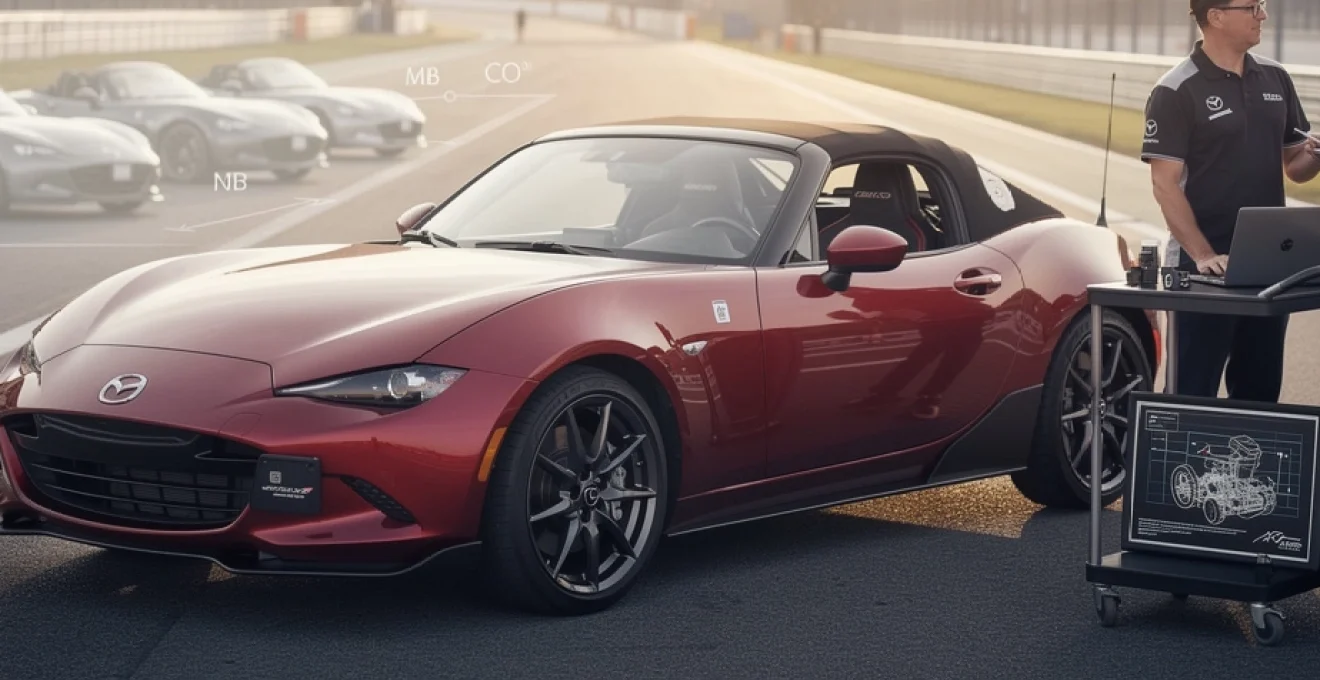
The Mazda MX‑5 35th anniversary edition arrives at a time when lightweight, analogue sports cars are becoming rare, yet driver engagement matters more than ever. As hot‑hatchback power outputs escalate and kerbweights creep upward, the MX‑5 continues to prove that precision, balance and feel can still win hearts on road and track. This commemorative Roadster, unveiled at Mazda Fan Festa at Fuji Speedway, builds on more than three decades of continuous evolution, celebrating a heritage that started with the original Eunos Roadster in 1989 and now stretches to the latest ND‑generation icon.
For you as an enthusiast, this edition is more than a new colour and a badge pack. It blends the familiar 2.0‑litre SKYACTIV‑G drivetrain, rear‑wheel‑drive layout and 6‑speed manual gearbox with carefully curated cosmetic, ergonomic and chassis upgrades. The result is a car designed to feel special every time you walk up to it, yet usable enough to enjoy every day on British B‑roads and European passes. If you value tactility, heritage and engineering subtlety over headline power figures, the 35th anniversary MX‑5 deserves very close attention.
MX‑5 35th anniversary edition: positioning within the NA–ND generational timeline and heritage milestones
From NA (1989 eunos roadster) to ND2: design lineage culminating in the 35th anniversary edition
The MX‑5 story starts in 1989 with the NA Eunos Roadster, a compact, minimalist two‑seat convertible that revived the traditional lightweight roadster at a time when such cars were disappearing. Pop‑up headlights, a sub‑1,000 kg kerbweight and a rev‑happy 1.6‑litre engine set the template. Each generation since – NB, NC and ND – has reinterpreted that formula without losing the core ingredients of a front‑engine, rear‑drive layout, 50:50 weight distribution and a manual gearbox focused on driver feel.
The ND generation, launched in 2015, distilled the design further. Short overhangs, taut proportions and Mazda’s Kodo design language gave the car a muscular yet elegant stance, while intensive weight‑saving brought mass back close to NA levels. The later ND2 update introduced a higher‑revving 2.0‑litre engine with 181 hp, sharpening the car’s responses without compromising the famed usability. The 35th anniversary edition uses this ND2 hardware as its foundation, wrapping it in an exclusive presentation that nods to early Eunos purity while embracing advanced paint technology and modern convenience.
The continuity is obvious when you place an NA beside the latest commemorative Roadster. The low scuttle, compact cabin, and intimate cockpit still feel immediately familiar, even if the surfacing is more sculpted and the technology far more sophisticated. For anyone who has driven multiple MX‑5 generations, the 35th anniversary car feels like a well‑earned celebration rather than a break with tradition.
Production history, build numbers and collectability markers for limited‑run MX‑5 models
Historically, Mazda has used anniversary and special editions to mark key milestones and to keep the MX‑5 range fresh. Typically these runs have been strictly limited, with numbered plaques and unique colour and trim combinations that quickly become sought after. Early NA special editions in the 1990s often ran to a few thousand units worldwide, while certain NB and NC variants were limited to low hundreds in specific markets, especially in the UK and Europe.
That traditional limited‑run strategy helped build strong residuals. Enthusiasts actively seek cars with identifiable markers such as numbered sill plates, unique wheel designs or specific paint codes. Auction data from specialist platforms in 2023 and 2024 shows that desirable anniversary MX‑5 models can command 15–30% premiums over equivalent standard trims, particularly when mileage is low and provenance is clear. For you as a prospective buyer, understanding these build numbers is important if collector value sits alongside driving enjoyment in your priorities.
The 35th anniversary edition takes a different approach. Mazda has indicated that the car is special but not limited, meaning there is no fixed production cap. That reduces scarcity in pure numerical terms, but it also means more enthusiasts can access the specification. In practice, production will still be constrained by MX‑5 factory capacity and regional allocations, so UK and EU cars are likely to remain relatively rare on the used market in the medium term.
Comparative analysis with 10th, 20th and 30th anniversary editions in european and UK markets
The 10th Anniversary Edition (NB) arrived in 1999 with a striking blue exterior, matching interior trim and a six‑speed manual gearbox, signalling the MX‑5’s maturation into a more refined yet still playful roadster. The 20th Anniversary (NC‑based in Europe) continued the theme with bespoke colours, badging and, in some markets, chassis tweaks aimed at keen drivers. Both of these cars were strictly limited, with European allocations that sold out quickly and now sit on many enthusiasts’ wish‑lists.
The 30th Anniversary Edition, based on the ND, raised the stakes again with exclusive Racing Orange paint, forged wheels and uprated Brembo front brakes in many markets. Only 3,000 units were produced worldwide, with roughly 600 heading to Europe and a smaller subset reaching UK shores. Residual value data suggests these 30th Anniversary cars currently command some of the strongest premiums in the ND universe, particularly in manual form and with meticulous service histories.
Compared with those previous celebrations, the 35th anniversary MX‑5 focuses more on craftsmanship and colour depth than on overt mechanical upgrades. There is no orange paint or aggressive aero package here; instead, the emphasis lies on the Artisan Red Premium Metallic finish and a cohesive tan interior theme. For European and UK buyers used to very visibly different anniversary cars, this edition may appear more understated – but for you as a daily driver, that subtlety can make the car easier to live with over many years.
Uk‑spec vs JDM and EU‑spec 35th anniversary technical and cosmetic differences
Technical differentiation between UK‑spec, JDM and wider EU‑spec 35th anniversary models will likely follow the pattern already seen in the ND2 range. Japanese‑market Roadsters traditionally have slightly different equipment mixes and a broader spread of engine options, including the smaller 1.5‑litre SKYACTIV‑G that remains popular in Japan. In contrast, UK cars overwhelmingly favour the 2.0‑litre engine and six‑speed manual gearbox for their blend of performance and efficiency on motorways and country roads.
Cosmetically, the core elements remain consistent: Artisan Red Premium Metallic bodywork, tan soft top on fabric‑roof cars, interior tan highlights and 35th anniversary logos on headrests and floor mats. However, JDM cars may receive market‑specific infotainment features and safety packages, while UK and EU‑spec models are expected to align with recent regulatory requirements such as advanced driver‑assistance systems and enhanced pedestrian protection. If you are cross‑shopping imported JDM examples with official UK cars, pay close attention to Euro‑NCAP‑aligned safety features and navigation or connectivity differences.
Exterior design and aero package of the MX‑5 35th anniversary edition
Exclusive paint finishes, contrast elements and anniversary badging treatments
The visual centrepiece of the 35th anniversary MX‑5 is its Artisan Red Premium Metallic paintwork. Developed using Mazda’s Takuminuri painting process and previously seen as a premium option on the CX‑90, this finish offers a darker, richer alternative to the brand’s famous Soul Red. Complex layering and controlled metallic flake orientation create a sense of depth and fluidity that changes character under different lighting, much like a high‑end mechanical watch dial shifts with the angle of your wrist.
On the anniversary MX‑5, this colour flows beyond the exterior panels. The inside door inserts and circular air‑vent surrounds share the same tone, creating a visual bridge between exterior and interior. The tan soft‑top roof on fabric models contrasts warmly with the deep red body, reinforcing the classic roadster aesthetic. Subtle 35th anniversary badging appears on headrests, floor mats and a dedicated serial‑number plate on the passenger‑side dash, providing clear identity without overwhelming the design.
Even the key fob receives matching Artisan Red detailing, a small but telling sign of Mazda’s obsession with touchpoints and perceived quality. You notice this level of coherence every time you pick up the keys, walk up to the car and open the door, reinforcing the sense that you are interacting with something intentionally crafted rather than simply purchased off a standard options list.
Wheel design, tyre specification and unsprung mass optimisation on the 35th edition
Although Mazda has not radically overhauled the wheel and tyre package for the 35th anniversary edition, the underlying philosophy of minimising unsprung mass remains central. Lightweight alloy wheels help the suspension respond more quickly to surface imperfections, improving grip and comfort simultaneously. In performance driving, that reduction in unsprung mass can be worth more to real‑world speed than an extra 10–20 horsepower.
Tyre choice continues to focus on a balance between everyday usability and engaging handling. The MX‑5 is famously responsive to tyre brand and compound changes; you will feel differences in steering weight, breakaway progression and road noise. Owners pursuing maximum B‑road performance often move to slightly stickier rubber, but Mazda’s factory calibration aims to deliver playful, progressive behaviour at legal road speeds rather than chasing ultimate lap times. Before experimenting with aftermarket wheels, it is worth appreciating how delicately the standard combination has been tuned.
Aerodynamic refinements: front splitter, side skirts and rear diffuser calibration
The MX‑5 has never relied on aggressive aerodynamic add‑ons to achieve stability. Instead, its relatively small frontal area, carefully managed underbody and subtle spoilers work together to maintain composure at motorway speeds. The 35th anniversary edition continues this philosophy, with any aero tweaks designed to be visually discreet while refining high‑speed stability and crosswind resistance.
Think of the aero package as finely tailored clothing rather than race overalls. The front valance, side sills and rear bumper edges guide airflow smoothly around the compact body, helping reduce lift without generating the kind of downforce that would compromise ride quality. If you intend to use your car primarily on fast A‑roads and occasional track days, that understated approach means you retain comfort while still enjoying secure, trustworthy dynamics at speed.
Lighting technology: LED headlamps, DRL signatures and heritage‑inspired details
Modern LED lighting technology allows the 35th anniversary MX‑5 to combine safety with recognisable visual signatures. Projector‑style LED headlamps deliver a wide, evenly distributed beam pattern, improving night‑time visibility without dazzling oncoming traffic when correctly aligned. Daytime running lights (DRLs) provide a contemporary light signature that helps the small roadster stand out among taller SUVs and crossovers, a relevant safety consideration in urban traffic.
At the same time, design cues subtly reference the round, expressive lamp graphics of early NAs, even though pop‑up headlights are no longer viable for pedestrian safety. Rear LED elements echo the circular themes of earlier generations while meeting current legality standards. For you as a driver, the result is a car that feels unmistakably modern yet still recognisably linked to the 1989 original from a quick glance in the mirror.
Cabin, ergonomics and anniversary‑specific interior appointments
Recaro and mazda sports seats, upholstery stitching and embossed 35th branding
The 35th anniversary interior centres around a warm, tan‑themed cabin that contrasts richly with the dark red exterior. Seats, carpets, door cards and parts of the centre console share this colour palette, creating an inviting cockpit that feels more like a tailored leather jacket than a conventional sports‑car interior. Depending on market and trim, the car is expected to offer either well‑bolstered Mazda Sports seats or optional Recaro chairs with integrated headrests.
Embossed 35th anniversary logos on headrests and dedicated floor mats reinforce the commemorative nature of the model each time you step in and out. Contrast stitching adds a subtle, hand‑finished feel, particularly around seat bolsters and knee‑contact areas. Long‑distance comfort has always been a quiet strength of the ND MX‑5, and this edition continues that tradition; if you regularly combine fast B‑road drives with motorway stretches, you will appreciate the careful balance between lateral support and day‑long comfort.
Steering wheel, gear knob and handbrake lever: material upgrades and tactile feedback
Driver touchpoints are critical in a car that sells itself on engagement, so Mazda has devoted particular care to the steering wheel, gear knob and handbrake lever. High‑quality leather wraps these components, with stitching patterns chosen to feel smooth in the hand without excess bulk. The MX‑5’s short‑throw 6‑speed manual is renowned for its rifle‑bolt action; pairing that mechanical precision with a tactile gear‑knob finish amplifies the satisfaction of every shift.
The steering wheel rim thickness and diameter are optimised for fingertip control rather than sheer grip. You sense small changes in front‑tyre load through the rim, meaning feedback is both nuanced and easy to interpret. The traditional mechanical handbrake lever – a rarity in an age of electronic parking brakes – reinforces the analogue character. If you enjoy heel‑and‑toe downshifts on a favourite road, these details will matter to you as much as the car’s headline power figure.
Instrument cluster graphics, start‑up animations and commemorative plaques
The instrument cluster on the current MX‑5 blends an analogue central rev counter with digital supporting displays, offering a clear at‑a‑glance view of engine speed and essential information. On the 35th anniversary edition, expect subtle graphic tweaks and start‑up animations that highlight the commemorative status without distracting from readability. A clear, legible tachometer remains the focus, emphasising the engine’s willingness to rev to its 7,500 rpm ceiling in 2.0‑litre form.
The numbered plaque mounted on the passenger‑side dash is more than decoration; it is a key collector marker and a tangible reminder of the car’s place within MX‑5 history. When considering long‑term ownership or potential future resale, such details often become focal points in listings and valuations. Treat this plaque as part of the car’s identity in the same way you might regard a chassis plate or build certificate on a classic model.
Infotainment stack: mazda connect, apple CarPlay/Android auto and audio tuning
The ND‑generation MX‑5 uses Mazda Connect for infotainment, combining a rotary‑controller interface with touchscreen functionality when stationary. Support for Apple CarPlay and Android Auto means you can mirror smartphone apps for navigation, music and communication, keeping the built‑in system relevant even as mobile software evolves. For many owners, this integration transforms long‑distance touring comfort, allowing seamless use of favourite mapping apps and playlists.
Audio tuning in a compact soft‑top cabin presents challenges, particularly with roof‑down wind noise. Mazda’s engineers have calibrated speaker placement and equalisation to deliver clear midrange and acceptable bass even with the roof open at moderate speeds. If you are an audiophile, aftermarket upgrades remain an option, but for most drivers the standard system offers a good compromise between weight, complexity and sound quality. Importantly, the infotainment screen sits low enough not to dominate the classic dual‑cowl dashboard design.
Chassis tuning, suspension hardware and handling characteristics
Bespoke bilstein damper calibration, spring rates and anti‑roll bar configurations
Many MX‑5 variants, especially performance‑oriented trims, have benefitted from Bilstein dampers, and the 35th anniversary edition is expected to follow that pattern in key markets. Bespoke damper tuning allows Mazda to maintain the car’s trademark suppleness over poor surfaces while improving body control during quick direction changes. Think of it as carefully chosen running shoes: firm enough for stability, flexible enough to avoid fatigue on a long run.
Spring rates and anti‑roll bar thickness are typically set to maintain slight body roll, giving you clear feedback about grip levels without feeling sloppy. On UK B‑roads, this philosophy pays off, especially on broken or undulating tarmac where excessively stiff setups can unsettle the chassis. For track‑day regulars planning suspension modifications, starting from the refined 35th anniversary baseline will likely require fewer aftermarket changes than beginning with a softer, non‑Bilstein trim.
Kinematic behaviour: double wishbone front, multi‑link rear and body rigidity enhancements
The MX‑5’s front double‑wishbone and rear multi‑link suspension layout underpins its precise yet forgiving dynamics. This configuration allows engineers to control camber and toe changes through the suspension travel, keeping the tyre’s contact patch optimised as the car leans and pitches. You feel this as consistent, confidence‑inspiring grip at moderate slip angles rather than abrupt breakaway at the limit.
ND‑generation body‑in‑white improvements, such as strategic bracing and use of high‑tensile steel, provide a stiff but relatively light structure for the suspension to work from. The 35th anniversary edition benefits from these existing enhancements, so steering inputs translate cleanly into chassis responses. That structural integrity also supports refinement: fewer squeaks and rattles over time, and a more solid impression even on rough surfaces common in the UK and much of Europe.
Steering ratio, EPS tuning and turn‑in response unique to the 35th anniversary edition
Electric power steering (EPS) has been carefully tuned on the ND to emulate the natural, linear weighting of earlier hydraulic systems while adding variable assistance for parking and low‑speed manoeuvres. Although Mazda has not publicised a radically different steering ratio for the 35th anniversary edition, minor software adjustments to EPS calibration can subtly alter on‑centre feel and turn‑in sharpness.
On twisting roads, this means you can place the car accurately with small inputs, maintaining a light but communicative connection to the front tyres. If you are stepping into an MX‑5 from a heavier hot hatch or performance SUV, the agility may initially feel almost telepathic. Over time, that sense of immediacy becomes second nature, making everyday journeys more engaging without demanding constant high speeds.
Comparison with ND sport tech, sport tech GT and 30th anniversary handling packages
Within the ND range, trims such as Sport Tech and Sport Tech GT already offer keen handling, often pairing the 2.0‑litre engine with limited‑slip differentials and uprated dampers. The 30th Anniversary Edition added even more track‑oriented gear, including Brembo front brakes and forged wheels, producing a sharper, more focused dynamic character. That car feels at home on circuits and fast, smooth roads, but its set‑up may be too uncompromising for some urban and rough‑surface driving.
The 35th anniversary MX‑5, by contrast, is expected to sit slightly closer to the standard Sport Tech balance, prioritising fluidity and comfort over outright aggression. For daily use and mixed‑surface driving, this can actually make the car quicker point‑to‑point for many owners, because you feel confident exploiting more of its performance more of the time. If your primary use case involves spirited B‑road drives rather than regular track days, this more rounded set‑up will likely suit you extremely well.
Powertrain specification and performance metrics of the 35th anniversary MX‑5
SKYACTIV‑G 1.5 vs 2.0 litre output, rev ceiling and torque curve mapping
Globally, the MX‑5 range offers both 1.5‑litre and 2.0‑litre SKYACTIV‑G engines, each tuned for responsiveness and efficiency rather than turbocharged headline figures. The 2.0‑litre unit used in many 35th anniversary configurations produces around 181 hp and a broad, flat torque curve that peaks near 7,000 rpm and continues pulling to a 7,500 rpm redline. This linear delivery encourages you to explore the upper rev range, making every gear change an event rather than a necessity.
The smaller 1.5‑litre engine, where offered, trades outright power for even lighter front‑axle weight and a more old‑school, rev‑it‑to‑the‑limit personality. For UK drivers regularly using motorways or mountainous routes, the 2.0‑litre’s extra torque provides more relaxed overtaking and lower effort at typical cruising speeds. Fuel‑consumption data from ND2 models indicates that both engines deliver real‑world economy in the mid‑30s to low‑40s mpg range, depending on driving style – impressive for a sports car with genuinely engaging performance.
6‑speed manual vs automatic transmission ratios, shift feel and final drive selection
The 6‑speed manual gearbox remains the enthusiast’s default choice, with short, precise throws and well‑chosen ratios that keep the engine in its sweet spot on twisty roads. The final‑drive selection provides brisk acceleration without excessive revs at motorway speeds, contributing to long‑distance comfort and acceptable fuel consumption. For many owners, the satisfying mechanical feel of this gearbox is reason enough to choose an MX‑5 over heavier turbocharged rivals.
An automatic transmission is offered in some markets, catering to buyers who spend more time in congested urban environments or simply prefer two‑pedal driving. Ratio spreads and lock‑up strategies aim to preserve as much engagement as possible, but the manual remains the purist’s option, particularly if you intend to attend track‑day events or advanced driver‑training courses. When assessing residual values, manuals traditionally enjoy a small edge among enthusiast buyers, although high‑quality automatics still sell strongly in certain regions.
Exhaust back‑pressure, sound tuning and WLTP emissions conformity in UK models
Compliance with WLTP emissions standards has required careful calibration of the MX‑5’s exhaust system to manage back‑pressure without strangling the engine’s character. Mazda’s engineers have tuned the exhaust note to deliver a crisp, mechanical sound at higher revs while remaining civilised at cruising speeds. On a cold start, you hear a brief flare, then the note settles into a quiet idle suitable for early‑morning departures in residential areas.
If you are considering aftermarket exhaust upgrades, understanding the balance between sound, flow and emissions compliance is crucial. Excessively loud or poorly designed systems can reduce mid‑range torque and cause annoyance on longer journeys. For most owners, the factory system strikes a sweet spot between character and refinement. Modest cat‑back upgrades from reputable suppliers can enhance the soundtrack without compromising WLTP conformity, but always check local regulations and insurance implications.
Acceleration, top speed and real‑world b‑road performance benchmarks
On paper, the 2.0‑litre MX‑5’s performance figures – around 0–62 mph in the mid‑6‑second bracket and a top speed close to 135 mph – may look modest alongside turbocharged hot hatches. Yet raw numbers tell only part of the story. The car’s low mass, responsive throttle and compact footprint allow you to carry speed through corners and exploit short straights more effectively than many faster‑on‑paper rivals, especially on tight, technical routes.
Independent road tests of recent ND2 models show that real‑world cross‑country averages often match more powerful cars because you can use a greater proportion of available performance more often. For you as a driver, this translates into more fun at realistic speeds and less frustration in traffic or on narrow lanes. In many ways, the MX‑5’s performance envelope is ideally pitched for modern roads, where opportunities for sustained high‑speed running are rare.
Safety systems, driver assistance and structural engineering updates
I‑activsense suite: lane‑keep assist, blind‑spot monitoring and adaptive cruise control
Modern MX‑5 models increasingly benefit from Mazda’s i‑Activsense safety suite, and the 35th anniversary edition is expected to reflect this trend, particularly in the UK and EU where regulations continue to tighten. Features such as lane‑keep assist, blind‑spot monitoring and rear cross‑traffic alert provide valuable backup on busy dual carriageways and in urban environments. Adaptive cruise control, where fitted, reduces fatigue on long motorway journeys without eroding the car’s fundamentally engaging character.
Some purists worry that driver‑assistance systems dull the experience, but in practice these aids can often be configured or temporarily disabled to suit your preferences. Think of them as a safety net rather than a straightjacket. For example, blind‑spot monitoring may catch a motorcycle in your mirror’s blind zone at a critical moment, while lane‑keep alerts can help during late‑night drives when concentration naturally wanes.
Body‑in‑white reinforcements, crumple zones and pedestrian protection engineering
Under the skin, the MX‑5’s body structure incorporates reinforced sills, strategic cross‑members and carefully engineered crumple zones designed to absorb and redirect impact forces away from the passenger compartment. High‑tensile steels are used where strength‑to‑weight benefits are greatest, maintaining low mass while achieving strong crash‑test performance. European safety standards have become more demanding over the MX‑5’s lifetime, and the ND platform reflects this evolution.
Pedestrian‑protection measures influence bonnet height, bumper design and the clearance between engine components and the bonnet skin. Although these requirements ended the era of pop‑up headlights, they have significantly reduced injury risk in real‑world incidents. From an engineering standpoint, the challenge has been to integrate these safety features without losing the MX‑5’s compact, low‑slung appearance. The 35th anniversary edition inherits these underlying protections, giving you confidence that the charismatic roadster also respects modern safety expectations.
Brake hardware: caliper specification, disc sizing and ABS/ESC calibration
The MX‑5’s braking system balances weight, performance and pedal feel. Ventilated front discs and solid rear discs provide ample stopping power for road use, while ABS and electronic stability control (ESC) are tuned to intervene progressively rather than abruptly. On spirited drives, you will notice that the system allows modest slip angles and trail‑braking inputs before stepping in, preserving driver engagement while still catching larger mistakes.
While the 35th anniversary edition may not feature the Brembo‑brake hardware of the 30th Anniversary model, the standard system is more than adequate for typical road and occasional track use, especially when paired with high‑quality pads and fluid. If you plan regular high‑intensity circuit driving, upgrades are straightforward and well supported by the aftermarket. For most owners, however, keeping the standard hardware in top condition with regular maintenance will yield consistent, confidence‑inspiring braking performance.
Ownership experience, pricing strategy and collector value of the MX‑5 35th anniversary edition
UK pricing bands, PCP/lease positioning and residual value projections
Exact UK pricing for the 35th anniversary MX‑5 will sit above equivalent Sport Tech or Sport Tech GT trims, reflecting its premium paint and bespoke interior. In recent years, ND2 list prices in the UK have typically ranged from the mid‑£20,000s to mid‑£30,000s depending on trim and options, with monthly PCP and lease deals tailored to keep access relatively affordable. Expect the anniversary model to command a modest monthly uplift, justified by its higher specification and stronger perceived exclusivity.
Residual‑value forecasts for well‑specced MX‑5s remain robust, with industry data often showing 3‑year/30,000‑mile residuals in the 45–55% range, depending on finance structure and mileage. The 35th anniversary’s commemorative status and distinctive colour scheme should help sustain demand on the used market, particularly among enthusiasts looking for something a little rarer than a standard car. For you as a buyer, this can translate into lower whole‑life costs than raw list prices might suggest.
Limited production run, numbered plaques and long‑term collector desirability
Although Mazda has stated that the 35th anniversary edition is not a tightly limited run, the presence of numbered plaques and a unique specification still grant the car special appeal. Over the long term, enthusiast communities tend to favour clearly identifiable variants with traceable production histories. Detailed records of build numbers, regional allocations and specification changes will matter once these cars enter classic‑car territory in future decades.
Commemorative editions often achieve a sweet spot between everyday usability and long‑term collector interest, combining distinctive finishes with proven mechanicals.
If you plan to preserve collector potential, practical steps such as keeping meticulous service records, retaining original parts when modifying, and protecting the Artisan Red paint with quality detailing products are advisable. Low‑mileage, unmodified examples with intact plaques and original documentation are likely to command the strongest premiums in years to come, much as early 10th Anniversary and 30th Anniversary MX‑5s do today.
Aftermarket upgrades, OEM accessories and mazda dealer‑fit performance parts
Part of the MX‑5’s enduring appeal lies in its vibrant aftermarket ecosystem. From suspension kits and exhaust systems to roll‑over protection and aesthetic enhancements, the car invites careful personalisation. For the 35th anniversary edition, Mazda’s own accessory catalogue and dealer‑fit parts provide options that preserve warranty coverage while allowing you to tailor the car to your driving style and aesthetic taste.
Popular upgrades include mild suspension drops with uprated dampers, performance brake pads for more demanding driving, and subtle exterior pieces that complement rather than clash with the Artisan Red and tan theme. When modifying, consider the balance between individuality and future desirability: reversible changes and OEM‑plus parts help maintain value while still making the car your own. Approached thoughtfully, the 35th anniversary MX‑5 can serve simultaneously as a cherished collector’s piece, a rewarding daily driver, and an engaging project that evolves with your experience as an enthusiast.