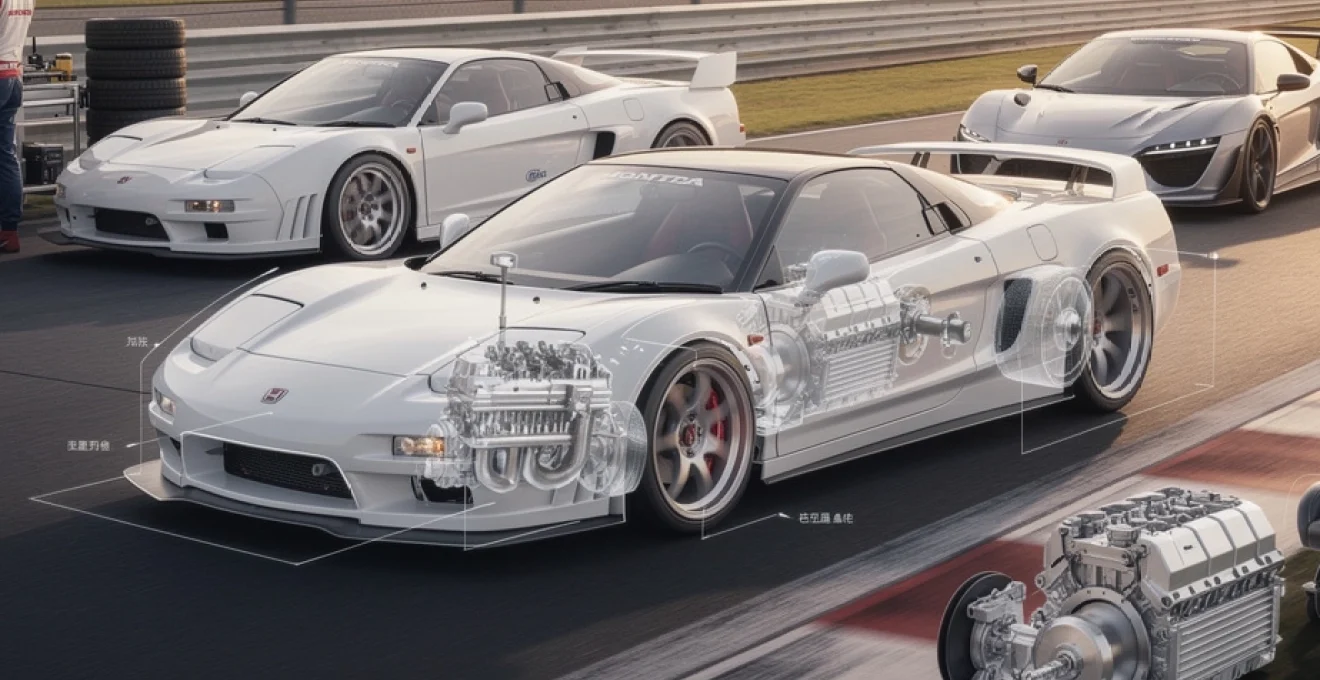
The NSX Honda Type R sits at a rare crossroads where motorsport engineering, everyday usability and obsessive attention to detail meet. Conceived as a purist alternative to heavier, softer supercars, each NSX-R and NSX Type R variant has been engineered first and foremost for lap time, consistency and driver feedback. If you care about braking points, mid-corner balance and throttle response more than soft-touch plastics, this lineage speaks directly to you. Beyond the legend and the Ayrton Senna connection, the NSX Honda Type R story is about how intelligent weight reduction, naturally aspirated VTEC power and race-bred chassis tuning can still feel relevant in an era of turbocharged, hybrid supercars.
NSX honda type R lineage: NA1, NA2 and NC1 evolution towards track-focused performance
NA1 NSX-R (1992–1995): ayrton senna-influenced chassis tuning and weight reduction programme
The first NA1 NSX-R, launched in 1992, was Honda’s answer to customers who loved the original NSX but wanted something closer to a road-legal GT racer. Based on the 3.0-litre NSX (chassis code NA1), it kept the pioneering all-aluminium monocoque but went through an aggressive weight reduction programme. Sound deadening, power steering, audio system, spare wheel, traction control and much of the luxury equipment were removed or made optional. The result was a kerb weight of around 1,230 kg, roughly 120–140 kg lighter than a standard NSX depending on specification.
Chassis tuning was heavily influenced by development work carried out with Ayrton Senna during the original NSX programme. Engineers added localised reinforcements under the battery tray and ahead of the radiator to trim unwanted flex and oversteer, while retuning spring rates, bush stiffness and damper curves. On track, the NA1 NSX-R feels like someone has dialled the resolution up from high definition to 4K; every bump, camber change and grip transition is clearer, helping you place the car with confidence at the limit.
NA2 NSX-R (2002–2005): 3.2-litre C32B engine upgrades, shorter final drive and aero revisions
The second-generation NA2 NSX-R arrived in 2002 as a more extreme evolution of the facelifted NSX. Power came from the enlarged 3.2-litre C32B V6, officially rated at 280 bhp but widely believed to produce closer to 300 bhp in blueprinted Type R form. A six-speed manual gearbox with shorter overall gearing and a more aggressive final drive sharpened straight-line performance, dropping 0–100 km/h times to around 4.4–5.0 seconds depending on test conditions.
Aero revisions were much more visible than on the first NSX-R. A carbon-fibre bonnet with an integrated vent, a fixed rear wing, underbody diffusers and revised bumper intakes generated measurable downforce at speed. Independent testing quoted approximately 36 kg of front and 25 kg of rear downforce at 100 mph, an impressive figure for a car still shaped with road use in mind. Combined with stiffer springs, firmer dampers and retuned ABS, the NA2 NSX-R closed the performance gap to contemporary track heroes like the Porsche 911 GT3 (996) while retaining an inherently progressive balance.
NC1 NSX type R development rumours vs official NSX type S: hybrid supercar rethink
When the hybrid NC1 NSX launched in 2016, speculation immediately turned to whether a dedicated NSX Type R would follow. Rumours pointed to lighter batteries, more aggressive electric motor mapping and reduced sound insulation to create a sharper, more vocal car. Instead, Honda chose to release the NSX Type S as the final evolution of the NC1, effectively serving as the spiritual successor to a would-be NSX Type R for the modern era.
The NSX Type S focused on recalibrated hybrid systems, improved cooling, revised aero and modest weight savings rather than a full “strip everything out” approach. In that sense, it represented a hybrid supercar rethink: balancing the need for daily usability with track-focused performance. For you as a track-day driver, that meant broader performance bandwidth rather than the singular focus of the original NSX-R. It underlines a shift in philosophy from extreme lightweighting to intelligent use of electric torque and software tuning.
Jdm-only NSX-R models vs european NSX type R availability and specification differences
Both the NA1 and NA2 NSX-R models were officially sold only in Japan as JDM specials, all built in right-hand drive and produced in very small numbers. The first NA1 NSX-R totalled around 483 units between 1992 and 1995, while the second-generation NA2 NSX-R run was even more limited at roughly 140–160 cars. These track-oriented models featured elements such as carbon-Kevlar Recaro seats, Momo steering wheels without airbags and minimal interior trim that would have been difficult to homologate for certain markets at the time.
For European enthusiasts, “NSX Type R” often refers informally to imported JDM NSX-Rs or to NSX examples modified with similar weight reduction and suspension specifications. Major differences included the absence of factory air conditioning, the deletion of sound insulation, unique ECU mapping and, in the case of NA2, dedicated aero parts and shorter transmissions. If you compare a European-market standard NSX to a JDM NSX-R, you notice not only the lack of comfort equipment but also the more focused brake feel, higher steering effort and different character of the limited-slip differential under power.
Powertrain engineering of the NSX honda type R: naturally aspirated VTEC and drivetrain specs
C30A and C32B V6 architecture: aluminium block, titanium conrods and high-compression pistons
At the heart of every NSX Honda Type R is a hand-finished, naturally aspirated V6. The original C30A is a 2,977 cc 90-degree V6 with an aluminium block and heads, four valves per cylinder and dual overhead cams. Honda employed titanium connecting rods to reduce reciprocating mass and allow the engine to spin safely past 8,000 rpm. A relatively high compression ratio of around 10.2:1, combined with precise fuel metering via PGM-FI, delivered both strong power and excellent throttle response.
For the NA2 NSX-R, the C32B enlarged displacement to 3,179 cc via a longer stroke while maintaining the same fundamental all-aluminium architecture. Type R engines received special attention: blueprinted internals, hand-balanced crankshafts, and in the NA2, carefully matched pistons and con rods assembled by a single specialist. Official output figures stayed near Japan’s gentleman’s agreement ceiling of 280 PS, but dyno results consistently suggested closer to 290–300 bhp for NA1 NSX-Rs and 300+ bhp for NA2 versions, giving you around 220 bhp per tonne in the later car.
VTEC cam profile switching, 8,000 rpm redline and throttle response on circuit
The magic in the NSX Honda Type R’s engine lies in its VTEC system, which uses hydraulically actuated pins to switch between low- and high-lift cam profiles at specific rpm and load thresholds. On track, you feel this as a distinct second wind: below the engagement point, the engine is tractable and flexible; above it, the V6 snaps to attention, lunging for the 8,000 rpm redline with increasing urgency. Keeping the engine in its VTEC band through corners becomes a central part of extracting lap time.
Compared to turbocharged rivals, the NA1 and NA2 NSX-R deliver a more linear, predictable power curve. That predictability translates into easier modulation of traction, especially on corner exit when grip can fluctuate. With a direct cable-operated throttle in early cars and a sharp drive-by-wire setup in the NA2 NSX-R, the response to your right foot is almost immediate. This immediacy, combined with relatively short gearing, makes it easier to balance the car mid-corner using subtle throttle adjustments.
Gearbox ratios, close-ratio 6-speed manual and final drive optimisation for suzuka and tsukuba
Honda’s approach to gearing in the NSX Type R was unapologetically track-oriented. The NA1 NSX-R used a five-speed manual gearbox but adopted a shorter final drive ratio (4.235:1 versus 4.06:1 on the standard car). This sacrificed a few mph off the top speed, dropping from around 270 km/h to 262 km/h, but significantly improved acceleration between 80 and 200 km/h—exactly where you spend time on circuits such as Suzuka.
The NA2 NSX-R introduced a close-ratio six-speed manual. Here, engineers optimised each gear to keep the C32B squarely in its VTEC power band on key straights and between major corners at Suzuka and Tsukuba. Shorter second and third gears improved drive out of slow corners, while a taller sixth still allowed comfortable highway cruising. If you plan to track an NSX-R, monitoring corner exit rpm and ensuring shifts place you just below the VTEC crossover point can typically shave tenths off each sector without additional power.
Limited-slip differential (LSD) calibration and traction behaviour on corner exit
The limited-slip differential in the NSX Honda Type R plays a crucial role in how effectively the car deploys its power. NA1 NSX-R models received a higher locking LSD than standard cars, improving traction as both rear wheels shared torque more aggressively under power. This tuning reduced inside-wheel spin exiting tighter bends and contributed to a more neutral, slightly tail-happy balance when provoked.
Later cars, including the mid-1990s NSX and especially the NA2 NSX-R, adopted a torque-reactive limited-slip design with more nuanced behaviour. Under light throttle, lock-up is relatively modest, allowing tight manoeuvring without scrub; under heavy throttle or sudden load changes, the LSD tightens to maintain traction. On track, you feel the car digging out of corners rather than lighting up an inside tyre. For maximum pace, you are rewarded for early but progressive throttle application, using the differential’s locking characteristics to help rotate the car instead of relying solely on steering input.
Lightweight construction and chassis tuning: how honda engineered the NSX type R for lap times
All-aluminium monocoque, body-in-white reinforcement and torsional rigidity figures
The NSX platform was revolutionary in 1990, being the first mass-produced all-aluminium monocoque sports car. This foundation gave the NSX Honda Type R a crucial head start: dramatic weight savings without sacrificing structural integrity. Aluminium extrusions, castings and stampings were riveted and bonded into a unit body, achieving torsional rigidity figures comparable to or better than many steel-bodied contemporaries while cutting mass by up to 200 kg in some cases.
For the NSX-R variants, Honda kept the basic body-in-white architecture but added targeted reinforcements in areas that affected steering precision and suspension control. These locally stiffened regions—such as around the front bulkhead and suspension pickups—reduced flex under high lateral loads. The payoff for you on circuit is a more consistent steering feel and geometry that stays truer to its design angles through high-g corners, which in turn improves tyre contact patches and repeatability over long sessions.
Weight reduction strategy: carbon-kevlar recaro seats, thinner glass, sound deadening delete
Weight reduction in the NSX Honda Type R was not an abstract goal; it was a carefully costed and measured strategy. Engineers targeted both obvious and less obvious components. Heavy electric leather seats were replaced with fixed-back Recaro buckets made from carbon-Kevlar, saving around 15–20 kg alone. The battery was downsized, spare tyre deleted, and glass for the rear screen made thinner.
In the cabin, swathes of sound insulation were removed, and equipment such as air conditioning, power steering and even some wiring looms became optional. The NA2 NSX-R went further by using a carbon-fibre engine cover mesh, carbon rear wing and lighter bumpers. If you are planning a track build on a regular NSX, replicating this philosophy—starting with high-mounted weight such as seats and glass before tackling rotating components like wheels—offers some of the best returns in lap time per kilogram saved.
Suspension geometry: double wishbone setup, spring rates, dampers and anti-roll bar tuning
Both NSX-R generations rely on a pure double wishbone suspension layout at each corner, inspired by contemporary Formula One practice. This geometry gives precise control over camber and toe through suspension travel, crucial for maintaining a stable tyre contact patch under heavy braking and high lateral loads. For NSX Type R duty, Honda increased spring rates significantly over the base NSX, combined with revalved dampers that resist roll and pitch more assertively.
Anti-roll bars were thickened, particularly at the front on the NA2 NSX-R, to sharpen initial turn-in and reduce body roll. Bushes were made firmer to reduce compliance steer and unwanted deflection. On bumpy roads, this can feel uncompromising; on track, the benefits are obvious. The car changes direction with minimal delay, and you can confidently attack kerbs and compressions without the chassis taking a set, then floating. As a driver, this gives you the headroom to brake later and carry a few extra km/h through medium- and high-speed corners.
Wheel and tyre packages: forged enkei wheels, bridgestone potenza RE010 / RE070 track compounds
Factory wheel and tyre choices on the NSX Honda Type R reflect the same focus on unsprung mass and grip. Early NA1 NSX-Rs ran lightweight forged Enkei wheels, 15 x 6.5 inches at the front and 16 x 8 inches at the rear, wrapped in 205/50 ZR15 and 225/50 ZR16 tyres. Bridgestone Potenza RE010 rubber provided a blend of dry grip and feedback well-suited to circuit use in the 1990s.
By the time of the NA2 NSX-R, wheel diameters had grown to 17 inches at the rear and 16 inches at the front, with seven-spoke designs often finished in Championship White for that iconic Type R look. Tyres like the Bridgestone Potenza RE070 offered much higher grip levels and heat tolerance, effectively modern semi-slick performance in road-legal form. For your own setup, the key is preserving the NSX’s carefully balanced stagger and rolling radius while moving to modern performance tyres that can handle repeated hot laps without excessive heat soak.
Braking system: ventilated discs, 4-pot callipers and fade resistance in repeated hot laps
Braking performance is a make-or-break factor in any track car, and the NSX-R specification addresses this area thoroughly. Early cars used 282 mm ventilated discs all round, clamped by performance-oriented callipers and managed by a four-channel ABS system. While the disc diameter sounds modest by modern standards, the combination of light overall weight, aggressive pad compounds and excellent cooling kept fade under control for most circuit work.
Later NSX variants and especially track-focused builds often move to larger discs and multi-piston callipers, akin to a 4-pot setup, significantly increasing thermal capacity. Honda also revised master cylinder sizing and ABS calibration in the NA2 NSX-R, producing a firmer, more communicative pedal. On track, that translates into trustworthy, linear braking deep into the stop zone, giving you the confidence to explore later braking points. Regular fluid changes, performance pads and careful attention to ducting will ensure the system maintains consistency over long sessions.
Aerodynamics and exterior design: downforce, stability and cooling on the NSX-R
Aerodynamics on the NSX Honda Type R strike a delicate balance between road usability and track performance. The base NSX shape already worked well, with a low drag coefficient and relatively neutral lift characteristics. The NA1 NSX-R made only subtle changes: mesh-filled openings where fog lights once sat, revised side intakes for better cooling and a red-backed Honda badge to signal its intent. Despite the discreet appearance, underbody airflow was tidied up, reducing high-speed instability and improving brake and radiator cooling.
The NA2 NSX-R took aero development much further. A vented carbon bonnet relieved pressure from the front wheel wells, reducing lift and helping to push the front axle into the tarmac at speed. A fixed rear wing and redesigned rear diffuser worked together to create a modest but useful net downforce balance. At approximately 100 mph, the system added around 61 kg of total downforce without a significant drag penalty. For a driver, that extra load becomes most noticeable in high-speed direction changes and long sweepers, where the car feels more planted and less nervous, even when you commit to aggressive turn-in.
NSX honda type R track performance metrics: lap times at suzuka, tsukuba and nürburgring
Suzuka circuit lap times: NA1 vs NA2 NSX-R compared with porsche 911 GT3 (996) benchmarks
Suzuka Circuit is a natural benchmark for any Japanese supercar, and the NSX Type R has long been measured against rivals there. Period testing suggests the NA1 NSX-R could circulate Suzuka in the 2:25–2:27 range on period tyres, already outpacing many European contemporaries such as the Ferrari 348 and matching early 993-generation 911 Carrera RS times. The combination of low weight, mid-engine balance and reliable braking made it especially strong through the “Esses” and Degner curves.
The NA2 NSX-R, on stickier rubber and with aero and powertrain upgrades, closed the gap to early 996 GT3s, with tests and Best Motoring comparisons showing lap times around 2:20–2:22. While exact numbers vary with driver and conditions, the pattern is clear: around Suzuka, a well-driven NSX-R can run at or near the pace of dedicated track specials from Porsche, despite less outright power. For you as a driver, this emphasizes how much time the NSX-R finds in technical sections rather than relying purely on straight-line speed.
Tsukuba circuit (TC2000) testing: best motoring hot laps and sector-by-sector analysis
Tsukuba Circuit TC2000 is shorter and more stop–start, magnifying differences in traction, low-speed agility and braking. Hot laps from Japanese media sources often quote NA1 NSX-R times in the high 1:05 to low 1:06 range on contemporary tyres. The NA2 NSX-R, especially on Potenza RE070 or equivalent rubber, frequently dips into the 1:03–1:04 bracket. For context, that puts it in the same ballpark as track-focused versions of the Nissan Skyline GT-R R34 and early 996 GT3s in similar conditions.
Sector analysis from these tests shows where the NSX-R gains its edge. Initial turn-in through the first hairpin and the high-speed back section reveal the benefits of the double wishbone chassis and aero tuning. Corner exit speeds are helped by the well-calibrated LSD and linear VTEC power delivery, allowing earlier throttle application. If you want to improve your own Tsukuba times in an NSX-R, focusing on brake release technique into T1 and maximising minimum speed through the final double-apex right-hander generally yields the biggest time gains.
Nürburgring nordschleife performance: unofficial timings, gearing and high-speed aero balance
Unlike more recent hot hatches, the NSX Honda Type R never received a heavily publicised official Nürburgring Nordschleife lap record. However, various unofficial times and owner reports place a well-driven NA2 NSX-R on modern tyres in the 7:50–8:00 minute BTG (Bridge-to-Gantry) range. Such performance aligns closely with early 2000s GT cars and emphasises how effective its lightweight and aero package remains on a long, demanding circuit.
The gearing and aero balance play a major role here. Shorter ratios keep the C32B in its sweet spot on climbs like Kesselchen, while the car’s stable high-speed behaviour allows committed entries into sections such as Schwedenkreuz and Fuchsröhre. Heat management becomes a bigger challenge over a full lap—holding 240 km/h plus on Döttinger Höhe taxes cooling and brakes—so ensuring fresh fluids, optimal brake ducting and correct tyre pressures is critical if you intend to chase lap times on the Nordschleife.
Acceleration, braking and skidpad data: 0–100 km/h, 100–0 km/h and lateral g figures
Hard numbers help illustrate where the NSX Type R stands in objective performance. Typical independent test figures include:
| Model | 0–100 km/h | Top speed | 100–0 km/h | Skidpad (lateral g) |
|---|---|---|---|---|
| NA1 NSX-R | ~5.0 s | ~263 km/h | ~36 m | ~0.95 g |
| NA2 NSX-R | 4.4–5.0 s | ~280 km/h | ~34 m | 1.0–1.1 g |
These statistics show a clear progression: slightly faster sprints, shorter braking distances and higher cornering grip from NA1 to NA2. Yet the figures only tell part of the story. What stands out most when you drive an NSX-R is consistency. In a well-maintained example, you can repeat 0–100 km/h runs and heavy braking manoeuvres with minimal degradation, which is exactly what you want during extended track days.
Comparison with contemporary rivals: ferrari 348/355, honda S2000 type V, skyline GT-R R34
Placing the NSX Honda Type R in context against its rivals highlights its strengths and compromises. Compared with a Ferrari 348 or early 355, the NA1 NSX-R often posts similar acceleration but enjoys a noticeable advantage in reliability, ergonomics and visibility. The chassis feels more forgiving at the limit, allowing you to explore slip angles with less fear of sudden breakaway. Versus an R34 Skyline GT-R, particularly the V-Spec, the NSX-R trades turbocharged punch and all-wheel drive traction for lower weight and clarity of feedback.
Against Honda’s own S2000, especially the Type V and later high-performance variants, the NSX-R offers a more exotic mid-engine balance and higher-speed stability, while the S2000 counters with an even more accessible running cost and arguably similar steering purity. A recurring professional observation is that the NSX Type R feels like a precision instrument—more scalpel than hammer—rewarding clean lines and smooth inputs. For you, that means the car constantly encourages better driving habits rather than simply flattering rough technique with electronics or brute force.
Driver feedback and setup optimisation: extracting maximum pace from the NSX honda type R
Owning or tracking an NSX Honda Type R is as much about understanding setup as it is about raw numbers. The chassis is extremely sensitive to alignment, corner weighting and tyre choice. A small change in front toe or camber can shift the balance from benign understeer to lively neutrality. For most circuits, a slightly more aggressive negative camber setting at the front (within manufacturer tolerances) and a square, consistent tyre pressure strategy once hot will allow you to lean on the outer front tyre without excessive shoulder wear.
Brake pad selection and fluid choice are equally critical, especially on fast European circuits. Moving to a high-temperature racing pad and a quality DOT 4 or DOT 5.1 fluid dramatically increases fade resistance. Treat the car like a lightweight GT racer: warm up gradually, monitor pedal feel and give it proper cool-down laps. The aluminium construction sheds heat efficiently, but components will reward this mechanical sympathy with longer life and more consistent performance.
For maximum performance in an NSX Type R, the single most valuable upgrade is often the driver. Professional coaching typically unlocks more time than any bolt-on component.
If you want practical steps to improve lap times in an NSX-R, consider three priorities. First, invest in seat time and, if possible, coaching to refine braking release and throttle application. Second, baseline the car: fresh fluids, correct alignment, balanced corner weights and quality tyres in the right heat range. Third, log data—even a simple lap timer with GPS—so you can correlate subjective feel with objective improvements. Treat the NSX-R like a living setup project rather than a static museum piece.
One of the most engaging aspects of the NSX Honda Type R is how honestly it communicates through its steering and chassis. Every change you make, from tyre pressure to damper adjustment or pad compound, is reflected clearly in the way the car feels. That transparency turns ownership into a continual learning process: the more you listen and respond, the faster and more rewarding the car becomes. For a driver who values precision, that iterative dialogue between human and machine is where the NSX Type R truly justifies its legendary status.