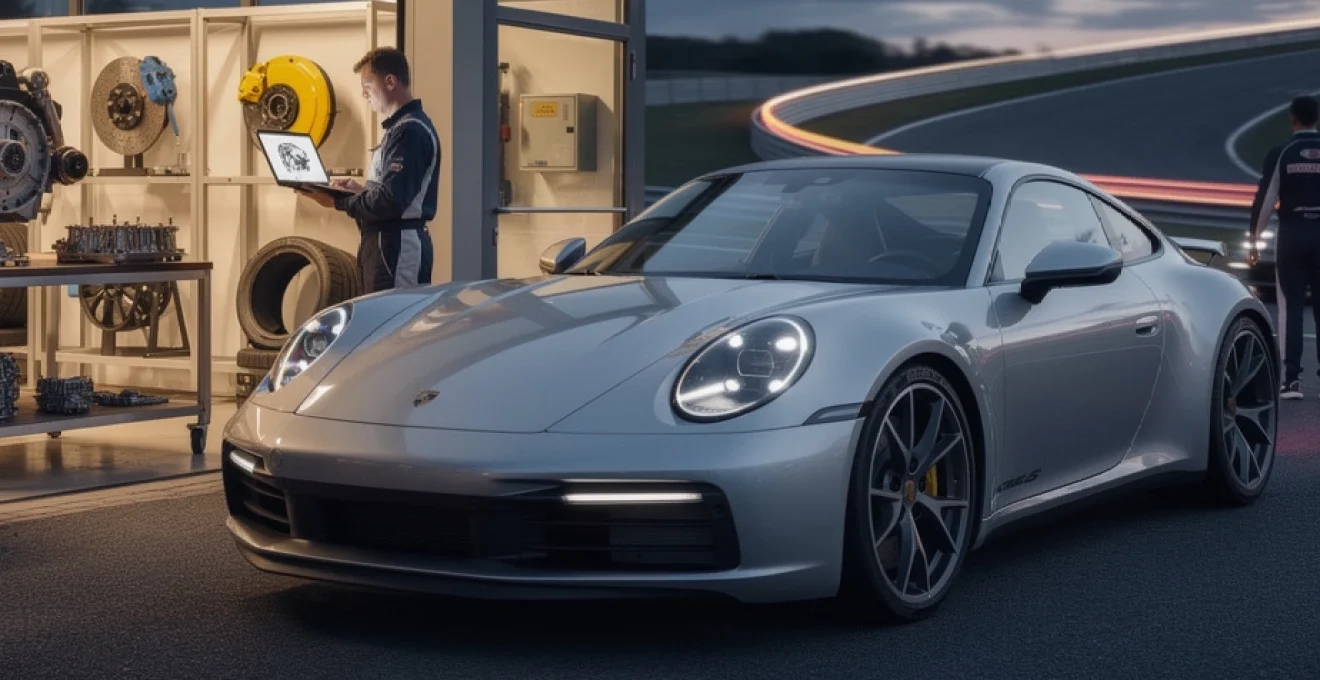
The Porsche 911 992 Carrera S sits at a rare intersection of heritage and high technology. It preserves the rear-engined, flat-six formula that defined generations of 911s, while adding an arsenal of digital systems, advanced aerodynamics and a chassis tuned to handle everyday use and circuit abuse with equal ease. If you are looking for a sports car that can commute on Monday, cross Europe on Friday and lap a track on Saturday, the 992 Carrera S stands out as one of the most complete choices on the market.
Beyond the numbers and the Nürburgring lap times, what makes this generation fascinating is how it makes complex engineering feel natural from behind the wheel. You do not have to understand PASM, PDK or PTV to sense their effect. The car simply feels more composed, more secure and more exploitable than almost anything in its class. For drivers coming from earlier 911s, the 992 Carrera S delivers a convincing answer to a difficult question: how far can a legend evolve without losing its soul?
Porsche 911 992 carrera S overview: dimensions, kerb weight, performance figures and model positioning
The 992-generation Porsche 911 Carrera S launched globally for the 2019 model year, replacing the 991.2 Carrera S as the core performance variant in the range. It uses the eighth-generation 911 platform, wider and stiffer than before, with aluminium body panels and a standard widebody look across the line-up. Overall length is just under 4.52 m, with a width of around 1.85 m and a height close to 1.30 m, giving the 992 Carrera S a squat, muscular stance on the road. The mixed wheel setup of 20 inches at the front and 21 inches at the rear further underlines its rear-drive bias.
Kerb weight sits in the region of 1,600–1,650 kg depending on specification and options such as the glass roof, larger wheels and ceramic brakes. That makes the 992 Carrera S roughly 50–60 kg heavier than the equivalent 991.2, primarily due to stricter safety standards, additional sound insulation and a more complex drivetrain. Yet the performance figures more than compensate: the turbocharged 3.0-litre flat-six delivers 443 hp (450 PS) and around 530 Nm of torque, enabling 0–100 km/h in about 3.5 seconds with the eight-speed PDK and Sport Chrono, and a top speed of roughly 308 km/h.
Within the broader 911 hierarchy, the 992 Carrera S occupies a sweet spot between the entry Carrera models and the extreme GT and Turbo derivatives. It has notably more power and dynamic hardware than the base Carrera, but avoids the expensive complexity and running costs of a Turbo S or GT3. For many enthusiasts, especially those wanting a single car to handle daily driving and spirited weekend use, the Carrera S represents the most rational – and yet still highly emotional – choice in the 992 family.
3.0-litre twin-turbo flat-six engine: power delivery, torque curve and thermal management in the 992 carrera S
At the heart of the 992 Carrera S lies a 3.0-litre twin-turbocharged flat-six engine, internally known as a boxer due to its opposing piston layout. This unit develops 443 hp, a 30 hp gain over the outgoing 991.2 Carrera S, with torque remaining strong and linear across the mid-range. The character of this engine is defined less by peak numbers and more by the way it delivers thrust: there is usable torque from little over idle, a substantial plateau through the middle of the rev range, and a strong pull towards the 7,500 rpm red line.
The engine’s thermal management has been carefully reworked for the 992 generation. A single, larger centrally mounted intercooler replaces the twin side-mounted intercoolers of the 991, increasing effective cooling area by around 12%. Lower intake-air temperatures allow more aggressive ignition timing and boost control without sacrificing durability. The adoption of a particulate filter to meet Euro 6d regulations adds around 10 kg, but careful calibration of the exhaust and fuel systems ensures the engine still revs freely and responds crisply to throttle inputs.
The 992 Carrera S engine demonstrates how turbocharging, when combined with intelligent cooling and precise control, can deliver both efficiency and an engaging, naturally progressive power band.
VTG turbochargers, intercooler layout and boost control in the 992-generation 3.0 boxer
Each bank of cylinders in the 3.0-litre flat-six is fed by its own turbocharger. These units feature variable turbine geometry (often referred to as VTG), allowing the effective size of the turbine to change depending on engine speed and load. At low rpm, the vanes close to accelerate gas flow, improving response and reducing lag; at higher rpm, the vanes open to prevent back pressure and maintain efficiency. For you as a driver, the result is near-instant torque when you squeeze the throttle in any gear.
The relocation of the intercooler to a central position above the engine is more than a packaging trick. It shortens the charge-air path, reduces pressure losses and exposes the intercooler to cleaner, more uniform airflow from the rear grille. Combined with active cooling flaps and carefully managed ducting, the system can maintain consistent intake temperatures even during extended high-speed Autobahn runs or track sessions. Boost control strategies are tuned to deliver smooth, predictable escalation of power rather than a sudden surge, which makes the car easier to place precisely on corner exit.
Direct fuel injection, compression ratio and combustion efficiency versus 991.2 carrera S
Compared with the 991.2 Carrera S, the 992’s engine benefits from refinements in direct fuel injection, injector positioning and spray pattern control. These changes improve mixture formation, allowing a slightly higher compression ratio – up from 10.1:1 to about 10.5:1 – while still supporting stable combustion under boost. The higher compression ratio aids low-end torque and part-throttle response, contributing to better fuel efficiency in real-world driving.
For you, that means the 992 Carrera S can cruise at motorway speeds with surprisingly modest fuel consumption for a 450 hp sports car, often dipping into the 8–9 l/100 km range in gentle use. Yet when you request full power, the high-pressure injection system can deliver precisely metered fuel in multiple pulses per combustion cycle, stabilising the flame front and reducing knock. This combination of compression, injection and turbo control is one reason the 992 feels both stronger and smoother than its predecessor across the rev band.
Exhaust system, sports exhaust option and sound engineering under euro 6d emissions
Meeting Euro 6d emissions standards while retaining a recognisable 911 soundtrack is no trivial task. The 992 Carrera S exhaust system incorporates a gasoline particulate filter and complex muffler internal routing to clean up emissions and control noise. Active exhaust flaps adjust back pressure and sound character based on drive mode, engine load and rpm. With the standard system, the car remains civilised at low speeds but builds a purposeful, bass-rich growl under acceleration.
The optional sports exhaust option sharpens that character further, with less muffling and a more pronounced bark at higher revs. It does not emulate the shriek of a naturally aspirated GT3, but it offers a satisfying blend of mechanical flat-six tone and turbo whistle. For many owners, this upgrade significantly enhances emotional connection without compromising long-distance comfort. From a technical perspective, it also slightly reduces back pressure, aiding transient response and making the engine feel a touch more eager above 4,000 rpm.
Real-world performance: 0–62 mph, in-gear acceleration and autobahn vmax data
Officially, the 992 Carrera S with PDK and Sport Chrono records 0–100 km/h (0–62 mph) in about 3.5 seconds, with some independent tests measuring as low as 3.3 seconds on a prepared surface. The manual version trails slightly, typically around 4.0 seconds, depending on launch technique. In-gear acceleration is arguably more impressive: 80–120 km/h (50–75 mph) in fourth gear can take less than 3 seconds, providing rapid overtaking ability on country roads and motorways.
Top speed is quoted at approximately 308 km/h for the coupé, a figure it can sustain comfortably on unrestricted Autobahn sections thanks to its thermal management and aerodynamics. In independent high-speed testing, the 992 Carrera S has shown strong stability and cooling resilience, with no significant power drop-off after repeated full-throttle runs. For drivers who value real-world performance – the kind that matters on a wet B-road at dusk – the broad torque curve and fast shift capabilities make the car feel relentlessly quick, regardless of speed.
PDK gearbox, manual transmission and drivetrain calibration in the 992 carrera S
The 992 Carrera S offers two distinct transmission philosophies: a cutting-edge eight-speed PDK dual-clutch automatic and a more traditional seven-speed manual available on select configurations. Each option shapes the car’s character in different ways. If you aim for maximum acceleration, consistency and ease in heavy traffic, the PDK is the logical choice. If you prioritise mechanical interaction and a more old-school sports-car feel, the manual gearbox offers a rare experience in a world of increasingly automated performance cars.
Underlying both is a rear-wheel-drive layout, with an electronically controlled rear differential lock as standard on manual cars and optional on PDK variants through the Porsche Torque Vectoring system. The drivetrain calibration is designed to balance traction, agility and stability, giving you confidence even in wet or low-grip conditions. The result is a car that feels rear-driven and playful when you want it to, but never unruly or intimidating, even at high speeds.
Eight-speed PDK architecture, gear ratios and launch control strategy
The eight-speed PDK in the 992 Carrera S is a development of Porsche’s proven dual-clutch technology. It packs two clutches and two input shafts into a compact housing, allowing one gear to engage while the next is pre-selected. Gear ratios are carefully spaced: first gear is shorter than in the 991.2, improving off-the-line snap, while the upper gears are longer, aiding fuel economy and refinement at cruising speeds. The final drive ratio works with these gears to keep the engine in its fat torque band during spirited driving.
Launch Control, part of the Sport Chrono package, manages clutch engagement, boost pressure and traction control to deliver repeatable, optimal starts. Simply select Sport Plus, hold the brake, floor the throttle until the system confirms readiness, then release. The electronics juggle wheelspin and torque delivery to achieve 0–100 km/h in the low 3-second range on a suitable surface. For track days, this consistent launch behaviour can be useful when practising starts or comparing setups, though many owners reserve it as a party trick rather than a daily habit.
Seven-speed manual gearbox take-rate, shift quality and driver engagement
The seven-speed manual transmission in the 992 Carrera S is a deliberate nod to enthusiasts who value tactile involvement as much as raw speed. Take-rate figures vary by market, but in some enthusiast-heavy regions, manual gearbox orders have accounted for 15–25% of Carrera S sales. The shift action has a relatively short throw and a precise gate, though it remains a little more mechanical than the rifle-bolt feel of classic air-cooled 911s.
Manual-equipped cars receive a mechanical rear differential lock and the Sport Chrono package as standard, including an automatic rev-matching function. This system blips the throttle on downshifts to smooth the transition, making heel-and-toe techniques optional rather than essential. For many drivers, the manual transforms the 992 Carrera S from an ultra-capable GT into a more interactive, analogue-feeling sports car. If you enjoy planning your downshifts and working with the engine’s torque curve, this gearbox significantly deepens engagement.
Rear-wheel-drive layout, porsche torque vectoring (PTV) and traction management
The 992 Carrera S retains the classic 911 rear-engine, rear-wheel-drive configuration. With a substantial proportion of mass over the driven wheels, traction under acceleration is excellent, particularly in dry conditions. However, Porsche supplements the basic physics with an array of software and hardware systems, including PTV (Porsche Torque Vectoring) and finely calibrated stability control. PTV uses the rear differential and selective brake application to send more torque to the outer rear wheel in a corner, helping the car rotate into the apex.
Traction management strategies monitor steering angle, throttle position, yaw rate and wheel slip to determine how much intervention is necessary. In the sportier drive modes, the systems allow more slip and a greater sense of rear-drive character, while still providing a safety net. This dual nature is one of the standout traits of the 992 Carrera S: you can enjoy gentle oversteer and playful behaviour when space and conditions permit, yet the car remains controllable and forgiving if grip levels drop unexpectedly.
Differential types, final-drive ratio and impact on nürburgring lap times
The electronically controlled rear differential lock fitted to many 992 Carrera S models manages lock-up both under power and on overrun. At corner exit, increased locking reduces inside wheelspin and channels more torque to the outer wheel, improving traction. On turn-in, controlled opening of the diff aids agility and reduces understeer. The combination of diff behaviour and final-drive ratio has a direct impact on lap times at circuits such as the Nürburgring Nordschleife and other technical tracks.
Although factory lap times focus more on flagship models like the GT3, internal and independent testing of the 992 Carrera S shows notable gains versus the 991.2, often shaving several seconds per lap on longer circuits. These improvements stem not simply from more power, but from enhanced traction out of slower corners and better stability in high-speed sections. If you intend to use your Carrera S regularly on track days, specifying PTV and the mechanical diff is highly advisable, as the added consistency lap after lap is significant.
Chassis dynamics: PASM, rear-axle steering and active systems in the 992 platform
The 992 platform redefines how a 911 balances comfort and performance. It introduces wider tracks, new suspension geometry and more intelligent use of active systems like Porsche Active Suspension Management and optional rear-axle steering. For daily use, the chassis delivers an impressively compliant ride, even on large wheels. When you switch into more aggressive drive modes, damping, steering weight and throttle response tighten, revealing a car that can rival traditional track specials for precision and speed.
One of the most impressive aspects is how naturally these systems work together. Rather than feeling like an overlay of electronics, the whole car feels of a piece, with body movements tightly controlled but not abrupt. For you, that means the freedom to experiment with lines and braking points without fighting the car. Whether on a twisting mountain road or a fast, flowing circuit, the 992 Carrera S gives the confidence to exploit its grip safely.
Wider track, mixed tyre sizes and pirelli P zero vs michelin pilot sport 4S setups
The front track of the 992 has grown by around 45 mm versus the 991, requiring wider front wings and a subtle change in stance. All Carrera S models feature mixed tyre diameters – 20 inches at the front and 21 inches at the rear – with corresponding increases in tyre width for greater footprint area. This configuration enhances front-end bite and stability while preserving the classic 911 rear-drive sensation under power.
Factory-fit tyres commonly include Pirelli P Zero or Michelin Pilot Sport 4S options, each with a slightly different character. P Zeros tend to offer sharp, immediate steering response and strong dry grip, suiting track-focused drivers. Pilot Sport 4S tyres provide excellent wet-weather confidence and a more progressive breakaway, making them ideal if you drive in varied climates. Whichever you choose, maintaining correct pressures is essential for maximising both grip and even wear.
Porsche active suspension management (PASM) and optional -10 mm sports chassis
PASM is central to the 992 Carrera S driving experience. It continuously adjusts damper force at each wheel based on road conditions, driving style and selected mode. In Normal mode, the suspension is relatively supple, absorbing small bumps and surface imperfections with ease. In Sport and Sport Plus, damping stiffens, reducing body roll and pitch to deliver a more focused, connected feel. The change is immediately noticeable when you drive the same stretch of road back-to-back in different modes.
The optional -10 mm sports chassis goes a step further, with shorter springs and stiffer anti-roll bars. This setup lowers the centre of gravity and sharpens responses but remains surprisingly livable on decent roads. If your priority is frequent track use or you appreciate a firmer, more communicative ride, the sports chassis is worth serious consideration. For mixed-use driving, the standard PASM strikes an excellent balance, particularly if you regularly encounter rougher surfaces or urban speed bumps.
Rear-axle steering, variable steering ratio and high-speed stability tuning
Optional rear-axle steering is one of the most transformative technologies available for the 992 Carrera S. At low speeds, the rear wheels steer in the opposite direction to the fronts by a small degree, effectively shortening the wheelbase and improving manoeuvrability. Parking and tight hairpins become less stressful, especially if you are used to larger GT cars. At higher speeds, the rear wheels steer in the same direction as the fronts, extending the virtual wheelbase to enhance stability.
Combined with a variable steering ratio at the front, this gives the 992 a unique blend of agility and composure. On a fast autobahn sweeper or a high-speed circuit bend, the car feels locked onto its line, resisting crosswinds and mid-corner bumps. Yet in tighter sections, it rotates eagerly when you turn in. For many drivers, especially those covering long motorway distances, rear-axle steering is one of the most valuable dynamic options on the car.
Braking systems, PCCB ceramic option and fade resistance in circuit use
Standard braking on the 992 Carrera S uses sizeable steel discs with multi-piston calipers, providing strong, consistent stopping power for road use. Many cars are also equipped with Porsche Surface Coated Brakes (PSCB), which apply a thin layer of tungsten carbide to steel discs, improving wear and reducing dust. For the most demanding applications, Porsche Ceramic Composite Brakes (PCCB) are available, featuring carbon-ceramic discs that are lighter and more resistant to fade.
On circuit, the benefits of PCCB become clear. Lower unsprung mass improves suspension response, while the high thermal capacity of the discs allows repeated heavy stops without a spongy pedal. However, ceramics come at a high initial cost and potential replacement expense, so they make most sense if you intend to run regular track days or high-speed driving events. For occasional circuit use and mainly road driving, the standard and PSCB systems provide ample performance and a more forgiving ownership profile.
Interior ergonomics, digital interfaces and driving modes in the 992 carrera S cockpit
Open the door of the Porsche 911 992 Carrera S and the interior quickly reveals the generation’s dual personality. The basic architecture is reminiscent of classic 911s, with a low scuttle, clear visibility and a simple, horizontal dashboard. Yet the technology embedded within this layout is thoroughly modern. A central 10.9-inch touchscreen manages navigation, media and car settings, supported by a digital instrument cluster that flanks a traditional analogue tachometer on most 992.1 models.
The driving position is low and adjustable, with supportive seats that can be ordered in various configurations, from comfort-oriented multi-way electric chairs to more aggressive sports buckets. Controls fall readily to hand, and key functions such as the drive-mode selector on the steering wheel allow quick adjustments without taking your eyes off the road. Wet Mode, for instance, can be activated when sensors detect water on the surface, automatically optimising traction control, stability thresholds and throttle mapping for slippery conditions. For long journeys, the mix of high-quality materials, sound insulation and refined ergonomics means you can cover hundreds of kilometres without fatigue.
Digital interfaces include Apple CarPlay and Android Auto integration on the PCM 6.0 infotainment software, along with connected navigation that uses “swarm intelligence” from other vehicles to optimise routing. If you regularly travel across Europe or the UK, this connectivity significantly reduces the stress of traffic and unfamiliar roads. Customisable instrument layouts let you prioritise information relevant to your driving style – perhaps a large map display for touring, or prominent oil temperature and tyre-pressure readouts for track sessions. Once you have dialled in your preferences, the cockpit feels like a tailored workspace focused on your needs as a driver.
Design evolution: bodywork, aerodynamics and lighting from 991.2 to 992 carrera S
The visual evolution from 991.2 to 992 Carrera S is subtle yet meaningful. At the front, the 992 features a more upright, squared-off bonnet with a distinct central groove that recalls the air-cooled 993 generation, emphasising lineage. The car is wider overall, with more pronounced front and rear haunches that highlight the increased track width and standard widebody. Flush, electronic door handles tidy up the side profile, reducing drag and lending the bodywork a cleaner, more sculptural look.
At the rear, the continuous LED light bar defines the 992’s night-time signature, stretching across the entire width of the car and integrating with a redesigned engine cover. This unbroken strip not only looks distinctive but also visually widens the car. Below, the bumper houses larger exhaust outlets and an active rear wing, which deploys in stages depending on speed and driving mode. The wing contributes both to high-speed stability and to cooling management, as different positions alter airflow over the engine bay and rear brakes.
Lighting technology also takes a clear step forward. Matrix LED headlights, optional or standard depending on market, intelligently adjust beam pattern to avoid dazzling oncoming traffic while maintaining maximum illumination elsewhere. Integrating daytime running lights and indicators into the main headlight units cleans up the front bumper, enabling larger, more efficient air intakes and improving the car’s aerodynamic balance. If you frequently drive at night or in poor weather, these systems noticeably enhance safety and reduce fatigue, allowing you to concentrate more on driving and less on manually adjusting lighting.
Daily usability, running costs and long-term ownership of the porsche 911 992 carrera S
Owning a Porsche 911 992 Carrera S as a daily driver is far more realistic than older stereotypes about supercars might suggest. The car offers usable 2+2 seating, with rear seats suitable for children or occasional adult use on short trips, and a front luggage compartment that can swallow weekend bags or a compact set of golf clubs. Ride comfort in Normal mode is comparable to many high-end saloons, while cabin noise levels are low enough for relaxed motorway cruising at legal UK and European speeds. If you live in a city, you will appreciate the compact footprint and good visibility, which make parking and narrow streets less stressful than in many SUVs.
Running costs naturally sit above those of an ordinary family car, but they are manageable for a vehicle of this performance. Service intervals are typically around 20,000 km or two years, and reliability has proven strong in early 992 production, with the tried-and-tested 3.0-litre turbo engine showing few systemic issues when maintained correctly. Fuel consumption varies widely with use: expect around 9–10 l/100 km on gentle motorway runs, rising into the mid-teens with spirited driving or track use. Tyres, particularly the rear 21-inch items, can be a notable expenditure if you regularly exploit the car’s performance, so budgeting for periodic replacement is wise.
- Warm the engine fully before sustained high-load driving to protect the turbochargers and oil system.
- Check tyre pressures at least monthly; correct pressures transform both handling and tyre longevity.
- Consider a professional geometry check annually if you drive hard on challenging roads or attend track days.
Long-term, the 911’s reputation for residual value remains strong. Well-specified 992 Carrera S models with documented service history tend to hold value better than many rivals, especially if maintained in original condition. Choosing timeless colours, popular options such as sports seats and PASM, and avoiding excessive aftermarket modifications can help preserve desirability. From a driver’s perspective, the 992 Carrera S rewards regular use: the more you learn its responses, the more confidence you gain in exploiting its balance between power, grip and electronics. For someone who truly enjoys driving, it can become not just a possession, but a central part of everyday life.