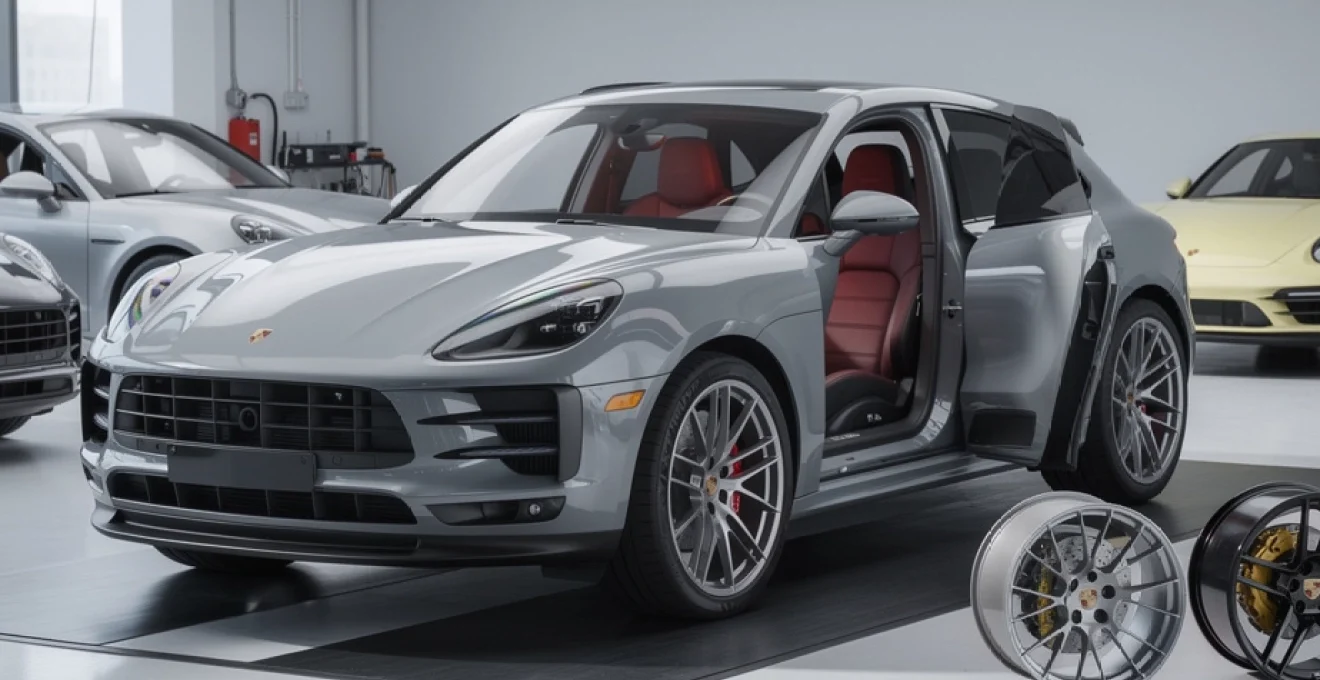
The Porsche Macan in Crayon Grey has become a modern design icon, sitting somewhere between classic motorsport understatement and contemporary minimalism. On an SUV that is already known as the “sports car among compact SUVs”, this light, non‑metallic grey gives the bodywork a sculptural quality and a quietly confident presence on the road. If you want a Macan that feels special every time you walk up to it, yet remains timeless and easy to live with, Crayon Grey is one of the most compelling exterior choices you can make.
Beyond simple aesthetics, the Crayon finish has practical advantages: it hides dust better than black, shows the Macan’s curves more clearly than white, and feels more exclusive than the usual silver or dark grey fleet colours. Combined with the Macan’s sharp flyline and Porsche design DNA, the result is a car that looks equally at home in the city, on a B‑road or parked outside a modern townhouse. Understanding how Crayon Grey works across model years, packages and detailing helps you build a specification that looks considered rather than accidental.
Porsche macan in crayon grey: paint code, colour specification and model year availability
Porsche crayon grey paint code (M9A) and internal colour designation versus chalk
On recent Porsche models, Crayon Grey is internally designated as Crayon and often paired with the paint code M9A for the non‑metallic body colour. In some English‑language markets, you will also see the name Chalk used in brochures, configurators and press materials. Both labels refer to the same pale solid grey tone: a warm, slightly beige‑tinted light grey that sits between pure white and conventional silver.
That dual naming convention can create confusion when you shop for used cars or paint products. If a Macan advertisement lists the colour as Chalk but your VIL sticker or build sheet mentions Crayon with code M9A, the colour is effectively identical. For paint touch‑ups or repairs, professional bodyshops rely on the numeric paint code rather than the marketing name, so matching by M9A (or the equivalent regional code) is what matters most for a perfect respray on bumpers or side blades.
Historically, Porsche has used similar light greys such as Pearl Grey and Heron Grey on early 911 models, and Crayon draws inspiration from those tones. Compared to them, Crayon is slightly cleaner and more neutral, designed to work with modern LED lighting and broader body surfaces like those on SUVs and EVs. This is why it appears across multiple current lines, from the Macan to the Taycan and 911.
Macan model years and trims available in crayon grey (macan, macan S, GTS, turbo, T)
Crayon Grey started as a high‑end, often extra‑cost option and progressively became more widely available across the Macan range. On combustion‑engine Macan models, it has been offered on the Macan base model, Macan S, Macan GTS and, in some markets, the Macan Turbo and Macan T, depending on the specific model year and local product strategy. As the Macan family evolved, Crayon remained one of the most requested special colours, particularly on performance‑oriented trims such as the GTS.
With the arrival of the Macan Electric line, Crayon Grey continues to feature as a hero colour in configurators. It is often showcased on the Macan 4 Electric, Macan 4S Electric and Macan Turbo Electric in marketing imagery, underlining its role as an anchor shade for the new generation. As of the latest WLTP data releases for Macan and Macan Electric, Crayon remains present in the palette, whereas some tones such as Papaya Metallic have already been discontinued, which enhances the long‑term desirability of Crayon specifications.
If you are evaluating used Macan GTS or Turbo models in Crayon, it is worth checking the build sheet to confirm whether the colour was priced as a standard, special or Porsche Exclusive option in that specific year, as this can influence both rarity and residual values.
Factory order options for crayon grey: standard, special and paint to sample (PTS)
Crayon Grey sits in an interesting position within the Porsche paint hierarchy. On some model years and in some regions it is listed as a regular “special colour” with a fixed surcharge, while in others it may be part of a more exclusive palette that edges towards Paint To Sample territory. For Macan buyers, this means you might find Crayon listed differently in price lists between the UK, EU and US markets even in the same production year.
Compared with true Paint To Sample (PTS) colours – which can be fully bespoke and may require approval from Porsche Exclusive Manufaktur – Crayon is relatively accessible. It offers much of the “individual” visual impact of a PTS car without the extended lead times and higher costs often associated with completely custom colours. Professionally, Crayon is one of the colours most likely to provide that PTS‑like feel while still being easy to maintain and repair over time.
From a bodyshop standpoint, the use of a solid, non‑metallic basecoat like Crayon simplifies blending into adjacent panels compared with complex three‑stage or high‑effect metallic colours. This can reduce repair costs if you ever need to correct a scratch or panel damage, yet the finish still looks highly premium on the Macan’s surfaces.
Regional availability of Crayon/Chalk on macan in the UK, EU and US configurators
Regional product planning can influence which exterior colours are emphasised or even offered at all. In UK configurators, Crayon (often labelled as Chalk) appears prominently among the most popular Macan colours, alongside Volcano Grey Metallic and Carrara White Metallic. Marketing copy frequently highlights it as an alternative for drivers who want something more distinctive than “countless shades of grey” yet still understated enough for daily use.
Across EU markets, Crayon/Chalk generally appears on all key Macan derivatives, including Macan S and Macan GTS, but may be bundled differently with styling and wheel packages. In the US, Chalk has been widely promoted on performance models such as 911 GT3 and Taycan, which has increased awareness and demand for the same shade on SUVs like the Macan. Recent configurator refreshes that showcase Macan Electric in bold colours like Crayon, Carmine Red or Miami Blue underline the brand’s push towards more expressive exterior choices, while still retaining classic options like black, white and silver.
For anyone importing or exporting a Macan between markets, checking the official colour code on the car’s documentation is crucial. Naming may change, but the underlying paint formulation remains tied to the code recorded at the factory.
Visual characteristics of crayon grey on the porsche macan body style
Non‑metallic flat light grey tonality under natural daylight and artificial lighting
Crayon Grey is a solid, non‑metallic paint with a relatively flat optical effect compared with metallic or pearlescent finishes. Under natural daylight, it appears as a clean, light grey with a subtly warm undertone. The absence of metallic flake means the colour does not “sparkle” but instead presents as a smooth, almost ceramic surface, which suits the Macan’s taut panel work and muscular arches.
At night, under artificial lighting, Crayon can shift slightly in character. Sodium streetlights or underground car parks may pull out a hint of beige, emphasising the “Chalk” aspect of the name. LED illumination, on the other hand, tends to make it look crisper and more neutral. This chameleon‑like behaviour is part of the appeal: the colour feels dynamic even without any metallic content, a little like a high‑end designer wall paint that changes mood throughout the day.
Crayon Grey manages to stand out without shouting, which is rare in a market dominated by high‑gloss blacks and glittering metallic silvers.
If you prefer an SUV that feels refined rather than ostentatious, this light solid grey grants presence while avoiding the glare of bright reds or yellows.
Contrast between crayon grey and black exterior packs, SportDesign package and GTS styling
One of the strongest arguments for choosing a Crayon Grey Macan is how well it pairs with black exterior details. High‑Gloss Black exterior packs, black window surrounds, de‑chromed badging and black tailpipes all stand out crisply against the light grey bodywork. This contrast creates a technical, almost monochrome look reminiscent of high‑end camera equipment or audio gear.
On the Macan GTS, where dark accents and aggressive front and rear aprons are standard, Crayon transforms the car into something that looks both purposeful and sophisticated. The SportDesign package – with its more pronounced front apron, side skirts and unique rear diffuser – gains further definition because every contour and vent is visually separated from the body by shadows rather than by metallic effects. If you prefer the “stealth” SUV aesthetic, pairing Crayon with black wheels and exterior packs results in a particularly cohesive configuration.
Professionally, this combination often photographs extremely well for resale adverts, as the camera can easily capture the edges and contrasts without suffering from reflections common on darker paints.
Perceived size and stance: how crayon grey works with macan’s SUV proportions
Colour has a strong influence on perceived size. Darker shades like Jet Black or Volcano Grey often visually shrink a car, while white or very light metallics can exaggerate bulk. Crayon Grey sits in a sweet spot between those extremes. On the Macan, it tends to reduce perceived height while emphasising width, which makes the SUV appear lower, wider and more planted on its wheels.
Because it is a solid colour, panel transitions are more visible, so the pronounced rear shoulders and flared arches are easy to read from a distance. This helps reinforce the Macan’s “sports car” stance, especially when combined with the optional air suspension in its lowest setting or with the Sport Chrono Package and larger wheel options. In traffic, a Crayon Macan often looks more compact and more athletic than darker equivalents, even though the dimensions are identical.
For drivers moving from a saloon or coupé into an SUV for the first time, that visual balance can make the Macan feel less like a bulky family car and more like a raised sports hatchback.
Colour rendering with LED matrix headlights, tinted LED tails and panoramic roof
The latest Macan models feature advanced lighting technology such as LED Matrix headlights and three‑dimensional LED tail lamps. On a Crayon Grey body, these lighting signatures are particularly striking. The dark inner elements of the Matrix headlights create a strong contrast against the pale paint, while the continuous light bar at the rear seems to float across the tailgate, especially at night.
Optional tinted LED rear lights interact well with Crayon, adding a subtle smoked effect that echoes the black exterior pack without overwhelming the design. The panoramic glass roof further breaks up the body colour on top, so from higher viewing angles the car appears as a harmonious mix of light grey, dark glass and black trim. This visual layering helps prevent the large roof surface from looking like a single slab of colour, which can sometimes be an issue with very light paints.
Modern LED lighting and a pale solid body colour create one of the most distinctive night‑time signatures in the compact luxury SUV class.
This makes a Crayon Macan easy to recognise in a car park or when viewed in a rear‑view mirror, adding a subtle sense of identity to everyday driving.
Crayon grey versus other porsche macan greys: chalk, volcano grey, dolomite silver and GT silver
Side‑by‑side comparison: crayon grey vs chalk on macan, 911 and taycan
From a technical perspective, Crayon and Chalk refer to the same underlying light solid grey used across the Porsche range. On a Macan, Chalk often appears in marketing copy, while Crayon may appear in internal documents or in descriptions of other models such as the 911 and Taycan. Seeing those sports cars in Chalk in official imagery is helpful if you want to gauge how the colour behaves on complex curves, then translate that impression to the Macan’s SUV surfaces.
On the 911, Chalk emphasises wheel arches and roofline; on the Taycan, it highlights the muscular rear haunches. These same characteristics carry onto the Macan: wheel arches, bonnet lines and the gently sloping flyline all stand out clearly. If you already like Chalk on a 911 GT3 or a Taycan Cross Turismo, you will find that the shade delivers a similar mix of modernity and heritage on a Crayon Macan, just on a slightly more upright canvas.
For used car shoppers, the key is to treat Crayon and Chalk as interchangeable from a visual and maintenance standpoint while still checking the exact colour code for bodyshop work.
Metallic flake and depth: crayon grey vs volcano grey metallic and dolomite silver metallic
Volcano Grey Metallic and Dolomite Silver Metallic are among the most popular Macan colours, often chosen for their strong resale performance and ease of daily use. Compared with those metallic greys, Crayon offers a very different visual proposition. Volcano Grey is a dark, rich metallic with high flake content that gives deep reflections and a more traditional “luxury SUV” look. Dolomite Silver, by contrast, is a bright silver metallic that sparkles strongly under sun.
Crayon, lacking metallic flake, appears smoother and more uniform. It does not have the same multi‑layer optical “depth” as Volcano or Dolomite, but instead feels more like a piece of industrial design or high‑end technology. This difference is particularly apparent under direct sunlight: where metallic colours dance with light, Crayon remains calm and stable, letting the Macan’s shape do the talking rather than the paint itself.
| Colour | Type | Visual effect | Maintenance difficulty (1–5) |
|---|---|---|---|
| Crayon Grey | Solid (non‑metallic) | Flat, sculptural, modern | 2 |
| Volcano Grey Metallic | Metallic | Deep, reflective, classic | 3 |
| Dolomite Silver Metallic | Metallic | Bright, sparkling, technical | 2–3 |
If you want a Macan that feels less like a company car and more like a tailored object, the solid Crayon finish is usually the stronger choice.
Heritage link: crayon grey contrasted with classic porsche colours like fashion grey and stone grey
Crayon’s popularity owes much to Porsche’s heritage. Earlier decades saw tones like Fashion Grey, Stone Grey and the already‑mentioned Pearl and Heron Grey on 356 and early 911 models. Those colours often featured on cars owned by enthusiasts and even members of the Porsche family, adding emotional weight to the palette. Crayon can be read as a contemporary, slightly warmer evolution of that design language.
Compared with those classic paints, Crayon appears cleaner and more neutral, tuned for modern LED and fluorescent lighting rather than the incandescent and daylight‑only environments of the 1960s. Yet it keeps that subtle, understated aura that long‑time Porsche fans appreciate. On a Macan, having such a heritage‑inspired colour helps bridge the gap between the SUV format and the sports car history that many buyers associate with the brand.
If you have owned an older Porsche in a historic grey, a Crayon Macan can feel like a respectful nod to that past while still being fully contemporary in its execution.
Resale desirability of crayon grey versus white, black, and silver macan configurations
From a resale perspective, neutral colours such as white, black and silver traditionally perform well across the premium SUV segment. However, recent used‑market data and dealer feedback increasingly highlight demand for distinctive but tasteful paints, and Crayon Grey fits that trend perfectly. It is neutral enough not to deter conservative buyers, yet rare enough to stand out on listing pages filled with black and silver examples.
Anecdotally, many Porsche Centres report quicker enquiry rates on Macan listings finished in Crayon compared with less individual colours, especially when combined with desirable options like the Sport Chrono Package, 21‑inch wheels and a contrasting interior. Because Crayon has been strongly promoted on high‑end models such as the 911 GT3 and Taycan Turbo, it carries a halo effect that filters down to the Macan range.
In a crowded used‑SUV marketplace, a well‑specified Crayon Macan often sits at the intersection of high desirability and broad appeal.
If you plan to change cars within three to five years, choosing Crayon can therefore be seen not only as an aesthetic decision but also as a strategic one, helping maintain strong residual values without the polarising effect of very bright or very dark colours.
Exterior configuration: pairing crayon grey with wheels, brake calipers and trim packages
Best wheel designs for crayon grey macan: RS spyder design, 21″ 911 turbo design, sport classic
Wheel choice has a huge impact on how a Crayon Macan reads visually. The RS Spyder Design wheel, with its motorsport‑inspired multi‑spoke pattern, pairs exceptionally well with the colour, echoing Porsche’s racing heritage and reinforcing the athletic character of the SUV. On a light body, the intricacy of the RS Spyder design stands out without becoming visually heavy.
The 21″ 911 Turbo Design wheel offers a more classic, turbine‑like look. On Crayon, it creates a subtle link to the 911 range, particularly effective if you are familiar with Porsche sports car styling. For those who prefer a more retro flavour, Sport Classic style wheels with their slightly bolder spokes and more compact visual mass can give a hint of 1970s and 1980s Porsche road cars, which ties in nicely with Crayon’s heritage undertones.
In each case, the light body colour acts like a neutral stage for the wheel design, so the focus is on shapes and finishes rather than on the paint fighting for attention.
Wheel finish optimisation: satin platinum, High‑Gloss black and dark titanium on crayon grey
Once you have chosen a wheel design, finish becomes the next key decision. Satin Platinum is a particularly strong match for Crayon, adding a soft, technical sheen that complements the flat grey rather than competing with it. High‑Gloss Black wheels create maximum contrast and a more aggressive stance, especially on GTS or Macan S models with black exterior packs.
Dark Titanium or similar anthracite finishes sit between those two extremes, offering contrast without the high maintenance of pure black. They are also effective at hiding brake dust, which can appear quickly on lighter body colours. If you regularly drive in winter conditions or on rougher roads, pairing Crayon with a slightly darker wheel finish can help the car look cleaner for longer between washes, while still maintaining a refined appearance.
From a detailing perspective, satin and matte finishes require more careful cleaning products, but the overall look is often worth the extra care, particularly on a design‑driven specification like a Crayon Macan.
Brake caliper colours with crayon grey: red (sport chrono), yellow (PCCB), black and acid green (E‑Hybrid)
Brake calipers provide one of the most visible colour accents on any Macan. With Crayon Grey, red calipers associated with the Sport Chrono Package or specific performance brake options deliver a classic Porsche motorsport look. They stand out strongly against both the body and the wheel, signalling performance intent even at a standstill.
Yellow calipers, denoting Porsche Ceramic Composite Brakes (PCCB) on certain models, create an even more striking contrast. On a Crayon Macan, this combination has a distinctly high‑end, almost supercar‑like feel. Black calipers, standard on many variants, offer a more understated approach that suits monochrome builds with black wheels and black exterior packs.
On E‑Hybrid derivatives, acid green calipers bring a flash of colour that highlights the electrified powertrain. Against Crayon, this neon tone reads clearly but not excessively, thanks to the neutral backdrop. If you like the idea of a subtle performance SUV with one playful accent, this is a very effective route.
Black High‑Gloss exterior pack, carbon exterior pack and de‑chroming in combination with crayon grey
Exterior trim packages are critical for finalising the Crayon Macan’s character. The Black High‑Gloss exterior pack replaces many chrome elements – such as window trims and grille surrounds – with gloss black components. On a light solid colour, this creates a sharp outline around the greenhouse and lower body, refining the silhouette and visually lowering the centre of gravity.
Carbon exterior elements, where available, introduce a technical, motorsport‑derived detail that appeals particularly to enthusiasts. On a Crayon Macan GTS or Turbo, carbon mirror caps, side blades or front apron details break up the light grey with a tactile texture. Full de‑chroming (where all brightwork is deleted or replaced) pushes the car towards a more minimal, monochrome aesthetic, very much in line with current luxury design trends seen across automotive, architecture and fashion.
If you appreciate clean, graphic design, combining Crayon with de‑chromed black trim is one of the most satisfying visual configurations for the Macan body style.
Sportdesign front apron, side blades and rear diffuser colour choices to complement crayon grey
The optional SportDesign package reworks the Macan’s front apron, side blades and rear diffuser for a more assertive look. In Crayon, specifying these elements in contrasting black or dark grey emphasises the sporty intent, almost like adding an aerodynamics kit to a track‑oriented 911. Painted side blades in Crayon create a more seamless, body‑colour look, while black or carbon blades introduce a visual “layer” along the lower body line.
Rear diffusers finished in black or dark metallic shades help anchor the car visually, particularly on models fitted with quad tailpipes. The result is a strong visual base that balances the light upper body. This is especially effective when combined with a roof spoiler and, on Macan Electric variants, the distinctive aero‑optimised rear design.
Choosing how much of the SportDesign treatment to highlight or hide in contrasting colours allows you to dial the car either towards sporty aggression or refined understatement, all within the same Crayon Grey canvas.
Interior specification strategies for a crayon grey porsche macan
Monochrome interiors: black, slate grey and agate grey against a crayon exterior
Inside the car, a Crayon exterior pairs effortlessly with monochrome interiors. A full Black leather or partial leather interior delivers a timeless, low‑risk combination that suits both private buyers and company car drivers. The contrast between the light exterior and dark cabin creates a “helmet” effect, with the glasshouse and interior visually tied together.
Slate Grey and Agate Grey interiors offer a softer alternative, reducing the starkness of full black while remaining neutral. These greys echo the exterior tone without matching it exactly, creating a layered, tonal effect much like a tailored outfit in different shades of the same colour family. For anyone intending to keep the car for many years, such interiors also age gracefully and hide wear better than very light colours.
If you are sensitive to reflections on the dashboard in strong sun, darker upper dash trims available within these monochrome schemes help minimise glare, a small but noticeable comfort benefit on long drives.
Contrasting cabin themes: bordeaux red, truffle brown and mojave beige with crayon grey
For a bolder, more luxurious statement, contrasting interior colours can transform the way a Crayon Macan feels from the driver’s seat. Bordeaux Red leather against the pale exterior creates a classic sports‑car inspired combination, reminiscent of historic Porsches with light exteriors and rich red cabins. It offers a strong sense of occasion every time you open the door.
Truffle Brown provides a more understated, club‑lounge atmosphere. Paired with Crayon, it evokes modern interior design trends seen in high‑end furniture and architecture, with warm, earthy tones set against light greys and blacks. Mojave Beige, meanwhile, delivers an airy, bright interior that maximises the sense of space, particularly when combined with the panoramic roof.
Each of these contrasting themes turns the Macan into something more personal. If you often carry passengers or use the car for long journeys, such interiors can make the cabin feel more inviting and less purely functional.
Two‑tone and leather package options: Black/Bordeaux red, Black/Mojave beige and GTS interior pack
Two‑tone interiors offer the best of both worlds: visual flair with practical dark surfaces where it matters. Black/Bordeaux Red, for example, often places black on high‑wear areas like seat bolsters and carpets, with Bordeaux Red on seat centres, door inlays and lower dash. Against a Crayon exterior, this combination reads as sporty yet sophisticated, ideal for a Macan S or GTS.
Black/Mojave Beige accomplishes a similar balance for those who prefer lighter tones, keeping the upper dash dark to reduce reflections while brightening the lower cabin. The GTS interior package typically adds elements such as Alcantara or Race‑Tex, coloured stitching and specific logos, accentuating the performance character. In a Crayon Macan GTS, that combination is particularly strong, as the cabin feels purpose‑built without losing comfort.
Leather upgrade packages, including extended leather on the dash and doors, complement Crayon’s premium exterior impression and tend to support resale values as buyers in this segment often prioritise high‑quality interiors.
Interior trim inlays: brushed aluminium, high‑gloss black, carbon fibre and open‑pore wood with crayon grey
Trim inlays act as the jewellery of the cabin. Brushed aluminium works exceptionally well with Crayon, reinforcing the technical, modern character of the car. It reflects light softly and pairs nicely with both black and grey upholstery. High‑gloss black, although more prone to visible dust and fingerprints, can create a seamless flow from exterior black packs into the cockpit, particularly around the centre console and air vents.
Carbon fibre inlays are ideal for performance‑focused builds, visually linking the interior to any carbon exterior parts and to the Macan’s track‑inspired driving dynamics. Open‑pore wood trims, such as dark walnut or oak, provide an interesting contrast: a warm, organic material against a cool, industrial exterior colour. This is a popular choice among buyers who see the Macan as both a daily driver and a piece of travelling craftsmanship.
Professionally, the advice is to keep trim materials consistent with the overall character you want from the car – technical and sporty, or warm and luxurious – as Crayon is neutral enough to accommodate both directions.
Stitching, seat belts and tachometer colour accents to echo or contrast crayon grey
Smaller details like contrast stitching, coloured seat belts and tachometer rings allow you to fine‑tune the cabin’s mood. Light grey or Crayon‑coloured stitching subtly echoes the exterior without drawing too much attention, ideal if you prefer a quiet, cohesive look. Red stitching or red seat belts, by contrast, inject energy and underline the car’s performance credentials, especially when paired with Sport Chrono and a red‑accented central rev counter.
On Macan Electric versions, using blue or acid green details can echo the electrified powertrain, mirroring the effect of acid green brake calipers outside. The tachometer background (or its digital equivalent in newer models) is a small but highly visible surface; choosing a complementary colour such as white, red or grey can change the perceived character of the driving environment every time you glance at the instruments.
If you enjoy the process of configuring a car as a personal object, these finer touches are where a Crayon Macan can truly become unique, even among other cars in the same body colour.
Paint technology, care and detailing for crayon grey macan owners
Porsche paint system structure: e‑coat, primer, basecoat and clearcoat for non‑metallic crayon
Underlying the Crayon finish on a Macan is a multi‑layer paint system engineered for durability and visual quality. At the factory, the body shell is first treated with an E‑coat (electrophoretic coating) for corrosion resistance, followed by a primer layer that improves adhesion and smooths surface imperfections. On top of this sits the Crayon basecoat, providing the actual colour, and finally a clearcoat that delivers gloss, UV protection and physical resilience.
For a non‑metallic colour like Crayon, the basecoat layer is more uniform than for metallic paints, which must distribute metallic flake evenly. This uniformity simplifies colour matching for repairs, as bodyshops can focus on hue and saturation without also worrying about flake orientation. The clearcoat, shared across multiple colours, is usually the layer most exposed to environmental damage such as swirls, stone impacts and chemical etching.
Understanding this structure helps when choosing protection methods such as PPF or ceramic coatings, as these products interact primarily with the clearcoat rather than the base colour itself.
Swirl mark visibility and defect masking characteristics on light solid grey finishes
One practical advantage of Crayon Grey is its forgiving nature regarding minor wash marks and light scratches. On very dark colours like Jet Black Metallic, even fine swirls are immediately visible under sun or strong LED light. In contrast, a light solid grey diffuses reflections, making minor defects much harder to spot unless viewed very closely or under specific inspection lighting.
Statistically, owners of light‑coloured vehicles report lower perceived paint maintenance stress, even when objective defect levels are comparable, simply because imperfections are less obvious day‑to‑day. Road grime and light dust are also less glaring than on black, while bird droppings and tree sap remain equally harmful but slightly easier to see than on pure white.
This does not mean a Crayon Macan can be neglected, but it does translate to a more relaxed ownership experience if you are not inclined to frequent machine polishing or show‑level detailing.
Ceramic coating, PPF (paint protection film) and ceramic glass coatings on crayon grey
To protect the investment in a Crayon Macan, many owners choose a combination of ceramic coating and paint protection film (PPF). PPF, typically applied to high‑impact areas such as the front bumper, bonnet, wings and mirror caps, physically absorbs stone chips and minor abrasions. On a solid colour like Crayon, high‑quality, self‑healing PPF is virtually invisible once installed, preserving the uniform appearance of the paint.
Ceramic coatings, applied on top of the exposed paint and sometimes over PPF, add chemical resistance, hydrophobic behaviour and enhanced gloss. On Crayon, the effect is a deeper, slightly wetter look that still retains the flat, non‑metallic character. Extending protective treatments to glass – via ceramic glass coatings on the windscreen and roof – improves visibility in wet conditions and reduces the frequency of wiper use at speed.
If you cover significant motorway mileage or regularly drive in winter, combining a full‑front PPF package with a professional‑grade ceramic coating offers one of the best balances between up‑front cost and long‑term paint preservation.
Recommended wash techniques, ph‑neutral shampoos and drying methods for crayon grey
Even though Crayon is forgiving, correct wash technique still matters to keep the clearcoat in top condition. A two‑bucket wash method with grit guards, high‑quality wash mitts and a pH‑neutral shampoo is recommended to minimise swirl induction. Pre‑rinsing with a pressure washer or foam cannon helps dislodge dirt before physical contact with the paint.
Drying should be done with soft, high‑GSM microfibre towels or a dedicated car dryer to avoid dragging contaminants across the surface. Using a quick‑detailer or drying aid can provide lubrication during this process and add a little extra gloss and hydrophobicity. For wheels, dedicated brushes and wheel cleaners prevent brake dust from contaminating wash mitts used on the paint, an important step in avoiding micro‑marring.
Regular, gentle washing is more beneficial than infrequent aggressive cleaning; Crayon’s ability to hide light dust means you can maintain a presentable look with lower wash frequency, reducing the risk of cumulative micro‑damage over time.
Stone chip, tar and road grime behaviour on crayon grey versus darker macan colours
Stone chips, tar spots and general road grime behave differently across colour families. On Crayon Grey, fresh stone chips that reach the primer or bare metal can appear as small dark dots, but they are often less visually jarring than on black or very bright white paints. Tar spots from newly laid asphalt are noticeable yet easier to monitor and remove with dedicated tar removers, as the mid‑light background gives decent contrast without the harshness seen on pure white.
In winter or on wet roads, accumulated grime tends to manifest as a gentle overall darkening rather than stark streaking. This can actually make a Crayon Macan look reasonably tidy even when it is objectively dirty, extending the time between washes during busy periods. From a professional standpoint, this behaviour, combined with strong resale demand and heritage connections, makes Crayon one of the most rationally attractive yet emotionally satisfying colour choices available for the Porsche Macan today.