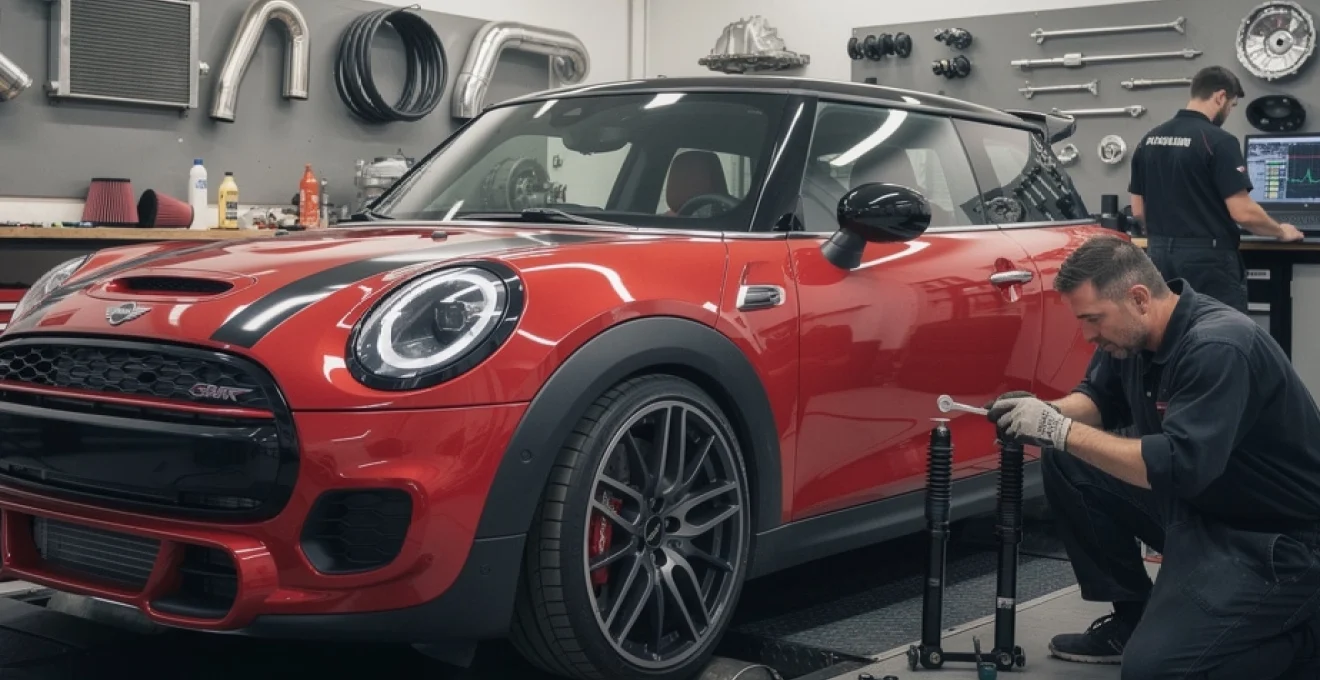
The R56 Mini Cooper JCW is one of those rare hot hatches that feels alive even at everyday speeds. Strong mid‑range torque, compact dimensions and that trademark go‑kart steering make it addictive on both B‑roads and track days. With thoughtful upgrades and sensible maintenance, the R56 JCW can be transformed into a seriously quick road or track tool while still remaining usable as a daily driver. The key is understanding where the platform excels from the factory, where it falls short, and how to extract extra performance safely. Whether you are chasing lap times, a faster 0–60 mph sprint or simply sharper throttle response on the commute, the R56 JCW offers a flexible and rewarding tuning base.
R56 mini cooper JCW overview: factory specs, engine codes and performance figures
N14 vs N18 JCW engines: production years, power output and reliability differences
The R56 Mini Cooper JCW was offered with two main turbocharged 1.6‑litre engines: the N14 and the N18. Early JCW models up to around mid‑2010 use the N14, while later cars adopt the N18 with revised internals and improved control systems. Both engines are based on the same alloy block and direct‑injection architecture and share the factory power figure of roughly 208 bhp (211 PS) and around 260 Nm of torque, with an overboost function that briefly raises torque to about 280 Nm.
The N14 is often regarded as having slightly more aggressive tuning headroom thanks to camshaft and turbo options, but it is also more vulnerable to timing chain stretch and carbon build‑up on the intake valves. The N18 adds VANOS variable valve timing on both inlet and exhaust, revised PCV routing and better mapping from the factory, dramatically improving drivability. From a reliability perspective, the N18 typically shows fewer timing and idle issues when maintained properly, although both benefit from regular oil changes well below the official intervals.
For anyone planning a high‑power build, engine choice matters. The N14 may appeal if you want to chase maximum output with aggressive cams and larger turbos, but you must budget for preventative timing work and frequent walnut blasting. The N18, by contrast, suits a fast‑road or mild track car where 260–300 bhp and excellent drivability are the targets rather than absolute headline numbers.
R56 JCW chassis codes, trim levels and factory option packs (aero kit, chili pack, LSD)
Within the second‑generation Mini range, the R56 JCW sits alongside the R55 Clubman and R57 Convertible, all sharing a similar platform but with different body styles. Chassis codes such as R56 (hatch), R55 (Clubman) and R57 (Cabrio) help when sourcing suspension, brake and aero parts, as fitment can vary slightly between models. The core JCW package includes uprated brakes compared with Cooper S models, a lower ride height and a more aggressive factory calibration.
Factory option packs have a significant influence on how a used R56 JCW feels today. The JCW Aero Kit adds more pronounced bumpers and side skirts, helping both aesthetics and, at higher speeds, a degree of stability. The popular Chili Pack bundles features such as sports seats and upgraded interior trim, which are desirable if you still want comfort on daily drives. A small subset of early R56 JCW cars also came with a factory limited‑slip differential, which delivers a noticeable improvement in traction when accelerating hard out of tight corners.
Identifying which packs a car has from the outset helps you plan a modification path. A car with the factory Aero Kit and Chili Pack may only need subtle styling and interior tweaks, allowing more budget for performance upgrades. Conversely, a JCW without the LSD might push you towards an aftermarket differential sooner, especially if you plan to run track‑oriented tyres and higher torque levels.
Stock performance metrics: 0–60 mph, in-gear acceleration, top speed and braking distances
Out of the box, the R56 JCW is brisk rather than brutally fast. Most healthy cars record 0–60 mph in the mid‑6‑second range, with independent tests often quoting 6.3–6.5 seconds using standard launch techniques. Top speed sits just north of 150 mph (around 246 km/h), which is plenty for track use and more than adequate for typical road driving. Where the JCW really impresses is in in‑gear acceleration, particularly from 30–70 mph, where the turbocharged torque delivery makes overtakes simple.
Braking performance is solid for a factory hot hatch. Expect 62–0 mph stopping distances of roughly 36–38 metres on quality tyres in dry conditions. That figure can increase significantly on budget tyres or if the pads and fluid are tired, which is why anyone considering performance upgrades should view the braking system as a core priority. For context, modern hot hatches with larger brake packages and stickier tyres sometimes dip below 34 metres, so a well‑set‑up R56 JCW can still be competitive.
On track, repeated heavy braking and sustained boost reveal the limitations of the standard components. Stock pads start to fade after a handful of hot laps, and the intercooler heat‑soaks quickly, leading to rising intake temperatures and reduced power. These real‑world metrics explain why so many owners prioritise cooling, pads and suspension before diving into extreme power increases.
Common R56 JCW issues affecting performance: timing chain, carbon build-up, turbo failures
Anyone buying or tuning an R56 JCW needs to be realistic about its known weak points. Timing chain issues, particularly on the N14 engine, are widely reported. A noisy cold start rattle is often the first sign that the chain or tensioner is wearing, and leaving it unresolved can lead to poor performance, incorrect cam timing and, in extreme cases, catastrophic failure. Many specialists recommend pre‑emptive replacement around 60,000–70,000 miles, especially on tuned cars.
Carbon build‑up on the intake valves is another well‑documented problem on direct‑injection engines such as the N14 and N18. Over time, oil vapour and blow‑by create deposits that restrict airflow and disturb mixture quality, leading to misfires, lost power and rough idle. Walnut blasting every 40,000–50,000 miles is widely accepted as the most effective way to restore clean ports and recover lost bhp. Some owners also fit catch cans to reduce the rate of deposit formation.
Turbocharger failures, while less common than timing issues, do occur, especially on aggressively tuned cars that see frequent track use. Worn wastegates, cracked housings and bearing wear can all lead to inconsistent boost and reduced performance. Regular oil changes with quality synthetic oil, proper cool‑down after hard driving and conservative ECU mapping help extend turbo life considerably. Upgraded turbos often feature stronger internals and better heat tolerance, offering both performance and longevity improvements when specified correctly.
Engine and turbocharger performance upgrades for the R56 mini cooper JCW
Stage 1 ECU remap for R56 JCW: torque limits, boost targets and ignition timing calibration
A Stage 1 ECU remap is usually the most cost‑effective way to transform the feel of a standard R56 JCW. With no hardware changes beyond a high‑quality panel filter and colder‑rated spark plugs, a reputable tuner typically extracts an extra 25–40 bhp and 40–70 Nm of torque. Power gains come from optimising boost targets, fuelling curves and ignition timing, while also smoothing out factory torque limiters in lower gears.
On N14 engines, careful control of boost and ignition timing is vital to avoid knock and excessive exhaust gas temperatures. Tuners often aim for safe boost pressures in the mid‑teens (psi) range, prioritising usable torque and reliability over peak numbers. N18 engines, thanks to improved valve timing control, can achieve very strong mid‑range performance with a relatively conservative tune, making them ideal for drivers looking for a responsive fast‑road setup.
Quality mapping also refines throttle response and part‑load behaviour, making the car feel more linear and predictable. An ECU remap, when combined with upgraded spark plugs and fresh fluids, usually delivers a 0–60 mph improvement of around 0.3–0.5 seconds and noticeably stronger in‑gear acceleration. For many owners, this level of tuning strikes the perfect balance between performance, fuel economy and long‑term reliability.
Stage 2 and stage 2+ tuning: downpipe, front-mount intercooler and induction kit combinations
Stage 2 and Stage 2+ packages for the R56 JCW focus on freeing up airflow and controlling intake temperatures. Typically, this involves a high‑flow downpipe with an ECE‑marked sports catalyst, a larger front‑mount intercooler and a well‑designed induction kit. Together with a revised ECU map, these parts can deliver total gains of 50–70 bhp over stock on a healthy engine, pushing a JCW into the 260–280 bhp range depending on fuel quality.
A quality intercooler from brands such as Airtec or Forge dramatically reduces heat‑soak, keeping intake air temperatures more stable during repeated pulls or track sessions. Lower IAT means the ECU can maintain optimal ignition timing without pulling power for safety, so the car feels consistently strong rather than quick on the first run and sluggish afterwards. A free‑flowing downpipe and cat‑back exhaust improve turbine efficiency and reduce back‑pressure, helping the turbo spool faster and breathe more easily at higher rpm.
Stage 2+ setups sometimes add slightly larger injectors or upgraded fuel pumps to maintain a safe air‑fuel ratio when running higher boost. At this level, the standard clutch often begins to struggle, especially on older cars or those used enthusiastically. Planning a drivetrain upgrade alongside Stage 2 power modifications avoids frustrating slip and protects the gearbox from shock loads.
Upgraded turbo options: BorgWarner K03 hybrid, garrett GTX and littco L380 installed on R56 JCW
When Stage 2 power is no longer enough, an upgraded turbocharger becomes the logical next step. Hybrid turbos based on the factory BorgWarner K03 core are popular because they fit the stock manifold and require minimal modification. These units typically use larger compressor and turbine wheels and more robust internals, supporting 280–320 bhp on the right supporting mods while maintaining fast spool and strong mid‑range torque for road use.
For drivers seeking even more, options like Garrett GTX‑based setups or units such as the Littco L380 provide significantly higher flow capacity. These turbos can push power figures into the 320–350 bhp region on the N14 platform with appropriate fuelling and cooling upgrades. The trade‑off is more lag and greater stress on the engine, clutch and gearbox, so they suit experienced enthusiasts who understand the compromises of a high‑output build.
Choosing the right turbo is as much about usage as it is about numbers. A hybrid K03 often feels ideal for a dual‑purpose car that sees both road and occasional track work, while a big‑frame turbo is better reserved for dedicated track machines or drag‑style builds. Think of it as choosing between a scalpel and a sledgehammer: both are powerful in context, but only one suits precise, everyday driving.
Fuel system and cooling enhancements: HPFP, injectors, uprated radiator and oil cooler kits
As power levels rise, the fuel and cooling systems must keep pace. The direct‑injection setup on the R56 relies on a high‑pressure fuel pump (HPFP) driven from the camshaft, and early pumps are known to experience wear and intermittent pressure loss. On heavily tuned cars, an upgraded or refreshed HPFP, combined with higher‑flow injectors where required, keeps fuel pressure stable at high rpm and under sustained boost.
Cooling is equally critical. An uprated aluminium radiator improves coolant capacity and heat rejection, which is especially valuable on track or in hot climates. Many high‑power builds also add an external oil cooler to keep oil temperatures in the sweet spot, typically under 120°C during hard use. Excessive oil temperature thins the lubricant, accelerating wear on bearings, turbo components and valvetrain parts.
Some owners pair these upgrades with a slightly larger or baffled sump to reduce the risk of oil starvation during long, high‑g corners. As recent track‑day statistics show, sustained lateral forces can easily exceed 1 g on semi‑slick tyres, enough to move oil away from the pickup on marginal systems. Proper fluid management therefore becomes an essential part of building a durable, high‑performance R56 JCW.
Dyno tuning and data-logging: using dynojet, maha and cobb accessport to validate JCW upgrades
Once hardware is in place, accurate calibration is the glue that holds the package together. Rolling‑road systems such as Dynojet and Maha dynos provide repeatable conditions to measure power, torque and boost curves. While the absolute number is often the headline, the real value lies in seeing how smoothly the JCW delivers power, whether there are dips in the torque curve and how intake and exhaust temperatures behave under load.
Data‑logging tools, including laptop‑based software and handheld devices akin to the Cobb Accessport concept, allow you to record parameters such as boost pressure, ignition timing, knock correction, air‑fuel ratio and throttle position during real‑world driving. Analysing logs after a spirited run can reveal issues that a single dyno pull might miss, such as heat‑soak on a hot day or inconsistent fuelling under partial load. In effect, the logs act as a black box for your engine, showing what happens when conditions are less than perfect.
Professional tuners routinely rely on this combination of dyno testing and road logging to refine their maps. For an enthusiast, even simple logging of IAT, AFR and knock activity provides reassurance that the car is running safely. It also helps diagnose problems early, before they manifest as misfires, limp‑mode events or, in the worst case, engine damage.
R56 JCW intake, exhaust and airflow optimisation
Performance air intakes: ITG, AEM and eventuri systems for improved MAF scaling and IAT control
The stock R56 JCW airbox is reasonably efficient for mild tunes, but performance air intake systems offer better flow and, when well designed, more stable intake air temperatures. Brands like ITG, AEM and Eventuri engineer enclosed or shielded intakes that draw cooler air from outside the engine bay rather than from around the hot turbo. This helps stabilise IAT, particularly during stop‑start driving followed by hard acceleration.
Correct MAF scaling is vital when changing intake hardware. Poorly designed open filters can disturb airflow across the mass airflow sensor, leading to incorrect readings and fuelling errors. Reputable induction kits are carefully shaped to maintain laminar flow across the sensor and often include revised silicon hoses or air ducts to minimise turbulence. Some systems also take advantage of the R56’s bonnet scoop, channelling fresh air directly to the filter for maximum density.
Beyond performance, a quality intake enhances sound, adding more pronounced turbo spool and induction roar without overwhelming cabin comfort. For many enthusiasts, this is an important part of the driving experience, turning each acceleration run into a more immersive event while still supporting safe, accurate ECU calibration.
Turbo-back exhaust systems: milltek, scorpion and remus setups with sports cat vs decat pipes
An upgraded turbo‑back exhaust is one of the most effective ways to reduce back‑pressure and unlock extra power on the R56 JCW. Systems from manufacturers such as Milltek, Scorpion and Remus typically feature larger‑diameter pipework, smoother mandrel bends and less restrictive silencers. The choice between a resonated and non‑resonated system affects both noise levels and cabin refinement, so daily‑driven cars often favour resonated options.
The main decision point is usually between a high‑flow sports catalyst and a decat downpipe. A quality ECE‑approved sports cat provides near‑decat levels of performance on the road while retaining legal compliance and keeping MOT emissions checks straightforward. A decat may offer marginal gains at very high power levels but introduces significant legal and ethical drawbacks, as well as the risk of the vehicle being grounded if inspected.
Exhaust tuning is also about character. A well‑chosen system adds a deeper tone and more pronounced overrun burble without excessive drone at motorway speeds. For track‑focused builds, noise limits at many circuits have become stricter in recent years, meaning a subtle, well‑silenced system can be more practical than an ultra‑loud setup that risks black‑flagging after just a few laps.
Boost piping and intercooler upgrades: forge motorsport, airtec and wagner tuning solutions
High‑quality boost pipes and intercoolers complete the airflow package. The factory plastic and rubber boost pipes can expand under high boost, slightly softening throttle response and becoming potential failure points on older cars. Upgraded aluminium or reinforced silicone boost pipes from specialists such as Forge Motorsport, Airtec and Wagner Tuning provide a more durable, pressure‑stable path for compressed air from turbo to intake.
Intercooler upgrades deliver some of the most tangible results on a tuned R56 JCW. Larger bar‑and‑plate cores with efficient end‑tank design improve heat transfer and minimise pressure drop, keeping intake temperatures closer to ambient during hard driving. On a summer track day, the difference between a stock and an uprated intercooler can easily be 20–30°C in IAT, which translates to a noticeable difference in power and consistency.
From a reliability standpoint, cooler, denser charge air also reduces knock risk and exhaust gas temperature, both of which are beneficial for long‑term engine and turbo health. It is a classic example of an upgrade that enhances both performance and durability, making it essential beyond Stage 1 tuning.
Wastegate, diverter valve and boost control improvements for stable R56 JCW boost curves
Stable boost control is essential for predictable performance. The factory electronic wastegate and diverter valve arrangements can cope with mild tuning, but as boost levels rise, weaknesses begin to show. A tired diverter valve can leak under high pressure, causing inconsistent boost and audible flutter, while wastegate actuator wear can lead to boost creep or difficulty holding target pressure at high rpm.
Upgrading to a stronger diverter valve and, where appropriate, an uprated wastegate actuator helps the turbo maintain commanded boost without spikes or drop‑offs. Some tuners also refine the boost control strategy within the ECU, smoothing the way the car ramps into boost to reduce wheelspin and torque steer. Think of it as traction by calibration rather than relying solely on electronic traction control systems to cut power aggressively.
In practice, a well‑controlled boost curve feels more natural and confidence‑inspiring. You gain a predictable surge of torque rather than a sudden spike, which makes it easier to modulate throttle input mid‑corner and maintain grip. This is particularly important on wet roads or when using more aggressive, track‑oriented tyres that approach their limits more abruptly.
Chassis, suspension and braking upgrades for track-ready R56 mini cooper JCW builds
Coilover kits and dampers: bilstein B14/B16, KW V1/V3 and öhlins road & track configurations
The factory R56 JCW suspension delivers a sporty, slightly firm ride, but dedicated coilover kits transform composure and body control. Entry‑level fixed‑damping systems such as Bilstein B14 offer a well‑judged balance for fast road use, lowering the car by around 20–30 mm to reduce body roll and centre of gravity without compromising ground clearance. Many owners report that, despite being stiffer, quality coilovers actually ride better over poor surfaces because they control the wheel more precisely.
More advanced options like Bilstein B16 or KW V3 introduce separate rebound and compression adjustment, allowing you to fine‑tune the JCW for road, track or mixed use. Öhlins Road & Track kits sit at the premium end, often favoured by serious track‑day enthusiasts for their superb damping quality and consistency during long sessions. Adjustability is useful if you want to soften the suspension for winter commuting, then dial in a stiffer, more responsive setup for summer circuits.
Ride height should be set with care. Excessive lowering might look aggressive but can upset roll‑centre geometry, cause driveshaft angle issues and reduce suspension travel, making the car skittish on bumpy roads. In most cases, a sensible drop of 25–30 mm combined with carefully chosen damping settings gives the best combination of grip, comfort and tyre wear.
Anti-roll bars, strut braces and bushings: reducing body roll and improving turn-in on R56 JCW
Anti‑roll bars, strut braces and uprated bushes further refine chassis behaviour. A thicker rear anti‑roll bar, for example, helps the R56 JCW rotate more eagerly into corners, trimming understeer and making the car feel more adjustable on the throttle. Paired with quality coilovers, this setup can deliver genuinely sharp, track‑car‑like turn‑in while remaining predictable at the limit.
Front and rear strut braces link suspension mounting points, reducing chassis flex and maintaining consistent alignment under load. While gains can be subtle on the road, they become more apparent when attacking kerbs or high‑speed sweepers on circuit. Uprated rubber or polyurethane bushes in key locations such as front control arms and rear trailing arms enhance precision by limiting unwanted movement without resorting to harsh solid mounts.
Engine and gearbox mounts are also worth attention. Stiffer mounts reduce engine rock during hard acceleration and gear changes, improving shift feel and throttle response. The trade‑off is a slight increase in cabin vibration at idle, so choosing well‑engineered mounts designed specifically for fast‑road use is advisable if you still want daily‑driver refinement.
Performance brake packages: brembo, AP racing big brake kits and high-friction pad compounds
Braking is a critical element of any performance build. While the stock JCW brakes are reasonable, they are not designed for repeated heavy track use. A high‑friction pad compound such as Ferodo DS2500, EBC Yellowstuff or Mintex M1144 offers a substantial improvement in stopping power and fade resistance on the road, especially when combined with braided brake lines and high‑temperature DOT 5.1 fluid.
For serious track work, big brake kits from brands like Brembo or AP Racing introduce larger diameter discs and multi‑piston calipers, dramatically increasing thermal capacity. Statistics from track‑day operators consistently show that brake‑related issues are among the top three causes of early session endings, so investing in a robust system pays off in seat time as well as safety. Two‑piece discs further reduce unsprung mass and improve cooling, making them ideal for repeated high‑speed stops.
Pad choice should be matched to usage. Track‑focused compounds such as Pagid RS29 or Mintex M1155 offer outstanding fade resistance but can be noisy and dusty on the street. Many owners therefore run a dedicated track pad and swap before and after events, treating brake pads almost like tyres: consumables tailored to the conditions and driving style.
Wheel and tyre setups: 17” vs 18” alloys, michelin pilot sport 4, yokohama AD08R and track tyres
Wheel and tyre selection shapes the way every upgrade feels. The R56 JCW runs 17‑inch wheels as standard, and this size remains a sweet spot for a fast‑road car. A lightweight 17” alloy with a 205/45 or 215/40 tyre keeps unsprung weight low, improves ride quality and offers a wide choice of high‑performance tyres such as Michelin Pilot Sport 4. For those chasing sharper turn‑in and more grip, semi‑slick options like Yokohama AD08R or similar track‑biased tyres provide a substantial step up in dry performance.
Moving to 18‑inch wheels can enhance visual presence and steering precision but often adds weight and reduces tyre sidewall height, which can make the ride harsher and less forgiving over rough surfaces. On bumpy circuits or poor roads, the extra compliance of a 17‑inch setup can actually make the car faster by keeping the tyres in better contact with the tarmac. It is a classic case where bigger is not always better in performance terms.
Tyre pressures and alignment complete the package. Running slightly increased negative camber at the front, modest toe‑out and appropriate hot pressures tailored to the chosen tyre compound can yield significant gains in grip and consistency. Treated with the same attention as suspension and power upgrades, wheels and tyres become one of the most cost‑effective tools for lowering lap times and enhancing everyday confidence.
Drivetrain, clutch and differential tuning for high-torque R56 JCW
Upgraded clutch and flywheel options: helix, sachs performance and SMF conversions
As torque climbs beyond roughly 300 Nm, the standard JCW clutch starts to show its limits, especially on older cars or those subjected to aggressive launches. Upgraded clutches from suppliers such as Helix or Sachs Performance use stronger friction materials and uprated pressure plates to cope with higher loads. For a fast‑road car, an organic performance clutch provides the best balance of torque capacity and drivability, avoiding the snatchy engagement often associated with full‑race sintered discs.
Many owners choose to pair a clutch upgrade with a single‑mass flywheel (SMF) conversion. Replacing the factory dual‑mass flywheel removes a potential failure point and reduces rotating mass, sharpening throttle response and allowing the engine to rev more freely. The downside can be increased transmission noise at idle and low speed, but on a performance‑focused JCW, this trade‑off is often considered acceptable.
Choosing a clutch and flywheel package should be done with a clear view of future plans. Installing a kit with some overhead capacity allows for later power upgrades without needing to revisit the gearbox. It is similar to sizing a turbo or intercooler: planning for growth avoids duplicated labour and cost further down the line.
Limited-slip differential choices: factory JCW LSD vs quaife ATB vs wavetrac installations
A limited‑slip differential (LSD) is one of the most transformative drivetrain upgrades for the R56 JCW. Early cars fitted with the rare factory LSD already enjoy improved traction when exiting tight corners, but the unit is relatively mild in action. Aftermarket torque‑biasing differentials from brands such as Quaife ATB and Wavetrac offer a more proactive approach, distributing torque to the wheel with more grip rather than simply braking the spinning wheel via electronic aids.
On the road, a quality LSD reduces inside‑wheel spin when accelerating out of junctions or roundabouts, allowing you to deploy power more cleanly. On track, it improves stability under power and lets you lean on the front axle more aggressively, effectively turning traction into a performance tool rather than a limiting factor. Many drivers describe the change as akin to unlocking an extra dimension of grip and adjustability.
Installation typically involves removing and opening the gearbox, so LSD fitting is often combined with a clutch upgrade to minimise labour duplication. Properly set up, an LSD‑equipped R56 JCW feels more like a miniature touring car than a traditional front‑wheel‑drive hatchback, making full use of every extra horsepower added through engine tuning.
Gearbox durability: R56 getrag transmission weak points and recommended fluids
The R56 JCW uses a Getrag six‑speed manual gearbox that is generally robust, even on tuned cars, provided it is maintained sensibly. There are relatively few widespread failure patterns compared with some rivals, but high‑mileage boxes can suffer from worn synchros, particularly if subjected to repeated hard shifts without adequate warm‑up. Short‑shift kits amplify mechanical feel but should be combined with precise linkage adjustment to avoid accelerated wear.
Fluid choice plays a significant role in transmission longevity and shift quality. Fresh, high‑quality gear oil with the correct specification reduces friction and protects bearings and synchros under high load. Many enthusiasts change gearbox oil every 40,000–50,000 miles or after a heavy season of track use, despite longer official intervals, treating it as inexpensive insurance against premature wear.
Driving style matters too. Allowing the gearbox to reach operating temperature before aggressive driving, avoiding clutchless upshifts and resisting the temptation to rest a hand on the gear lever all help preserve internal components. In combination with a robust clutch and differential, a well‑maintained Getrag transmission can comfortably handle the torque of a 280–320 bhp R56 JCW used for fast road and occasional track work.
ECU software, reliability and maintenance strategies on tuned R56 mini cooper JCW
Popular tuners and software: lohen, 1320mini, manic motorsport, MTH and custom dyno maps
Choosing the right tuner is as important as choosing the right hardware. Within the R56 Mini community, software from specialists such as Lohen, 1320Mini, Manic Motorsport and MTH has established strong reputations for blending power with safety. Each offers different map stages tailored to common hardware combinations, from simple Stage 1 remaps to custom calibrations for big‑turbo builds with aftermarket cams and fuelling upgrades.
Custom dyno mapping remains the gold standard for extracting maximum performance while accounting for the unique condition of each car. Factors such as injector health, compression, intercooler efficiency and even exhaust configuration can subtly change the way an engine responds to tuning. A bespoke map on a quality rolling road allows the tuner to see exactly how your JCW behaves, adjusting ignition timing, boost, fuelling and torque limits accordingly.
Recent years have also seen a rise in remote or “e‑tuning” services, reflecting broader industry trends in ECU calibration. While convenient, especially for owners far from a specialist, these services depend heavily on thorough data‑logging and clear communication. In‑person dyno sessions still offer the most controlled environment for high‑power or track‑dedicated builds where the margin for error is smaller.
Preventative maintenance on tuned N14/N18: timing chain, walnut blasting and PCV system
A tuned R56 JCW rewards meticulous maintenance. On N14 engines in particular, pre‑emptive timing chain replacement with the latest‑spec tensioner and guides reduces the risk of failure under the higher stresses of increased boost and torque. Listening for start‑up rattle, checking for timing‑related fault codes and inspecting service history provide useful indicators of chain health, but many owners simply budget for replacement as a matter of course around key mileage milestones.
Regular walnut blasting of the intake valves keeps airflow consistent and reduces the chance of misfires at high load. For cars used predominantly on short journeys or in urban environments, deposits can form surprisingly quickly, sometimes affecting performance in less than 40,000 miles. A clean intake tract helps the ECU maintain accurate fuelling and timing, allowing the engine to make full use of its tuning potential without fighting airflow restrictions.
The PCV (positive crankcase ventilation) system also deserves attention. A healthy system manages crankcase pressure and minimises oil vapour entering the intake, but aged components or poor aftermarket modifications can upset this balance. Some owners adopt baffled catch cans or revised PCV routing to reduce oil ingestion and slow carbon build‑up. Whatever approach is chosen, ensuring the system functions as designed is crucial for consistent performance and oil control.
Monitoring tools: OBD scanners, oil temperature gauges and AFR logging for safe JCW tuning
Ongoing monitoring is the final piece of the reliability puzzle. Modern OBD scanners and Bluetooth dongles allow you to view live data such as coolant temperature, intake air temperature, ignition timing and knock activity directly on a smartphone or tablet. For a tuned R56 JCW, watching these parameters during spirited driving offers early warning of developing issues, such as a failing thermostat, heat‑soaked intercooler or marginal fuel quality.
Dedicated gauges for oil temperature and, in some cases, oil pressure add another layer of protection. Knowing when the oil has reached operating temperature before pushing the engine hard reduces wear, while spotting abnormal readings early can help avoid serious damage. For higher‑powered builds, wideband AFR logging is invaluable, confirming that the engine is receiving the correct fuel mixture under all conditions and that the ECU is not being forced into unsafe compensations.
The most reliable tuned cars are rarely those with the largest parts lists, but those where every component is monitored, maintained and calibrated to work in harmony.
Combining thoughtful hardware upgrades with specialist software, regular preventative maintenance and intelligent monitoring tools allows you to enjoy a tuned R56 Mini Cooper JCW with confidence. Treat the car as a complete system rather than a collection of isolated mods, and each drive becomes a demonstration of how well‑engineered enhancements can elevate an already engaging hot hatch into something genuinely special.