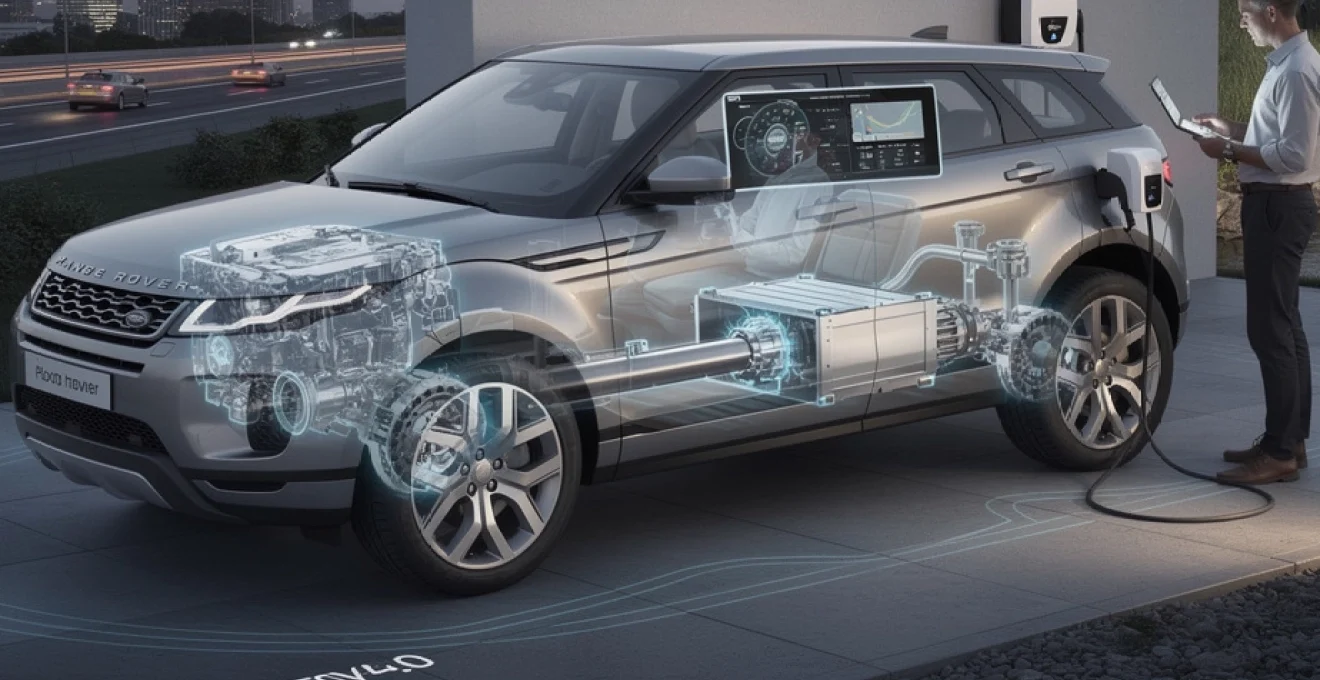
The Range Rover Evoque P300e sits in a sweet spot between traditional diesel SUVs and full electric cars, offering electric-only commuting with long-range flexibility. For drivers who want a prestigious compact SUV without abandoning the reassuring feel of petrol power, this plug‑in hybrid brings a compelling mix of performance, refinement and efficiency. Company car users are drawn to its low CO₂ figures, while private buyers value the quiet EV running and reduced fuel bills on urban journeys. As emissions regulations tighten across Europe and UK cities expand clean-air zones, understanding exactly how this sophisticated hybrid system works can help you decide if the P300e fits your daily life and driving patterns.
Range rover evoque p300e powertrain architecture: plug‑in hybrid system, components and layout
At the heart of the Range Rover Evoque P300e is a transverse plug‑in hybrid layout that combines a compact three‑cylinder petrol engine at the front with an electric rear axle. This gives the car an electronically controlled all‑wheel drive capability without a mechanical propshaft, improving packaging and efficiency. The system develops a total of around 304–305 bhp and 540 Nm, enough to move this premium compact SUV from 0–62 mph in just over six seconds. A 14.9 kWh high‑voltage battery sits beneath the rear seats and central tunnel, preserving the standard boot capacity of roughly 472 litres. High‑voltage cabling runs through the floor structure to the rear‑axle motor and the on‑board charger, controlled by a dedicated Hybrid Control Unit (HCU) that constantly arbitrates between electric and combustion power.
1.5-litre ingenium three-cylinder turbo engine: power output, torque curve and efficiency mapping
The combustion side of the Evoque P300e uses a 1.5‑litre Ingenium three‑cylinder turbocharged petrol engine, part of the same modular family as the brand’s 2.0‑litre units but with one cylinder removed. In this application, the engine delivers around 200 bhp and a strong torque figure that peaks low in the rev range, helping the car feel responsive even when the battery state of charge (SOC) is low. Engineers have optimised the combustion process with high injection pressures, variable valve timing and a compact turbocharger, so the engine spends as much time as possible in its “sweet spot” of efficiency. In hybrid mode, the HCU uses detailed efficiency maps to decide whether the 1.5‑litre should provide direct drive, charge the battery, or shut down completely to let the electric motor take over.
80 kw rear‑axle electric motor (ERAD): packaging, cooling and e‑drive characteristics
At the rear, an 80 kW electric motor – often referred to as the ERAD (Electric Rear Axle Drive) – powers the back wheels through a dedicated reduction gear. This compact unit is mounted close to the rear axle to keep unsprung mass low and preserve the Evoque’s trademark handling balance. Liquid cooling keeps temperatures under control during repeated acceleration runs or long motorway climbs in EV mode. The ERAD delivers instant torque, giving the Evoque P300e that familiar electric “shove” from low speed and making city driving feel effortless. When the front engine and rear motor work together, the car gains a form of electric torque vectoring between axles, enhancing traction on slippery surfaces and during brisk overtakes.
14.9 kwh lithium‑ion battery pack: chemistry, usable capacity and high‑voltage management
The plug‑in hybrid system draws its energy from a 14.9 kWh lithium‑ion battery pack mounted within the floor structure. Only part of this gross capacity is available as usable energy, with a buffer at the top and bottom of the SOC window to prolong battery life and maintain performance in cold weather. Typical usable capacity is in the 12–13 kWh region, enough for a WLTP electric‑only range of around 39 miles in the latest calibration. The pack uses prismatic cells grouped into modules, with integrated liquid cooling channels linked to the car’s broader thermal management system. A dedicated battery management unit (BMU) sits on the high‑voltage network, constantly monitoring cell voltages, temperature gradients and charge/discharge rates to keep the system within safe operating limits.
Eight‑speed automatic transmission and AWD integration: torque split between ICE and e‑motor
Unlike earlier mild‑hybrid Evoque models with a nine‑speed automatic, the P300e uses an eight‑speed torque converter automatic on the front axle. This gearbox is optimised for the torque characteristics of the 1.5‑litre engine and the hybrid system’s requirement for smooth transitions. In most driving, torque is split longitudinally: the front wheels are driven by the engine via the gearbox, while the rear wheels receive power from the ERAD. There is no physical mechanical link between the axles; instead, the HCU coordinates the torque request to each power source in milliseconds. Under hard acceleration, both systems deliver maximum output for brisk performance. At low speeds or in EV mode, the gearbox often decouples the engine to reduce drag, further improving fuel consumption.
Hybrid control unit (HCU) and software strategy: CAN bus communication and drive mode coordination
The “brain” of the Evoque P300e is its dedicated HCU, which communicates with the engine ECU, transmission controller, battery management system and brake controller via multiple CAN bus networks. This high‑speed communication allows the vehicle to coordinate regenerative braking, torque delivery and gear selection seamlessly. When you select EV, Hybrid or Save modes, the HCU adjusts SOC targets, engine start thresholds and power limits accordingly. For example, in EV mode it will resist calling on the petrol engine until the accelerator is pushed past a calibrated kick‑down point. The system also factors in temperature, navigation data and driver behaviour, adapting over time to typical commute patterns to optimise both fuel economy and battery usage.
Performance and efficiency: real‑world fuel consumption, EV range and CO₂ emissions of the p300e
Official WLTP figures for the Range Rover Evoque P300e PHEV quote combined fuel economy of roughly 190–200 mpg and CO₂ emissions around 32–38 g/km, depending on specification and wheel size. The electric‑only range is officially 39 miles in the most recent update, an improvement on the earlier 34‑mile claim thanks to chemistry tweaks. Real‑world testing across UK roads typically shows EV ranges of 25–35 miles depending on temperature, driving style and topography, with average fuel economy varying from below 30 mpg (with a flat battery and motorway use) to well over 100 mpg when daily charging is used for short commutes. Company car drivers benefit from BIK rates based on those low CO₂ figures, even if actual fuel savings depend heavily on charging discipline.
WLTP figures vs on‑road testing: electric‑only range, combined mpg and g/km CO₂
WLTP testing assumes a fully charged battery and a standardised driving cycle, which heavily favours plug‑in hybrids. That is why the headline figure of up to 190.9 mpg can look unrealistic if you are used to diesel SUVs returning 45–50 mpg on long journeys. In independent on‑road testing, the Evoque P300e has repeatedly matched or come close to its 39‑mile EV range in gentle mixed driving, even in low temperatures. However, once the battery is depleted, petrol‑only consumption tends to fall into the high‑20s to low‑30s mpg. As a rule of thumb, if you can cover at least 60–70% of annual mileage on electricity, the real‑world CO₂ output and fuel use will be much closer to those eye‑catching WLTP numbers.
0–62 mph acceleration, in‑gear response and top speed in hybrid and EV modes
Performance is a strong suit of the P300e plug‑in hybrid. With the 1.5‑litre engine and ERAD working together, the Evoque P300e posts a 0–62 mph time of around 6.1–6.4 seconds, putting it on par with many hot hatchbacks. The top speed is 132 mph (or slightly less with certain wheel options), with strong in‑gear response for overtakes thanks to the combined 540 Nm torque output. In pure EV mode, the car can reach motorway speeds up to around 84 mph, though acceleration tapers off at higher velocities to protect the battery. Around town, EV mode feels particularly brisk because the electric motor delivers peak torque instantly, giving you confidence when joining traffic or pulling away from junctions.
Impact of driving profiles (eco, comfort, dynamic) on energy consumption and battery discharge
The Evoque P300e offers multiple drive profiles – typically Eco, Comfort and Dynamic – layered on top of the EV, Hybrid and Save powertrain modes. In Eco, throttle response softens, climate control becomes less aggressive, and the HCU prioritises electric running wherever possible, stretching that usable SOC window. Comfort mode aims for a balanced feel, blending electric and petrol power smoothly while keeping the cabin serene. Dynamic sharpens the accelerator and gearbox mapping, allowing the engine to rev higher and calling on the ERAD more often for brisk acceleration. The trade‑off is higher energy consumption: in Dynamic, you may notice the battery depleting faster as the system prioritises performance over ultimate efficiency.
Urban commutes vs motorway usage: how trip length and speed affect plug‑in hybrid efficiency
Like all plug‑in hybrids, the Evoque P300e is most efficient for drivers whose daily usage fits within its electric‑only range. If you typically travel 20–30 miles per day with access to home charging, you may complete most journeys without using any petrol at all. Shorter trips also allow the car’s pre‑conditioning features to keep the battery and cabin at optimal temperature while plugged in, further reducing on‑road energy demand. Motorway driving at 70 mph is more demanding: aerodynamic drag rises and EV mode is used more sparingly, so the petrol engine contributes more. For long road trips with limited charging opportunities, expect fuel economy similar to a smooth petrol SUV of similar size, with the added weight of the battery slightly offset by occasional regeneration on descents.
Charging the range rover evoque p300e: AC home charging, DC rapid charging and charge scheduling
Living with a plug‑in hybrid such as the Evoque P300e centres on convenient, reliable charging. Home AC charging will cover the majority of use cases, with DC rapid charging acting as a useful backup on longer journeys. The on‑board AC charger supports typical UK domestic supplies, and the battery’s relatively modest 14.9 kWh capacity keeps charge times manageable even from a three‑pin plug. Public charging networks across the UK and Europe increasingly support plug‑in hybrids, although tariff structures can make DC charging expensive relative to the energy taken on. Smart scheduling and off‑peak tariffs can significantly lower running costs, especially for drivers who charge overnight on a consistent pattern.
Type 2 AC charging on 3‑pin plug vs 7 kw wallbox: charge times and recommended setups in the UK
The Evoque P300e uses a Type 2 connector for AC charging. On a standard UK three‑pin plug (around 2.3–2.4 kW), a full charge from empty to 100% typically takes about 7–7.5 hours, making overnight charging entirely viable if you drive modest daily distances. A dedicated 7 kW wallbox reduces this dramatically to roughly 1.5–2 hours from empty to full. For most owners, a home wallbox offers the best balance between speed, convenience and cost, especially if combined with an EV‑friendly electricity tariff. Using a heavy‑duty cable and ensuring the socket is on a suitable circuit is essential if you rely on a three‑pin charger for regular use, as extended high‑current draw can stress older wiring.
DC rapid charging up to 32 kw: CCS connector, 0–80% times and public network compatibility
Unusually for a compact plug‑in hybrid SUV, the Range Rover Evoque P300e supports DC rapid charging via a CCS connector. The maximum charging rate is around 32 kW, allowing a 0–80% charge in roughly 30 minutes under ideal conditions. Because the battery is relatively small compared with fully electric SUVs, DC charging can feel particularly quick in day‑to‑day use – a short supermarket stop can add enough range for several days of urban driving. However, DC charging is more expensive per kWh on many networks, so it makes the most sense for occasional top‑ups on long trips rather than routine daily use.
Using networks such as pod point, BP pulse and InstaVolt: tariffs, RFID cards and app access
To make full use of public charging, you will likely register with multiple providers such as Pod Point, BP Pulse and InstaVolt. Each network has its own pricing model, with some offering membership packages that lower per‑kWh costs in exchange for a monthly fee. Access methods vary: many rapid chargers now support contactless bank card payment, but others still rely on RFID cards or smartphone apps for authentication. For a plug‑in hybrid like the Evoque P300e, the most cost‑effective strategy is often to reserve public charging for situations where home or workplace charging is unavailable, focusing on providers whose tariffs align with your typical usage patterns.
Timed charging and off‑peak tariffs: using the InControl remote app with octopus go or similar plans
Smart charging can substantially reduce the cost of running a Range Rover Evoque P300e. Off‑peak EV tariffs from suppliers such as Octopus (for example, Octopus Go with cheap rates between 00:30 and 05:30) let you charge the battery for a fraction of the daytime cost. The P300e can integrate with such plans through scheduled charging, either via the car’s on‑board menu or the InControl Remote smartphone app. By setting charge windows to match off‑peak periods, you can routinely replenish the full 14.9 kWh battery overnight, often for close to £1 in electricity. For drivers who commute Monday to Friday on predictable distances, this approach can make the plug‑in hybrid exceptionally cheap to fuel compared with petrol‑only or diesel alternatives.
Driving modes and off‑road capability: EV, hybrid, save and terrain response 2 calibration
One of the Evoque P300e’s distinguishing traits in the compact premium PHEV class is its off‑road capability. While competitors often prioritise front‑wheel‑drive efficiency, the Land Rover heritage brings genuine all‑terrain talent. The interplay between EV, Hybrid and Save modes, combined with the brand’s sophisticated Terrain Response 2 system, allows the P300e to tackle mud, snow and gravel with surprising composure. For drivers in rural areas or those who regularly face challenging winter conditions, this dual focus on efficiency and capability sets the Evoque plug‑in hybrid apart from many rivals that limit electric drive to the front axle only.
Pure EV mode operation: rear‑wheel drive dynamics, regen braking levels and use cases
In Pure EV mode, the Evoque P300e runs almost exclusively on its rear‑axle electric motor, effectively becoming a rear‑wheel‑drive SUV. This setup gives a distinct driving feel compared with many PHEVs that use front‑wheel electric drive only; the car feels agile and composed when turning, with the rear pushing the vehicle out of junctions. Regenerative braking levels are calibrated to feel natural for drivers transitioning from conventional cars, capturing energy during deceleration without excessive “one‑pedal” behaviour. EV mode is ideal for low‑speed urban traffic, school runs and suburban commutes, particularly where access to clean‑air zones or congestion charges is a factor.
Hybrid mode logic: predictive energy management, GPS‑assisted routing and SOC targets
Hybrid mode is the default setting for many owners and arguably the most sophisticated. Here, the HCU decides when to deploy electric power, when to blend in the petrol engine and when to coast. On routes programmed into the navigation system, predictive algorithms can reserve battery charge for low‑speed sections, urban centres or steep climbs at the end of the journey. For instance, if a destination in a city centre is selected, the system may preferentially use the petrol engine on faster dual carriageways earlier in the trip, holding a target SOC so that the final urban portion can be driven mostly on electric power. This kind of GPS‑assisted energy management separates the P300e from simpler parallel hybrids.
Save mode behaviour: engine‑driven charging, thermal management and battery reserve strategies
Save mode instructs the system to preserve or rebuild a specific battery charge level. When activated with a low SOC, the petrol engine will run more frequently and at slightly higher load points, sending surplus energy back into the battery via the generator. This can be useful if you are approaching an urban zero‑emission zone and want to arrive with enough charge to drive fully electric. However, engine‑driven charging is less efficient than plugging in, so Save mode is best used sparingly. The HCU also factors in thermal management, bringing the battery up to an efficient operating temperature when conditions are cold, so that subsequent EV usage is both responsive and predictable.
Terrain response 2 settings (Grass/Gravel/Snow, mud & ruts, sand): traction control with e‑AWD
Terrain Response 2 gives the Evoque P300e a suite of selectable off‑road programmes: typically Grass/Gravel/Snow, Mud & Ruts and Sand. Each setting adjusts throttle mapping, gearbox behaviour, traction control thresholds and the way torque is apportioned between front engine and rear ERAD. Because the system can send instant electric torque to the rear axle even when the petrol engine is not contributing much, low‑speed traction on slippery surfaces is particularly strong. For example, in Grass/Gravel/Snow mode the throttle becomes very gentle and the ERAD steps in early, helping the car pull away without wheelspin on ice or wet grass.
Off‑road metrics: wading depth, approach/departure angles and hill‑descent control with the p300e system
Despite its plug‑in hardware, the P300e retains the core off‑road metrics of the Evoque line. Ground clearance is around 211 mm, comfortably ahead of most compact premium SUVs. Wading depth is in the region of 500 mm, although as with any electrified vehicle, caution is advised when tackling deeper water. Approach and departure angles remain competitive thanks to careful packaging of the ERAD and battery, so the car can crest ramps and ruts without grounding. Hill Descent Control works seamlessly with the regenerative braking system, using both friction brakes and electric regeneration to maintain a controlled speed on steep descents, feeding recovered energy back into the battery where possible.
Interior technology and UX: pivi pro, digital instrumentation and connected hybrid features
Inside the Range Rover Evoque P300e, the latest generation of the brand’s Pivi Pro infotainment and digital cockpit emphasises clarity, minimalism and connectivity. The earlier dual‑screen setup has been replaced with a single 11.4‑inch curved glass touchscreen, floating from the dash to create extra storage and a wireless charging pad below. Climate, volume and seat controls are now integrated into the screen interface, always present as soft keys at the sides and bottom. The cabin’s design and technology mirror larger Range Rover models, giving you the same UX language in a more compact footprint. Over‑the‑air updates help keep navigation, apps and system software current without workshop visits.
Pivi pro infotainment system: navigation with EV routing, live traffic and over‑the‑air updates
Pivi Pro in the Evoque P300e supports EV‑aware navigation that can estimate energy usage for planned journeys, suggesting charge stops if needed and showing whether a trip can be completed on available battery charge. Live traffic data helps reroute around congestion, and voice control can be used to set destinations without removing hands from the wheel. The interface is fast and fluid, with sharp graphics and a layout that emphasises large touch targets – important when adjusting settings on the move. Over‑the‑air (OTA) capability means maps, system apps and even some control modules can receive software improvements remotely, refining hybrid strategy or adding new features over the vehicle’s life.
Digital instrument cluster and head‑up display: energy flow diagrams and EV range visualisation
A 12‑inch digital instrument cluster (standard on higher trims such as Dynamic SE and Autobiography) provides configurable views including classic dials, full‑screen navigation and hybrid‑specific displays. Energy flow diagrams show, in real time, whether the car is drawing power from the battery, charging it through regeneration, or using both motor and engine together. Remaining EV range is shown prominently, helping you decide when to select EV or Save mode. Where equipped, a head‑up display projects speed, navigation prompts and driver assist status onto the windscreen, reducing eye movement. This information‑rich yet uncluttered presentation makes it easier for you to understand what the hybrid system is doing at any given moment.
Incontrol remote app functions: pre‑conditioning, remote lock/unlock and charge status monitoring
The InControl Remote app extends control of the Evoque P300e beyond the cabin. From a smartphone, you can check the current charge level, estimated EV range and whether the vehicle is plugged in. Remote pre‑conditioning allows you to heat or cool the cabin and, importantly, bring the battery to an optimal temperature while the car is still connected to mains power. This preserves on‑road range and avoids heavy HVAC loads at start‑up. The app also handles remote lock/unlock, location services and, in some markets, sends maintenance alerts. Used properly, these connected features let you align charging with your schedule and with off‑peak tariffs, further improving the real‑world running costs of the plug‑in hybrid SUV.
Effective use of pre‑conditioning and off‑peak charging can turn a plug‑in hybrid from a complex gadget into a very low‑cost, low‑stress daily companion.
Driver assistance systems: adaptive cruise control, lane keep assist and 360° camera integration
Advanced driver assistance systems (ADAS) on the Evoque P300e include Adaptive Cruise Control, Lane Keep Assist, Blind Spot Monitoring and Rear Traffic Monitor. For city driving and parking, the 360° camera system is particularly valuable, giving you a bird’s‑eye view of surroundings and helping protect those large alloy wheels from kerbing. On the motorway, Adaptive Cruise Control can maintain distance to the car in front, while lane‑centering assistance gently steers to keep the vehicle within lane markings. The integration of these features into the Pivi Pro interface – with clear graphics and intuitive prompts – contributes to a calm driving environment, which suits the hushed, refined character of the plug‑in drivetrain.
Ownership costs and tax: company car BIK, VED bands and real‑world running costs in the UK
From an ownership standpoint, the Evoque P300e is shaped as much by tax policy as by engineering. In the UK, the combination of low WLTP CO₂ emissions and sufficient electric range puts the PHEV in a favourable Benefit‑in‑Kind (BIK) band compared with diesel and petrol equivalents. Vehicle Excise Duty (VED) is also tied to CO₂ for the first year, while everyday running costs reflect electricity prices, fuel costs and servicing. Depreciation trends for premium plug‑in hybrids are now clearer than a few years ago, showing steady demand but strong competition from rapidly improving full EVs and new PHEV rivals. For many drivers, especially high‑mileage business users with home charging, the numbers can still work out very strongly in favour of the P300e.
Company car Benefit‑in‑Kind (BIK) rates for the evoque p300e vs diesel D200 and petrol P250
Because its official CO₂ figure sits around 32–38 g/km and its electric range is close to 39 miles, the Evoque P300e qualifies for a much lower BIK percentage than the diesel D200 or petrol P250 models. Company car drivers taxed at 20% or 40% income tax bands can therefore see substantial monthly savings. By contrast, a D200 diesel with CO₂ above 160 g/km falls into a much higher BIK bracket, and the petrol P250 is similarly penalised. For fleets focusing on reducing their average emissions and tax exposure, the P300e is often the only Evoque variant that makes sense on whole‑life‑cost spreadsheets, provided employees can charge regularly and make meaningful use of the electric range.
Vehicle excise duty (VED), congestion charge exemptions and ULEZ compliance
First‑year VED for the Evoque P300e is based on its low CO₂ output, making it cheaper to tax initially than higher‑emission diesel models. Subsequent years fall into the standard flat rate for petrol and diesel cars, unless the list price exceeds the luxury car threshold, in which case the supplemental rate applies. In terms of urban access, the P300e meets Euro 6 standards and is classed as an ultra‑low emission vehicle when operating in EV mode, meaning it is fully compliant with the London ULEZ and similar clean‑air zones. While it may not always be exempt from congestion charges, its low emissions status can reduce or remove certain local fees, depending on scheme rules at the time of use.
Servicing intervals, brake wear, and HV battery warranty compared to conventional evoque models
Service intervals for the P300e are broadly similar to other Evoque models, typically every 12 months or a set mileage, whichever comes first. However, plug‑in hybrids can experience reduced brake wear thanks to regenerative braking, which takes some of the load off the friction pads and discs. The high‑voltage battery is usually covered by a separate warranty – commonly eight years or up to around 100,000 miles – against significant capacity loss or outright failure. For many owners, this battery cover extends beyond typical PCP or lease terms, adding reassurance. Routine checks during servicing include inspection of the high‑voltage cabling, cooling circuits and software updates for the hybrid controllers.
For company car users with reliable home charging, the tax advantage of a plug‑in hybrid can outweigh the higher list price within just a few years of use.
Depreciation, PCP and lease pricing: how the p300e sits against BMW X1 xdrive25e and volvo XC40 recharge T4/T5
Depreciation forecasts show the Evoque holding value well compared with many mainstream SUVs, although premium rivals such as BMW and Volvo are similarly resilient. PCP and lease deals for the P300e are influenced by this residual strength, often making monthly payments relatively close to diesel and petrol Evoques despite the higher recommended retail price. Against a BMW X1 xDrive25e or Volvo XC40 Recharge T4/T5, the P300e may carry a modest premium, reflecting the Range Rover badge and interior ambience. For private buyers, the key consideration is balancing these finance costs with expected fuel and electricity savings; for fleet buyers, whole‑life‑cost calculations that incorporate BIK, employer NI and residuals typically show the P300e competing strongly with its closest plug‑in SUV peers.
Range rover evoque p300e vs rivals: BMW X1 xdrive25e, audi Q3 TFSI e and mercedes GLA 250 e
The compact premium plug‑in hybrid SUV sector has grown rapidly in recent years, with the BMW X1 xDrive25e (and newer xDrive30e), Audi Q3 TFSI e and Mercedes GLA 250 e all vying for attention. Each offers a blend of electric running and combustion backup, but their priorities differ. The Evoque P300e leans towards luxury and off‑road ability, the BMW emphasises driver engagement and efficiency, the Audi majors on interior tech and refinement, while the GLA 250 e aligns closely with urban comfort and connectivity. Comparing their technical specifications, practicality and driving dynamics can help clarify which model best suits your usage profile.
Technical spec comparison: power output, battery size and EV range across premium PHEV SUVs
| Model | System power | Battery size (kWh) | Official EV range (miles) |
|---|---|---|---|
| Range Rover Evoque P300e | ≈304–305 bhp | 14.9 | Up to 39 |
| BMW X1 xDrive25e | ≈220–230 bhp | ≈14.2 | ≈30–35 |
| Audi Q3 TFSI e | ≈245 bhp | ≈13 | ≈30–32 |
| Mercedes GLA 250 e | ≈215–220 bhp | ≈15.6 | ≈37–40 |
As the table suggests, the Evoque P300e sits at the upper end of the power spectrum, delivering stronger acceleration than the Q3 and GLA, and broadly matching or exceeding the X1 depending on generation. Battery capacities are closely matched, with official EV ranges clustering around the mid‑30s to 40‑mile mark. The key differentiator lies in all‑wheel‑drive capability: while the Land Rover and BMW employ electric rear axles, providing e‑AWD, some versions of rival models rely on front‑wheel drive in EV mode, impacting traction in poor conditions. If you value brisk performance and genuine 4×4‑style capability, the Evoque’s specification is particularly appealing.
Practicality trade‑offs: boot space, rear legroom and towing capacity with PHEV packaging
PHEV packaging inevitably introduces compromises, usually by reducing boot space or fuel tank size. The Evoque P300e avoids a boot capacity penalty by positioning the battery carefully under the cabin floor, maintaining around 472 litres of space – although rear legroom is merely adequate rather than class‑leading. In contrast, some rivals such as the BMW X1 offer slightly more rear knee room and a larger luggage area, particularly in non‑PHEV variants. Towing capacity is another differentiator: depending on engine and configuration, the Evoque can tow up to 2000 kg, whereas certain plug‑in competitors are more restricted. If you intend to tow a caravan, horsebox or trailer, checking the exact braked towing figure for each model is essential before committing.
Driving dynamics and refinement: NVH, power delivery and chassis tuning compared
On the road, the Evoque P300e emphasises comfort and refinement. Ride quality remains composed even on 20‑inch wheels, with the extra battery mass helping to dampen sharp impacts. At low speeds in EV mode, cabin noise levels are very low, and even when the three‑cylinder engine cuts in, its sound is well suppressed, with only a distant thrum under hard acceleration. BMW’s X1 generally offers sharper steering feel and a slightly firmer, more agile chassis, appealing to enthusiastic drivers, while the Audi Q3 TFSI e positions itself as a quiet, secure cruiser. The Mercedes GLA 250 e majors on soft‑edged comfort but, in personal opinion, cannot match the Evoque’s sense of solidity over broken surfaces. For you as a driver, the choice becomes whether to prioritise dynamic verve, ultimate refinement, or the unique combination of off‑road prowess and upmarket ambience that defines the Range Rover Evoque P300e.