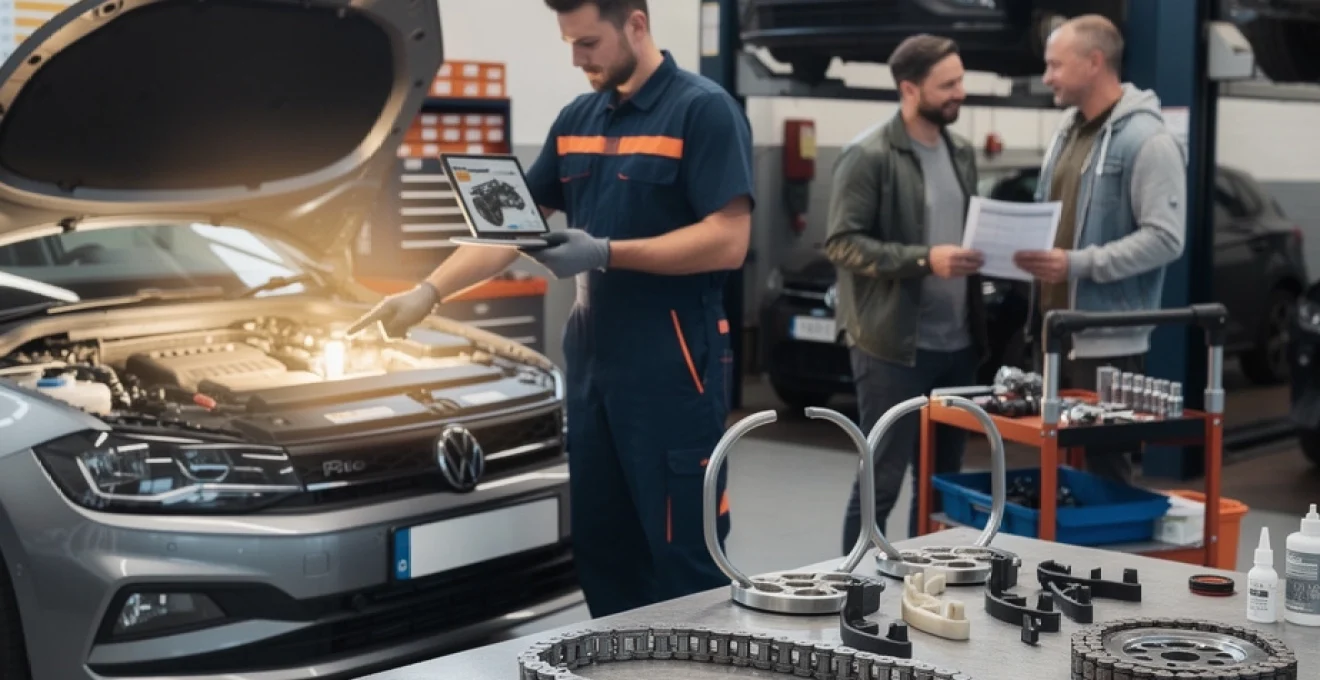
The cost of a VW Polo timing chain replacement in the UK can come as a shock, especially if you bought a small hatchback expecting low running costs. Timing chains are often sold as “lifetime” components, yet many Polo owners face four‑figure bills as early as 40,000–60,000 miles. When the chain stretches or fails, the engine can misfire, go into limp mode, or in the worst case, suffer catastrophic internal damage.
Understanding how garages price this job, which Polo engines are most at risk, and what drives those scary quotes helps you decide whether a repair is good value and how to reduce the bill. It also highlights how vital proper servicing and oil quality are if you want to avoid a premature timing chain replacement cost on a VW Polo.
Average VW polo timing chain replacement cost in the UK by engine code and model year
Cost range for 1.2 TSI (CBZB, CJZB) timing chain replacement at independent VAG specialists
For the problematic 1.2 TSI EA111 engines (most 2010–2014 Polo 6R models with engine codes CBZB and CJZB), independent Volkswagen/Audi Group (VAG) specialists typically quote between £700 and £1,000 for a full timing chain replacement. Data from UK garage comparison tools show an average VW timing chain replacement cost of around £872, with some drivers saving over £250 by avoiding main dealers.
At many independents, the parts element of the job often sits in the £220–£350 range for a quality kit, with labour taking the total to near four figures. A small number of mobile mechanics may quote £600–£700, but this is usually for a bare‑bones chain job without all the recommended ancillaries. If you are driving a 2011–2013 1.2 TSI Polo that is rattling from cold, you are firmly in this cost bracket.
Dealer (volkswagen main dealer) timing chain replacement pricing versus independent garage rates
Volkswagen main dealers are usually the most expensive option for Polo timing chain replacement. It is not uncommon to be quoted £1,100–£1,400 for a 1.2 TSI timing chain job on a Polo 6R, especially in major cities. This mirrors real‑world examples where owners have been given £1,200 timing chain quotes for low‑mileage 2011 Polos at franchised dealerships.
Independent VAG specialists leverage lower hourly rates while still using OEM or OE‑equivalent parts, which is why the average independent bill sits closer to £800–£900. For many owners of out‑of‑warranty cars, the dealer premium is only justifiable when pursuing a goodwill contribution or if a full dealer history is essential to preserve warranty or resale value.
Labour hours, workshop rates and VAT impact on total VW polo timing chain replacement invoice
Timing chain replacement on a VW Polo is labour‑intensive. Workshop labour guides typically allocate 5–7 hours for a full chain kit on a 1.2 TSI, rising to 8–10 hours on some 1.4 TSI GTI engines. Multiply this by a dealer rate of £140–£180 per hour in London, and the labour alone can exceed £1,000 including VAT.
Independent garages often charge £60–£100 per hour, so the same 6‑hour job comes out at £360–£600 plus 20% VAT. VAT is a significant hidden factor: an £800 ex‑VAT invoice becomes £960 at the till. When comparing quotes, check whether figures are inclusive; a quote that seems cheaper at first glance may simply exclude tax or some consumables.
Regional price differences in timing chain replacement across london, birmingham, manchester and glasgow
Location has a clear effect on VW Polo timing chain replacement cost in the UK. London and the South East tend to sit at the top end of the spectrum, with many owners facing £1,000–£1,400 dealer quotes and £850–£1,050 independent prices, driven by higher workshop overheads and labour rates.
In Birmingham and Manchester, typical independent timing chain quotes for a Polo 1.2 TSI sit around £750–£900, while franchised dealers tend to land in the £1,000–£1,250 region. In Glasgow and other parts of Scotland, rates can be slightly lower again, with some rural garages quoting from £650–£800 for straightforward jobs. If you are flexible, calling garages a little further afield can sometimes shave £150–£200 off the final bill.
Parts and labour breakdown of a VW polo timing chain replacement quote
OEM versus aftermarket timing chain kit (INA, febi bilstein, gates) cost comparison
The heart of the job is the timing chain kit itself. Genuine Volkswagen kits are usually sourced via the dealer network, often made by brands such as INA or Mahle. Expect dealer retail on an OEM chain kit for a 1.2 TSI to sit around £250–£350 including tensioner and guides. An aftermarket kit from INA, Febi Bilstein or Gates can range from £150–£250 depending on specification and engine code.
Professionally, using a known OE‑quality brand is strongly recommended; cheap, unbranded kits can introduce new problems quickly. A £70 saving on parts is of little comfort if the chain rattles again within a year. Many good independents quote two options: full OEM at a slightly higher cost, or high‑quality aftermarket at a modest discount.
Associated components: tensioners, guides, sprockets, crankshaft bolt and front crank seal pricing
A proper VW Polo timing chain replacement quote goes beyond the chain. The hydraulic tensioner, plastic guides and often the camshaft and crankshaft sprockets are replaced at the same time. Individually, tensioners usually retail between £60 and £120, guides £30–£70, and sprockets £50–£90 each, depending on engine.
Single‑use items like the crankshaft bolt and front crankshaft seal are also essential. These may only cost £10–£30 each, but skipping them is a false economy. A leaking front crank seal can contaminate the new chain with oil, while a reused stretch‑type crank bolt risks loosening, with catastrophic consequences. A thorough quote will itemise these, giving you confidence that the engine is being reset to factory‑fresh timing hardware.
Additional parts: engine oil, coolant, sealants and single‑use fixings in a full timing chain service
Because the timing chain on many Polo engines sits behind the front engine cover, the repair requires draining engine oil and, on some models, coolant. That adds a service element to the job. Budget £40–£80 for quality engine oil and filter, £20–£40 for coolant, and an additional £20–£40 for specialist sealants and single‑use bolts such as engine mount fixings.
When comparing VW Polo timing chain replacement costs, check whether the quote includes these fluids and fixings. A cheaper quote may simply leave them out. A full chain service effectively gives the car a minor oil service at the same time, which can be seen as a modest offset against the total bill if the service interval is due soon anyway.
Diagnostic time, strip‑down, reassembly and road test labour segments explained
Labour on a timing chain job can be split into clear stages. Some garages only bill for the replacement, but many rightly charge diagnostic and verification time. It typically breaks down into:
- Initial diagnosis: listening for rattles, scanning for timing codes and checking cam/crank correlation
- Strip‑down: removing covers, engine mounts and ancillary components to access the timing assembly
- Installation: fitting the new
timing chain kit, setting timing and reassembling with new fluids - Final checks: VCDS or similar scan, road test and post‑repair inspection for leaks or warning lights
On average, diagnosis and final checks take 1–1.5 hours, with the remaining 4–7 hours spent on the physical replacement. Some garages bundle diagnosis into the quote, others may charge separately if you then decline the work, so it is worth asking how this is handled.
VW polo engines with known timing chain issues and how this affects replacement cost
1.2 TSI EA111 (2010–2014 polo 6R) timing chain stretch patterns and typical repair bills
The early EA111 1.2 TSI engine has a well‑documented history of timing chain stretch and tensioner problems. Many owners report cold‑start rattling, juddering, misfires and engine warning lights before 60,000 miles. Internal service bulletins and technical updates have acknowledged the issue, and many cars had revised tensioners or chains under warranty.
Once out of warranty, owners face the full VW Polo timing chain replacement cost. Real‑world data show typical repair bills of £800–£1,200 depending on the severity of the fault and whether any valve or piston damage has occurred. In some cases, goodwill contributions from Volkswagen have been negotiated for cars with a full dealer service history, particularly where timing chain failure occurred at low mileage, although this is increasingly rare as these cars age.
Chain‑driven 1.2 petrol versus belt‑driven 1.0 and 1.2 MPI engines: cost and risk differentiation
Not all VW Polo engines use timing chains. Many 1.0 and 1.2 MPI petrol engines use a conventional rubber timing belt instead. Belts have a finite replacement interval, usually every 5–7 years or 60,000–80,000 miles, but the replacement cost is often lower than a chain job, typically £300–£500 at independent garages for a belt and water pump package.
The chain‑driven 1.2 TSI is theoretically a “lifetime” system, yet in practice it can fail earlier and cost more to rectify. So while a belt might need changing more often, the predictable and lower cambelt change price gives many owners more peace of mind than the unpredictable timing chain replacement cost on a VW Polo 1.2 TSI. If you are shopping for a used Polo, the type of timing drive is worth factoring into your long‑term maintenance budget.
High‑mileage polo GTI 1.4 TSI (CAVE, CTHD) timing chain and tensioner failures and repair pricing
Polo GTI models with the 1.4 TSI CAVE or CTHD engines combine a supercharger and turbocharger with a chain‑driven timing system. These engines are known for higher stress levels and more complex layouts, which makes timing chain work more demanding. Owners often report chain rattle and tensioner issues at higher mileages, especially on tuned or hard‑driven cars.
Because of the added complexity and labour time, Polo GTI timing chain replacement can easily exceed £1,000 even at independent specialists, and £1,500 at main dealers. When the chain has jumped or the tensioner has failed, valve and piston damage is more common, potentially pushing the repair into full rebuild or replacement engine territory with costs of £2,500–£4,000 or more.
Effect of engine damage (bent valves, piston contact) on total timing chain replacement cost
When a timing chain simply stretches, the engine may run poorly but avoid internal damage. Once the chain skips teeth or snaps, valves can hit pistons. This bends valves, damages seats and sometimes cracks pistons. At that point, the job goes from “timing chain replacement” to partial or full engine rebuild.
Repairing a cylinder head with bent valves on a Polo engine often adds £600–£1,000 to the bill for machining, new valves, gaskets and extra labour. In some cases, garages quote for an exchange or used engine instead, which may cost £2,000–£3,000 fitted. That is why acting quickly on early warning signs such as cold start rattle, misfires or timing‑related fault codes can dramatically limit the final VW Polo timing chain replacement invoice.
Workshop process for VW polo timing chain replacement and why labour costs are high
Engine timing lock‑out using VAG special tools (T10171, T40011) and setup procedures
Setting timing on a modern Polo engine is not a matter of lining up a few marks by eye. Technicians use dedicated VAG special tools such as T10171 and T40011 to lock the camshaft and crankshaft in precise positions before removing the old chain. This ensures the engine is re‑timed exactly to factory specifications.
The process involves rotating the engine to top dead centre, installing the locking tools, verifying the alignment and then carefully releasing the tensioner. Incorrect setup can lead to valves being out of phase with pistons, so experienced garages take time to triple‑check these stages. This precision work partly explains why timing chain labour rates seem high: the job is more like surgery than a simple bolt‑on repair.
Front end disassembly, engine support methods and access constraints on the polo 6R/6C platform
Access on the Polo 6R/6C platform is tight. To reach the timing chain on many models, the technician must remove engine mounts, auxiliary belts, pulleys and sometimes move the front panel and radiator support into a “service position”. The engine is then supported from above or below using an engine support bar or transmission jack while mounts are removed.
This front‑end disassembly typically occupies 2–3 hours of the job. On models with air conditioning, turbochargers or additional ancillaries, space becomes even more limited, and careful manoeuvring is needed to avoid damage. The difficulty of access is a major contributor to the overall VW Polo timing chain replacement labour cost, particularly at main dealers with strict procedure times.
Camshaft and crankshaft timing alignment, chain installation and torque‑to‑yield fastener tightening
Once access is gained and the old chain removed, the new timing chain, tensioner and guides are installed in sequence. The technician aligns timing marks, checks the locking tools are still correctly seated, and primes the hydraulic tensioner. Modern VW engines use numerous torque‑to‑yield bolts, which must be tightened to a specific torque and then turned by a set angle.
Using a calibrated torque wrench and angle gauge is essential. Reusing old bolts or guessing torque settings risks loosening or distortion under load. In professional opinion, this is where cutting corners with inexperienced mobile mechanics can be dangerous; saving a small amount on labour is not worth the risk of a second engine strip‑down.
Final checks: VCDS (VAG‑COM) diagnostics, cam/crank correlation and test drive verification
After reassembly and refilling with new oil and coolant, the engine is started and allowed to reach operating temperature while the technician listens for abnormal noises. A scan tool such as VCDS (VAG‑COM) or ODIS is then used to check for stored or pending fault codes and to verify camshaft and crankshaft correlation figures.
A proper test drive follows, monitoring fuel trims, performance and any re‑occurring timing‑related alerts. A high‑quality VW Polo timing chain replacement job should come back quiet from cold, free of misfires and without timing codes. Some garages recheck torque on accessible fasteners after the first heat cycle as an extra safeguard, which is a small but valuable professional touch.
How driving conditions and maintenance history impact VW polo timing chain replacement intervals
Unlike timing belts, chains do not have a fixed replacement interval, so real‑world life is heavily influenced by how the car is used and serviced. Frequent short trips from cold, stop‑start city driving and long oil change intervals all accelerate chain and tensioner wear. The 1.2 TSI EA111, in particular, is sensitive to oil quality; poor‑quality or old oil can cause sludge build‑up and starve the tensioner of pressure.
Service history plays a major role in timing chain longevity. A Polo with annual oil changes using the correct VW‑approved oil often reaches 100,000–120,000 miles without chain issues, while one stretched to 2‑year or 20,000‑mile long‑life intervals may rattle much sooner. Some owners, especially after experiencing a failure, choose to switch from variable long‑life servicing to fixed 10,000‑mile or yearly intervals as a preventative strategy. From a cost perspective, spending £150–£250 per year on servicing is mild compared with a £900–£1,200 timing chain bill plus potential engine damage.
Money‑saving strategies and warranty options for VW polo timing chain replacement in the UK
Facing a VW Polo timing chain replacement cost does not automatically mean paying full retail price. Several practical strategies can reduce the financial impact. First, obtain multiple quotes from independent VAG specialists rather than relying on a single dealer estimate; variations of £200–£300 are common for identical work. Make sure each quote specifies whether it includes a full chain kit, tensioner, guides, fluids and VAT, so you can compare like with like.
If your Polo has a full or near‑full Volkswagen dealer service history, it may be worth approaching VW Customer Care to request a goodwill contribution, especially if the car has relatively low mileage and the timing chain issue is a known weakness for your engine code. While goodwill gestures are discretionary and far from guaranteed, there are documented cases where owners have received partial coverage of parts or labour. Extended warranties and third‑party mechanical breakdown insurance can also help if taken out before symptoms appear, though policies differ widely on how they treat “wear and tear” on components like timing chains.
Another way to manage cost is timing the repair around other maintenance. If your Polo is due an oil service or coolant change, combining these with the timing chain job avoids paying twice for fluids. Some garages will discount ancillary work when carried out together. Finally, listening early for cold‑start rattles and booking a diagnostic as soon as symptoms appear can be the most cost‑effective step of all: catching a stretched chain before it jumps a tooth often keeps the repair below £1,000 and prevents the much larger expense of cylinder head or engine replacement.