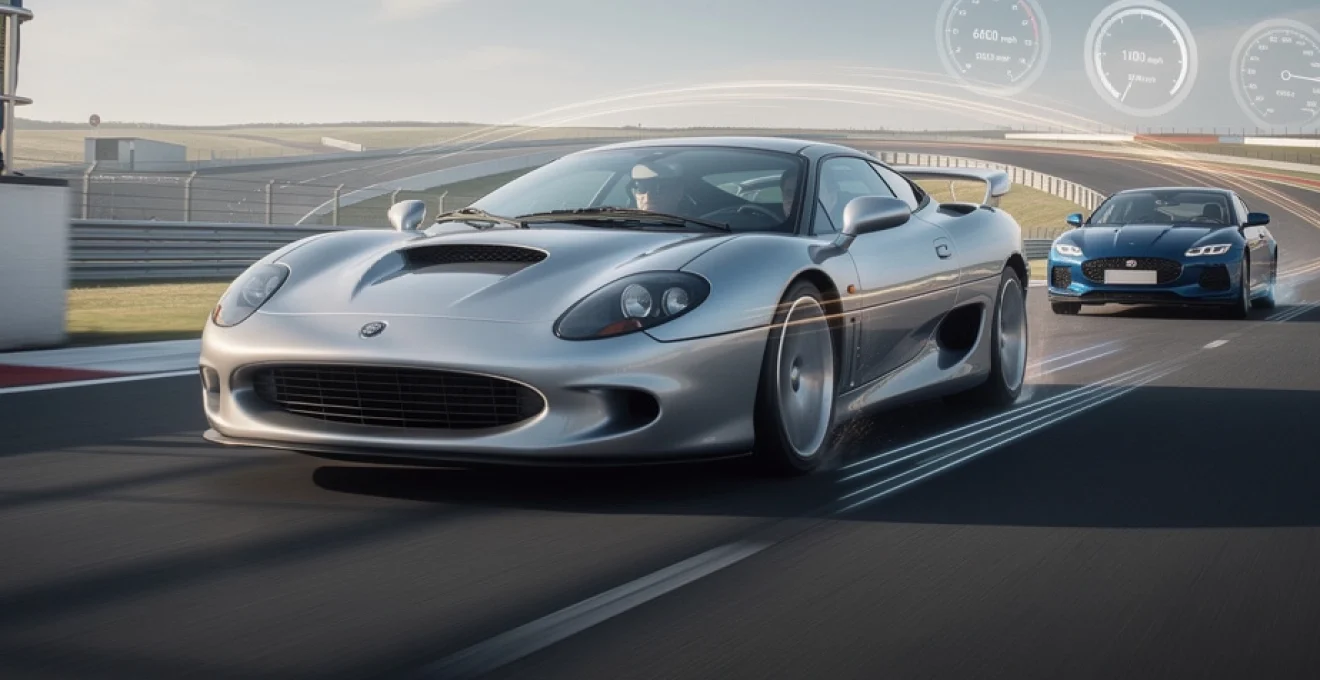
Ask ten enthusiasts what the fastest Jaguar car ever is and you will probably hear several different answers. Some will say the legendary XJ220, others will point to the barely tamed XE SV Project 8, and a few will argue for modern supercharged F‑TYPEs that hit the magic 200 mph. The confusion is understandable: “fastest” can mean top speed, acceleration, lap time or even real‑world cross‑country pace. For anyone who loves Jaguar’s mix of style, performance and engineering, understanding how these records are set – and what they really mean – is part of the fascination.
If you are considering a classic Jaguar, chasing data for a collection, or simply want to settle a pub debate with facts, it helps to look beyond the brochure numbers. Official top speeds, independent road tests, gearing, aerodynamics and even tyre technology all play a role in deciding which is genuinely the fastest Jaguar car ever.
Defining “fastest jaguar car ever”: top speed benchmarks, acceleration metrics and official jaguar records
Top speed vs 0–60 mph and 0–100 mph: which metric defines the fastest jaguar?
When enthusiasts talk about the fastest Jaguar, they almost always mean top speed. That is the highest velocity a car can sustain in a straight line, usually measured over a timed distance, much like the famous 217.1 mph run of the XJ220 at Nardò. Yet in modern performance car culture, acceleration metrics like 0–60 mph and 0–100 mph are often quoted more frequently, because you feel them every time you join a motorway or overtake.
For context, the XE SV Project 8 launches from 0–60 mph in about 3.3 seconds, while the F‑TYPE SVR Coupé needs around 3.5 seconds. Meanwhile, the older, aero‑slippery XJ220 takes roughly 3.6 seconds to 60 mph – not slow by any standard, but its true strength lies beyond 150 mph, where its gearing and aerodynamics allow relentless acceleration to over 210 mph. If you are interested in drag races and traffic‑light sprints, acceleration numbers matter most; if the objective is *absolute* speed, top speed remains the defining metric.
From a technical standpoint, top speed is a better long‑tail keyword for this topic than “quickest Jaguar” because it ties directly to measurable engineering factors such as drag, power and gearing. That is why official records and historic claims from Jaguar tend to focus on maximum velocity rather than short‑burst acceleration.
Factory-claimed figures vs independent tests from autocar, evo and top gear
Another crucial distinction is between factory‑claimed performance and independently verified tests. Jaguar, like every major manufacturer, publishes top speed and 0–60 mph figures based on internal testing on proving grounds such as Nardò, Millbrook or Bruntingthorpe. Independent magazines – for example Autocar, evo and TV shows such as Top Gear – perform their own runs, often under different conditions, on shorter tracks or with less than ideal weather.
This is why you occasionally see discrepancies: an official 200 mph claim for the F‑TYPE SVR may translate to an independently measured 195–197 mph due to shorter straights or headwinds. Similarly, early tests of the XJ220 produced slightly lower headline speeds than Jaguar’s own 217.1 mph record. Tyre temperature, fuel load, even crosswinds at over 200 mph can change results by several mph. When comparing the fastest Jaguars ever, it is important to note *how* and *where* the numbers were obtained.
Production road car criteria: road legality, series production and homologation rules
A common challenge in identifying the fastest Jaguar road car is deciding what qualifies as a “production” car. Typically, three criteria are applied:
- It must be road‑legal in at least one major market, with lights, number plates and emissions equipment.
- It must be built in series production, not as a one‑off prototype or pure racing special.
- It must have a clear
VINrange and a defined production run, often with homologation paperwork.
By these standards, cars such as the XJ220, XJR‑15 and XE SV Project 8 qualify, even though they are incredibly rare. In contrast, dedicated Le Mans prototypes like the XJR‑9 and XJR‑12 do not, because they were never intended for public roads. This production‑car criterion is why the XJ220’s 217.1 mph run earned recognition from the Guinness Book of World Records as the fastest official speed ever achieved by a *production road car* in 1992, whereas faster race‑only Jaguars remain in a different category.
Distinguishing fastest jaguar road cars from jaguar racing and le mans prototypes
Jaguar’s motorsport history sometimes complicates the picture. Group C racers like the XJR‑9 could exceed 240 mph on the Mulsanne Straight at Le Mans, comfortably out‑gunning any road‑going Jaguar in terms of peak velocity. Yet the engineering compromises of a pure prototype – tiny ground clearance, single‑minded aerodynamics, zero concession to comfort – place these machines in a different world to the road cars you might drive.
For anyone researching the fastest Jaguars for collections or historic interest, this distinction is essential. Road‑legal models such as the XJ220, XKR‑S GT and Project 8 are genuinely usable (if sometimes extreme) cars, with number plates and MOT certificates. The circuit‑only cars are closer to fighter jets with number roundels: astonishing, but operating to a different rulebook. With that context, the main question becomes: among *road‑legal production cars*, which Jaguar is truly the fastest?
Jaguar XJ220: verifying its status as the fastest production jaguar in history
Development history of the XJ220: from 1988 concept to 1992 production car
The Jaguar XJ220 story began in 1988 as a sensational concept car, unveiled to shock and awe. The original concept featured a V12 engine and four‑wheel drive, drawing heavily on Jaguar’s Le Mans successes. Public reaction was extraordinary; deposits were taken from eager buyers, and the pressure to turn the show car into a production reality grew.
By the time production began in 1992, the technical recipe had evolved significantly. Instead of a V12, the XJ220 used a 3.5‑litre twin‑turbo V6 derived from Group B rally and Group C racing programmes. The transmission became rear‑wheel drive only, and the car’s proportions were refined for packaging and aerodynamics. Around 275 cars were initially planned, but approximately 282 XJ220s were built in total, all hand‑assembled and each with a unique VIN sequence that marks it out as a genuine production car rather than a prototype.
Technical specification: 3.5-litre twin‑turbo V6, TWR engineering and aluminium honeycomb chassis
Under the low, elegant body, the XJ220 hides very race‑inspired engineering. Its 3.5‑litre twin‑turbocharged V6 produced around 542 hp and 475 lb ft of torque, driving the rear wheels through a five‑speed manual gearbox. Those numbers might not sound extraordinary in an era of 600+ hp super saloons, but remember that the XJ220 weighed under 1,500 kg thanks to an aluminium honeycomb structure and lightweight bodywork developed with Tom Walkinshaw Racing (TWR).
That aluminium honeycomb chassis – similar in principle to an aircraft wing – combined outstanding stiffness with low mass. When coupled with extensive wind tunnel work, the result was a car that could slice through the air with far less resistance than most 21st‑century performance cars. The combination of modest drag, strong turbocharged power and long gearing is at the heart of why the XJ220 still defines the phrase “fastest Jaguar car ever” in top‑speed terms.
Official top speed runs: nardò proving ground 212.3 mph and gearbox ratio controversy
The crucial numbers for the XJ220 come from officially observed runs at the Nardò Proving Ground in southern Italy. In testing, the car achieved an officially certified 217.1 mph (349 km/h), a figure accepted by Guinness World Records in 1992 as the highest speed ever recorded by a production road car at that time. In separate tests, including a widely cited 212.3 mph run, different final‑drive ratios and conditions led to slightly lower recorded speeds.
Much of the subsequent debate centres on gearbox ratio choices. Jaguar engineered the XJ220 with gearing long enough to reach its projected 220 mph (hence the name) under ideal circumstances. For some demonstrations, a shorter final drive was fitted to optimise acceleration and drivability, capping the achievable top speed slightly below the theoretical maximum. This has led to a mild “controversy”, but the best independently observed speeds, combined with Jaguar’s own verified record, still comfortably exceed any subsequent production Jaguar on top speed alone.
Tyre technology, aerodynamic drag (cd) and stability at 200+ mph
Reaching and sustaining more than 200 mph is not only about horsepower. The XJ220’s drag coefficient (Cd) was impressively low for its era, typically quoted around 0.36, combined with a small frontal area and carefully managed underbody airflow. This allowed the car to push the air aside with less effort than taller, bluff‑fronted modern vehicles like SUVs. At 200+ mph, aerodynamic drag grows roughly with the square of speed, so each extra mph requires an exponential increase in power.
Tyre technology is just as critical. The XJ220 used bespoke high‑speed tyres developed specifically for its weight and performance envelope, a demanding task even in the early 1990s. At Nardò, the combination of rising tyre temperature, centrifugal forces and aerodynamic load had to remain within safe limits. The car’s long wheelbase, wide track and carefully tuned suspension also contributed to remarkable stability, something you can still see today when XJ220s are demonstrated at proving grounds and high‑speed events.
Production numbers, VIN ranges and road-legal homologation details
From a homologation standpoint, the XJ220 ticks every box required of a production supercar. Approximately 282 cars were completed, each with its own VIN, emissions equipment and road‑legal lighting. Many markets regarded it as a fully type‑approved model; specialist service remains available through Jaguar Classic, which continues to maintain and restore XJ220s using original or newly tooled parts.
Servicing intervals mirror motorsport practice: XJ220 owners are advised to have major work, such as replacement of the motorsport‑style bladder fuel cells, at fixed time intervals rather than simple mileage. At Jaguar Classic, technicians with decades of experience still routinely service these cars, sometimes needing 10–12 hours for a comprehensive annual check. For you as a potential buyer or enthusiast, that level of factory support is a strong indicator of the car’s ongoing legitimacy as Jaguar’s flagship performance icon.
How the jaguar XJR-15, XJR-9 and other race-bred models compare on absolute speed
XJR-15 road/race hybrid: 6.0-litre V12, carbon fibre monocoque and 190+ mph capability
The XJR‑15 is often described as Jaguar’s “hidden” supercar. Built in tiny numbers between 1990 and 1992, it used a full carbon fibre monocoque and body inspired by the Le Mans‑winning XJR‑9. Power came from a naturally aspirated 6.0‑litre V12 producing roughly 450 hp and 420 lb ft of torque, with a kerb weight just over 1,050 kg.
On paper, the XJR‑15 could exceed 190 mph, and independent sources often quote a top speed of around 191 mph. In practical terms, it was as close as a private owner could get to a Group C race car for the road. Yet its shorter gearing and aero configuration, biased more towards downforce than outright slipstreaming speed, mean that it sits below the XJ220 in the all‑time Jaguar top‑speed ranking.
Group C icons XJR‑9 and XJR‑12: mulsanne straight speeds at le mans exceeding 240 mph
Pure racing Jaguars from the Group C era, such as the XJR‑9 and XJR‑12, reached astonishing velocities. On the pre‑chicane Mulsanne Straight at Le Mans in the late 1980s, speeds in excess of 240 mph were recorded, putting these cars among the fastest circuit racers of their time. Their naturally aspirated V12 engines produced upwards of 700 hp, housed in highly optimised low‑drag shells designed purely for endurance racing.
However, these cars were never homologated for normal road use. No indicators, no catalytic converters, minimal cooling at low speeds: they existed solely to win races. As a result, even though they technically out‑pace the XJ220 and any modern Jaguar road car, they belong in a separate “racing” category rather than the list of production Jaguars you might drive to a track day.
Jaguar R performance saloons: XFR‑S, XJR575 and terminal velocities on the autobahn
Moving from exotic supercars to more familiar territory, Jaguar’s “R” performance saloons have also pushed high‑speed boundaries. The XFR‑S of 2014, for example, used a 5.0‑litre supercharged V8 with 550 hp and 502 lb ft to deliver a top speed of 186 mph when the limiter was raised. The later XJR575, based on the XJ luxury saloon, extracted 575 hp from the same AJ133 V8 and was also electronically capped at around 186 mph.
On unrestricted sections of the German Autobahn, independent testers have reported real‑world indicated speeds nudging beyond these official figures, but braking, stability and traffic constraints limit what can be safely explored. From an engineering perspective, these cars show how far a large saloon can be taken: sophisticated aero, high‑speed cooling and carefully calibrated stability control systems all allow you to experience serious velocity with four seats and a boot full of luggage.
Modern supercharged V8 and electric contenders: F‑TYPE SVR, project 8 and I‑PACE
F‑TYPE SVR and F‑TYPE R AWD: 5.0‑litre AJ133 V8, 200 mph calibration and cooling strategies
In 2016, the F‑TYPE SVR became the first series‑production Jaguar since the early 1990s to officially break the 200 mph barrier. Its 5.0‑litre supercharged AJ133 V8 produced 575 hp and 516 lb ft, sent to all four wheels through an eight‑speed automatic gearbox. Jaguar quoted a 0–60 mph time of 3.5 seconds and a top speed of 200 mph for the coupé, while the convertible was limited to around 195 mph.
Achieving those numbers required more than just a power increase over the regular F‑TYPE R. Engineers re‑worked the cooling package with additional radiators and ducting, recalibrated the engine management for sustained high‑load running and refined the underbody for reduced lift at speed. The more recent F‑TYPE R AWD models, with up to 575 hp, share much of this hardware, even if they are electronically capped at 186 mph for tyre and legislative reasons. For you as a driver, that means 200‑mph capable hardware, even if the limiter intervenes before you match the XJ220.
Jaguar XE SV project 8: nürburgring lap record, aero package and 195 mph vmax
The XE SV Project 8 might not match the XJ220’s top‑speed number, but in real‑world terms it is one of the fastest Jaguars ever created. With 592 hp and 516 lb ft from a ramped‑up 5.0‑litre supercharged V8, plus all‑wheel drive, it blitzes 0–60 mph in about 3.3 seconds. More impressively, it set a Nürburgring Nordschleife lap time of 7:18.361 on the 20.6 km layout, later improved to 7:23.164 over the full 20.832 km circuit – at the time, the quickest for a four‑door production car.
Top speed for the Project 8 is quoted at 200 mph in some specifications and 186–195 mph in the more aero‑laden Touring configuration. A fully enclosed flat underfloor, adjustable front splitter and gigantic carbonfibre rear wing generate meaningful downforce, improving stability and cornering but inevitably increasing drag. For sustained maximum‑speed running, the strategy is almost the inverse of the XJ220’s: the Project 8 trades a few mph of ultimate v‑max for astonishing circuit pace, especially if you regularly attend track days.
I‑PACE EV400: electric drivetrain torque delivery vs outright top speed limitations
Electric Jaguars such as the I‑PACE EV400 represent a different kind of performance. With around 394 hp and 513 lb ft available instantly from its dual electric motors, the I‑PACE can sprint from 0–60 mph in about 4.5 seconds. In everyday driving, that instant torque delivery often makes it feel quicker than some older supercharged petrol Jaguars up to typical road speeds.
However, outright top speed is limited to around 124 mph. That is partly due to battery efficiency and thermal management: pushing an EV to 150+ mph would drain the battery extremely quickly and put huge stress on cooling systems. For you as a driver, the I‑PACE shows how Jaguar’s performance DNA is evolving: massive shove off the line, serene cruising, but a much lower v‑max ceiling than the XJ220, F‑TYPE SVR or Project 8.
Aerodynamics, powertrain engineering and gearing: why the XJ220 remains the fastest jaguar
Drag coefficient, frontal area and downforce balance on XJ220 vs F‑TYPE SVR
To understand why the XJ220 still holds the title of fastest Jaguar car ever by top speed, it helps to compare its aerodynamic philosophy with a modern car like the F‑TYPE SVR. The XJ220 was designed as a long, low, slippery shape with minimal frontal area and relatively modest downforce. Its drag coefficient, combined with its svelte profile, results in an exceptionally low total drag figure. This allows 542 hp to push it beyond 210 mph given the right gearing and room to run.
The F‑TYPE SVR, in contrast, is a shorter, taller car with a larger frontal area and a focus on both high‑speed stability and everyday usability. Active rear wings, front splitters and underbody work generate useful downforce, but every extra kilogram of aerodynamic load comes with drag. Even with 575 hp, the SVR needs 4WD traction, robust cooling and very long straights to reach its 200 mph calibration. The XJ220, with less downforce and lower drag, still has the advantage once speeds climb above 190 mph.
Turbocharging vs supercharging: boost characteristics and high‑speed power sustainability
There is also a fundamental difference in how the XJ220’s turbocharged V6 and the modern supercharged V8s deliver power at very high speeds. A turbocharged engine tends to gain efficiency at sustained high load, as exhaust gas flow keeps the turbines spinning and boost pressure consistent. At 200+ mph, the XJ220’s turbos operate in a sweet spot, giving strong, sustained thrust without dramatic heat‑soak issues.
A supercharged engine, such as the AJ133 V8 in the F‑TYPE SVR or Project 8, delivers instant response at lower speeds but draws power directly from the crankshaft to drive the blower. At very high, sustained speeds, the parasitic loss of the supercharger and the additional heat it generates place more stress on the cooling system. Modern Jaguars manage this brilliantly with intercoolers, radiators and sophisticated control software, but from a physics standpoint, the XJ220’s turbo layout remains slightly better optimised for chasing an ultimate v‑max figure.
In the realm of ultimate top speed, low aerodynamic drag and efficient forced induction matter more than sheer headline horsepower.
For you, that means the fastest Jaguar in a straight‑line duel on an endless runway is still the one with the lowest drag and the most high‑speed‑friendly powertrain, not necessarily the one with the biggest power figure on paper.
Gear ratio selection, redline and speed-in-gear calculations for 200+ mph runs
Finally, gearing often determines whether a car can translate its power and aerodynamics into real‑world top speed. The XJ220’s five‑speed manual gearbox was configured with a tall fifth gear, allowing the car to reach its maximum speed just under redline when drag, power and engine revs all balance. This is why its theoretical “220 mph” capability came so close to being realised in practice, with 217.1 mph officially recorded.
Many modern Jaguars, by contrast, use eight‑speed automatics with shorter individual ratios for acceleration and flexibility. Even if the final drive allows a theoretical 200+ mph figure, electronic limiters, tyre speed ratings and emissions‑test calibrations often intervene first. If you run the speed‑in‑gear calculations, you will often find that maximum speed arrives before the engine reaches redline in top gear, especially in saloons and SUVs.
Think of gearing as the bicycle sprockets of a supercar: choose them for sprints and hill climbs, and you sacrifice absolute top speed; choose them for a land‑speed record, and the bike feels lazy away from the lights.
For anyone comparing the fastest Jaguar car ever, the XJ220 still sits at the top of the table because its entire package – aero, powertrain and transmission – was optimised with a single target: the highest possible top speed from a road‑legal Jaguar. Modern performance models like the F‑TYPE SVR and XE SV Project 8 are arguably better all‑round cars and vastly quicker from point to point, but on a long, empty high‑speed bowl, the 1990s icon still remains the ultimate expression of Jaguar’s obsession with outright speed.