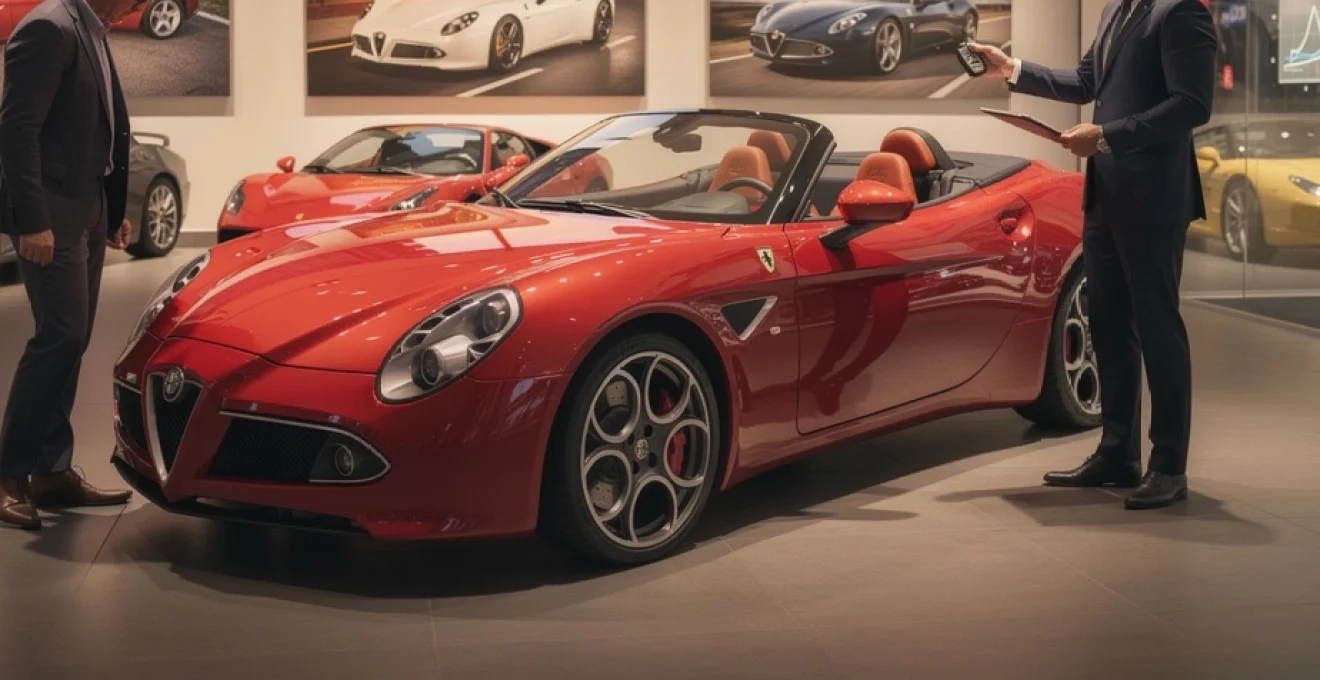
The Alfa Romeo 8C Spider sits in that rare space where design object, race-bred heritage and modern supercar engineering collide. With only 500 examples produced worldwide, locating a car for sale today is less about casual browsing and more about understanding a tightly held collector market. If you are serious about owning one, you are entering a world of limited chassis ranges, cross-border transactions and private networks where the best cars often change hands quietly. Knowing where to look, how to read a listing and which specialists to trust makes the difference between securing a blue-chip 8C Spider and overpaying for an average example.
Values have risen steadily over the past decade as collectors recognise the 8C Spider as the “modern classic” Alfa Romeo halo car, combining a Ferrari–Maserati derived V8 with hand-finished carbon fibre bodywork. For many enthusiasts, it is the ultimate open Alfa: a car with Le Mans-winning bloodlines in its name and a soundtrack that has been voted one of the finest of the 21st century. Understanding this context before starting a search helps you interpret asking prices, evaluate provenance and move quickly when the right car appears.
Understanding the alfa romeo 8C spider market: production numbers, chassis codes and collector demand
Limited production overview: 8C spider build numbers, VIN ranges and market scarcity
The Alfa Romeo 8C Spider was officially limited to 500 units worldwide, mirroring the 8C Competizione coupé. In practice, market data from dealer registries and owners’ clubs suggests that around 450–480 cars remain in circulation, with a small proportion locked away in long-term collections. Typical annual public turnover is remarkably low: in most years, only 15–25 8C Spiders appear on the open market globally, and often fewer than five at any one time in Europe.
Each car carries a distinctive VIN within the 8C Spider production range, and serious buyers often track chassis numbers to verify originality and build position. While “early” versus “late” chassis numbers do not dramatically affect performance, some collectors favour lower numbers or specific production years such as 2010 or 2011. Market scarcity is compounded by regional distribution: estimates indicate that fewer than 20 spiders reside in the UK, while Italy, Germany and the US each account for around 60–90 cars, many of which trade privately rather than via public listings.
For every 8C Spider advertised publicly, at least one more tends to change hands off-market through specialist brokers or marque experts.
Key technical specifications driving values: 4.7 V8, maserati F136 engine and carbon fibre body
The heart of the Alfa Romeo 8C Spider is its 4.7-litre V8, part of the renowned Maserati–Ferrari F136 engine family. Producing around 331 kW (450 hp), it delivers 0–60 mph in around 4.5 seconds and a top speed close to 292 km/h. The engine’s character – free-revving, vocal and rich in mid-range torque – is a major contributor to values. Buyers are not just acquiring performance, but one of the most celebrated exhaust notes of its era, recognised in multiple magazine sound tests.
Bodywork is predominantly carbon fibre, bonded to a rigid structure that preserves torsional stiffness even without a fixed roof. The Spider’s carbon-fibre windscreen surround, formed as a single monolithic loop, is a technical highlight and a visible sign of the car’s engineering depth. Combined with carbon-ceramic brakes on many cars, a rear transaxle layout and advanced suspension geometry, these features mean that you are not simply buying a pretty convertible, but a limited-series supercar with technology normally reserved for far more expensive exotics.
Regional demand patterns: UK, EU (germany, italy), US and middle east buyer profiles
Demand for the 8C Spider is strongest in Europe and the US, but buyer profiles differ subtly. In the UK, the car is often purchased as a low-mileage collector piece, used sparingly in good weather and stored in climate-controlled garages. With only an estimated 17–20 cars on UK roads, many buyers are Alfa loyalists adding a halo model to an existing fleet. Continental Europe, particularly Italy and Germany, shows more mixed usage: some cars have ultra-low mileage, while others have 20,000–30,000 km and are driven regularly on Alpine passes and Autobahns.
US buyers typically discovered the 8C Spider via Alfa Romeo’s relaunch in North America and often cross-shop it against Ferrari 430s, 458s and Maserati GranTurismo MC Stradales. In the Middle East, the car tends to be part of broader supercar collections, where colour and specification – especially unique paint and interior combinations – play a decisive role. Across regions, a consistent trend emerges: as of recent years, more than 70% of 8C Spider transactions involve collectors already owning at least one other limited-series Italian performance car.
Price brackets explained: driver-grade cars vs concours examples and delivery-mileage 8C spiders
Prices vary significantly depending on mileage, provenance and cosmetic condition. At the “driver-grade” end, expect higher-mileage examples – typically 20,000–40,000 km – with honest usage, some stone chipping and a full service history. These cars sit in the lower price bracket of the market but are increasingly rare, as owners recognise the car’s investment potential and reduce annual mileage to preserve value. For many enthusiasts, a well-maintained driver-grade 8C Spider offers the best balance between enjoyment and long-term appreciation.
Mid-range cars, often with 5,000–15,000 km, original paint, documented servicing and desirable options such as carbon-ceramic brakes, command a premium. At the very top, concours-level or delivery-mileage examples, sometimes with fewer than 1,000 km, are priced as blue-chip investments. These cars often boast rare colours (Bianco Madreperla, special triple-layer reds) and meticulously documented ownership histories. In the last few years, auction data shows that such “time-capsule” cars can achieve 30–40% more than equivalent driver-grade examples, underscoring the importance of condition and provenance.
Where to find an alfa romeo 8C spider for sale in the UK and europe
Authorised alfa romeo and stellantis heritage dealers listing 8C spiders
Although the 8C Spider is no longer a current-model Alfa Romeo, official brand channels remain a valuable resource. Selected Stellantis Heritage and approved Alfa dealers occasionally list 8C Spiders, especially in Italy and Germany, where the manufacturer has stronger historic ties to the model. Official dealers tend to see fewer cars, but those that appear often have excellent service documentation and may have been maintained within the Alfa/Maserati network from new.
When an 8C Spider surfaces through a heritage programme, you can expect more rigorous checks on originality and the potential for factory-issued certification. Availability is sporadic, so it helps to maintain regular contact with preferred dealers, express interest early and be prepared to move quickly when a suitable car becomes available. Many cars in these channels are sold directly to known clients before reaching public listing pages.
High-end independents and supercar boutiques: romans international, joe macari, tom hartley, DK engineering
In the UK, the most visible stock of Alfa Romeo 8C Spiders tends to pass through high-end independents and boutique supercar dealers. Names such as Romans International, Joe Macari, Tom Hartley and DK Engineering have all marketed multiple examples, often with extremely low mileage and rare specifications. These dealers typically work at the top tier of the market, sourcing cars from long-term owners and collectors who trust them to manage discreet sales.
Browsing recent inventory gives a useful benchmark for pricing and specification desirability. For instance, cars presented in classic Alfa Red with black or tan leather, carbon-ceramic brakes and low mileage regularly appear near the upper end of the UK price range. Some boutiques offer comprehensive pre-sale preparation, including paint correction, PPF installation and up-to-date servicing, making the purchase experience closer to acquiring a new car than a typical used vehicle.
Continental specialists in italy, germany and switzerland: autotrader.it, mobile.de, autoscout24
Continental Europe is often the richest hunting ground for an 8C Spider, particularly Italy and Germany, where a higher proportion of the original allocation was delivered. Specialist platforms such as Mobile.de and Autoscout24 regularly host listings from German and Swiss dealers, while Italian portals and marque specialists in Milan, Turin and Rome can uncover cars that never appear in English-language adverts. Many of the examples referenced in market overviews – from Köln to Pordenone – have surfaced via these channels.
When searching these sites, using local-language terms and filters is crucial. Combining keywords like "Alfa Romeo 8C Spider" with “4.7 V8”, “carbonio ceramico” or “pochissimi km” can surface better-targeted results. Buyers willing to purchase in the Eurozone benefit from a larger pool of left-hand-drive cars, often with exceptionally low mileage and fastidious servicing. Expect to see asking prices from around €230,000 for higher-mileage examples up to €400,000+ for near-delivery-mileage, collector-grade cars.
Cross-border sourcing strategies: EU–UK imports, right-hand drive vs left-hand drive 8C spider stock
Because the 8C Spider was built only in left-hand drive, UK buyers are effectively shopping the same pool as continental European and global collectors. Cross-border purchases are therefore the norm rather than the exception. Importing from the EU into the UK now involves additional logistics and customs steps, but the relative scarcity of domestic cars means that ignoring European stock severely limits choice. Many UK-based dealers specialise in sourcing, transporting and registering EU cars on a UK V5C.
When considering a cross-border purchase, factor in currency fluctuations, transport costs, UK import VAT where applicable and any compliance work required for UK MOT. Well-documented cars with clear EU registration histories are generally straightforward to import. However, cars with frequent country changes or incomplete paperwork deserve closer scrutiny. Using a broker or legal specialist for higher-value transactions can provide additional comfort, especially for buyers new to EU–UK vehicle imports.
Global online marketplaces and search platforms for locating alfa romeo 8C spider listings
Supercar and collector portals: PistonHeads, classic driver, JamesEdition, DuPont registry, CarGurus
Global supercar portals aggregate listings from dealers and private sellers, giving a broad view of current 8C Spider availability. Platforms such as PistonHeads, Classic Driver, JamesEdition, DuPont Registry and CarGurus allow you to set model-specific alerts so that any new Alfa Romeo 8C Spider for sale triggers an immediate notification. For a car that might appear only a handful of times per year in a given region, this alert-based approach is invaluable.
These sites are particularly helpful for cross-comparison: by looking at asking prices and specifications across different countries, you can sanity-check whether a given car is attractively priced or ambitiously listed. Many serious buyers track listings passively for six to twelve months to build a mental database of typical mileage bands, colour mixes and price trends, then act decisively once a promising example surfaces.
Classic-car specific platforms: collecting cars, car & classic, hemmings, bring a trailer archives
Classic-focused marketplaces provide a more curated environment for rare cars. Platforms such as Collecting Cars, Car & Classic, Hemmings and Bring a Trailer have all featured 8C Spiders, sometimes with extensive photographic documentation and detailed seller commentary. Even when there is no live 8C Spider auction, archived listings remain a goldmine of information on real-world sale prices, options and condition nuances.
Studying these archives lets you see how specification and mileage influenced the final hammer price. For instance, cars with factory carbon-ceramic brakes, special paint and full dealer history consistently achieve stronger results than base-spec cars, even if the latter have similar mileage. As the 8C Spider matures into a recognised investment-grade classic, these platforms are likely to host more examples, particularly from second or third owners looking to maximise exposure.
Using advanced search filters: model codes, year, mileage, colour and service history keywords
Search filters can dramatically speed up the process of finding the right 8C Spider for sale. Where possible, use precise model terms such as "Alfa Romeo 8C Spider 4.7" or “8C Competizione Spider” rather than generic Alfa keywords. Filtering for model years 2009–2012, mileage under 20,000 km and colours like “Rosso 8C”, “Bianco Madreperla” or “Nero” quickly narrows the field to the most desirable cars for long-term holding.
Keyword search within descriptions is equally important. Terms like “full service history”, “Alfa Romeo main dealer”, “one owner”, “PPF”, “carbon ceramic brakes” and “limited edition badge” often signal well-kept examples. On some platforms, you can save customised searches that incorporate these criteria, ensuring that future results remain tightly focused on high-quality cars rather than generic listings or miscategorised vehicles.
Monitoring off-market and coming-soon 8C spider inventory via dealer newsletters and private networks
Many 8C Spiders never reach public advertising. Instead, they are offered discreetly to existing clients or via private WhatsApp groups, owners’ clubs and marque-specific networks. To access this off-market inventory, it pays to build relationships with key dealers and sign up for their newsletters or “coming soon” lists. Some high-end independents provide early-bird alerts giving subscribers a preview of new stock several days before it hits the open web.
In a market as thinly traded as the 8C Spider, personal relationships often matter more than search engines when the best cars quietly change hands.
Engaging with owners’ forums and club meetings also opens doors. Many owners prefer to sell to enthusiasts who understand the car’s significance, and a direct introduction can bypass competitive bidding. Staying visible and communicative within these communities increases the chances that you will be contacted when an owner begins considering a sale.
Auction houses and live bidding options for alfa romeo 8C spiders
Blue-chip auctioneers: RM sotheby’s, bonhams, gooding & company, Barrett-Jackson, silverstone auctions
Top-tier auction houses have played a crucial role in establishing benchmark values for the Alfa Romeo 8C Spider. Firms such as RM Sotheby’s, Bonhams, Gooding & Company, Barrett-Jackson and Silverstone Auctions periodically include these cars in flagship sales like Monterey Car Week, the Goodwood Festival of Speed and major Geneva or Paris events. Over the last five to seven years, hammer prices have shown a clear upward trajectory, reflecting growing collector recognition.
Auction catalogues usually provide rich detail, including build numbers, ownership history and option lists. For a buyer, this level of documentation is extremely useful, even if bidding ultimately takes place elsewhere. Given the global reach of these auctioneers, cars sold through their platforms often represent some of the most desirable examples to hit the open market, making catalogues a worthwhile reference even long after the gavel has fallen.
Analysing past hammer prices and catalogues to benchmark 8C spider valuations
Past auction data works like a pricing compass for 8C Spider shopping. By comparing realised prices with the catalogued mileage, condition and specification, you can calibrate expectations for current listings. For example, if a 7,000-mile Bianco Madreperla with carbon-ceramic brakes and one-owner history hammered at €320,000 two years ago, a similar car now advertised at €350,000 may be justifiable given market inflation and limited supply.
When interpreting auction results, always factor in buyer’s premiums, which can range from 10% to over 20% depending on the house and price bracket. Catalogues usually note whether sales were “with premium” or hammer-only. Using a simple spreadsheet to track half a dozen historic results – including currency, sale date and auction house – creates a robust internal benchmark that can prevent overpaying out of enthusiasm.
On-site versus online auctions: bidding strategies, buyer’s premiums and reserve prices
Choosing between on-site and online auctions for an Alfa Romeo 8C Spider comes down to how you prefer to inspect and bid. On-site events offer a visceral experience: you can hear the car run, inspect the paint in natural light and speak directly with specialists. However, they also come with travel costs and a more emotionally charged atmosphere that can encourage overbidding. Online auctions, by contrast, provide convenience and more time to analyse photographs and documentation, but rely heavily on remote reports.
Regardless of format, clarify three points before bidding: the buyer’s premium structure, any additional taxes and whether a reserve is in place. Decide your maximum all-in figure, including fees, and stick to it. A disciplined approach is essential with emotionally appealing cars like the 8C Spider, where sound, style and rarity can easily tempt you beyond rational limits in the heat of bidding.
Pre-auction inspections: condition reports, originality checks and matching-numbers verification
Pre-auction inspection is the equivalent of due diligence in a property purchase. Major houses provide condition reports, but those are often high-level. For a serious acquisition, commissioning an independent specialist – ideally with Alfa/Maserati experience – is highly advisable. This expert can verify key elements such as matching numbers for engine and gearbox, check for repainting or accident damage and assess the health of expensive components like carbon-ceramic discs.
A robust inspection should also include a diagnostic scan using factory-level tools to identify stored fault codes, gearbox behaviour and ECU updates. Given the cost of major repairs on a limited-run car, a few hundred pounds or euros spent on inspection can save tens of thousands later. Treat an 8C Spider auction purchase like acquiring a rare artwork: provenance, originality and condition matter as much as the hammer price.
Evaluating alfa romeo 8C spider listings: condition grading, provenance and specification
Service history and documentation: alfa romeo main dealer stamps, invoices and recall records
A complete, transparent service history is one of the strongest indicators of a high-quality 8C Spider. Look for consistent Alfa Romeo main dealer or Maserati franchised service stamps, ideally with accompanying invoices that detail work performed. Service intervals should align broadly with manufacturer recommendations, even if mileage has been low; a car that has covered only 2,000 miles in a decade but still received regular servicing shows evidence of conscientious ownership.
Check for documentation relating to factory recalls or technical campaigns, as well as MOT or TÜV records where available. A thick file that includes sales invoices, export/import documentation and correspondence with marque specialists tells a reassuring story. Incomplete or patchy histories are not necessarily deal-breakers, but they should be reflected in the asking price and warrant closer mechanical inspection.
Factory specifications and rare options: rosso 8C competizione, nuvola white, carbon-ceramic brakes
Specification plays a large role in desirability. High-demand factory options include Rosso 8C Competizione triple-layer paint, Bianco Madreperla, certain special greys and interior trims with woven or braided leather. Carbon-ceramic brakes are especially sought-after, both for performance and for their association with top-tier supercars of the era. Cars featuring options like carbon-fibre centre consoles, unique alloy wheel designs, upgraded audio and factory navigation tend to present better both in photos and in person.
While taste is personal, market data shows that traditional Alfa combinations – red over tan, white over black with weave leather – consistently sell faster and for more money than unconventional colour pairings. When browsing listings, think not only about personal preference but also future liquidity; a rare but awkward colour may suit you, yet reduce the pool of future buyers when the time comes to sell.
Originality and matching components: engine, gearbox, ECU, body panels and interior trim
For a collector-grade 8C Spider, originality is almost as important as condition. Matching-numbers engine and gearbox, original ECU, unmodified exhaust and intact factory carbon-fibre body panels all contribute to long-term value. Modifications such as aftermarket wheels, non-original paintwork or custom interiors may appeal to some, but they typically narrow the potential buyer base and can complicate resale. A car that has been “personalised” extensively should generally be priced below a comparable original example.
Visual inspection should focus on panel alignment, paint thickness and signs of repair around vulnerable areas such as bumpers and sills. Interior wear patterns should match mileage; a 5,000-mile car with heavily worn bolsters or shiny steering wheel suggests odometer discrepancies or harder than expected use. Where possible, cross-check physical badges and plates against registration documents and historical photographs.
Independent pre-purchase inspections and diagnostic scans by Alfa/Maserati specialists
Even for private sales outside auctions, a professional pre-purchase inspection is highly advisable. An independent Alfa or Maserati specialist familiar with the 8C’s shared componentry can perform both a visual and mechanical evaluation, including a test drive. On a car of this value, a detailed written report – covering engine compression, gearbox operation, suspension wear and brake condition – provides an evidence base for negotiation.
Modern diagnostics play an important role too. A scan of the car’s control units can reveal hidden issues such as intermittent sensor faults, gearbox clutch wear levels or past overheating incidents. Think of this as reading a car’s medical record: a clean diagnostic log combined with documented services, especially at low mileages, significantly increases confidence that you are acquiring a healthy, properly maintained example.
Importing, registering and insuring an alfa romeo 8C spider in the UK
Import procedures and taxes: UK customs, VAT, NOVA and V5C registration for EU and non-EU cars
Importing an Alfa Romeo 8C Spider into the UK involves several administrative steps. From the EU, post-Brexit purchases generally require declaration to HMRC via the NOVA system, followed by payment of any applicable customs duty and VAT. For many collector cars over 30 years old, reduced VAT rates may apply, but the 8C Spider is too modern to qualify; standard rates are likely unless classification changes. From non-EU countries, additional customs procedures and potential shipping insurance costs enter the equation.
Once HMRC clearance is complete, you can apply to the DVLA for registration and a UK V5C. This process typically requires proof of identity, purchase invoice, foreign registration documents and evidence of NOVA notification. Using an import agent familiar with high-value vehicles can simplify the process, particularly for first-time importers. Building all of these costs – often 5–25% of the car’s purchase price depending on origin – into your budget ensures there are no unpleasant surprises after purchase.
Compliance checks: MOT, IVA (where needed) and UK lighting/emissions conformity
Before a newly imported 8C Spider can be legally driven on UK roads, it must meet local compliance standards. In most cases, a standard MOT test is sufficient, as the 8C Spider already conforms broadly to European lighting and emissions regulations for its production era. However, some cars may require minor adjustments such as headlamp beam pattern changes or rear fog light modifications to satisfy UK rules.
An Individual Vehicle Approval (IVA) test is rarely needed for 8C Spiders sourced from within the EU, but could become relevant for cars that have undergone major modifications or originate from markets with different homologation standards. Working with a specialist workshop that has previously registered imported supercars in the UK helps streamline these checks. Approaching this stage methodically, treating it like a checklist, ensures the car moves swiftly from container or trailer to legally registered, road-ready status.
Specialist insurance cover: agreed value policies, limited mileage and classic supercar brokers
Given the 8C Spider’s limited production and rising values, a standard motor policy often provides inadequate protection. Specialist insurers and brokers offer agreed value cover, where you and the insurer set a specific insured value – typically supported by an independent valuation or purchase invoice. In the event of total loss, this agreed figure, rather than trade book value, guides reimbursement. For a car where mainstream guides may lag behind real market prices, this approach is critical.
Limited-mileage policies, often in the 2,000–5,000 miles per year range, can significantly reduce premiums while reflecting realistic use patterns for a collector-grade 8C Spider. Some classic supercar brokers also bundle benefits such as European breakdown cover, track-day extensions or laid-up cover for periods when the car is stored. Engaging with a broker that understands collector car risk profiles helps ensure that you are properly covered, not just legally insured, from the first day the car enters your garage.